14 539 résultats
1956réf. 71435Paris Cercle Zimmerwald 1956 1 vol. broché plaquette, in-8, agrafée, 61 pp. Dos légèrement insolé. Sinon bon état. Peu courant.
2001réf. 100138663BLOOMSBURY 3PL 2001 256 pages 16 2x2 2x23 4cm. 2001. Cartonné jaquette. 256 pages.
1934réf. 1156701934 Bureau d'Editions, Paris / Institut Marx-Engels-Lénine, Moscou - 1934 - In-12, broché couverture illustrée - 61 pages - Illustrations en N&B hors texte
1937réf. 1098831937 Imprimé à Paris, S.G.I.E. - 1937 - In-8, broché - 39 p.
1971réf. 120162Paris Gallimard, coll. "Témoins" 1971 1 vol. broché in-8, broché, couverture illustrée, 620 pp. Exemplaire du service de presse. Couverture défraîchie, dos ridé et un peu sali. En l'état.
réf. 16346Genève, 1871. xvi, 311, (1) pp. 8vo. Modern half morocco, original covers preserved. Zaleski 79; not in Catalogue Russica. First French edition. Alexander Herzen (1812-70) was a prominent nineteenth-century Russian social thinker and is known as the 'father of Russian socialism.' Early in his intellectual development, Herzen was influenced by German idealist thinkers such as Schiller and Schelling. He believed in the autonomy and dignity of the individual and opposed forces, such as family and state, that oppressed the individual. Later, under the influence of French socialist thinkers such as Charles Fourier, Herzen's thought became more radical. Herzen projected his earlier concern for the oppressed individual onto society at large and he became a supporter of socialism. The socialism he envisioned was a loose federation of self-governing communes. Only in such a system could the ideal society be achieved- according to Herzen that society would be a free association of individuals which provided for the full flowering of each personality. Herzen initially placed his hopes for this future order in the European socialist movement. After the failure of the 1848 revolutions to achieve socialist principles, however, Herzen became disillusioned about European prospects and turned his attention to Russia. Herzen argued that socialist transformation would actually come first to Russia because communal institutions such as the peasant commune survived and bourgeois attitudes hadn't yet emerged. This sense of the advantages of Russian 'backwardness' was influential among the Populists in the 1870s. Herzen has been called a 'gentry revolutionary.' The illegitimate son of a wealthy landowner, Herzen viewed the gentry as a progressive class. The revolution he envisioned was for the people but not necessarily by them. Also, his socialism was a national destiny rather than a class one, and because he promoted the value of individualism in collectivist form--in other words, the full flowering of the individual could best be realized in a socialist order. Among Herzen's works are From the Other Shore (1848-50) and The Russian People and Socialism and his autobiography, My Past and Thoughts.He founded a periodical, the famous Kolokol, in whose pages the free word first appeared in the Russian language, unhampered by censor or police, exposing the government's secrets, criticizing bureaucratic abuses, approving the good intentions of the czar, the 'liberator', and trying to dictate to him a reform program.
réf. 60884Lingua italiana, Editori riuniti, 1967, 256 pp., legatura editoriale, sovracoperta, leggere tracce d'uso, condizioni iouttosoto buone.
1981réf. 185257Gallimard Collection témoins Gallimard, 1981. In-8 broché de 299 pages. Très bon état.
réf. 337248Editions De La Bibliothèque Du Travail Paris 1921 In-12 carré ( 180 X 130 mm ) de 62 pages, demi toile à la bradel, dos lisse avec étiquette de titre de basane fauve, couvertures conservées. EDITION ORIGINALE de la traduction par Alix Guillain. Premier cahier de la première série des Cahiers du Travail, publié en mars 1921. Tirage à 4000 exemplaires.
1970réf. 115598Maspero, 1970, in-8°, 284 pp, broché, couv . illustrée à rabats, bon état (Coll. Cahiers libres)
réf. 24713P., Maspero (Collection "Cahiers Libres"), 1970, in 8° broché, 285pp. ; couverture illustrée.
1970réf. 157638Maspéro Maspéro, 1970. In-8 broché, couverture à rabats de 284 pages. Collection Cahiers libres 175-176. Le parti communiste, les masses et les forces révolutionnaires pendant la campagne électorale à Naples en mai 1968. Rares passages discrètement soulignés au crayon de papier et petite déchirure sans manque en dos sinon bon état
1970réf. 185384Maspero Paris, Maspero, 1970. Cahiers libres 175-176. In-8 broché, couverture illustrée à rabts de 284 pages + table. Le parti communiste, les masses et les forces révolutionnaires pendant la campagne électorale à Naples en Mai 1968. Bon état
réf. 42664Traduit de l'italien. Paris : François Maspero ("Les Cahiers libres" n°175-176), 1970. Un volume broché sous couverture à rabats, 284 pages. Bon état.
1968réf. 672631968 Paris, éditions Anthropos,1968, in huit, 219 pp, en bon état,
1971réf. 116260Editions Sociales, 1971, in-12, 296 pp, index des noms, broché, bon état (Coll. Classiques du marxisme)
1970réf. 1256Maspéro In-8 Couverture souple Paris 1970
1970réf. 8259François maspero 1970 284 pages in8. 1970. Broché couverture rempliée. 284 pages. Ce livre rassemble les lettres écrites par Maria Antonietta Macciocchi depuis l'intérieur du Parti communiste italien offrant un témoignage et une analyse de la campagne électorale de mai 1968 à Naples. L'ouvrage examine les relations entre le parti les masses populaires et les forces révolutionnaires de l'époque et a suscité des critiques sévères dans la presse communiste italienne
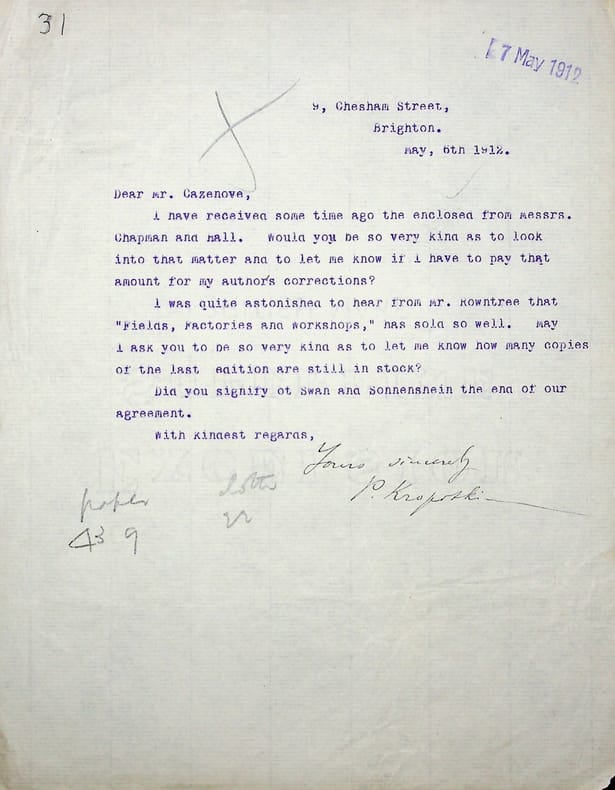
réf. 016244Pierre Piotr Kropotkine (1842-1921), prince russe, géographe, anarchiste, théoricien du communisme libertaire. L.S. avec quelques mots autographes, 6 mai 1912, 1p in-4. A Charles-François Cazenove (1870-1915), agent littéraire à Londres. Intéressante lettre : « Dear Mr Cazenove, I have received some time ago the enclosed from Messrs Chapman and Hall. Would you be so very kind as to look into that matter and to let me know if I have tu pay that amount for my authors corrections ? I was quite astonished to hear from Mr Rowntree that "Fields, Factories and Workshops" has sold so well. May I ask you to be so very kind as to let me know how many copies of the last edition are still in stock ? Did you signify at Swan and Sonnenshein the end of our agreement. With kindest regards. Yours sincerely. P Kropotkine ». Kropotkine s'enquiert donc de savoir si on lui fait payer le bon prix pour les corrections et où en est la vente d'un de ses principaux ouvrages, Champs Usines et Ateliers. Il y aura une nouvelle édition anglaise en 1912 qui est l'édition de référence. Beau document. [135]
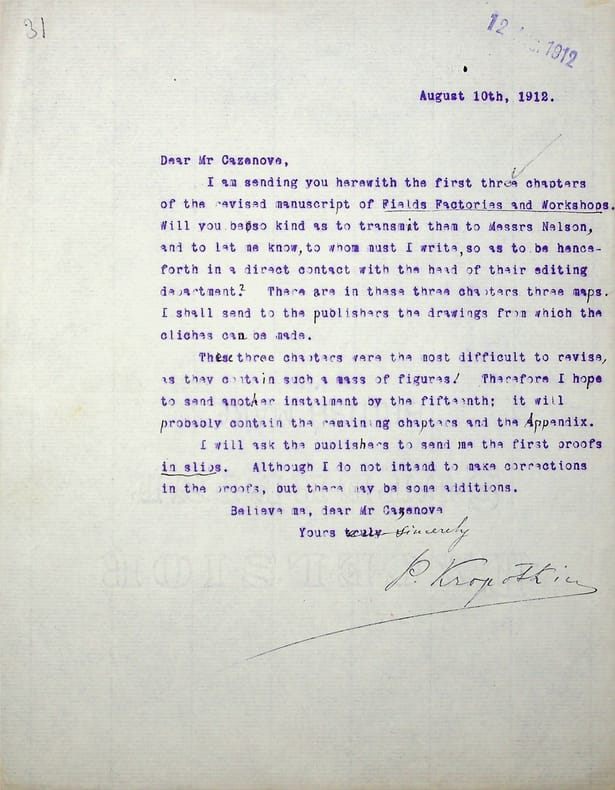
réf. 016245Pierre Piotr Kropotkine (1842-1921), prince russe, géographe, anarchiste, théoricien du communisme libertaire. L.S. avec corrections autographes et un mot autographe, 19 août 1912, 1p in-4. A Charles-François Cazenove (1870-1915), agent littéraire à Londres. Intéressante lettre : « Dear Mr Cazenove, I am sending you herewith the first three chapters of the revised manuscript of Fields Factories and Workshops. Will you be so kind to transmit them to Messrs Nelson, and to let me know, to whom must I write, so as to be henceforth in a direct contact with the head of their editing department ? There are in these three chapters three maps. I shall send to the publishers the drawings from which the cliches can be made. These three chapters were the most difficult to revise, as they contain such a mass of figures. Therefore I hope to send another instalment by the fifteenth ; it will probably contain the remaning chapters and the Appendix. I will ask the publishers to send me the first proofs in slips. Although I do not intend to make corrections in the proofs, but there may be some additions. Believe me, dear Mr Cazenove. Yours truly sincerely. P Kropotkine ». Kropotkine travaille donc à la nouvelle édition d'un de ses principaux ouvrages, Champs Usines et Ateliers. Cette édition de 1912 est l'édition de référence. Beau document. [135]
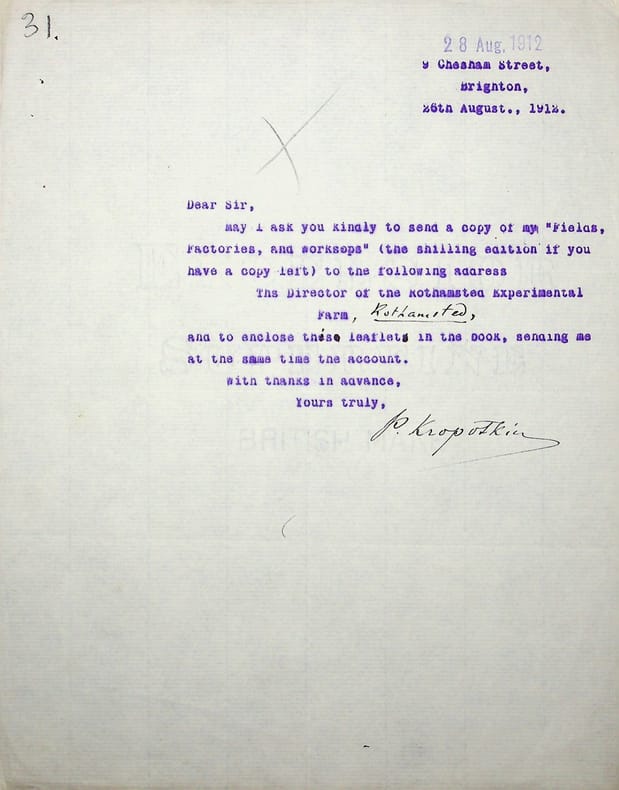
réf. 016247Pierre Piotr Kropotkine (1842-1921), prince russe, géographe, anarchiste, théoricien du communisme libertaire. L.S. avec corrections autographes et un mot autographe, 26 août 1912, 1p in-4. A Charles-François Cazenove (1870-1915), agent littéraire à Londres. « Dear Sir, May I ask you kindly to send a copy of my "Fields, Factories, and Workshops" (the shilling edition if you have a copy left) to the following address. The Director of the Rothamsted Experimental Farm, Rothamsted, and to enclose this leaflet in the book, sending me at the same time the account. With tranks in advance. Yours truly. P Kropotkine ». Kropotkine envoie donc un exemplaire de son ouvrage à Edward John Russell (1872-1965), probablement au moment où celui-ci devient directeur de la ferme de Rothamsted. [135]
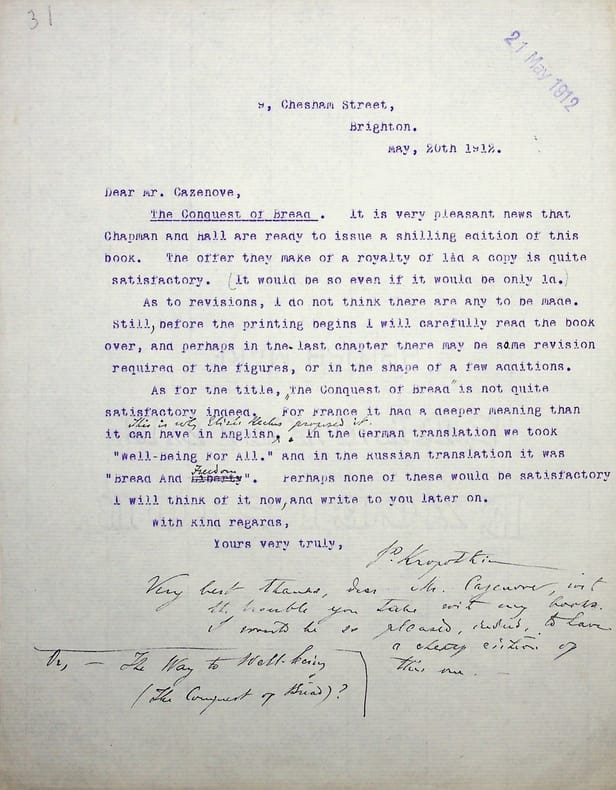
réf. 016248Pierre Piotr Kropotkine (1842-1921), prince russe, géographe, anarchiste, théoricien du communisme libertaire. L.S. avec corrections et large partie autographe, 20 mai 1912, 1p in-4 A Charles-François Cazenove (1870-1915), agent littéraire à Londres. « Dear Mr Cazenove, The Conquest of Bread. It is very pleasant news that Chapman and Hall are ready to issue a shilling edition of this book. The offer they make of a royalty of 1 œd a copy is quite satisfactory. It would be so even if it would be only 1d. As to revisions, I do not think there are any to be made. Still, before the printing begins I will carefully read the book over, and perhaps in the last chapter there may be some revision required of the figures, or in the shape of a few additions. As for the title, "The Conquest of Bread" is not quite satisfactory indeed. For France, it had a deeper meaning than it can have in English, this is why Elisée Reclus proposed it. In the German translation we took "well-Being for All" and in the Russian translation it was "Bread and Freedom". Perhaps none of these would be satisfactory. I will thing of it now, and write to you later on. Yours very truly, P Kropotkine. Very best thanks, dear M Cazenove, with the trouble you take with my books. I would be so pleased, indeed, to have a cheep edition of this one. Or - The Way to Well-being (The Conquest of Bread) ? ». Très intéressante lettre pour la nouvelle édition de son ouvrage. [135]
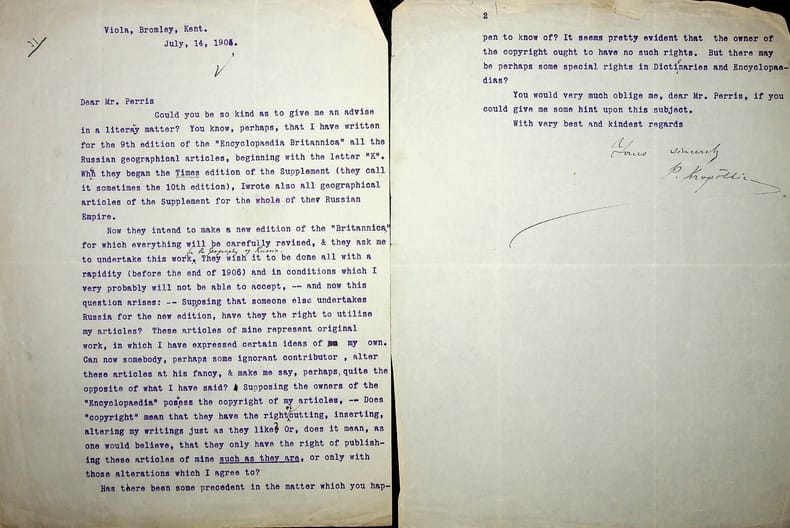
réf. 016249Pierre Piotr Kropotkine (1842-1921), prince russe, géographe, anarchiste, théoricien du communisme libertaire. L.S. avec corrections autographes et quelques mots autographes, 14 juillet 1906, 1p 1/2 in-4. Au journaliste et écrivain George Herbert Perris (1866-1920). Belle lettre sur sa participation à l'Encyclopaedia Britannica et ses droits d'auteur. « Dear Mr Perris, Could you be so kind as to give me an advise in a literary matter ? You know, perhaps, that I have written for the 9th edition of the "Encyclopaedia Britannica" all the Russian geographical articles, beginning with the letter "K". When they began the Times edition of the Supplement (they call it sometimes the 10th edition), I wrote also all geographical articles of the Supplement for the whole of the Russian Empire. Now they intend to make a new edition of the "Britannica" for which everythinh will be carefully revised, & they ask me yo undertake this work for the Geography of Russia. They wish it to be done all with a rapidity (before the end of 1906) and in conditions which I very probably will not be able to accept, - and now this question arises : - supposing that someone else undertakes Russia for the new edition, have they the right to utilise my articles ? These articles of mine represent original work, in which I have expressed certain ideas of my own. Can now somebody, perhaps some ignorant contributor, alter these articles at his fancy, & make me say, perhaps, quite the opposite of what I have said ? Supposing the owners of the "Encyclopaedia" possess the copyright of my articles, - Does "copyright" mean that they only have right of publishing these articles of mine such as they are, or only with those alterations which I agree to ? Has there been some precedent in the matter which you happen to know of ? It seems pretty evident that the owner of the copyright ought to have no such rights. But there may be perhaps some special rights in Dictionaries and Encyclopaedias ? You would very much oblige me, dear Mr. Perris, if you could give me some hint upon this subject. With very best and kindest regards. Yours sincerely. P Kropotkine ». Belle lettre. [135]
réf. 38575Paris, Gallimard, 1953. 12 x 19, 253 pp., broché, bon état (papier jauni).