14 480 résultats
16mo, ril. tela ed. in sovracoperta bianca a strisce rosse, pp.ix-196. graffio sulla sovracoperta, numerose sottolineature in matita, altrimenti ottimo.
1970Alessandro Nangeroni Manuale del comunista cristiano. Milano, De Vecchi 1970 italian, 226 CR32.CBrossura editoriale,volume in buone condizioni, lievi segni di usura sulla copertina, interno in ottimo stato, legatura salda226 pagine circacopertina come da foto
197018 cm, brossura editoriale con abrasione alla copertina; pp. 136, alcune tabelle
196918 cm, brossura editoriale leggermente brunita, p. 121, alcune tabelle
1970(Codice SW/1111) In 16º 136 pp. Seconda edizione aggiornata (la prima è del 1969). Timbrino ex-libris. Brossura editoriale, buono stato. ~~~ SPEDIZIONE IN ITALIA SEMPRE TRACCIATA
190223 cm, br. editoriale con qualche traccia d'uso, p. 111
1945352pp., pour la plupart non coupé, bel état
réf. 13603Heraklion Crete Greece. 12 January 1947. 4pp. 8vo. 96 lines of text. On paper ruled for accounts. On lightly-aged paper with loss to corners and at central edge affecting a few lines of text. Accompanying the letter is a translation 2pp. 8vo by Colin Jordan with the assistance of Dr Loukas Christodloulos. The letter is of great interest casting light on Leigh Fermor's activities in Crete in the period following the Second World War. The identity of 'Haris' is not immediately apparent: he does not appear to feature in George Psychoundakis's account of the Cretan resistance 'The Cretan Runner' 1955 which was translated by Leigh Fermor. Addressing 'Mr. Leigh Fermor' the author of the letter begins in reproachful terms: 'After my third letter you remain silent. I write now with a big question mark: why this is happening and why you are ignoring my thoughts and my offer in general' He asks Fermor 'for the sake of our friendship and co-operation and for our land of Crete' to guide him in his thoughts and to advise him in his actions 'and to help me in my efforts against the slanderers and the malevolent enemies of our union'. He desires Leigh Fermor's 'co-operation against the transformation of Crete and Greece my country into a Soviet protectorate.' He proceeds to report on 'the situation that exists': 'The Communist newspaper "Free Crete" has begun again a serious campaign against the English generally and in particular against us Major Fielding Major Alexander Wallace 'Xan' Fielding who like Leigh Fermor was in the SOE in Crete during the war and Kyrios Giorgos. They claim that the crimes of killing a villager from Potamiko Nikos Komi of another from Heraklion prior to the referendum others from Apokoronou and from Hania family murders for revenge and political party murders were done by you that you organized them that is and ordered their execution by your people.' A further claim is that 'from the time of the occupation' Leigh Fermor has been 'organizing here the ground for the occupation of Crete by the English and the creation of military bases since Alexandria is hostile towards Egypt and you are using that against her'. In his view it is easy to refute the Apokorona and Hania murder charges 'since it's commonly known that they were done by locals for revenge and due to political hatred and had nothing whatsoever to do with our work. The murder of the police officer from Heraklion happened before your arrival here in September. As for the killing of Komi at Potamiko the same man wrote a letter that he did it because of personal motives and not following orders from yourself.' He proposes to write 'to the newspapers of the Right-wing here that your visit to Crete was entirely a holiday trip to see your friends and that the villager's murder was done before you came. Also that the Hana murder had other purposes and that you and the English generally have never thought of occupying Crete and that you have always acted from friendship. I will also go to the prison and I will oblige Nikos Komis to sign a letter of protest against the writings of the "Free Crete" newspaper.' He will take responsibility for the publication 'as I did a few days ago when I published articles about English/Greek friendship in the <.>IDI and PATRIDA newspapers. Regarding 'the Communist nightmare that threatens all of us with destruction': 'Once again I give my life and for that thought I would gladly sacrifice. The communists know this and consider me their enemy like nobody else.' He ends with an enquiry regarding 'the Anglo-Greek Society at Heraklion that you had promised back in September'. Heraklion [Crete, Greece]. 12 January 1947. unknown
1952- s.l. [Paris] 22 février 1952, 21x27cm, 3 pages sur 3 feuillets. - Manuscrit autographe signé rédigé à l'encre bleue sur trois feuillets de papier blanc ; nombreuses ratures et corrections. "Si quelque part au monde le coeur de la liberté continue à battre, s'il est un lieu d'où ses coups nous parviennent mieux frappés que de partout ailleurs, nous savons tous que ce lieu est l'Espagne." Ce magnifique texte fut prononcé par André Breton le 22 février 1952 lors du meeting organisé par la Ligue des Droits de l'Homme Salle Wagram. Le discours sera ensuite publié dans Le Libertaire du 6 mars 1952. "N'oublions pas que le monstre qui pour un temps nous tient encore à sa merci s'est fait les griffes en Espagne. C'est là qu'il a commencé à faire suinter ses poisons : le mensonge, la division, la démoralisation, la disparition, qui pour la première fois il a fait luire ses buissons de fusils au petit matin, à la tombée du soir ses chambres de torture. Les Hitler, les Mussolini, les Staline, ont eu là leur laboratoire de vivisection, leur école de travaux pratiques. Les fours crématoires, les mines de sel, les escaliers glissants de la N.K.V.D., l'extension à perte de vue du monde concentrationnaire ont été homologués à partir de là. C'est d'Espagne que part l'égouttement de sang indélébile témoignant d'une blessure qui peut être mortelle pour le monde. C'est en Espagne que pour la première fois aux yeux de tous, le droit de vivre libre a été frappé." "Breton ne saurait rester indifférent aux évènements internationaux. En Espagne, le régime de Franco se maintient par la répression policière, mais il ne peut empêcher une succession de grèves importantes, animées par les organisations anarchistes toujours vivaces. En mars, onze meneurs sont condamnés à mort. Une campagne alertant l'opinion publique européenne se déclenche en leur faveur. Breton prend la parole au meeting organisé salle Wagram le 22 février 1952. Citant les grèves de Barcelone, lancées sur un prétendu mot d'ordre de la Phalange, il prophétise à terme une victoire totale. L'humeur des meneurs clandestins annonce la révolte contre la misère économique, contre le fascisme, monstre tricéphale qui a d'abord essayé ses griffes en Espagne." (Henri Béhar, André Breton) [ENGLISH DESCRIPTION ON DEMAND]
réf. ML2170P, PUF, 1977, gr in8br, 331pp Langue: Français
réf. L8654Seghers, 1949. Plaquette in-12 agrafée. Coll. " Poésie 49 ". Traduit par J. Mitaud. Avec trois poèmes de Mao Tsé Toung. E.O. sur papier d'édition.
réf. 22048P., NRF (Collection "L'Air du Temps"), 1963, in 8° broché, 477pp.
réf. 15116Paris, Edition Galilée, 1976 14 x 21, 290 pp., broché, bon état (pliures au dos, tranches légèrement salies).
1977réf. 59731977 Editions Galilée, Paris, 1977. Un volume in-8 couverture illustrée à rabats, 290 pages. Rousseurs sur les tranches, néanmoins bon état.
1970réf. 104753Gallimard 1970 In-4 relié 25 cm sur 22. 253 pages. Jaquette usagée avec manque. Bon état d’occasion.
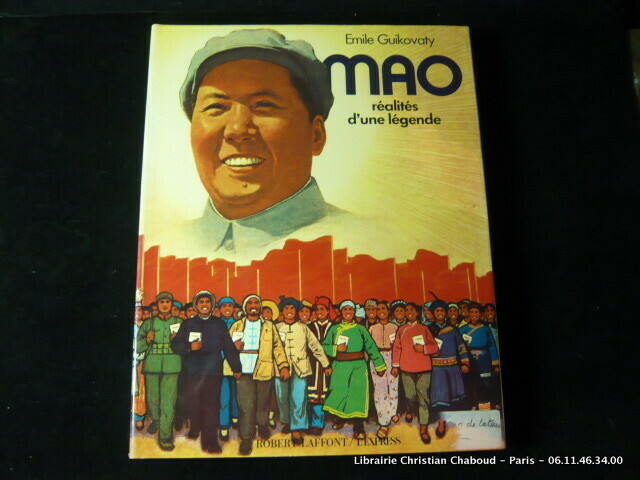
1976réf. 50186Paris, Robert Laffont / L'Express, 1976, in-4, relié-jaquette éditeur, 33 pages. Très bon état
1976réf. 1078461976 Editions Robert Laffont / L'Express - 1976 - Fort in-4, cartonnage rouge avec dorure sur le 1er plat et le dos, sous jaquette illustrée en couleurs de l'éditeur - 336 p. - Très nombreuses reproductions potographiques in, hors-texte et pleine page en couleurs et en N&B
réf. 76197Coll. "Politique" n°69, Paris, éd. du Seuil, 1975, in-12, cartonnage souple, couv. ill. en noir avec texte en noir et rouge éd., 192 pp., traudction et présentation par Hu Chi-Hsi, table des matières La direction politique, le communisme, qu'a chois le leader chinois Mao. Pas courant Très bon état
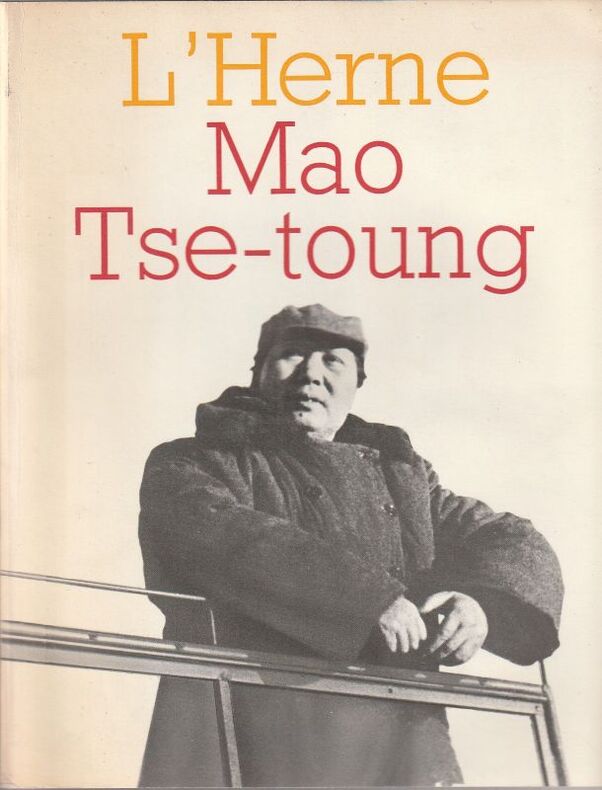
réf. 19605L'Herne, 25 avril 1972. In quarto, brochure forte ill, 448 pages puis 12 pages in fine de clichés en noir en vignettes. Très propre.
réf. 113583Paris, Editions de l’Herne 1972, 270x210mm, 447pages, broché. Bel exemplaire.
1966réf. 107585Couverture rigide. Reliure de l'éditeur, 254 pages.
réf. 99732Paris, Seghers, 1965. 14 x 16, 181 pp., quelques illustrations et 1 carte, broché, bon état.
réf. 103.793Paris, Seghers, 1965. 13 x 16, 181 pp., quelques illustrations, broché, très bon état.
1967réf. 8703Editions de Saint-Clair 1967 251 pages in8. 1967. reliure editeur. 251 pages. Il s'agit d'une collection d'œuvres choisies de Mao Tsé-Toung présentée en plusieurs tomes ou volumes rassemblant des articles clés écrits pendant la révolution chinoise. L'ouvrage inclut également des citations thématiques classées selon une perspective idéologique communiste
1965réf. 125780Couverture rigide. Reliure toile de l'éditeur. 310 pages. Rhodoïd.