3.631 resultados
2004ref. 142475New York NY: Thornwillow Press Ltd 2004. full crushed light brown moroccan goatskin eight inlaid gems Opals Citrines and Carnelians in a circular pattern with the title in gilt on the front board marbled endsheets cloth clamshell box with leather spine title in gilt on spine. Thornwillow Press. small oblong 8vo. full crushed light brown moroccan goatskin eight inlaid gems Opals Citrines and Carnelians in a circular pattern with the title in gilt on the front board marbled endsheets cloth clamshell box with leather spine title in gilt on spine. 34 pages. Monotypes by Wendy Mark. Limited to 1000 copies of which this is one of 4 unique manuscript copies bound thus. Signed by Mark Strand and Wendy Mark on the half-title and title pages as well as the publisher Luke Ives Pontifell on the colophon. Fine in fine clamshell box. Produced under the direction of Luke Ives Pontifell at his Thornwillow Press on handmade paper. From the artist: "This whimsical and beautiful poem by former U.S. Poet Laureate Mark Strand celebrates the many virtues joys and challenges of candy. The monotypes by Wendy Mark were made especially for this edition and were reproduced from her originals using offset lithography." Having received her Masters of Fine Arts from Columbia University Wendy Mark has been producing wonderfully illustrative art primarily to coincide with poetical works. Not only has she worked with Mark Strand on this project but she has worked with other authors such as Charles Simic and Paul Muldoon among others. Thornwillow Press, Ltd unknown books
2016ref. 142375Limited to 24 copies of which this is one of 14 deluxe portfolios. A fine copy of this magnificent portfolio illustrating Strand's poem written in 1990. Twelve chine collé woodcuts and three letterpress pages interleaved with Kitakata Japan paper housed in a linen clamshell box with constructed inner folder. Each woodcut signed by Briggs colophon signed by Briggs and Strand. Colophon bears Roman numeral unique number for the each of the 14 portfolios. The cloth covered portfolio box inner chemise folder and letterpress pages were designed by Alice Leora Briggs and Kelly Leslie. Portfolio box and folder were constructed by Jace Graf of Cloverleaf Studios Austin Texas. From the artist's website: "Alice Leora Briggs born in an oil boomtown in West Texas grew up in Idaho's Snake River Valley and woke up later on la frontera the borderlands of the U.S. and México. Her investigations into human frailties have generated thousands of drawings woodcuts letterpress broadsides site-specific installations and books. Her artworks have been featured in over fifty solo exhibitions and are in over thirty-five public collections including Crystal Bridges Museum of American Art Library of Congress Oxford's Bodleian Library and Yale's Beinecke Rare Book and Manuscript Library. Publications include Dreamland: The Way Out of Juárez 2010 an illuminated manuscript-police blotter with writer Charles Bowden The Room 2016 a suite of twelve woodcuts with poet Mark Strand and Abecedario de Juárez: An Illustrated Lexicon 2022 with photojournalist Julián Cardona. Briggs was a Fulbright Scholar at the Academy of Fine Arts and Design in Bratislava Slovakia and received a Guggenheim Fellowship in 2020." Austin TX: Flatbed Press 2016. Briggs Alice Leora. The box measures 25.25 x 21.75 x 1.375 inches. Individual prints interleaved with Japan Kitakata paper. Flatbed Press
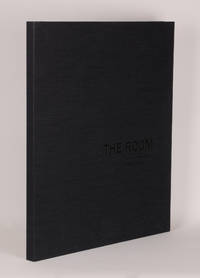
2016ref. 142375Limited to 24 copies of which this is one of 14 deluxe portfolios. A fine copy of this magnificent portfolio illustrating Strand's poem written in 1990. Twelve chine collé woodcuts and three letterpress pages interleaved with Kitakata Japan paper housed in a linen clamshell box with constructed inner folder. Each woodcut signed by Briggs colophon signed by Briggs and Strand. Colophon bears Roman numeral unique number for the each of the 14 portfolios. The cloth covered portfolio box inner chemise folder and letterpress pages were designed by Alice Leora Briggs and Kelly Leslie. Portfolio box and folder were constructed by Jace Graf of Cloverleaf Studios Austin Texas. From the artist's website: "Alice Leora Briggs born in an oil boomtown in West Texas grew up in Idaho's Snake River Valley and woke up later on la frontera the borderlands of the U.S. and México. Her investigations into human frailties have generated thousands of drawings woodcuts letterpress broadsides site-specific installations and books. Her artworks have been featured in over fifty solo exhibitions and are in over thirty-five public collections including Crystal Bridges Museum of American Art Library of Congress Oxford's Bodleian Library and Yale's Beinecke Rare Book and Manuscript Library. Publications include Dreamland: The Way Out of Juárez 2010 an illuminated manuscript-police blotter with writer Charles Bowden The Room 2016 a suite of twelve woodcuts with poet Mark Strand and Abecedario de Juárez: An Illustrated Lexicon 2022 with photojournalist Julián Cardona. Briggs was a Fulbright Scholar at the Academy of Fine Arts and Design in Bratislava Slovakia and received a Guggenheim Fellowship in 2020." Austin TX: Flatbed Press 2016. Briggs Alice Leora. The box measures 25.25 x 21.75 x 1.375 inches. Individual prints interleaved with Japan Kitakata paper. Flatbed Press books
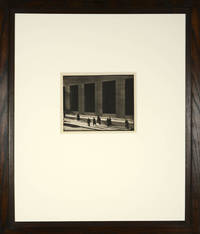
ref. 91270New York 1916. . Photogravure on japan paper from Camera Work No. 48 annotated on the reverse image size 13.4 x 16.6 cm. sheet 28.1 x 20 cm mounted and framed. An iconic image of Wall Street and a turning point in modern photography. Wall Street depicts a scene of everyday life in Manhattan's Financial District. Workers are seen walking past the J.P. Morgan building in New York City on the famous Wall Street of which the photograph takes its name. The photograph is famous for its reliance on the sharpness and contrast of the shapes and angles created by the building and the workers that lead to its abstraction. This photograph is considered to be one of Strand's most famous works and an example of his change from pictorialism to straight photography. Strand moved from the posed to portraying the purity of the subjects. There is no focal point with the lines converging off of the frame of the image. The financial building take majority of the frame. Emphasis is placed on the strong shapes created by the architecture of the building. The workers are included in the image but are faceless and are trumped in size by the massive square shapes from the building they walk past. Also the workers are captured in motion which on film makes them appear blurry. This aesthetic that Strand creates in Wall Street is his break toward the modern. Social change was important to Strand. With Wall Street he sought to portray a social message. He captured the faceless people next to the looming financial building in order to give a warning. Strand shows 'the recently built J.P. Morgan Co. building whose huge dark recesses dwarf the passers-by with the imposing powers of uniformity and anonymity' Ollman Art Review: Paul Strand: A Transition Caught on Film. The people cannot escape the overwhelming power that this modern establishment will have on their future and the future of America. He warns us to not be the small people that look almost ant-like next to this building that has a massive amount of control over the American economy. The photo now simply titled 'Wall Street' was one of six Paul Strand pictures Stieglitz published in Camera Work. In three of the six pictures humanity strides out from abstract ideas and each figure was a study in itself an irregular item complimented by modular formats that surround it. Another set of eleven Strand photos were published in the magazine's final issue in 1917 and those pictures overwhelmingly endorsed by Stieglitz as 'brutally direct' made Strand's reputation. New York, 1916. unknown
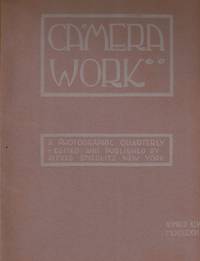
1619ref. 23330N. Y.: Camera Work 1916-1917. First only editions of the final two issues of Alfred Stieglitz's monumental photographic periodical Camera Work including in number 48 the earliest appearance in print of the work of Paul Strand and in number 50 an issue entirely dedicated to the work of Strand. Limited to 500 copies printed. "The work of Paul Strand was the first photography to excite Stieglitz in a long time. He saw Strand as practicing a truly photographic version of the kind of forceful representation he found in painters like Picasso and Matisse and he presented Strand's work as a clean break even changing the time-tested production methods of Camera Work Strand's photogravures were printed on thicker paper and with different inks." - Roth 101 pp. 42-43. Issue No. 48 includes six photographs by Strand six halftones by Steiglitz of installations at his gallery 291 and single photographs by Frank Eugene Arthur Allen Lewis and Francis Bruguiere. Issue No. 49/50 includes eleven original photogravures all after work by Strand among them "The White Fence" "Abstraction Porch Shadows" and "Abstraction Bowls". One cannot overestimate the importance of these two issues of Camera Work. As Milton Brown has noted the appearance of Strand's portrait series herein "was a revelation. Even today they are strikingly powerful images; they were then a new stage in photographic realism. The close-up views and cropping of negatives cut off the subjects from their environment sometimes even breaking the frame and riveting attention entirely on the physiognomic and psychological revelation of individuality character and social condition. . . . Strand's experiments with abstraction and the machine were his unwitting contribution to the history of photography: the portraits basic to the rest of his development are the first clear expression of his own aesthetic philosophy." - Milton W. Brown "The Three Roads" in Paul Strand: Essays on His Life and Work. Edited by Maren Stange. Aperture 1990 p. 29. Although not noted in the volumes these two issues of Camera Work came from the collection of James Johnson Sweeney at various times the Curator of Painting and Sculpture at MOMA the second Director of the Guggenheim Museum and the Director of the Museum of Fine Arts Houston. . Among the most sought-after issues of Camera Work these two numbers are complete and in remarkable condition. The plates are clean free of foxing and creasing. The text blocks are clean bright and sound largely unopened. A bit of offsetting from plates to the facing pages as usual somewhat more pronounced in No. 49/50 but not affecting the images themselves. Wrappers are clean with only very light wear; the hinges are firm and there is no creasing or darkening of the spines. Overall both issues are in near fine and extremely scarce thus. . 2 volumes small folio illustrated with 9 and 11 original photogravures respectively original printed wrappers. Among the most sought-after issues of Camera Work these two numbers are complete and in remarkable condition. The plates are clean free of foxing and creasing. The text blocks are clean bright and sound largely unopened. A bit of offsetting from plates to the facing pages as usual somewhat more pronounced in No. 49/50 but not affecting the images themselves. Wrappers are clean with only very light wear; the hinges are firm and there is no creasing or darkening of the spines. Overall both issues are in near fine and extremely scarce thus. . Camera Work unknown
1619ref. 23330N. Y.: Camera Work 1916-1917. First only editions of the final two issues of Alfred Stieglitz's monumental photographic periodical Camera Work including in number 48 the earliest appearance in print of the work of Paul Strand and in number 50 an issue entirely dedicated to the work of Strand. Limited to 500 copies printed. "The work of Paul Strand was the first photography to excite Stieglitz in a long time. He saw Strand as practicing a truly photographic version of the kind of forceful representation he found in painters like Picasso and Matisse and he presented Strand's work as a clean break even changing the time-tested production methods of Camera Work Strand's photogravures were printed on thicker paper and with different inks." - Roth 101 pp. 42-43. Issue No. 48 includes six photographs by Strand six halftones by Steiglitz of installations at his gallery 291 and single photographs by Frank Eugene Arthur Allen Lewis and Francis Bruguiere. Issue No. 49/50 includes eleven original photogravures all after work by Strand among them "The White Fence" "Abstraction Porch Shadows" and "Abstraction Bowls". One cannot overestimate the importance of these two issues of Camera Work. As Milton Brown has noted the appearance of Strand's portrait series herein "was a revelation. Even today they are strikingly powerful images; they were then a new stage in photographic realism. The close-up views and cropping of negatives cut off the subjects from their environment sometimes even breaking the frame and riveting attention entirely on the physiognomic and psychological revelation of individuality character and social condition. . . . Strand's experiments with abstraction and the machine were his unwitting contribution to the history of photography: the portraits basic to the rest of his development are the first clear expression of his own aesthetic philosophy." - Milton W. Brown "The Three Roads" in Paul Strand: Essays on His Life and Work. Edited by Maren Stange. Aperture 1990 p. 29. Although not noted in the volumes these two issues of Camera Work came from the collection of James Johnson Sweeney at various times the Curator of Painting and Sculpture at MOMA the second Director of the Guggenheim Museum and the Director of the Museum of Fine Arts Houston. . Among the most sought-after issues of Camera Work these two numbers are complete and in remarkable condition. The plates are clean free of foxing and creasing. The text blocks are clean bright and sound largely unopened. A bit of offsetting from plates to the facing pages as usual somewhat more pronounced in No. 49/50 but not affecting the images themselves. Wrappers are clean with only very light wear; the hinges are firm and there is no creasing or darkening of the spines. Overall both issues are in near fine and extremely scarce thus. . 2 volumes small folio illustrated with 9 and 11 original photogravures respectively original printed wrappers. Among the most sought-after issues of Camera Work these two numbers are complete and in remarkable condition. The plates are clean free of foxing and creasing. The text blocks are clean bright and sound largely unopened. A bit of offsetting from plates to the facing pages as usual somewhat more pronounced in No. 49/50 but not affecting the images themselves. Wrappers are clean with only very light wear; the hinges are firm and there is no creasing or darkening of the spines. Overall both issues are in near fine and extremely scarce thus. . Camera Work unknown books