Bent GreveBiblio.com

3 673 résultats
réf. A9780367276348Hardback. New. hardcover
réf. A9781138520929Hardback. New. hardcover
réf. A9780803952867Hardback. New. In Treating Secondary Victims the author builds upon a foundation of both the research literature on incest victims and families as well as her own clinical experience to provide a conceptual framework for intervention and treatment of the non-offending mother. hardcover
réf. A9781138206045Paperback / softback. New. paperback
réf. A9780415356558Paperback / softback. New. Covering subjects like globalization and IT this text provides an introduction to the key phases of the contracting process and the skills required by managers in its implementation. These include: policy for contracting; strategic purchasing; understanding markets; communicating the contracting decision; and designing and drafting the contract. paperback
réf. A9780415470377Paperback / softback. New. Previous edition: Colloquial Norwegian Kari Breatveit W. Glyn Jones and Kirsten Gade 1995. paperback
1921réf. e0937Eskilstuna: Oberg. VG : in Very good condition without dust jacket. Some rubbing of covers. 1921. First Edition. Brown hardback cloth cover with marbled boards. 240mm x 160mm 9" x 6". 367pp. In German. . Oberg hardcover
1983réf. 27360NYGS / Little Brown and Company 1983-01-01. First Edition; First Printing. hardcover. Collectible; Very Good. 11x9x0. Signed. SIGNED on the title page by Olivia Parker and by Mark Strand not on a bookplate but directly on the page without any inscriptions to anyone ; Tight and clean. Solid binding. A touch of light shelf wear to price clipped dustjacket with sunning along the spine and to top and foxing to top edge otherwise a gently read book In Very Good condition. No inscriptions. No remainder mark. Not ex-library. ; Introduction by Mark Strand. NYGS / Little, Brown and Company hardcover
2026réf. __103534159XEdward Elgar Pub 2026. Hardcover. New. 384 pages. 9.25x6.12 inches. Edward Elgar Pub hardcover
réf. 0893819557.Ghardcover. Good. Access codes and supplements are not guaranteed with used items. May be an ex-library book. hardcover
réf. 1634300599.Glibrary. Good. Access codes and supplements are not guaranteed with used items. May be an ex-library book. unknown
réf. 2922405397.Gpaperback. Good. Access codes and supplements are not guaranteed with used items. May be an ex-library book. paperback
2025réf. __1035309971Edward Elgar 2025. Hardcover. New. 416 pages. 9.62x6.62 inches. Edward Elgar hardcover
2004réf. mon0003784931Diagonal 2004-10-01. Paperback. Good. 0.7000 7.2000 5.2000. Cover and edges may have some wear. Diagonal paperback
réf. PJH52883Aperture 2004. Mint in publishers cloth in like dustjacket still shrink wrapped. 112pp. Illustrated. 1st edition. For Paul Strand the summers of 1926 and 1930 - 1932 marked a period of critical artistic growth. Absorbing the Southwest's complex cultural history Strand made pictures that merged realism with abstraction and formalism with an American romanticism. He began to shape his ideas of photographing a region in depth - the collective portraiture that he later expanded in Mexico New England Africa and Europe. The Southwest period brought not only artistic renewal but also personal turmoil. His political and social ideas were shifting and his relationship with the two most important people in his life - his wife Rebecca and his mentor Alfred Stieglitz - were disintegrating. This book reconstructs in an intimate visual way the emotional and creative swirl around Paul Strand. Each summer the Strands stayed with Mabel Dodge Luhan at her fabled Taos ranch where many illustrious guests drifted through from D. H. Lawrence to Ansel Adams. The linking of Strand's photographs to the New Mexico paintings of his friends Marsden Hartley John Marin and Georgia O'Keeffe enriched by many personal letters snapshots and artifacts reveals the flavor of an extraordinary environment and the cross-pollination of ideas. While a handful of Strand's Southwest photographs have been previously published Ranchos de Taos Church and City Hall among them this period of his outstanding career remains largely unexplored. Paul Strand Southwest presents many images for the first time including dramatic landscapes decayed ghost towns the noble architecture of adobe churches and his final austere portraits of Rebecca. ISBN 1931788464 Aperture 2004 hardcover
réf. A9781032384467Hardback. New. This fully revised and updated edition of Happiness provides an accessible introduction to the concept of happiness and how it can be applied to public policy in order to help citizens achieve the good life. hardcover
réf. 104594Dresden Verlag der Kunst 1962. . First edition; 4to 28 x 23 cm; presentation inscription by photographer on half title page reads 'To Mohamed and Aicha Ouda with friendship and much affection. Paul Strand. Cairo. April. 1965.' numerous black & white photographic illustrations; publisher's printed grey cloth pictorial dust wrapper chipped and worn; overall a very good copy. One of the most influential photographers of the twentieth century Paul Strand 1890-1976 was born in New York City and went on to study under Lewis W. Hine before becoming a commercial photographer in 1912 following Alfred Stieglitz in his commitment to 'straight' photography. In 1933 he was appointed chief of photography and cinematography in the Secretariat of Education in Mexico. After 1942 he concentrated on still photography for his records of life in many parts of the world. This presentation copy is inscribed by Paul Strand to Mohamed Ouda and his wife. Ouda 1920-2006 was an Egyptian thinker and writer. He was one of Egypt's staunchest Nasserists whose motto in life was 'You never own anything. It is things that own you' - a motto which earned him the title of 'the Egyptian Gandhi'. Dresden, Verlag der Kunst, 1962. hardcover
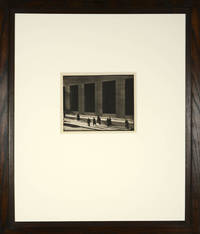
réf. 91270New York 1916. . Photogravure on japan paper from Camera Work No. 48 annotated on the reverse image size 13.4 x 16.6 cm. sheet 28.1 x 20 cm mounted and framed. An iconic image of Wall Street and a turning point in modern photography. Wall Street depicts a scene of everyday life in Manhattan's Financial District. Workers are seen walking past the J.P. Morgan building in New York City on the famous Wall Street of which the photograph takes its name. The photograph is famous for its reliance on the sharpness and contrast of the shapes and angles created by the building and the workers that lead to its abstraction. This photograph is considered to be one of Strand's most famous works and an example of his change from pictorialism to straight photography. Strand moved from the posed to portraying the purity of the subjects. There is no focal point with the lines converging off of the frame of the image. The financial building take majority of the frame. Emphasis is placed on the strong shapes created by the architecture of the building. The workers are included in the image but are faceless and are trumped in size by the massive square shapes from the building they walk past. Also the workers are captured in motion which on film makes them appear blurry. This aesthetic that Strand creates in Wall Street is his break toward the modern. Social change was important to Strand. With Wall Street he sought to portray a social message. He captured the faceless people next to the looming financial building in order to give a warning. Strand shows 'the recently built J.P. Morgan Co. building whose huge dark recesses dwarf the passers-by with the imposing powers of uniformity and anonymity' Ollman Art Review: Paul Strand: A Transition Caught on Film. The people cannot escape the overwhelming power that this modern establishment will have on their future and the future of America. He warns us to not be the small people that look almost ant-like next to this building that has a massive amount of control over the American economy. The photo now simply titled 'Wall Street' was one of six Paul Strand pictures Stieglitz published in Camera Work. In three of the six pictures humanity strides out from abstract ideas and each figure was a study in itself an irregular item complimented by modular formats that surround it. Another set of eleven Strand photos were published in the magazine's final issue in 1917 and those pictures overwhelmingly endorsed by Stieglitz as 'brutally direct' made Strand's reputation. New York, 1916. unknown
1973réf. 593154New York: Atheneum 1973. Hardcover. Near Fine. First edition hardcover issue. Yellow cloth gilt. Slightest soiling on the spine near fine issued without dust jacket. Published as a paperback original this is one of approximately 10 copies prepared by the publisher in hardcovers for the use of the author. This copy Inscribed by Strand using most of the front fly to fellow poet Donald Justice and his wife Jean: "for Don and Jean with love and thanks and better story in the making Mark Strand. Iowa City. Sept. 1973. The Yewell Street Story is merely a diversion." Laid into the book are seven pages carbon typed manuscripts on rectos only of a long poem by Strand "The Untelling" and the final poem in the book not identified as being by Strand except for a small pencil note "Strand" on the first page likely in Justice's hand. The seven-page manuscript has one small hand-correction and has been neatly folded into thirds else fine. The hardcover issue is rare. The association is significant. The carbon typescript is a bonus. Atheneum hardcover
réf. 0292726376.Ghardcover. Good. Access codes and supplements are not guaranteed with used items. May be an ex-library book. hardcover
réf. 163155090X.Glibrary. Good. Access codes and supplements are not guaranteed with used items. May be an ex-library book. unknown
réf. 0961080876.Gpaperback. Good. Access codes and supplements are not guaranteed with used items. May be an ex-library book. paperback
réf. 45133698-nnew. unknown
réf. 51825193like new. unknown
réf. 45072110-nnew. unknown