3 676 résultats
1980réf. 1418928New York: Atheneum 1980. First edition. Hardcover. Octavo viii 152 pages. In Very Good condition with a Very Good dust jacket. Spine is black with white print. Price unclipped: "$10.95". Boards in purple cloth stamped title. Textblock has orange tinted top edge. Signed in ink by the author on the title page. NOTE: Shelved in Netdesk Column F ND-F . 1418928. FP New Rockville Stock. Atheneum hardcover books
1969réf. 86522NY & Cleveland: NAL/World 1969. First edition. xxvi 390 pp w/index of first lines. Foxing along top edge else near fine in near fine dust jacket with two short tears to rear panel with a horizontal wrinkle. NY & Cleveland: NAL/World unknown books
1984réf. 86113Vancouver: William Hoffer 1984. First Canadian edition. 58 pp. Fine in full Coromandel silk over boards with printed cover and spine labels. No dust jacket as issued. Designed by Robert Bringhurst. One of 90 of 110 numbered copies on Carlyle Japan paper. Translated from the original German by Greve with his Afterword. Originally published in Germany in 1903. Publications of the F.P. Greve Seminar Number One. Vancouver: William Hoffer hardcover books
1998réf. 74155NY: Knopf 1998. Fifth printing. 55 pp. Fine in fine dust jacket. “Winner of the Pulitzer Prize” sticker on front panel. SIGNED by Strand on the title page. NY: Knopf, unknown books
1969réf. 71120NY & Cleveland: NAL/World 1969. First edition. xxvi 390 pp w/index of first lines. Fine in near fine dust jacket with some wrinkles near foot of spine. NY & Cleveland: NAL/World unknown books
2000réf. 48125NY: Turtle Point Press 2000. Uncorrected proof. 91 pp. Very near fine in printed wrappers. Laid into a near fine dust jacket misfolded but as issued with a light fade to spine. NY: Turtle Point Press, unknown books
1971réf. 42907Cambridge: Halty Ferguson 1971. First edition. 29 pp. Near fine in full cloth with gilt stamping to front cover. No dust jacket as issued. INSCRIBED by Strand on the half-title page “for Douglas Blazek /”A California Quechua” / from Mark Strand.” Cambridge: Halty Ferguson, hardcover books
1973réf. 38212NY: Atheneum 1973. First edition. 48 pp. Near fine in glossy illustrated wrappers; a trade paperback original. INSCRIBED by Strand “for Douglas / Blazek / with affection / from / Mark Strand.” NY: Atheneum, paperback books
1985réf. 16137NY: Knopf 1985. First edition. 112 pp. Near fine in near fine dust jacket. NY: Knopf, unknown books
2000réf. USTRMAK00acmfW. W. Norton 2000. Very Good. Strand Mark. The Making of a Poem. NY: W. W. Norton 2000. 366pp. Indexed. Bibliography. 8vo. Paperback. Book condition: Very good with bumped and yellowed edges. Sticker on spine and front panel. W. W. Norton paperback books
1990réf. 140948332New York: Alfred A. Knopf 1990. Uncorrected proof. Very Good. Mark Strand's personal copy of the uncorrected proof issued before the first edition. Signed by him on the title page. viii 63 4 pp. Bound in publisher's off-white wraps lettered in black. Very Good with light edge wear faint soiling and foxing to covers with pen correction made at first leaf to "moons of light"; a creased portion of "Orpheus Alone" from another book laid-in at rear. A small collection of poems by the Pulitzer-winning poet. Provenance: from the estate of the late poet bookseller and publisher Charles Seluzicki who wound up with a number of books from Strand's library. Alfred A. Knopf unknown books
1968réf. RDAVTIR00drpGrossman 1968. Very Good. Davidson Basil. Tir A'Mhurain: Outer Hebrides. Strand Paul. NY: Grossman 1968. 151pp. Illustrated. 4to. Grey cloth. Book condition: Very good with gently bumped corners and slightly discolored spine ends. Previous owner's name on front free endsheet with tiny bookseller's label. Dust Jacket Condition: Very good with rubbing and bumping. Slight chipping in spine ends. Old price crossed out on front flap. In DJ protector. Grossman hardcover books
2008réf. USTRINV00araSimon and Schuster 2008. Very Good. Strand Ginger. Inventing Niagara. New York: Simon and Schuster 2008. 337pp. 8vo. Hardcover. Book condition: Very good with light rubbing and bumping. Dust Jacket Condition: Very good with sticker residue on rear panel. Simon and Schuster hardcover books
1987réf. UBAIWIL00crHarry N. Abrams 1987. Very Good. Bailey William. William Bailey. Strand Mark. New York: Harry N. Abrams 1987. Illustrated. Bibliography. Oblong 4to. Paperback. Book condition: Very good. Harry N. Abrams paperback books
1967réf. USTREAR00lvWm B Eerdmans Publishing 1967. Fine. Strand Kenneth. Early Low German Bibles. Michigan: Wm B Eerdmans Publishing 1967. 48pp. Illustrated. 4to. Cloth. Book condition: Near fine with subtly bumped edges. Dust Jacket Condition: Good with faded spine and bumped and lightly chipped edges. . Wm B Eerdmans Publishing hardcover books
1993réf. RSTRPOE00FPRed Butte Press 1993. Fine. Strand Mark. A Poet's Alphabet of Influences. Sucec Bonnie. Salt Lake City UT: Red Butte Press 1993. copy #25 of 75. Illustrated. Tall narrow quarto. Brown cloth with painterly decorations in black. Signed by author. Book condition: Fine in very good taupe linen clamshell box with faint moisture stain at opening. Signed by Mark Strand and Bonnie Sucec on limitation page. Each poem headed with decorative hand-colored initials. Red Butte Press hardcover books
1917réf. RREETHI01DPESeven Arts Publishing 1917. Very Good. Reed John. This Unpopular War contained in The Seven Arts. August 1917 Vol 2 No 10. With Amy Lowell Vachel Lindsay John R. Dos Passos John Butler Yeats H. L. Mencken Paul Strand. New York: Seven Arts Publishing 1917. 8vo. Wraps. Book condition: Good with corners bumped short closed tears to yapp edges and lightly soiled panels. Light bump to textblock coming through from front cover & subtly showing on first several pages. Pages subtly soiled in lower fore edge corner. Seven Arts Publishing paperback books
1917réf. RREETHI00DPESeven Arts Publishing 1917. Good. Reed John. This Unpopular War contained in The Seven Arts. August 1917 Vol 2 No 10. With Amy Lowell Vachel Lindsay John R. Dos Passos John Butler Yeats H. L. Mencken Paul Strand. New York: Seven Arts Publishing 1917. 8vo. Wraps. Book condition: Good. Lightly soiled. Several reases and small closed tears to yapp edges. Seven Arts Publishing paperback books
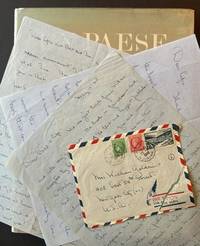
1955réf. 25259Milano/Torino: Giulio Einaudi Editore 1955. Cloth. Near Fine/Near Fine. A lovely Paul Strand collection including 3 long warm letters to his good friend Cipe Pineles pioneering graphic designer and art director -- Seventeen Vogue Vanity Fair Glamour. In the handwritten letters which date from 1954 1955 and 1962 and are 3 4 and 3 pgs. long respectively Strand among other things reflects on the 1955 1st edition of Un Paese a very sharp copy of which we present here with the letters. The book and its dustjacket are very clean and each is solid and easily Near Fine. And the 3 letters are also bright clean and eminently legible. An uncommon look through these correspondences at the musings of a major photographer toward his own recently published work. The 3 letters and the book all being offered together as an archive. Giulio Einaudi Editore unknown books
réf. 125421972. Near Fine. A warm gracious 2 pg. ALS from the photographer Paul Strand referencing --among other things-- an evening with Hart Crane. Strand is patiently responding from France to a Vietnam vet whose 2 letters are here included who asks if he and his wife might work for an aging Strand in any capacity. Strand's August 1972 8 1/4" x 10 1/2" letter in response is bright and clean and has held up nicely. His hand is strong and the ball-point ink completely legible. Also includes the original enevelope addressed in Strand's hand and postmarked "Yvesines" France. unknown books
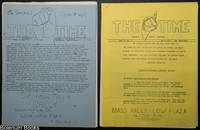
1970réf. 351085New York: Columbia University Strike Committee 1970. Two consecutive issues mimeographed and stapled 5 and 12 sheets respectively; minor toning and handling otherwise very good. Two issues of the daily bulletin produced at Columbia during the nationwide student strike following the invasion of Cambodia and the killing of four students at Kent State. The covers reproduce hand-lettered announcements for a May 6 rally in Low Plaza and the May 9 demonstration in Washington D.C. The May 6 issue includes the strike's three national demands and Jerry Alter's eyewitness account of the Kent State shootings. The substantially longer May 7 issue reports on the aftermath and funerals includes an account titled "Pigs Bust Heads at Columbia" describing police beatings of four students and promotes the May 9 antiwar demonstration in Washington D.C. Note: The May 7 issue repeats the previous day's numbering in error; the May 8 issue was numbered Vol. I no. 4. [Columbia University Strike Committee] unknown books
1945réf. 233441945. Women's LaborUnion Organizing Women telephone workers on strike press photo archive documenting labor organization picket lines arrests and union settlement efforts in New York Brooklyn Chicago Seattle St. Louis and Cleveland 1945-1950. The images illustrate the postwar labor conflict in the American telephone industry as women workers fought for better wages pensions union recognition and working conditions. The group records labor action through formal union voting publicity picketing mass walkouts police intervention and settlement. The archive highlights women at the center of the labor organizing process showing the workforce that staffed operator positions and other telephone company roles acting collectively during the major strike wave that followed World War II. Photo archive of 9 silver gelatin press photographs ranging from 6 x 7 to 8 x 10 inches New York Brooklyn Chicago Seattle St. Louis Cleveland and related U.S. locations 194New York5-1950. The photographs show women carrying and preparing strike placards leaving telephone company headquarters in a St. Louis walkout gathering on broad city steps with signs lining sidewalks outside company buildings sitting with placards reading "N.F.T.W. ON STRIKE" and smiling from inside a police wagon after arrest on an Ohio Federation of Telephone Workers picket line. Several images preserve highly specific labor text: placards call for "$12 per week" a "Union Shop" and a "Decent Pension" while another denounces the "union busting tactics of the Bell System." One image shows a woman tearing up a strike placard beside a noticeboard stating that the FLLTW and the company had reached an agreement and that the proposed strike had been called off. Versos retain typed caption strips credit and usage stamps editorial markings and filing notes identifying scenes such as a New York vote on whether traffic employees of the New York Telephone Company would strike on April 16 1945; Brooklyn strike cancellation at American Telephone and Telegraph on March 7 1946; Chicago women preparing picket signs on April 5 1947; Seattle workers and pickets outside a telephone building on April 7 1947; coffee served to women strike pickets at St. Alphonsus Hall that same evening; and later Cleveland newsroom handling marked November 10 1950. These photographs date to a time of broad labor upheaval of the mid 1940s and early 1950s when wartime employment rising prices and postwar contract battles pushed workers across the United States into repeated strikes. The telephone industry depended heavily on women as operators traffic workers and clerical employees and this archive shows those women as the visible organizers voters and public faces of labor activism in one of the country's largest communications networks. The images document five years of telephone strikes across several cities and through multiple stages of escalation and resolution. Moderate edge wear scattered creasing surface handling wear editorial markings stamps caption remnants and some toning or staining to versos; overall good condition. A concise multi-city record of women's labor militancy in the postwar telephone industry with strong evidence of how strike action operated inside a national communications system. unknown books
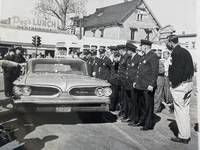
1960réf. 232971960. Labor OrganizingIndustry General Electric strike photo archive documenting the 1960 IUE Local 201 strike at the GE River Works plant in Lynn Massachusetts press photographs of workers and labor organizers resisting GE's take-it-or-leave-it bargaining practice at the factory gate. These images record the early days of the national IUE walkout. In the Fall of 1960 contract demands over wages cost of living protection and job security stalled when General Electric refused to bargain on terms acceptable to the union a move later condemned in federal litigation over the company's duty to bargain in good faith. Formal negotiations ran through 45 meetings from July into October 1960. The strike lasted three weeks and the dispute resulted in charges over unfair labor practice that became part of the major legal and labor history of "Boulwarism" GE's long campaign to dictate contract terms while exploiting division among the unions organized in its plants. Photo archive of 20 large silver gelatin press photographs measuring between 7 x 8 and 8 x 10 inches Lynn Massachusetts September-October 1960. The images show dense exterior picket scenes outside the GE plant with men and women carrying tall placards reading "LOCAL 201 IUE AFL CIO ON STRIKE" police officers linking arms and shoving crowds back from arriving automobiles and knotting lines of workers pressed against car hoods and fenders as management and police attempt to force entry through the picket. Several photographs isolate the mechanics of the strike itself: a car with rooftop loudspeaker positioned near the line an indoor union meeting beneath a huge banner attacking company leadership women pickets pointing and shouting across a fence line and a man stooping to gather tacks scattered across pavement with the caption explaining that picketers left tacks and nails at plant entrances to puncture the tires of management and scabs. One typescript caption reads "POLICE PUSH STRIKERS BACK" and states that officers acted "to clear way for cars entering or leaving the plant" while another notes that "A nationwide strike was called by the union Saturday at midnight." Additional versos carry date stamps for October 4 and 5 1960 typed caption slips and handwritten identifications such as "Mass. Lynn strikes G.E. Co." fixing the archive firmly within the first phase of the strike. Lynn held an important place in GE labor history well before 1960. Plant workers had challenged company control since the 1930s; by the postwar period the city had become one of the clearest sites where GE tested union-busting methods. This strike did not defeat GE on its own and the settlement came largely on company terms but resulting litigation condemning GE unfair bargaining practices became central to American labor organizing. The 1960 conflict thus stands as a precursor to the broader interunion coordination that emerged later in the decade and culminated in the national GE strike of 1969 to 1970 when unions finally forced a real challenge to Boulwarism. Scattered staining creasing and minor chipping at margins; most prints captioned on verso; overall good to very good condition. Primary source documentation of one of the country's most consequential corporate labor battlegrounds preserving the ground level struggle through which workers tested the limits of industrial union power in mid-century America. unknown books
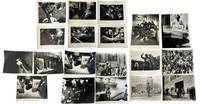
1969réf. 232051969. Steve Rose's photographic coverage of demonstrations strike activity broadcast spaces and police control in New York City and Washington D.C. circa 1969-1971 with dissent moving through street assembly underground and movement media institutional protest and municipal enforcement. Rose active in New York documentary photography during the early 1970s photographed activists such as Abbie Hoffman crowds radio workers and police at campuses transit sites and city streets where public speech met managed space. These photographs of early 1970s New York and D.C. activism span police violence organizers gathering outside major institutions broadcasters at consoles and microphones and school protest and street demonstration aligned with the same documentary practice that recorded Young Lords and Gay Liberation actions in the city. Photo archive of 19 Large silver gelatin photographs each 8 x 10 inches New York City and Washington D.C. circa 1969-1971. The most confrontational scenes place police with raised batons inside a damaged transit interior with shattered or cracked glass and turnstiles marked "NOT FOR EXIT" locating the violence inside a controlled urban access point rather than an open street. Riot helmets gas masks clubs broken barriers and confined stair and platform space place crowd control transit management and physical force together during moments of unrest. In this group the violent scenes are central evidence of municipal authority enforcing movement and restricting public assembly in New York at the turn of the 1970s. Contents include schoolchildren descending an interior stair with placards reading "A LITTLE RADIATION IS NO GOOD FOR CHILDREN AND OTHER PEOPLE" and "NO NO NO"; a street protester holding a hand-lettered sign reading "Strike! Support the Manifesto"; a crowd assembled outside the Interchurch Center one sign reading "Fight White Racism Join Us"; a woman labeled "Beulah" likely a college student impersonating activist Beulah Sanders addressing a large outdoor gathering; and a dense overhead crowd view made from an elevated vantage point. Another group centers on urban control points and police presence including subway turnstiles marked "NOT FOR EXIT" officers in helmets and gas masks advancing with batons a handwritten wall slogan reading "NO MORE FARE" above a tiled stair and a verso note identifying one image as "grand central subway control booth." Additional prints include a radio or news studio with a control console a broadcaster wearing headphones at a microphone a silhouetted operator in a booth and a saxophonist performing before an audience. Several versos bear Steve Rose photographer stamps signatures a Nancy Palmer Photo Agency stamp crediting Rose the note "view from president's terrace" and dated notations including "Steve Rose / Newsreel 6-9-69." One image is duplicated. The archive contains antiwar activism childcare and school protest strike support racial justice organizing broadcast work and police intervention inside the same metropolitan circuit. Press-marked versos agency stamps location notes and dated inscriptions record the working infrastructure through which Rose's images moved as news and movement documentation. Light handling wear minor curling scattered verso toning and staining editorial stamps and manuscript notations throughout; one duplicate image present. Police violence crowd control and organized dissent intersect inside transit interiors institutional exteriors broadcast studios and city streets in New York City and Washington D.C. unknown books
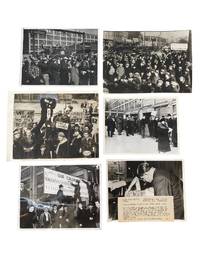
1937réf. 234461937. Labor Organization Chrysler strike press photo archive documenting the 1937 sit down strikes and picketing campaigns at Dodge Main and other Chrysler facilities in Detroit and Highland Park Michigan during the decisive phase of industrial unionization in the American automobile industry. The archive records workers occupying plants mass picket mobilizations outside factory gates anti injunction demonstrations and violence connected to the struggle between Chrysler management the United Automobile Workers and competing independent unions. These events unfolded only weeks after the February 1937 settlement of the Flint sit down strike against General Motors which established the UAW as a major industrial union and accelerated organizing efforts across Detroit's auto plants. Chrysler initially resisted recognition obtaining court injunctions ordering workers to evacuate occupied factories while thousands of laborers remained inside the plants or formed flying squadrons to block strikebreakers from entering. The scenes here capture the atmosphere of confrontation in Depression era industrial labor conflict at a time when mass production workers forced some of the largest corporations in the United States to negotiate with organized labor. Photo archive of 6 silver gelatin press photographs from 6 x 8 inches to 8 x 10 inches Detroit and Highland Park Michigan 1937. Affixed captions on versos with filing stamps dated March and August 1937. Crowds of striking workers gather outside Dodge Division and Chrysler factory gates beneath signs reading "Dodge Division of Chrysler Corporation Employment Office" and "We Are Here To Stay Dept. 82." Several men hold placards reading "82 is Sittin Too" "Spirit of 1937" and "Fence Jumper" while an effigy labeled "Injunction" hangs over the crowd in open defiance of a court order directing workers to vacate occupied plants. A large calendar board records the passing days of the sit down occupation beginning March 8 1937. Another scene shows relatives and supporters communicating with occupying workers through numbered department cards hung along the perimeter fence after union organizers established an improvised locating system for men inside the plant. One caption identifies "flying squadrons" directing picket activity outside Chrysler headquarters. The latest photograph records Frank A. Dillon identified as president of an independent Chrysler union receiving questioning from Detective Sergeant Harry Scher after an alleged beating connected to union violence that led Chrysler officials to temporarily close a plant pending investigation. The Chrysler strike formed part of the larger wave of industrial labor upheaval that reshaped American manufacturing during the New Deal. Passage of the Wagner Act in 1935 legally protected collective bargaining but enforcement depended on workers physically preventing corporations from continuing production with replacement labor. Sit down strikes became one of the most controversial tactics of the era because occupying workers halted machinery while denying employers access to their own factories. The archive preserves not only the mechanics of strike organization but also the public theater of industrial conflict in Depression era Detroit: marching pickets improvised communication systems anti injunction symbolism and massive worker assemblies outside factory gates. Moderate surface wear occasional creasing editorial markings and toning to versos with captions firmly affixed; images remain sharp and highly legible. Overall very good condition. unknown books