3673 risultati
1897rif. 250523London: George Newnes Ltd. 1897. First Edition. Hardcover. Good copy in the original title-blocked pictorial cloth. Slightest suggestion only of dust-dulling to the spine bands and panel edges. Remains well-preserved overall; tight bright clean and strong. Provenance; from the library of Peter F. Walkey with the owner's bookplate. Physical description; 804 pages. Notes; First appearance of tragedy of Arthur Conan Doyle's 'The Tragedy of the Korosko'. Subjects; The Strand Magazine. Arthur Conan Doyle. 'The Tragedy of the Korosko'. 1897. Periodicals. London: George Newnes, Ltd. hardcover
1892rif. 30779George Newnes 1892. Roy. 8vo. First Edition with numerous photographs and illustrations throughout free endpapers lightly spotted a little mild spotting throughout; attractively bound in contemporary niger half roan sides ruled in blind back with raised bands tooled in gilt second compartment with red leather label ruled and lettered in gilt all other compartments tooled with blind lozenge marbled edges a very good bright clean copy. Contains the first appearance of 'Silver Blaze' complete with Paget's inconic illustrations as 'The Adventures of Sherlock Holmes. No. XIII. 'The Adventure of Silver Blaze'. 'Silver Blaze' is of course the classic early tale containing Holmes' famous epigram of the dog in the nightime. It was subsequently collected as the first of the eleven 'Memoirs' published in book form in 1894. This issue also includes Harry How's well-illustrated article 'A Day with Dr. Conan Doyle' pp.182-188. An added Holmesian bonus is the presence of Clarke Russell's 'A Nightmare of the Doldrums' pp.189-198; his tales were a favourite of Dr. Watson: 'I was deep in one of Clark Russell's fine sea stories' 'The Five Orange Pips'. UNCOMMON IN THIS CONDITION. DeWaal 357. George Newnes, hardcover
1898rif. 24625George Newnes 1898. Roy. 8vo. First Edition thus with numerous photographs and illustrations throughout endpapers lightly browned some light spotting as usual; original pictorial blue cloth blocked and lettered in black gilt back bevelled boards red sprinkled edges lower hinge cracked but binding entirely sound a very good bright clean copy. Contains the first appearance of Doyle's 'Round the Fire' stories II-VII. No. II is 'The Story of the Man with the Watches' illustrated by Frank Craig; No. III is 'The Story of the Lost Special' illustrated by Max Cowper. These two stories are widely recognised by Holmesians as the two most important 'lost' Holmes adventures. Both stories feature an unnamed amateur reasoner clearly intended by Doyle to be identified by his readers as Holmes himself. These two tales and their fellows were collected and published as 'Round the Fire Stories' in 1908. UNCOMMON IN THIS CONDITION. See Green & Gibson p.409. George Newnes, hardcover
rif. 63-0840Berkeley CA: Bay Area Committee to Spread the Strike 1970. . Poster. 8.5" x 14". Photocopied Flyer Very Good with minor creasing. Illustrated. Mostly protesting the Vietnam War & pro-Civil Rights. [Berkeley, CA]: Bay Area Committee to Spread the Strike, 1970. unknown
rif. DADAX0316410713New unknown
rif. DADAX029574443XNew unknown
rif. DADAX0198254393New unknown
rif. DADAX0870133853New unknown
rif. DADAX0470138971New unknown
1948rif. 2092902137302311Kaizo-sha 1948. Soft Cover. Fine. The book is in fine condition. Kaizo-sha paperback
1980rif. KOS01202901A modified company 1980. Soft Cover. Fine. KOS01202901 A modified company paperback
rif. DADAX0520285603New unknown
rif. SONG0575002875Used: Good unknown
rif. DADAX0415531942New unknown
rif. 084660227X.Gpaperback. Good. Access codes and supplements are not guaranteed with used items. May be an ex-library book. paperback
rif. DADAX1916915035New unknown
rif. 1331280249.Gpaperback. Good. Access codes and supplements are not guaranteed with used items. May be an ex-library book. paperback
rif. 16755The stamp issued in 1912 by The Charles Dickens Testimonial 17-21 Tavistock Street London WC. The article published by the Strand Magazine London. 1910 or 1911. On 7 January 1911 Beckles Willson Honorary Secretary of the Charles Dickens Testimonial explained the scheme to the readers of the Spectator. Three members of Dickens's family were Willson explained 'drawing a niggardly pension of £25 per annum from the British Government' and that 'no volume recently published of Dickens has returned any copyright fee save those which bear the Dickens copyright stamp'. The stamp was 'on sale for one penny each-in sheets of twelve-at every bookseller's in the land and at all Messrs. W. H. Smith's and Wyman's news-stalls. His Majesty the King her Majesty the Queen her Majesty Queen Alexandra and other members of the Royal Family ever ready to be the exemplars in every good and just cause have led the way by placing the copyright stamps in their volumes of Dickens. Their example has been followed by many of the leading statesmen lawyers authors actors editors and divines of the day. If every owner of Dickens will not shirk his penny a magnificent centenary tribute will be assured. For there are forty-eight million copies of Dickens extant.' The publishers Macmillan Willson continued had agreed 'to insert a Dickens stamp gratis in every volume of every edition of Dickens issued by them during the hundredth year of the novelist. The significance of this must not be overlooked. It means that for the first time in literary history the representatives of a great writer will he in receipt of a copyright fee not conferred by the action of the copyright laws ; small it is true but to which they are entitled as truly as the heirs of any landlord are entitled to receive tribute in the shape of rent.' The stamp offered here is printed in black ink on a piece of paper approximately 5 x 4 cm with perforated edges and gummed reverse. In very good condition. Priced at a penny with an oval portrait of Dickens within a border in the form of a carved wooden frame with 'A TRIBUTE TO GENIUS' and the dates 1812 and 1912 at the head the words 'CENTENARY TESTIMONIAL' around the portrait and a facsimile of Dickens's signature at the foot. The four-page article paginated 608-611 is on three leaves extracted from the Strand Magazine. Stapled together and in good condition. Includes full-page 'Unpublished Photograph of Dickens' taken by Thrupp of Birmingham in 1869. The article features a reproduction of the stamp and a list of the scheme's committee headed by the Earl of Rosebery and including Theodore Roosevelt Hilaire Belloc G. K. Chesterton Sir Arthur Conan Doyle Thomas Hardy Rudyard Kipling and more than fifty others. 'The actual design for the stamp has been evolved by a sub-committee comprising Lord Alverstone and Messrs. Brition Riviere R.A. H. Rider Haggard Clement K. Shorter and Sir Adolph Tuck Bart.' [ The stamp issued in 1912 by The Charles Dickens Testimonial, 17-21 Tavistock Street, London WC. ] The article published by the unknown
1948160 pages. Index. Contents include: Round Strand Ropes; Galvanized Wire Ropes and Strands; Flattened Strand Wire Ropes; Special Wire Ropes; Wire Rope Fittings and Slings; Ordering Wire Rope; Handing Wire Rope; Socketing Wire Rope; Splicing Wire Rope; Attaching Clips; Wire Rope Recommendations for Construction, Quarries, Gravel Pits, Elevators, General Industry, Logging, Mines, Oil and Gas, Ships. Prior owner's name and date in marker inside front board. Couple of drops of paint near base of spine. Binding tight. Average wear. A sound vintage copy. Book
rif. 69-0141The Art Institute of Chicago 1991. 4to. 25 pp. Soft Cover. Very Good. BW Images.Provenance: From the estate of Gerald Nordland 1927-2019. Nordland was a museum director art critic educator and author.Dean of the Chouinard Art Institute 1960-64 Director of the San Francisco Museum of Art now SFMoMA 1966-73 Milwaukee Art Museum 1977-85 and the UCLA Wight Art Gallery 1973-1977. He is the author of over 60 publications including books on Lachaise Nakian Diebenkorn and Frank Lloyd Wright. The Art Institute of Chicago, 1991 paperback
rif. DADAX0521072573New unknown
1945rif. 233441945. Women's LaborUnion Organizing Women telephone workers on strike press photo archive documenting labor organization picket lines arrests and union settlement efforts in New York Brooklyn Chicago Seattle St. Louis and Cleveland 1945-1950. The images illustrate the postwar labor conflict in the American telephone industry as women workers fought for better wages pensions union recognition and working conditions. The group records labor action through formal union voting publicity picketing mass walkouts police intervention and settlement. The archive highlights women at the center of the labor organizing process showing the workforce that staffed operator positions and other telephone company roles acting collectively during the major strike wave that followed World War II. Photo archive of 9 silver gelatin press photographs ranging from 6 x 7 to 8 x 10 inches New York Brooklyn Chicago Seattle St. Louis Cleveland and related U.S. locations 194New York5-1950. The photographs show women carrying and preparing strike placards leaving telephone company headquarters in a St. Louis walkout gathering on broad city steps with signs lining sidewalks outside company buildings sitting with placards reading "N.F.T.W. ON STRIKE" and smiling from inside a police wagon after arrest on an Ohio Federation of Telephone Workers picket line. Several images preserve highly specific labor text: placards call for "$12 per week" a "Union Shop" and a "Decent Pension" while another denounces the "union busting tactics of the Bell System." One image shows a woman tearing up a strike placard beside a noticeboard stating that the FLLTW and the company had reached an agreement and that the proposed strike had been called off. Versos retain typed caption strips credit and usage stamps editorial markings and filing notes identifying scenes such as a New York vote on whether traffic employees of the New York Telephone Company would strike on April 16 1945; Brooklyn strike cancellation at American Telephone and Telegraph on March 7 1946; Chicago women preparing picket signs on April 5 1947; Seattle workers and pickets outside a telephone building on April 7 1947; coffee served to women strike pickets at St. Alphonsus Hall that same evening; and later Cleveland newsroom handling marked November 10 1950. These photographs date to a time of broad labor upheaval of the mid 1940s and early 1950s when wartime employment rising prices and postwar contract battles pushed workers across the United States into repeated strikes. The telephone industry depended heavily on women as operators traffic workers and clerical employees and this archive shows those women as the visible organizers voters and public faces of labor activism in one of the country's largest communications networks. The images document five years of telephone strikes across several cities and through multiple stages of escalation and resolution. Moderate edge wear scattered creasing surface handling wear editorial markings stamps caption remnants and some toning or staining to versos; overall good condition. A concise multi-city record of women's labor militancy in the postwar telephone industry with strong evidence of how strike action operated inside a national communications system. unknown books
1945rif. 233441945. Women's LaborUnion Organizing Women telephone workers on strike press photo archive documenting labor organization picket lines arrests and union settlement efforts in New York Brooklyn Chicago Seattle St. Louis and Cleveland 1945-1950. The images illustrate the postwar labor conflict in the American telephone industry as women workers fought for better wages pensions union recognition and working conditions. The group records labor action through formal union voting publicity picketing mass walkouts police intervention and settlement. The archive highlights women at the center of the labor organizing process showing the workforce that staffed operator positions and other telephone company roles acting collectively during the major strike wave that followed World War II. Photo archive of 9 silver gelatin press photographs ranging from 6 x 7 to 8 x 10 inches New York Brooklyn Chicago Seattle St. Louis Cleveland and related U.S. locations 194New York5-1950. The photographs show women carrying and preparing strike placards leaving telephone company headquarters in a St. Louis walkout gathering on broad city steps with signs lining sidewalks outside company buildings sitting with placards reading "N.F.T.W. ON STRIKE" and smiling from inside a police wagon after arrest on an Ohio Federation of Telephone Workers picket line. Several images preserve highly specific labor text: placards call for "$12 per week" a "Union Shop" and a "Decent Pension" while another denounces the "union busting tactics of the Bell System." One image shows a woman tearing up a strike placard beside a noticeboard stating that the FLLTW and the company had reached an agreement and that the proposed strike had been called off. Versos retain typed caption strips credit and usage stamps editorial markings and filing notes identifying scenes such as a New York vote on whether traffic employees of the New York Telephone Company would strike on April 16 1945; Brooklyn strike cancellation at American Telephone and Telegraph on March 7 1946; Chicago women preparing picket signs on April 5 1947; Seattle workers and pickets outside a telephone building on April 7 1947; coffee served to women strike pickets at St. Alphonsus Hall that same evening; and later Cleveland newsroom handling marked November 10 1950. These photographs date to a time of broad labor upheaval of the mid 1940s and early 1950s when wartime employment rising prices and postwar contract battles pushed workers across the United States into repeated strikes. The telephone industry depended heavily on women as operators traffic workers and clerical employees and this archive shows those women as the visible organizers voters and public faces of labor activism in one of the country's largest communications networks. The images document five years of telephone strikes across several cities and through multiple stages of escalation and resolution. Moderate edge wear scattered creasing surface handling wear editorial markings stamps caption remnants and some toning or staining to versos; overall good condition. A concise multi-city record of women's labor militancy in the postwar telephone industry with strong evidence of how strike action operated inside a national communications system. unknown
1957132 pages. Short Stories: Compromise Courtship; Doctor's Gamble; Hand-Me-Down Bride; The Meanest Kid in Town. Articles: Our Ordeal over the Pacific - Maj. Samuel W. Tyson nurses a crippled C-97 transport 1000 miles ; Theyd Rather Dance Than Eat - the Roseland at Broadway; The Woes of West Coast Football - the scandal-ridden Pacific Coast Conference; Out of My Past (part 4 of 5) - George Raft; The Negro in the North (part 1 of 2) - predictions of desegregation-related social upheaval; Struggle for Power In Indonesia; We Run a Nursing Home. Serials: Trouble at Midas Creek (part 2 of 7); Violent City (conclusion). Ads: Kelvinator and GE appliances; Chanse & Sanborn coffee; United Aircraft Corporation;Campbell's Soup; Euclid excavating equipment; GE TVs; Arvin transistor radios and radiant heaters; Wheeling Metal Products; Nice 7-Up ad features young drummer; Lucky Strike (back cover). Average wear. Unmarked. A sound vintage copy. Magazine
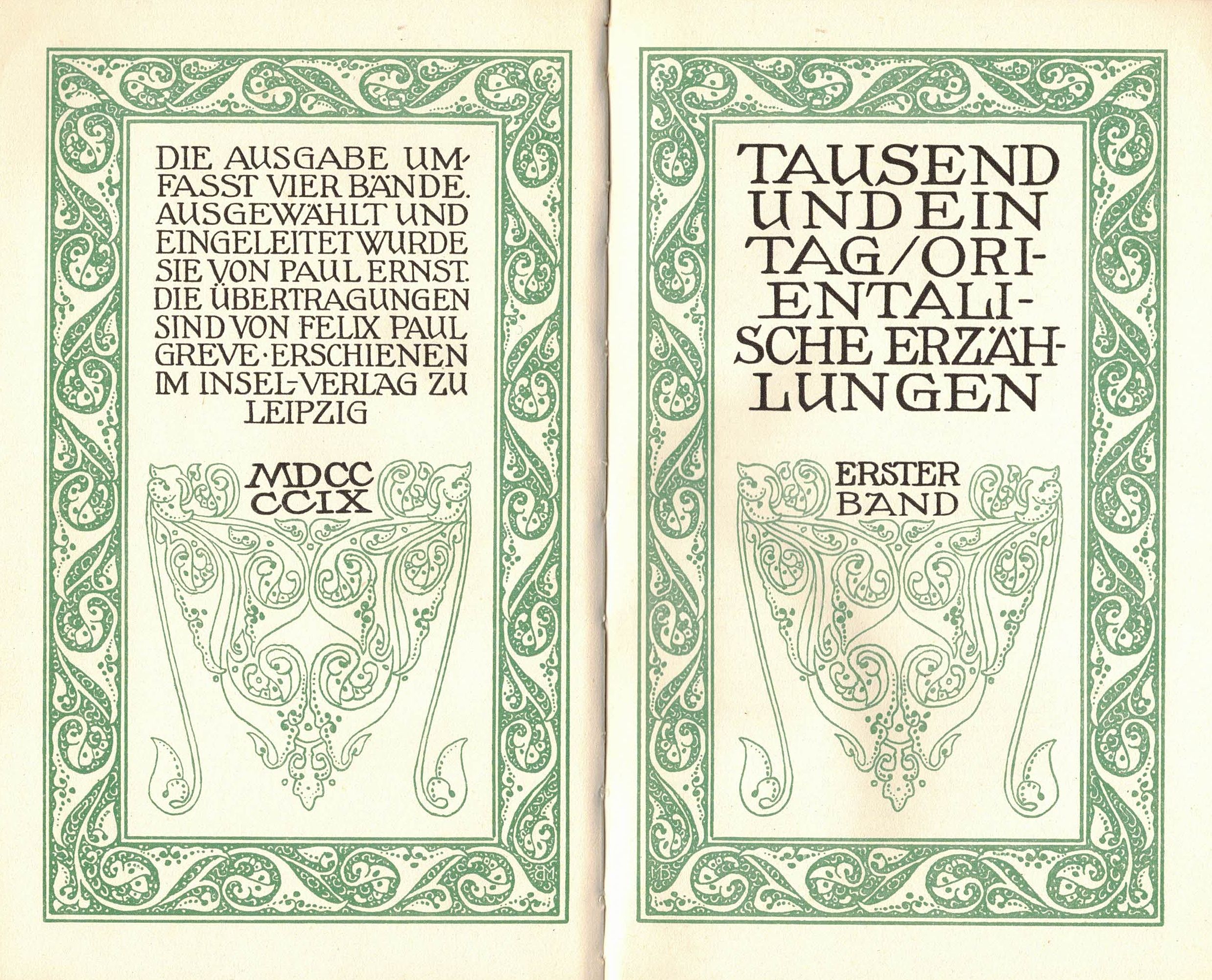
1909rif. 231081909. Insel, Leipzig, 1. Auflage. Sarkowski 1725. Doppeltitel von Marcus Behmer. OHalbleder mit Rückenvergoldung und Kopfgoldschnitt, 358 / 370 / 370 / 423 S..