FIGUERES Léo -MareMagnum

95 résultats
1969Paris, Editions Sociales, 1969, 16mo brossura editoriale, pp. 257 (ottimo stato).
19761ère édition de ce recueil de textes publiés en revues de 1946 à 1967 par l'économiste marxiste Ernest MANDEL (1922-1995), important théoricien et un des principaux dirigeants de la IVe Internationale (trotskyste): "Problèmes de la révolution européenne" (1946), "De Prague à Rome", "Lettre à Jean-Paul Sartre" (1953), "La 3e Révolution chinoise - Origine et signification de la victoire de Mao Tsé-Toung - Nature et perspectives de la Chine de Mao Tsé-tung" (1950), "La révolution mondiale, de sa phase empirique à sa phase consciente" (1954), "Le projet de programme du P. C. de l'Union soviétique" (1961), "Essai d'interprétation de la "révolution culturelle"" (1967), "La place du 9e congrès mondial dans l'histoire de la IVe Internationale"; préface du philosophe Jean-Marie VINCENT; notes et références. Dans la collection dirigée par Jean-Marie Vincent; photo du célèbre escalier de "Le Cuirassé Potemkine" d'Eisenstein en couverture. Français
1961Peu courante réédition, par la IVè Internationale, de la traduction (par Victor SERGE) de ce bilan de deux décennies de pouvoir soviétique publié en 1936 par Léon TROTSKY, alors en exil, où il analysait l'économie et la société soviétique, et les conditions du "Thermidor soviétique" stalinien; introduction (de 1961) de Pierre FRANK (1905-1984), secrétaire de Trotsky en 1932-1933 et membre de la direction de l'internationale trotskiste; notes biographiques; index des noms. Traducteur non cité; édition non datée, introduction datée 1961. Français
1968Extraits de textes de Léon TROTSKY (1879-1940) choisis et présentés par Jean BAECHLER (1937-2022), auteur (non trotskiste, non marxiste) d'une longue introduction sur la pensée trotskiste qu'il perçoit comme "un système intellectuel clos, fondé sur quelques postulats, à partir desquels l'édifice peut être constitué"; notes et références; chronologie; index thématique; bibliographie. Français
1975Traduction, par Claude BUHRER-LEVENSON, de 4 textes extraits de "Comment s'arma la révolution" ("Kak vooroujalas' revolioutsiia") publié en 1925 par Léon TROTSKY (1879-1940); introduction du sociologue Pierre NAVILLE (1904-1993): où l'auteur se proposait de "préciser les conditions d'un art de la guerre, telles que l'expérience et la réflexion les lui avaient apprises, à son poste de Président du Comité Militaire Suprême de la jeune République des Soviets, pendant toute la durée de la guerre civile"; notes. Français
1934Broch?. 256 pages.
1970Broch?. 143 pages. Format de poche.
2001Broch?. 189 pages.
Covers show edgewear & are tape-repaired at spine. Internally Very Good & Solid. (R-1-1); 8vo; Zheneva [i.e. Geneva], Gruppa "Khlieb i volia," 1904. Paper Wrappers, 12mo, 75 pages. 17 cm. In Russian. This is the first separate appearance of Kropotkin's important essay on the state, and also its first appearance in his native Russian (The essay first appeared as a series of articles entitled "L'Etat: son rôle historique" in Les Temps nouveaux, December 19, 1896- July 3, 1897.) It was later translated and published in English as "The State: Its Historic Role" (London: Freedom Press, 1911). Kropotkin, in exile in Western Europe, "became the best-known propagandist in the international anarchist movement" and "participated in several attempts to direct anarchist propaganda into Russia ..Kropotkin was and remains the most widely read anarchist writer, and his version of anarchist theory was the most influential contribution to the anarchist movement in Russia and elsewhere " (Nicolas Walter in Shukman, 1988, pp. 334-335) OCLC lists 3 copies worldwide (Hoover, U of Kansas, Columbia). This is Alexander Granovsky's copy with his signature & bookplate. Granovsky was a leader of the Ukranian exile community in the US and was the founder, in 1941, of the Ukrainian Scientific Institute, which had a short life but was one of the forerunners of other efforts that followed World War II. He was a also a leader of the Organization for the Rebirth of Ukraine and a world famous entomologist, activist and poet as well. From the English Translation: "First of all, let us be agreed as to what we wish to include in the term the State. There is, of course, the German school which enjoys confusing "State" with "Society". The best German thinkers, and many among the French, are guilty of this confusion because they cannot conceive of society without a concentration of the State; and because of this anarchists are usually accused of wanting to ``destroy society'' and of advocating a return to ``the permanent war of each against all.'' Yet, to argue thus is to overlook altogether the advances made in the domain of history during the last thirty-odd years; it is to overlook the fact that humans lived in Societies for thousands of years before the State had been heard of; it is to forget that so far as Europe is concerned the State is of recent origin---it barely goes back to the sixteenth century; finally, it is to ignore that the most glorious periods in history are those in which civil liberties and communal life had not yet been destroyed by the State, and in which large numbers of people lived in communes and free federations. The State is only one of the forms adopted by society in the course of history. Why then make no distinction between what is permanent and what is accidental? Then again the "State" has also been confused with "Government". Since there can be no State without government, it has been sometimes said that what one must aim at is the absence of government and not the abolition of the State. However, it seems to me that in State and government we have two concepts of a different order. The State idea means something quite different from the idea of government. It not only includes the existence of a power situated above society, but also of a "territorial concentration" as well as the "concentration of many functions of the life of societies in the hands of a few". It carries with it some new relationships between members of society which did not exist before the establishment of the State. A whole mechanism of legislation and of policing has to be developed in order to subject some classes to the domination of others. This distinction, which at first sight might not be obvious, emerges especially when one studies the origins of the State. Indeed, there is only one way of really understanding the State, and that is to study its historic development, and this is what we will try to do." OCLC lists 3 copies worldwide (Hoover, Kansas, & Columbia). (RUS-10-1)
19728vo; 299 pages; Index. Looks at the impact, manifestations, and changes in Trotsky's Jewishness and Jewish identity (or lack thereof) . Very Good in Good jacket with chips & closed tears (Comhist-2-4)
1930[6]-512 pp. Index. Black and white photo frontispiece photo of Trotsky [1879-1940]. A sound working copy of this tumultuous and impactful life story published in the year following Trotsky's exile from the Soviet Union and ten years before his murder in Mexico. No dust jacket. Faint prior owner's name upon front free endpaper otherwise unmarked. Moderate scattered foxing. Somewhat above-average wear to publisher's red cloth which is sunned on spine and lettered in gilt. Binding intact with moderate lean. Chip from top corner of pages 7-16. Book
1974GUANDA 1974 269 PP. FONDO DI MAGAZZINO: SCRITTA "SCONTO 50%" AL RISVOLTO DI QUARTA, SEGNI DEL TEMPO ALLA COPERTINA, VOLUME INTONSO, MAI SFOGLIATO, PERFETTO.
réf. 37939P., Selio, 1971, in 8° broché, 337 pages ; couvetrure illustrée (un peu ternie).
réf. 61822P., Les Editions de Minuit, 1974, in 8° broché, 206 pages ; quelques piqûres ; couvetrure illustrée (un peu fanée).
réf. 62963P., Editions Norman Bethune, 1971, in 8° broché, 96 pages.
1973réf. ln95François Maspero Poche Rouge Dos carré collé 1973 In-12 (11,1 x 18 cm), dos carré collé, 180 pages ; dos et bords des plats insolés, mors et bords des plats frottés, quelques légers frottements sur les plats, par ailleurs assez bon état général. Livraison a domicile (La Poste) ou en Mondial Relay sur simple demande.
1973réf. qq2070François Maspero Poche Rouge Dos carré collé 1973 In-12 (11 x 18 cm), dos carré collé, 180 pages ; dos insolé, mors blanchis, quelques frottements aux plats, par ailleurs assez bon état général. Livraison a domicile (La Poste) ou en Mondial Relay sur simple demande.
1979réf. vh4181Union générale d'éditions 10-18 Dos carré collé 1979 Six volumes in-12 (10,8 x 18 cm), dos carré collé, ensemble complet contenant : Trotsky, le prophète armé - Trotsky, le prophète désarmé - Trotsky, le prophète hors-la-loi ; volumes jaunis, dos un peu insolés, ex-libris manuscrit, par ailleurs bon état général. Livraison a domicile (La Poste) ou en Mondial Relay sur simple demande.
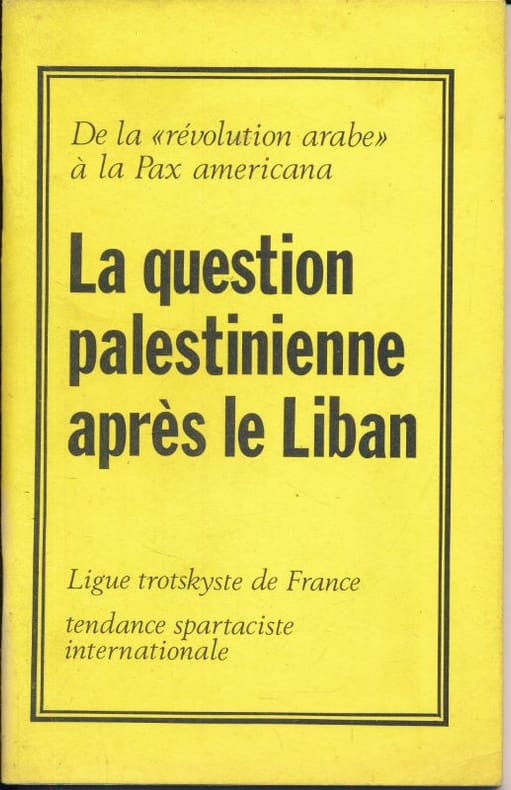
1982réf. 30758Ligue Trotskyste de France Paris, Ligue Trotskyste de France 1982. In-8 broché de 84 pages. Bon état
1990réf. 43589Cermtri 1990. In-4 Cermtri 1990. In-4 agrafé de 64 pages. Bel exemplaire
1960réf. 43593Révolution internationale . In-4 Révolution internationale . In-4 agrafé de 72 pages. La crise. Lutte de classe en Irlande ?. L'oppotunisme Trotskyste en Bolivie. Réponse à D GUEERIN. Bon état
1992réf. 48205CERMTRI 1992. In-4 CERMTRI 1992. In-4 agrafé d 86 pages. Bon état