457 risultati
1632rif. 34728Paris Pierre Gvillemot 1632. 8vo. Cont. full limp vellum remains of ties. Titlelabel in red leather on back this with a small nick. Top of spine strenghtened with a strip of vellum. Engraved title with Neptun & Mars. 627710 pp. 28 half-page textengravings and 15 large wood-cut illustrations. A few scattered brownspots. A good copy. Second enlaged edition of this scarce treatise of fireworks for war and recreation. The work is divided in five sections: the first 56 pp. to war pp. 57-146 to 'recreation' and pp. 147-277 to sundials fortification geometry and arithmetics. Of the English edition of 1629 Cockle says "This work though in advance of anything so far written on the subject in English does not attain to the standard of Thibourel and Appier. Yet it is with foreign treatises it must be weighed for Malthus received his training in pyrotechnics abroad.It was Malthus who about the year 1634 introduced the mortar into the French service." - Klaus Jordan: 2328 ed. 1629 - Chris Philip: M 040.3 - Cockle Nos 118 a. 939. hardcover
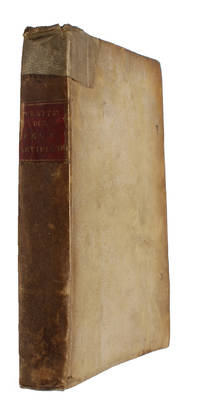
1632rif. 34728Paris, Pierre Gvillemot, 1632. 8vo. Cont. full limp vellum, remains of ties. Titlelabel in red leather on back, this with a small nick. Top of spine strenghtened with a strip of vellum. Engraved title with Neptun & Mars. (6),277,(10) pp., 28 half-page textengravings and 15 large wood-cut illustrations. A few scattered brownspots. A good copy.
rif. Z1-S-008-02813W. Pickering. Used - Good. Spine hinge damaged. Ships from UK in 48 hours or less usually same day. Your purchase helps support Sri Lankan Children's Charity 'The Rainbow Centre'. Ex-library so some stamps and wear but in good overall condition. 100% money back guarantee. We are a world class secondhand bookstore based in Hertfordshire United Kingdom and specialize in high quality textbooks across an enormous variety of subjects. We aim to provide a vast range of textbooks rare and collectible books at a great price. Our donations to The Rainbow Centre have helped provide an education and a safe haven to hundreds of children who live in appalling conditions. We provide a 100% money back guarantee and are dedicated to providing our customers with the highest standards of service in the bookselling industry. W. Pickering unknown
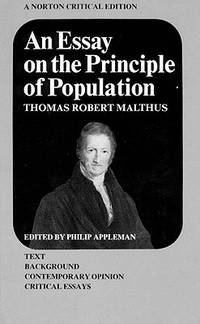
1976rif. 56124W. W. Norton & Company Inc. . As New. Paperback. FREE UPGRADE to Courier/Priority Shipping Upon Request – – IN STOCK AND IMMEDIATELY AVAILABLE FOR SHIPMENT - AS NEW THE TEXT BLOCK IS PRISTINE CLEAN UNMARKED AND IN EXCELLENT CONDITION - appears unread - 260 pages. -- with a bonus offer-- . 1976. 039309202X . W. W. Norton & Company Inc. paperback
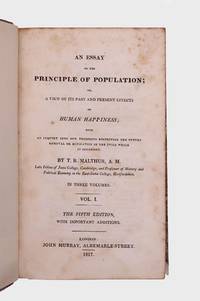
1817rif. 378979London: John Murray 1817. Fifth edition. xvi 496; iv 507 1; iv 500pp. 3 vols. 8vo. Modern quarter calf and marbled paper covered boards vellum tips flat spines gilt with green morocco lettering pieces. Very good. Fifth edition. xvi 496; iv 507 1; iv 500pp. 3 vols. 8vo. "The central idea of the essay - and the hub of Malthusian theory - was a simple one. The population of a community . increases geometrically while food supplies increase only arithmetically. If the natural increase in population occurs the food supply becomes insufficient and the size of the population is checked by 'misery' . The Essay was highly influential in the progress of thought in early 19th-century Europe . his influence on social policy whether for good or evil was considerable" PMM 251. Darwin among others credited Malthus as a source for his theory of natural selection. "The achievement of Malthus was the exposition of the theory of population; and his name has been associated so closely with this theory that like Darwin's it has added a new adjective to the language of civilized peoples" Palgrave II 670-71. First published anonymously in 1798 subsequent editions were exanded and this fifth edition published a decade after the fourth with "important additions" viz. adding substantial updates regarding public policy trade and data. The changes to this edition were so substantial that the changes were sold as a separate supplementary book titled Additions to the Fourth and Former Editions. The penultimate edition issued with Malthus's revisions during his lifetime and is often considered textually the best edition. Palgrave II 667-675; Kress B-6974. See PMM 251 John Murray unknown
1817rif. 378979London: John Murray 1817. Fifth edition. xvi 496; iv 507 1; iv 500pp. 3 vols. 8vo. Modern quarter calf and marbled paper covered boards vellum tips flat spines gilt with green morocco lettering pieces. Very good. Fifth edition. xvi 496; iv 507 1; iv 500pp. 3 vols. 8vo. "The central idea of the essay - and the hub of Malthusian theory - was a simple one. The population of a community . increases geometrically while food supplies increase only arithmetically. If the natural increase in population occurs the food supply becomes insufficient and the size of the population is checked by 'misery' . The Essay was highly influential in the progress of thought in early 19th-century Europe . his influence on social policy whether for good or evil was considerable" PMM 251. Darwin among others credited Malthus as a source for his theory of natural selection. "The achievement of Malthus was the exposition of the theory of population; and his name has been associated so closely with this theory that like Darwin's it has added a new adjective to the language of civilized peoples" Palgrave II 670-71. First published anonymously in 1798 subsequent editions were exanded and this fifth edition published a decade after the fourth with "important additions" viz. adding substantial updates regarding public policy trade and data. The changes to this edition were so substantial that the changes were sold as a separate supplementary book titled Additions to the Fourth and Former Editions. The penultimate edition issued with Malthus's revisions during his lifetime and is often considered textually the best edition. Palgrave II 667-675; Kress B-6974. See PMM 251 John Murray unknown books
rif. 71831E-090. Very Good. Hardcover. Leather. 8vo. Printed for J. Johnson by T. Bensley London UK. 1806. Two Volumes xvi 505 pgs; vii 559 pgs. Third Edition. Bound in gilt ruled fine calf leather with titles present to the spine. Boards have light shelf-wear present to the extremities boards are lightly rubbed and worn. Previous owner's bookplate present to the front pastedown. Text is clean and free of marks. Binding tight and solid. Third edition the first to be published in 2 volumes and the first published after the Great Quarto edition of 1803 of one of the most important and influential books in the history of economic thought. The third edition contained numerous revisions among which was a text entitled A Reply to the Chief Objections which have been urged against the Essay on the Principle of Population which was also published separately so that it might be bound with earlier ones. As the world's population continues to grow at a frighteningly rapid rate Malthus's classic warning against overpopulation gains increasing importance. An Essay on the Principle of Population examines the tendency of human numbers to outstrip their resources and argues that checks in the form of poverty disease and starvation are necessary to keep societies from moving beyond their means of subsistence. Malthus's simple but powerful argument was controversial in his time; today his name has become a byword for active concern about humankind's demographic and ecological prospects. ; 8vo 8" - 9" tall . hardcover
rif. Z1-S-008-02812W. Pickering. Used - Good. Volume Three. Part II. Ships from UK in 48 hours or less usually same day. Your purchase helps support Sri Lankan Children's Charity 'The Rainbow Centre'. Ex-library so some stamps and wear but in good overall condition. 100% money back guarantee. We are a world class secondhand bookstore based in Hertfordshire United Kingdom and specialize in high quality textbooks across an enormous variety of subjects. We aim to provide a vast range of textbooks rare and collectible books at a great price. Our donations to The Rainbow Centre have helped provide an education and a safe haven to hundreds of children who live in appalling conditions. We provide a 100% money back guarantee and are dedicated to providing our customers with the highest standards of service in the bookselling industry. W. Pickering unknown
1807rif. 52022HANDSOME COPY IN CONTEMPORARY BOLDLY SPECKLED CALF 2 vols. tall 8vo. iii-xvi 580; iii-viii 484 58 indexpp. contemporary boldly speckled calf smooth spines richly decorated in gilt in panels using two different designs black lettering and russet numbering labels gilt board edges gilt rolled spines a trifle chaffed at headbands some cracking at ends of some joints but overall a very nice copy. Near contemporary pencilled shelf number "D198" of Lord Dunraven of Adare Manor Co. Limerick on endpaper. KRESS B5219 This is edition incorporates the substantial revisions and additions which Malthus had made for his third edition of 1806. They are listed and described in full in his preliminary 'Advertisement' to that edition also printed here. The most substantial of the changes made was that "The chapters which were the fourth and sixth of the second book are nearly rewritten on account of an error into which the author had fallen in an attempt to estimate the fruitfulness of marriages and the number born living to be married from the data in registers" 'Advertisement'. Furthermore he added as an appendix here vol.2 p.429-484 his important Reply to the Chief Objections to the second edition of 1803. This appendix he had also published separately in quarto "for the accomodation of the purchasers of the former edition" 'Advertisement'.Malthus recommends that "those who have not the leisure or inclination to read the entire work will find in the appendix such notice of its most prominent arguments as will give them a good general idea of the aim and bent of the whole". In it he writes "My object is to correct some of the misrepresentations which have gone abroad respecting two or three of the most important points of the Essay. . The first grand objection that has been made to my principles is that they contradict the original command of the Creator to increase and multiply and replenish the earth . The next grand objection which has been urged against me is my denial of the right of the poor to support. . and lastly and rather a matter of feeling than of argument. Many persons have accused him of excessive pessimism in throwing a darker shade over our views of human nature and tending particularly to narrow our prospects of future improvement". All of these objections he attempts to refute. From the library of Edwin R. W. Wyndham-Quin Viscount Adare F.R.S. of Adare Manor Co. Limerick. Printed for J. Johnson .. by T. Bensley hardcover
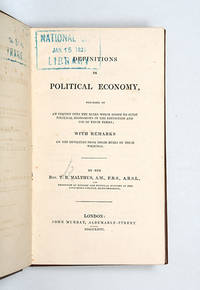
1827rif. 195032London: John Murray 1827. One of the earliest works on the methodology of economics First edition of "a valiant attempt to resolve differences of opinion in political economy by codifying its terminology and establishing rules for the definition of terms. It could be regarded as one of the earliest works on the methodology of economics" ODNB. Malthus devotes separate chapters to among others the French economists Adam Smith Say Ricardo James Mill McCulloch and Samuel Bailey although the latter's name was not known to him. The work is bound with an offprint of J. R. McCulloch's hostile review of the work from the Scotsman 10 March 1827 in which McCulloch questions Malthus's qualifications for the office of "Dictator in the Economical Republic". Octavo 193 x 114 mm. Complete with half-title without terminal colophon. Recent brown calf spine lettered gilt marbled endpapers cloth hinge supports marbled edges. Library stamp "National City Library Jan 15 1921" to title page offsetting to half-title. Slight chip to corner of front free endpaper p. 3 with faint offset where the original title label was inserted some light foxing. A good copy. Goldsmiths' 25180; Kress C.1924. hardcover
rif. elala6131Washington City: Roger Chew Weightman 1809. First American Edition based on the revised and enlarged third London edition of 1806 of one of the most important and influential works in the history of economic and social thought. “’Malthus’s law’ that population increases at a greater rate than the means of subsistence was one of the first and is still one of the most widely debated of modern economic theories. The work aroused a storm of controversy since Malthus held that checks on the growth of population would be necessary a theory which is still not finally extinguished. Malthus has exercised a strong influence not merely in economics but in the whole realm of social theory.” PMM Goldsmiths’ 19819. Kress B.5542. Palgrave II pp. 668-677. Shaw & Shoemaker 17975. cfNCBEL III 1294. cfGarrison & Morton 1693. cfPrinting and the Mind of Man. 251. 2 Volumes. 8vo. pp. xvi 510 xxxivindex; vii 1 542. complete with half-titles. contemporary tree calf rebacked several small library rubberstamps some foxing & browning throughout as usual – more extensive on outer leaves. elala6131 Washington City: Roger Chew Weightman, 1809 unknown
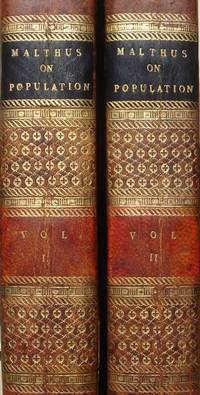
1826rif. 857601826. MALTHUS Thomas Robert. An Essay on the Principle of Population; or A View of its Past and Present Effects on Human Happiness. London: John Murray 1826. Two volumes. Octavo contemporary full diced brown calf raised bands black and red morocco spine labels marbled endpapers and edges. Housed in a custom slipcase. $2600.1826 edition of MalthusÕ controversial Essay the final one published in his lifetime in contemporary calf.""One of the founders of modern economics"" Malthus first published his highly contested Essay on the Principles of Population in 1798. This landmark work ""was originally the product of a discussion on the perfectibility of society with his father who urged him to publish. Thus the first edition published anonymously was essentially a fighting tract but later editions were considerably altered and grew bulkier as Malthus defended his views against a host of criticsÉ The Essay was highly influential in the progress of thought in early 19th-century Europe and his influence on social policy was considerableÉ Both Darwin and Wallace clearly acknowledged Malthus as a source of the idea of 'the struggle for existence"" PMM 251. ""The achievement of Malthus was the exposition of the theory of population; and his name has been associated so closely with this theory that like Darwin's it has added a new adjective to the language of civilized peoples"" Palgrave II:670-1. This is the sixth edition the final one to be published in his lifetime. Lowndes 1459. Goldsmiths 24893. Early owner signatures dated 1874.Text quite fresh and clean Volume II with small chip to rear free endpaper slight rubbing edge-wear to contemporary boards. An extremely good copy. hardcover
1826rif. 857601826. MALTHUS Thomas Robert. An Essay on the Principle of Population; or A View of its Past and Present Effects on Human Happiness. London: John Murray 1826. Two volumes. Octavo contemporary full diced brown calf raised bands black and red morocco spine labels marbled endpapers and edges. Housed in a custom slipcase. $2600.1826 edition of Malthus controversial Essay the final one published in his lifetime in contemporary calf.""One of the founders of modern economics"" Malthus first published his highly contested Essay on the Principles of Population in 1798. This landmark work ""was originally the product of a discussion on the perfectibility of society with his father who urged him to publish. Thus the first edition published anonymously was essentially a fighting tract but later editions were considerably altered and grew bulkier as Malthus defended his views against a host of critics The Essay was highly influential in the progress of thought in early 19th-century Europe and his influence on social policy was considerable Both Darwin and Wallace clearly acknowledged Malthus as a source of the idea of 'the struggle for existence"" PMM 251. ""The achievement of Malthus was the exposition of the theory of population; and his name has been associated so closely with this theory that like Darwin's it has added a new adjective to the language of civilized peoples"" Palgrave II:670-1. This is the sixth edition the final one to be published in his lifetime. Lowndes 1459. Goldsmiths 24893. Early owner signatures dated 1874.Text quite fresh and clean Volume II with small chip to rear free endpaper slight rubbing edge-wear to contemporary boards. An extremely good copy. hardcover books
rif. 95379Altona I. F. Hammerich 1807. . First German edition 2 vols 8vo 20 x 12.5 cm. pp. xvi 368; pp. vii 358; very slight spotting to vol. 1. Contemporary half-brown leather binding; flat spine gilt bands separating compartments compartments 1 3 5 and 6 contain gilt floral decoration compartments 2 and 4 contain gilt lettering including translator's name and title gilt library stamp to both upper boards library stamps to verso of both upper boards and title pages pencil markings to verso of upper boards and endpapers; rubbed water or possibly glue marks to verso of upper boards and endpapers. Rare first German edition and first translation into a foreign language of this important work by the father of Malthusianism. Malthus' original work written in English was first published anonymously in 1798. It discusses the problem of the gap between population growth which is potentially exponential and the growth of food supply which is not. The work arose from a discussion between Malthus and his father about the possibility of a better society and went on to have an enormous impact on social policy. Ultimately Malthus believed population growth would always outrun food supply and therefore the betterment of society was impossible without stern limits on reproduction. For this reason he is often associated with Darwin. His views became popular again in the XX century largely due to the work of John Maynard Keynes. 'The essay exercised a strong influence on European intellectual development at the beginning of the nineteenth century. the Socialists fought him unanimously. and the Conservatives were happy that somebody was fighting against the spread of revolutionary ideas from the continent.' Carter/Muir. Thomas Malthus 1766 - 1834 was born into a family of intellectuals and his father was a great friend of the philosopher David Hume. He took holy orders in 1797 but in 1805 decided to become a professor teaching history and the relatively new subject of political economy at the East India Company college in Haileybury. He was elected a member of the Royal Society in 1819 and in 1834 founded the Statistical Society of London. Altona, I. F. Hammerich, 1807. hardcover
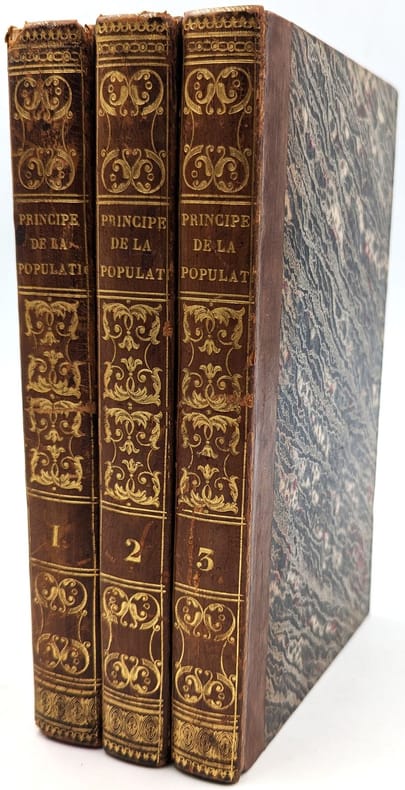
1809rif. 103515A Paris et à Genève, chez J.J. Pashoud, 1809, in-8, 3 vol. de I : 424-[6] pp. + II: [4]-395-[3] pp. + III : [6]-392-[5] pp, Demi-veau de l'époque, dos lisses filetés ornés en doré de roulettes et fers rocaille, Première traduction française, très augmentée par Pierre Prévost, pour qui l'ouvrage magistral de Malthus "a pour objet principal de diriger la bienveillance, vertu familière". Thomas-Robert Malthus (1766-1834) avec un siècle d'avance annonçait le principe qui sera repris par Keynes, de la demande effective opposée à la loi des débouchés. Publié originellement en anglais de façon anonyme en 1798, cet essai phare de la pensée économique et démographique du XIXe siècle instaure une réflexion sur le rapport entre le développement de la population et celui des subsistances qui amène à la conclusion que ce sont les salaires qui déterminent le chiffre de la population. Le second thème essentiel de la pensée malthusienne est sa critique du système anglais de lois sur les pauvres (Poor Laws) qui, selon lui, amplifie la pauvreté de manière générale. Excellent exemplaire en jolie reliure de l'époque, dos très légèrement frottés, petit accroc en tête d'une coiffe. Couverture rigide
1820rif. BB0781London: John Murray Albermarle-Street 1820. First Edition. Paper-covered Boards. First Edition with the rare 4-page publisher's catalog dated April 1820 of this classic of economic theory. 8vo: vi601 1pp. "London: Printed by C. Roworth Bell-yard Temple-bar." on colophon and title-page verso as called for. Uncut in the original publisher's drab blue paper-covered boards largely unopened with brown paper spine and remnants of original printed label. Internally fresh and bright with only occasionally spotting original spine largely perished but restored sensitively by an expert conservationist the boards somewhat stained and bumped but thoroughly original hinges reinforced. Small owner's book label probably contemporary partly effaced reading T Cobb. Clamshell case with leather spine label gilt. An unsophisticated copy of a truly scarce in publisher's binding important and desirable book a cornerstone of economic thought and a major influence on other scientific endeavors including the principles of evolution developed by Charles Darwin and Alfred Russell Wallace. Goldsmiths'-Kress 22767. Kress C577. Lowndes 1459. The title of Malthus's final major work is "something of a misnomer as the book was conceived as a series of tracts rather than a comprehensive and systematic treatise. . . . The Principles had only a limited impact at the time and was severely criticized by J. R. McCulloch and David Ricardo; the latter prepared extensive critical notes. But more recently it has received greater recognition largely as a result of the comments by John Maynard Keynes in the 1930s. Keynes argued that Malthus's theory of effective demand provided a scientific explanation of unemployment and that the hundred-year domination of Ricardo over Malthus had been a disaster for the progress of economics. Keynes believed that if economics had followed Malthus instead of being constrained by Ricardo in an artificial groove the world would be a much wiser and richer place." ODNB N. B. With few exceptions always identified we only stock books in exceptional condition carefully preserved in archival removable mylar sleeves. All orders are packaged with care and posted promptly. Satisfaction guaranteed. Fine Editions Ltd is a member of the Independent Online Booksellers Association and we subscribe to its codes of ethics. John Murray, Albermarle-Street unknown
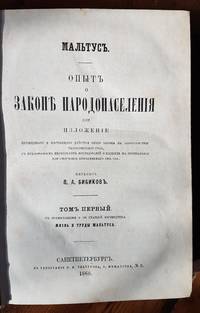
1868rif. 178Scarce first Russian edition of a major landmark of economic literature the Essay on the Principle of Population first published in English in 1798. With much added material. The translator P. A. Bibikov was a historian philosopher and literary critic who had already translated Smith's Wealth of Nations in 1866. With this background he added a wealth of material to this edition making it more than just a translation but also an a posteriori analysis. Next to the 80 pages on Malthus' life and works Bibikov added in a rich appendix translations of foreign commentators as well as his own footnotes relating to Russia. Very interestingly he updated and commented the many pages Malthus had already devoted to the Russian case. The appendix includes texts by Townsend Garnier Chernyshevskiy and Prudhon as well as a convenient 20-pp. alphabetical index. "The central idea of the essay - and hub of the Malthusian theory - was a simple one. If the natural increase in population occurs the food supply becomes insufficient and the size of the population is checked by 'misery' - that is the poorest sections of the community suffer disease and famine. Malthus recognises two other possible checks to population expansion: first 'vice' - that is homosexuality prostitution and abortion all totally unacceptable to Malthus; and second 'moral restraint' - the voluntary limitation of the product of children by the postponement of marriage." PMM. Provenance: Unidentified symbolistic booklabel to upper endpapers; small Baltic bookseller's stamps to lower endpapers. Physical description:Two volumes 8vo. 476 pp. incl. half-title title and table of contents at end; 468 pp. incl. table of contents. Later plain brown cloth author titled in ink on the spines. Condition:Very occasional light spotting. Glazunov, Skt. Peterburg, hardcover
1650rif. WB15505Paris 1650. Hardcover. Near Fine. Second edition. 4to. Engraved title 2 plates 28 illustrations 27 of which are full page. Bound in contemporary mottled calf. A very nice copy. Malthus was an Englishman employed in France. This work similar to others he published consists of five treatises: the first on artillery in general; the second on bombs and mortars; the third on "artificial fire"; the fourth on the mining and undermining of walls; the fifth concerns fireworks. hardcover books
1827rif. 122073London: John Murray 1827. First Edition. hardcover. near fine. viii 261pp. 8vo rebound in 3/4 red leather gilt-lettered spine; half-title expertly repaired otherwise fine. London: John Murray 1827. First Edition. Near fine. A critique of the terms used by French economists Adam Smith Jean-Baptiste Say James Mill David Ricardo J.R. McCulloch and Samuel Bailey followed by the author's classification. Kress C. 1924. NCBEL III 1294. Palgrave II p.677. John Murray unknown
1827rif. 122073London: John Murray 1827. First Edition. hardcover. near fine. viii 261pp. 8vo rebound in 3/4 red leather gilt-lettered spine; half-title expertly repaired otherwise fine. London: John Murray 1827. First Edition. Near fine. A critique of the terms used by French economists Adam Smith Jean-Baptiste Say James Mill David Ricardo J.R. McCulloch and Samuel Bailey followed by the author's classification. Kress C. 1924. NCBEL III 1294. Palgrave II p.677. John Murray unknown books
1718rif. 149970London: John Murray Eden: London J. Wright 1817 Eden: 1800. An excellent copy in contemporary calf Fourth edition of Malthus's Essay first published in 1798 one of the most important and influential works in the history of economic thought and the foundation text of modern demography. The second volume is appended with the first edition of Frederick Morton Eden's An Estimate of the Number of Inhabitants in Great Britain an appropriate pairing by the contemporary owner - Eden's population census preceded the first national decennial population census by a year but undershot the official figure by five million. It nonetheless marks like Malthus's Essay an important milestone in the study of population. Two works bound in 2 vols octavo 210 x 128 mm. Bound without half-titles. Contemporary sprinkled calf orange and dark green morocco labels gilt in compartments gilt roll border to covers blind serrated turn-ins marbled endpapers brown speckled edges. Contemporary ownership signature of Thomas Entwisle to title pages later small ink notation to front free endpapers versos. Minor patch of abrasion to rear cover of vol. I joints just beginning to split but holding firm light browning to Eden else contents fresh. An excellent copy. unknown
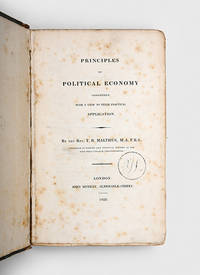
rif. 123522London John Murray 1820. . First edition; 8vo 21 x 13.5 cm; moderate spotting front free endpaper just starting to become loose at head of gutter margin remains of a library label to front pastedown; contemporary half calf marbled paper boards spine lettered in gilt dulled; vi 601 1pp. The first edition of Malthus' treatise on political economy. The book was conceived as a series of tracts rather than a comprehensive and systematic treatise though Malthus published it to establish his own position against that of Ricardo with whom he had been having an ongoing debate about the nature of labour demand and profit. 'In his 'Principles of Political Economy' Malthus was proposing investment in public work and private luxury as a means of increasing effective demand and hence as a palliative to economic distress. The nation he thought must balance the power to produce and the will to consume' DSB. 'The Principles had only a limited impact at the time and was severely criticized by J. R. McCulloch and Ricardo; the latter prepared extensive critical notes. More recently it has received greater recognition largely as a result of the comments by J. M. Keynes in the 1930s. Keynes argued that Malthus's theory of effective demand provided a scientific explanation of unemployment and that the hundred-year domination of Ricardo over Malthus had been a disaster for the progress of economics. Keynes believed that if economics had followed Malthus instead of being constrained by Ricardo in an artificial groove the world would be a much wiser and richer place.' ODNB. Goldsmiths' 22767; Kress C.577. London, John Murray, 1820. hardcover
1820rif. 168311London: John Murray 1820. In the original boards First edition of the author's major late work a re-examination of his economic work in the early 1800s and a point-by-point response to David Ricardo's Principles of Political Economy 1817. Notably Keynes held that "if economics had followed Malthus instead of being constrained by Ricardo in an artificial groove the world would be a much wiser and richer place" ODNB. In the Principles Malthus summarizes his earlier writing on rents currency food prices and corn laws. The book was conceived as a series of tracts rather than a comprehensive and systematic treatise though Malthus published it to establish his own position against that of Ricardo with whom he disagreed about the nature of labour demand and profit. "In his Principles of Political Economy Malthus was proposing investment in public work and private luxury as a means of increasing effective demand and hence as a palliative to economic distress. The nation he thought must balance the power to produce and the will to consume" DSB. In the 20th century the Principles received recognition "largely as a result of the comments by J. M. Keynes in the 1930s. Keynes argued that Malthus's theory of effective demand provided a scientific explanation of unemployment and that the hundred-year domination of Ricardo over Malthus had been a disaster for the progress of economics" ODNB. This copy includes an extremely early reback presumably by the original bookseller. The reback preserves the original blue boards while a section has been cut from the cloth backstrip to expose the original printed label. Octavo. Uncut in original blue boards early reback in brown cloth preserving original printed paper label. Circular "Y.S." ink stamp to title. Light bumping and wear moderate foxing to endpapers and contents front hinge cracked and lacking front free endpaper holding firm slight separations between and within several gatherings small hole to head of K4: a very good copy. Goldsmiths' 22767; Kress C.577; Mattioli 2221. hardcover
1809rif. 93446Paris: J. J. Paschoud 1809. The most influential work of its era on population in a contemporary binding First French edition translated by Pierre Prévost. First published in English in 1798 it was perhaps the most influential work of its era on population arguing that the growth of a population would always outrun its ability to feed itself. The first edition was so successful that Malthus soon elaborated on it under his real name culminating in the sixth edition of 1826 which was a scholarly expansion of the first. A political economist who occupies a hallowed place in the history of biology Malthus was acknowledged by both Charles Darwin and Alfred Russel Wallace as a key influence in developing the theory of natural selection. 3 vols octavo. Contemporary quarter calf marbled boards brown morocco labels spines lettered in gilt with gilt and black motifs edges uncut. Board edges slightly faded and a little scuffed joints tender tips bumped and lightly rubbed. A very good set. Carpenter XXXII 7; Kress B.5591. hardcover
1827rif. 170223003London: John Murray 1827. First Edition. Hardcover. Very Good. First edition first printing. Finely bound in brown leather with raised bands and gilt stamping. Contents lightly toned light restoration to several pages evident. Title page and text of last chapter show light evidence of erased pencil markings. Previous owner name on half title page. An important and early work on economic methodology. John Murray hardcover