Malthus, DanielABAA

604 results
1716ref. 3115621716. 4 pp. Small splits at old folds old reinforcement to center fold very good. 4 pp. The bill of one John Boundy as issued by Daniel Malthus 1651-1717 apothecary to Queen Anne and George I and great-grandfather of the economist Thomas Robert Malthus. Items charged include various juleps cordials and draughts linseed oil chamomile flowers marshmallow leaves purging potions King's drops quieting powders etc. Attested paid to estate of Mr. Malthus at end by Tho. Graham and docketed paid £58 July 10 1718. With 4 small circular stamps with the motto of the Earl of Fortescue "Forte Scutum Salus Ducum" "A Strong Shield is the Salvation of Leaders" unknown books
1821ref. 040304Boston MA: Wells and Lilly 1821. Book. Very Good. Full-Leather. First American Edition. 8vo - over 7¾" - 9¾" tall. Original full tree calf gilt on burgundy title label mounted on upper spine. Rubbed along edges some surface cracking/crazing rubbed joints and spine extremities. Foxed endpapers some toning and scattered foxing to interior but otherwise intact with firm binding. Former owner's signature on front flyleaf. viii472 pp. Exceptionally scarce first American edition issued a year after the first British edition of 1820. Wells and Lilly Hardcover
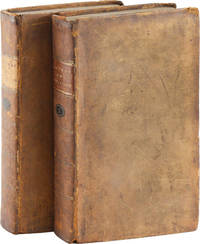
1807ref. 55024London: Printed for J. Johnson in St Paul's Church-Yard by T. Bensley 1807. Fourth edition. Octavo 22cm in two volumes. In contemporary brown calf seven sets of double gilt rules to spine titled in gilt on red leather spine label numbered on black leather spine labels blind tool to board edges all edges sprinkled grey; plain endpapers; vol. I: i-xvi 1-580pp; vol. II: i-viii 1-484 60pp. Sturdy copies much rubbed vol. I slightly cocked lower front joint of vol. I and upper front joint of vol. II cracking vol. II lacking spine label scratch to upper board of vol. II endleaves and some prelims foxed but otherwise internally free from soil: Good or better. The fourth edition of Malthus' widely influential discussion of overpopulation. Malthus 1766-1834 argued that population "increases geometrically while food supplies increase only arithmetically" and that some misery was inevitable unless population growth could be restrained. He proposed "moral restraint" as a solution. Many of his theories have now been largely rejected but "the Essay was highly influential in the progress of thought in early nineteenth-century Europe" and "his influence on social policy whether for good or evil was considerable." The first edition was shorter; "later editions were considerably altered and grew bulkier as Malthus defended his views against a host of critics" Printing and the Mind of Man. KRESS B.5219. GOLDSMITHS 19373. PMM 251 1st edn. Printed for J. Johnson in St Paul's Church-Yard, by T. Bensley unknown
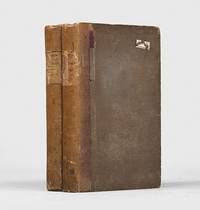
1806ref. 236862London: Printed for T. Johnson 1806. Third edition. xvi 505 1 blank 60 index pp.; vii 1 blank 559 1 pp. 2 vols. 8vo. Contemporary three-quarter calf; joints cracked two boards detached; rubbed and scuffed; scattered foxing throughout; withal a good serviceable copy. Third edition. xvi 505 1 blank 60 index pp.; vii 1 blank 559 1 pp. 2 vols. 8vo. GERITS: Third edition the first to be published in 2 volumes and the first published after the Great Quarto edition of 1803 of one of the most important and influential books in the history of economic thought. The third edition contained numerous revisions among which was a text entitled A Reply to the Chief Objections which have been urged against the Essay on the Principle of Population which was also published separately so that it might be bound with earlier ones. Kress B.5067; Goldsmiths 19210; Einaudi 3669; Carpenter Economic Bestsellers XXXII 3; PMM 251 for the first edition; Blaug Great Economists before Keynes p. 141ff Printed for T. Johnson unknown
1807ref. 55024London: Printed for J. Johnson in St Paul's Church-Yard by T. Bensley 1807. Fourth edition. Octavo 22cm in two volumes. In contemporary brown calf seven sets of double gilt rules to spine titled in gilt on red leather spine label numbered on black leather spine labels blind tool to board edges all edges sprinkled grey; plain endpapers; vol. I: i-xvi 1-580pp; vol. II: i-viii 1-484 60pp. Sturdy copies much rubbed vol. I slightly cocked lower front joint of vol. I and upper front joint of vol. II cracking vol. II lacking spine label scratch to upper board of vol. II endleaves and some prelims foxed but otherwise internally free from soil: Good or better. The fourth edition of Malthus' widely influential discussion of overpopulation. Malthus 1766-1834 argued that population "increases geometrically while food supplies increase only arithmetically" and that some misery was inevitable unless population growth could be restrained. He proposed "moral restraint" as a solution. Many of his theories have now been largely rejected but "the Essay was highly influential in the progress of thought in early nineteenth-century Europe" and "his influence on social policy whether for good or evil was considerable." The first edition was shorter; "later editions were considerably altered and grew bulkier as Malthus defended his views against a host of critics" Printing and the Mind of Man. KRESS B.5219. GOLDSMITHS 19373. PMM 251 1st edn. Printed for J. Johnson in St Paul's Church-Yard, by T. Bensley unknown books
1806ref. 236862London: Printed for T. Johnson 1806. Third edition. xvi 505 1 blank 60 index pp.; vii 1 blank 559 1 pp. 2 vols. 8vo. Contemporary three-quarter calf; joints cracked two boards detached; rubbed and scuffed; scattered foxing throughout; withal a good serviceable copy. Third edition. xvi 505 1 blank 60 index pp.; vii 1 blank 559 1 pp. 2 vols. 8vo. GERITS: Third edition the first to be published in 2 volumes and the first published after the Great Quarto edition of 1803 of one of the most important and influential books in the history of economic thought. The third edition contained numerous revisions among which was a text entitled A Reply to the Chief Objections which have been urged against the Essay on the Principle of Population which was also published separately so that it might be bound with earlier ones. Kress B.5067; Goldsmiths 19210; Einaudi 3669; Carpenter Economic Bestsellers XXXII 3; PMM 251 for the first edition; Blaug Great Economists before Keynes p. 141ff Printed for T. Johnson unknown books
1821ref. 048324Boston: Wells and Lilly 1821. First Edition. Hardcover Full Leather. Good Condition. Original full calf worn at edges and hinges slight bowing to covers. Internally with dampstains to upper corner heavy browning to half title and final pages and pervasive but mostly mild staining throughout not affecting legibility. Nearly very good overall. viii 472pp. Though largely overlooked at the time of publication it is in the principles that Keynes found "scientific explanation of unemployment" and that "the hundred-year domination of Ricardo over Malthus had been a disaster for the progress of economics" ODNB. Malthus's theory that spending on both public works and private luxuries could alleviate recessions and downturns by creating demand and prosperity were well ahead of his time. This is the first US edition. Size: Octavo 8vo. Quantity Available: 1. Shipped Weight: Under 1 kilo. Category: Economics; Americana. Inventory No: 048324. Wells and Lilly hardcover
1829ref. 147796London: J. Murray 1829. First appearance in print of these two papers by Malthus on the subject of value as contained in parts I pp. 171-180 and II pp. 74-81 of the first volume of the Transactions of the Royal Society of Literature here bound together. The papers were read before the society by Malthus in May 1825 and November 1827. In the first paper Malthus argues that "the natural and necessary conditions of the supply of all commodities not subject to a monopoly are represented and measured by the labour which they will ordinarily and on an average command and that no other object whatever can be substituted for labour or can represent and measure the natural and necessary conditions of the supply of commodities" p. 171. It was essentially a repetition of the arguments in Malthus's Measure of Value 1823. The second paper's aim was to show that when the term "value of a commodity" is used without referring to some other commodity in which it is to be estimated the term is "generally understood to refer and can only refer correctly to the conditions of its supply or the natural and necessary costs of its production" p. 74. The paper appears to have been intended as a development of the themes treated in his Definitions in Political Economy published earlier in 1827. 2 works bound in 1 vol. quarto 275 x 211 mm. With 21 plates of which 2 folding in first part; 7 plates of which 2 folding in second part. Twentieth-century blue quarter calf spine lettered gilt blue mottled sides marbled endpapers. With the book label to the front pastedown of the Ducs de Luynes at the Château de Dampierre. Residue from label removal at the foot of spine peripheral rubbing skilfully retouched contents clean and crisp. A very good copy. unknown
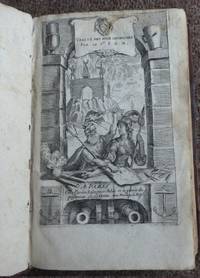
ref. 53104Paris Cardin Besogne 1640. TITLE CONTINUED: De nouveau reveu corrige & augmente par l'autheur. 1640 first published in 1629 8vo approximately 170 x 100mm 6¾ x 4 inches French text added engraved pictorial title page of Neptune and Mars fireworks in the background dated 1629 6 full page illustrations 38 text engravings both illustrations and diagrams some decorated initials and headpieces pages: 10 1-277 5 pages 136 and 139 misnumbered 116 and 137 collation: A-S8 T4 T4 a blank bound in contemporary speckled calf raised bands to spine gilt decoration to spine pale red speckling to edges. Binding slightly worn small neat repair to top of spine gilt slightly worn pitting to sides small water stain to top of engraved title a larger one to top of letterpress title see image a very faint small intermittent stain to upper margin throughout very faint half page water stain on S8 - T3 small closed tear to margin of 2 pages neatly repaired very small blank corner missing on S2 verso T3 lightly browned. A very good sturdy copy. Francis Malthus d.1658 of English origin was an engineer in the royal French army and a captain general of mines and sapping. He was responsible for the French use of the mortar beginning in 1634. See: Chris Philip A Bibliography of Firework Books page 91 M 040.5; Spaulding and Karpinski Early Military Books in the University of Michigan Libraries page 19; John Eliot Hodgkin Rariora Volume 3 Books on Fireworks section page 15; Maurice Cockle A Bibliography of Military Books to 1642 page 93 No.118 referring to the English edition of 1629: "This work though in advance of anything so far written on the subject in English does not attain to the standard of Thibourel and Appier. Yet it is with foreign treatises it must be weighed for Malthus received his training in pyrotechnics abroad. It was Malthus who about the year 1634 introduced the mortar into the French service." 4 copies of our 1640 edition listed in Library Hub Discover. MORE IMAGES ATTACHED TO THIS LISTING ALL ZOOMABLE FURTHER IMAGES ON REQUEST. POSTAGE AT COST AND ALL PARCELS SENT FULLY TRACKED AND FULLY INSURED. Paris, Cardin Besogne, 1640. hardcover
1820ref. 1015London: John Murray 1820. First Edition. Recent full calf in a contemporary style. Very good with some minor spotting at points. 8vo vi 1 - 601 1 - blank pp. Malthus published this book at a time when Ricardo's ideas were established orthodoxy. The Principles is the first complete statement of his economic theories. In it the theory of rent is clearly stated and the three main points of debate with Ricardo addressed. The principle of the value theory based on labor costs demand affects value in a limited way finally that profits are determined by the cultivation and fertility of the least arable land were central to Ricardo. Malthus challenges each of these ideas and what he termed Ricardo's ' new school of political economy ' . This is Malthus' intellectual manifesto with important sections on the theory of rent employment wages and the question of value. A key book in the development of modern economic theory. Kress C-577; Einaudi #3680; See Palgrave for a lengthy entry. John Murray unknown books
1821ref. 1512140034Boston: Wells and Lilly 1821-01-01. First Edition. Hardcover. Very Good. First American edition. Bound in marbled boards spine rebacked in modern leather. Burgundy Moroccan leather spine label. Clean unmarked pages. Marginal browning to pages. Internally very good. The first English edition was printed by John Murray in 1820 this is the 1st American edition printed in 1821 in Boston.J.M. Keynes "argued that Malthus's theory of effective demand provided a scientific explanation of unemployment and that the hundred-year domination of Ricardo over Malthus had been a disaster for the progress of economics. Keynes believed that if economics had followed Malthus . the world would be a much wiser and richer place" ODNB. The last chapter of the book was devoted to rebutting Say's law and argued that the economy could stagnate with a lack of "effectual demand". In other words wages if less than the total costs of production cannot purchase the total output of industry causing prices to fall; price falls decrease incentives to invest creating a downward spiral. Refs for 1st English ed: Goldsmiths 22767; Kress C577. Early signature of E.W. Paige Schenectady NY and his book plate on front paste down. Eugene W. Paige 1852-1919 served in the New York legislature in the 19th century. Boston: Wells and Lilly hardcover
1817ref. 22733London: John Murray 1817. First edition. 1 vols. 8vo. Rebound in later buckram. Title a little foxed contents generally clean. First edition. 1 vols. 8vo. Issued in conformity with but separately from the fifth edition - the penultimate edition before the sixth and final one in his lifetime. Kress B.6973; Goldsmith 21762 John Murray unknown
1820ref. 56733London: John Murray Albemarle-Street. Printed by C. Roworth Bell-yard Temple-bar 1820. First Edition. Hardcover. Very Good. 601 pp. Octavo 22 cm; rebound in later brown calf over hand-painted brown cloth with gilt-stamped black morocco spine label raised spine bands new endpapers. Surface of cloth treated with a transparent shellac of some kind giving it a striated shine when viewed at an angle; some bubbling-up of front board cloth light dampstaining to rear board; a handful of light pencil underlines and one contemporary ink blot very light foxing else interior is remarkably clean. A nicely rebound first edition of this classic work. John Murray, Albemarle-Street. Printed by C. Roworth, Bell-yard, Temple-bar hardcover
1820ref. 56733London: John Murray Albemarle-Street. Printed by C. Roworth Bell-yard Temple-bar 1820. First Edition. Hardcover. Very Good. 601 pp. Octavo 22 cm; rebound in later brown calf over hand-painted brown cloth with gilt-stamped black morocco spine label raised spine bands new endpapers. Surface of cloth treated with a transparent shellac of some kind giving it a striated shine when viewed at an angle; some bubbling-up of front board cloth light dampstaining to rear board; a handful of light pencil underlines and one contemporary ink blot very light foxing else interior is remarkably clean. A nicely rebound first edition of this classic work. John Murray, Albemarle-Street. Printed by C. Roworth, Bell-yard, Temple-bar hardcover books
1817ref. 22733London: John Murray 1817. First edition. 1 vols. 8vo. Rebound in later buckram. Title a little foxed contents generally clean. First edition. 1 vols. 8vo. Issued in conformity with but separately from the fifth edition - the penultimate edition before the sixth and final one in his lifetime. Kress B.6973; Goldsmith 21762 John Murray unknown books
1807ref. AQ28409London: Printed for J. Johnson.by T. Bensley 1807. In two volumes. xvi 580; vii 484pp 60. With half-titles. Contemporary gilt-ruled half-calf marbled paper boards contrasting green and tan calf lettering-pieces marbled edges. Lightly rubbed corners exposed. Hinges exposed later inked ownership inscription of Arthur Johnson to recto of front blank fly-leaf of Vol. I very occasional light spotting. The fourth edition greatly extended from the anonymous first of 1798 of this cornerstone of early studies of demography and an influential work in the history of political economy. Contrary to the prevailing Whig theory of history English cleric and scholar Thomas Robert Malthus 1766-1834 argued that the agricultural output of modern Britain would not be able to support the rapid population growth witnessed in the eighteenth-century and thus that society would return to earlier subsistence levels following catastrophic outbreaks of disease and famine. The second edition of 1803 was substantially revised and extended to include observations made from European data and most notably the recognition that human agency and especially moral restraint could alleviate the plight of the poorest elements of society. The third edition of 1806 added an appendix in which Malthus replied to his many contemporary critics. This fourth edition incorporates all of the previous revisions and additions. Provenance: Arthur Henry Johnson 1845-1927 historian and chaplain of All Souls College Oxford; author of inter alia The history of the Worshipful Company of the Drapers of London Oxford 1914-22 and The disappearance of the small landowner Oxford 1909. . Fourth edition. 8vo. Printed for J. Johnson...by T. Bensley hardcover
1826ref. 149989London: John Murray 1826. The definitive text in original boards Sixth edition the final lifetime edition and the definitive text with Malthus's final revisions marking a significantly expanded and amended text from the first edition of 1798. The Essay is one of the most important and influential works in the history of economic thought and the foundation text of modern demography. 2 vols octavo. Original purple cloth-backed drab grey paper boards printed spine labels. Ownership signature dated 1882 to front free endpaper old price label to front cover of vol. II. Spines lightly sunned label of vol. II chipped with loss paper covering on front cover of vol. II peeling around front joint tips a little worn light foxing partly unopened. A very good copy. hardcover
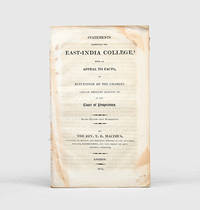
1817ref. 172742London: 1817. Second edition of Malthus's defence of the East-India Company's College at Haileybury his home from 1805-1834 offprinted from The Pamphleteer Vol. IX number XVIII and published the same year as the first. Malthus taught as professor of history and political economy at the East India Company College at Haileybury from its inception to his own death training generations of EIC management. By 1816 the College was attracting criticism both for its virtual monopoly on Indian Civil Service training and for the actual quality of its teaching. A series of student disturbances throughout 1816 provided the immediate occasion for Malthus's defence which outlines a thorough analysis of the College's work as the best solution to the immediate demands of the Indian subcontinent. Octavo. Pp. 469-523 1. Disbound. Light browning and foxing to contents: a very good copy. unknown
1809ref. 013706Washington City: Chew Weightman 1809. First american from the third London edition. Due volumi 13x22 cm di XVI-510-XXXIII pp e VI-542 pagine. Scritta di proprietà datata 5 march 1834 sulle pagine di titolo. Una gora alla metà inferiore del volume nelle prime ed ultime 30 pp del volume 1. Qualche altra brunitura sparsa. Legatura coeva in tutta pelle marmorizzata dorsi lisci con tassello di titolo; qualche usura e abrasioni ai piatti del volume 2 ma nel complesso bell'esemplare di questa prima edizione americana dell'opera di Malthus. Chew Weightman unknown
1817ref. 231696London : John Murray 1817. 1st edition. Hardcover. Contemporary aniline calf over marble boards. Front hinge loose with wear to the spine bands and panel edges. A good copy. Physical description; iv 327 1 p. ; 22 cm. Includes bibliographical references.Subjects; Population.Malthusianism. Population control. Population growth.Referenced by: Kress Lib B.6973. London : John Murray hardcover
1821ref. 23029Boston: Wells and Lilly 1821. First American edition of this landmark work in political economy. Octavo bound in three quarters leather over marbled boards black leather morocco spine label. In near fine condition. In his Principle of Political Economy Malthus was proposing investment in public works and private luxury as a means of increasing effective demand and hence as a palliative to economic distress. The nation he thought must balance the power to produce and the will to consume" DSB. Wells and Lilly hardcover
1986ref. 394863London : W. Pickering 1986. 1st edition. Hardcover. Fine copies in the original gilt-blocked cloth. The set remains particularly well-preserved overall; tight bright clean and strong. Series: The Pickering Masters. Physical description: 8 volumes : facsimiles ; 24 cm. Notes: Reprint of works originally published 1798-1836. Includes bibliographical references and indexes. Edited by E. A. Wrigley and David Souden. Contents: v. 1. An essay on the principle of population 1798 -- v. 2-3. An essay on the principle of population 1826 -- v. 4. Essays on population -- v. 5-6. Principles of political economy -- v. 7. Essays on political economy -- v. 8. Definitions in political economy. Subjects: Malthus T. R. Thomas Robert 1766-1834; Population; Economics; Economics History; Economics Study and teaching; Demography Great Britain. London : W. Pickering hardcover
1817ref. 720P18London: John Murray 1817. First edition. Hardback. Very Good. 9" by 5.5". None. The first edition of this additions volume to Thomas Robert Malthus' immensely influential essay on the issue of growing population. The first edition of this work.This work is Malthus' additions to his influential book 'An Essay on the Principle of Population' added to the fourth and earlier editions.'An Essay on the Principle of Population' is a treatise warning of the future difficulties with a growing population on Earth.The essay was not the first work to be published on population but it was incredibly influential as contributed to the passing of the 1800 Census Act.This addition volume highlights key issues in the original work and expands upon them giving the reader a wider understanding of the issue of population.Written by Thomas Robert Malthus a scholar who is best known for this work and for his influential economics.Bound without publisher's adverts. In the original publisher's marbled paper boards. Externally smart. A small amount of bumping to the head and tail of the spine and to the extremities. A little rubbing to the boards and spine resulting in fading of the marble pattern. Internally firmly bound. Pages are lightly age-toned and generally clean with some scattered spotting. Very Good John Murray hardcover
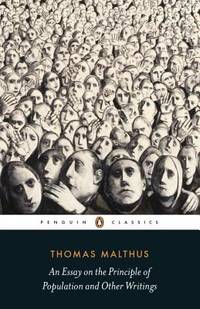
2015ref. SBBI-mon0000150877Penguin Classics 2015. paperback. Good. Our good condition books are generally good for reading but not for gifting or collecting. They could have imperfections such as creasing fanning inscriptions margin notes yellowing staining on edge or cover or pages bumps scuffs etc etc sometimes multiple of these. It's a wide category that encompasses anything that isn't almost-new down to anything that is slightly better than poor. We would NOT recommend gifting Good books - these should be considered reading copies. Our books are dispatched from a Yorkshire former cotton mill. We list via barcode/ISBN so please note that the images are stock images and may not be the exact copy you receive furthermore the details about edition and year might not be accurate as many publishers reuse the same ISBN for multiple editions and as we simply scan a barcode or enter an ISBN we do not check the validity of the edition data when listing. If you're looking for an exact edition please don't order at least not without checking with us first although we don't always have time to check. We aim to dispatch prompty the service used will depend on order value and book size. We can ship to most countries see our shipping policies. Payment is via Abe only. Penguin Classics paperback
1836ref. 1857London: William Pickering. 1836. Second edition "with considerable additions from the author's own manuscript and an original memoir". Richard Cobden's copy with engraved bookplate to the front pastedown for "Dunford Library" Cobden's home incorporating the initials "R. C.". Octavo. Contemporary half diced plum roan over marbled boards the spine ruled in gilt and with titles in gilt. pp. liv 2 446. A very good copy the binding firm albeit with a little cracking to the front hinge heavy rubbing to the boards rubbing to the joints and spine ends and wear to the corners. The contents with some light spotting to the preliminary pages and a minor crease to the bottom corner of a handful of pages are otherwise in very good order throughout. The second expanded edition of this key work of economic theory by Thomas Malthus originally published as a rebuttal to David Ricardo's 'On the Principles of Political Economy and Taxation' in 1820. This subsequent edition was substantially revised by Malthus himself and published posthumously two years after his death in 1834; it also includes the first appearance of William Otter's notable essay regarding his friend's life a "Memoir of Robert Malthus". Malthus had set about editing his Principles almost immediately after it appeared in print incorporating changes both minor and major particularly with regards to the important chapter on value theory building on the work of Adam Smith. Hollander 'The Economics of Thomas Robert Malthus' p. 4. An interesting association copy coming from the library of the contemporary radical politician campaigner for free trade and co-founder of the Anti-Corn Law League Richard Cobden 1804-1865. Provenance: From the library of Richard Cobden at his home Dunford House. London: William Pickering. hardcover