Thomas Robert MalthusBiblio.com

576 résultats
réf. 59115Norwalk Connecticut: Easton Press. Collector's Edition. Full Leather. As New. 24 x 16 cm. Octavo. Bound in full black leather with gilt design and lettering. 6 raised bands to spine. Still in original shrink wrap. Easton Press unknown
réf. BN320183Cambridge University Press. An Essay on the Principle of Population: Volume 1 An Essay on the Principle of Population: Volume 1 T. R. Malthus Cambridge University Press unknown
réf. BN417628Forgotten Books. Eine Abhandlung Über das Bevölkerungsgesetz oder eine Untersuchung Seiner Bedeutung für die Menschliche Wohlfahrt in Vergangenheit und Zukunft Vol. . Beseitigung oder Linderung der Übel di Eine Abhandlung Über das Bevölkerungsgesetz oder eine Untersuchung Seiner Bedeutung für die Menschliche Wohlfahrt in Vergangenheit und Zukunft Vol. . Beseitigung oder Linderung der Übel di Malthus Thomas Robert Forgotten Books unknown
1977réf. BN415541dtv Verlagsgesellschaft 1977. 1977. Das Bevölkerungsgesetz. Thomas Robert Malthus. Hrsg. u. übers. von Christian M. Barth Das Bevölkerungsgesetz. Thomas Robert Malthus. Hrsg. u. übers. von Christian M. Barth Malthus Thomas Robert. dtv Verlagsgesellschaft unknown
2008réf. BN179356Cambridge University Press 2008. 2008. Softcover. T. R. Malthus T. R. Malthus Pullen Thomas Robert Malthus Cambridge University Press paperback
2018réf. BN228732WENTWORTH PR 2018. 2018. Softcover. Eine Abhandlung Über Das Bevölkerungsgesetz Oder Eine Untersuchung Seiner Bedeutung Für Die Menschliche Wohlfahrt in Vergangenheit Und Zukunft . Eine Abhandlung Über Das Bevölkerungsgesetz Oder Eine Untersuchung Seiner Bedeutung Für Die Menschliche Wohlfahrt in Vergangenheit Und Zukunft . Thomas Robert Malthus WENTWORTH PR paperback
réf. 12217590-nnew. unknown
réf. 5705271-nnew. unknown
réf. 5705272-nnew. unknown
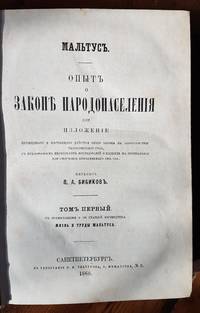
1868réf. 178Scarce first Russian edition of a major landmark of economic literature the Essay on the Principle of Population first published in English in 1798. With much added material. The translator P. A. Bibikov was a historian philosopher and literary critic who had already translated Smith's Wealth of Nations in 1866. With this background he added a wealth of material to this edition making it more than just a translation but also an a posteriori analysis. Next to the 80 pages on Malthus' life and works Bibikov added in a rich appendix translations of foreign commentators as well as his own footnotes relating to Russia. Very interestingly he updated and commented the many pages Malthus had already devoted to the Russian case. The appendix includes texts by Townsend Garnier Chernyshevskiy and Prudhon as well as a convenient 20-pp. alphabetical index. "The central idea of the essay - and hub of the Malthusian theory - was a simple one. If the natural increase in population occurs the food supply becomes insufficient and the size of the population is checked by 'misery' - that is the poorest sections of the community suffer disease and famine. Malthus recognises two other possible checks to population expansion: first 'vice' - that is homosexuality prostitution and abortion all totally unacceptable to Malthus; and second 'moral restraint' - the voluntary limitation of the product of children by the postponement of marriage." PMM. Provenance: Unidentified symbolistic booklabel to upper endpapers; small Baltic bookseller's stamps to lower endpapers. Physical description:Two volumes 8vo. 476 pp. incl. half-title title and table of contents at end; 468 pp. incl. table of contents. Later plain brown cloth author titled in ink on the spines. Condition:Very occasional light spotting. Glazunov, Skt. Peterburg, hardcover
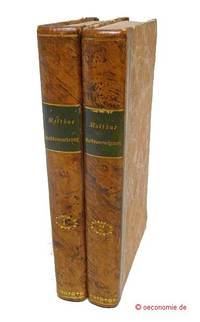
réf. 12420:1Altona bei J. F. Hammerich 1807. XVI 368; VIII 358 S. 1 S. Verbesserungen 2 Bde. HLdr. . -- Borst 819. Carpenter; Bestsellers XXXII 5. Humpert 13008. Kress B.5222. - "An Essay On The Principle Of Population." London 1806 - Erste deutsche Ausgabe. Altona, bei J. F. Hammerich, 1807. unknown
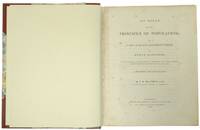
1803réf. 31325London Printed for J. Johnson by T. Bensley 1803. Large 4to. Later brown hcalf with four raised bands single gilt lines and red leather title-label to spine. First three and last 14 leaves a bit brownspotted title-page and last two leaves marginally repaired at hinge otherwise a very nice clean and solid copy. VIII 4 610 pp. The Great Quarto-edition of Malthus' milestone work the first and most influential book on population. Although being the second edition after the anonymously printed first of 1798 it is so significantly altered revised and expanded that it is considered a new work rather than a new edition. Malthus himself also thought of it as such. It is nearly four times the length of the 1798 essay the title has been changed the title of the first: "An Essay on the Principle of Population as it Affects the Future Improvement of Society with Remarks on the Speculation of Mr. Godwin M. Condorcet and Other Writers" and it is published with Mathus' name as the author not anonymously. All later editions were minor revisions of this heavily expanded and altered second one. "In the course of this inquiry I found that much more had been done than I had been aware of when I first published the essay. The poverty and misery arising from a too rapid increase of population had been distinctly seen and the most violent remedies proposed so long ago as the times of Plato and Aristotle. And of late years the subject had been treated in such a manner by some of the French economists occasionally by Montesquieu and among our own writers by Dr. Franklin Sir James Steuart Mr. Arthur Young and Mr. Townsend as to create a natural surprise that it had not excited more of the publick attention" Preface to the second edition p. IV. The controversial views because of which the work became so influential are most provocative and eyeopening in the second edition in which Malthus for instance for the first time advocates moral restraint meaning sexual abstinence and late marriage and elaborately explains his comparison between the increase of population and food. "The "Essay" was highly influential in the progress of thought in the early nineteenth-century Europe. "Parson" Malthus as Cobbett dubbed him was for many a monster and his views were often grossly misinterpreted. But his influence on social policy whether for good or evil was considerable. The Malthusian theory of population came at the right time to harden the existing feeling against the Poor Laws and Malthus was a leading spirit behind the Poor Law Amendment Act of 1834." PMM 251. Thomas Robert Malthus 1766-1834 called the "enfant terrible" of the economists was an English demographer statistician and political economist who is best known for his groundbreaking views on population growth presented in his "Essays on the Principle of Population" which is based on his own prediction that population would outrun food supply causing poverty and starvation. Among other things this caused the legislation which lowered the population of the poor in England. Malthus actually turned political economic and social thought upside down with this work which has caused him to be considered one of the 100 most influential persons in history Hart The 100: A Ranking of the most Influential Persons in History 1978. Malthus was naturally condemned by Marx and Engels and opposed by the socialists universally but the work had an enormous impact on not only politics economics and social sciences but also on natural sciences. For instance both Darwin and Wallace considered Malthus a main source in their development of the theory of natural selection considering him a great philosopher and his Essay on Population one of the most important books ever. "Malthus’s idea of man’s "Struggle for existence" had decisive influence on Charles Darwin and the theory of evolution. Other scientists related this idea to plants and animals which helped to define a piece of the evolutionary puzzle. This struggle for existence of all creatures is the catalyst by which natural selection produces the "survival of the fittest". Thanks to Malthus Darwin recognised the significance of intraspecies competition between populations of the same species e.g. the lamb and the lamb not just interspecies competition between species e.g. the lion and the lamb. Malthusian population thinking also explained how an incipient species could become a full-blown species in a very short timeframe." The second edition must be considered the most important of all the editions. This is far more a work on the problems of over-population than it is a response to Godwin and Condorcet on their works whic is the main concern of the first edition. "Not so much shocked by his own conclusions in his "Essay on Population" first ed. 1798 as driven by a naturally inquiring mind he travelled for three years through Europe gleaning statistics and then published a second edition 1803." Catlin A History of the Political Philosophers 1939 p. 377. PMM 251 first edition. hardcover
1934réf. P-14581London: Royal Statistical Society 1934. Hardcover. Fine/First Edition. Octavo. Presentation copy from the President Lord Meston with slip laid in. With an account of Malthus' role in founding the Society. A superb copy. Royal Statistical Society hardcover
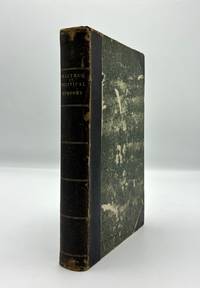
1836réf. 1857London: William Pickering. 1836. Second edition "with considerable additions from the author's own manuscript and an original memoir". Richard Cobden's copy with engraved bookplate to the front pastedown for "Dunford Library" Cobden's home incorporating the initials "R. C.". Octavo. Contemporary half diced plum roan over marbled boards the spine ruled in gilt and with titles in gilt. pp. liv 2 446. A very good copy the binding firm albeit with a little cracking to the front hinge heavy rubbing to the boards rubbing to the joints and spine ends and wear to the corners. The contents with some light spotting to the preliminary pages and a minor crease to the bottom corner of a handful of pages are otherwise in very good order throughout. The second expanded edition of this key work of economic theory by Thomas Malthus originally published as a rebuttal to David Ricardo's 'On the Principles of Political Economy and Taxation' in 1820. This subsequent edition was substantially revised by Malthus himself and published posthumously two years after his death in 1834; it also includes the first appearance of William Otter's notable essay regarding his friend's life a "Memoir of Robert Malthus". Malthus had set about editing his Principles almost immediately after it appeared in print incorporating changes both minor and major particularly with regards to the important chapter on value theory building on the work of Adam Smith. Hollander 'The Economics of Thomas Robert Malthus' p. 4. An interesting association copy coming from the library of the contemporary radical politician campaigner for free trade and co-founder of the Anti-Corn Law League Richard Cobden 1804-1865. Provenance: From the library of Richard Cobden at his home Dunford House. London: William Pickering. hardcover
réf. 45169270-6Used - Very Good. Former library copy. Pages intact with possible writing/highlighting. Binding strong with minor wear. Dust jackets/supplements may not be included. Includes library markings. Stock photo provided. Product includes identifying sticker. Better World Books: Buy Books. Do Good. unknown
réf. 6371905267Cambridge University Press CUP . Papeback. New. pp. 420 Cambridge University Press CUP unknown
réf. DADAX0521178630New unknown
2008réf. SONG0521071348Cambridge University Press 2008-09-04. Reissue. paperback. Used: Good. 6.00x1.16x9.00. Buy with confidence. Excellent Customer Service & Return policy. Cambridge University Press paperback
2011réf. SONG052118410XCambridge University Press 2011-02-17. paperback. Used: Good. 6.00x0.82x9.00. Buy with confidence. Excellent Customer Service & Return policy. Cambridge University Press paperback
1986réf. C66294London: Pickering 1986. First Edition Thus. Hardback. No Dust Jacket. Hardback Hardcover. Fine. First Edition Thus. Hardback. No Dust Jacket. 8vo. pp 139. Original publisher's burgundy cloth lettered gilt at the spine. Volume 1 only. First published in 1798. ISBN: 1851960015 Fine. Pickering, hardcover
2015réf. SBBI-mon0000150877Penguin Classics 2015. paperback. Good. Our good condition books are generally good for reading but not for gifting or collecting. They could have imperfections such as creasing fanning inscriptions margin notes yellowing staining on edge or cover or pages bumps scuffs etc etc sometimes multiple of these. It's a wide category that encompasses anything that isn't almost-new down to anything that is slightly better than poor. We would NOT recommend gifting Good books - these should be considered reading copies. Our books are dispatched from a Yorkshire former cotton mill. We list via barcode/ISBN so please note that the images are stock images and may not be the exact copy you receive furthermore the details about edition and year might not be accurate as many publishers reuse the same ISBN for multiple editions and as we simply scan a barcode or enter an ISBN we do not check the validity of the edition data when listing. If you're looking for an exact edition please don't order at least not without checking with us first although we don't always have time to check. We aim to dispatch prompty the service used will depend on order value and book size. We can ship to most countries see our shipping policies. Payment is via Abe only. Penguin Classics paperback
réf. 6100890702Other. New. pp. ix 396 unknown
réf. 697393041Cosimo Incorporated . Papeback. New. pp. 610 Cosimo, Incorporated unknown
1998réf. DADAX0521581389Cambridge University Press 1998-02-13. hardcover. New. 6.50x0.75x9.50. Buy with confidence. Excellent Customer Service & Return policy. Cambridge University Press hardcover