MALTHUS, Thomas RobertBiblio.com
594 résultats
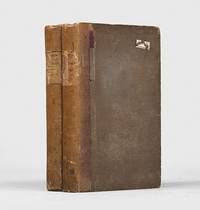
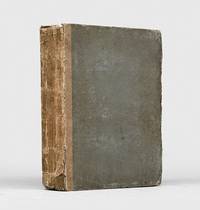
1803réf. 156812London: printed for J. Johnson by T. Bensley 1803. A classic of economic thought significantly expanded The Great Quarto edition notionally the second edition of the Essay on Population published in 1798 but so substantially enlarged rewritten and re-titled as to be a new book. "In 1803 Malthus published a greatly expanded second edition of the Essay incorporating details of the population checks that had been in operation in many different countries and periods. Although nominally a second edition it was regarded by Malthus as a substantially new work. He did not claim originality for the idea that population tends to outrun the food supply. In the preface to the second edition he stated that in writing the first edition he had deduced the principle of population from the writings of David Hume Robert Wallace Adam Smith and Richard Price but that in the intervening period he had become aware that much more had been published on the subject. He nevertheless believed that even more remained to be done especially in describing the means by which populations are checked and in drawing out the practical implications of the principle of population. In the second edition he made clear what was only implicit in the first that prudential restraint should if humanly possible be 'moral restraint' - that is delayed marriage accompanied by strictly moral pre-marital behaviour although he admitted that moral restraint would not be easy and that there would be occasional failures. Whereas in the first edition he had said that all the checks to population would involve either misery or vice in the second edition he attempted to lighten this 'melancholy hue' Essay on the Principle of Population 1st edition 1798 p. iv and 'to soften some of the harshest conclusions of the first essay' 2nd edition 1803 p. vii by arguing that moral restraint if supported by an education emphasizing the immorality of bringing children into the world without the means of supporting them would tend to increase rather than diminish individual happiness" ODNB. Quarto. Uncut in the original boards manuscript lettering to spine. Housed in a custom solander box with red label. Neat 20th-century ownership label to front pastedown. Joints and corners worn some expert reconsolidation to binding horizontal tear to head of title neatly repaired without loss and short vertical tear to lower margin of the same; a very good copy. Einaudi 3668; Goldsmiths' 18640; Kress B.4701. hardcover
1890réf. 226775London: Ward Lock & Co. Limited 1890. Hardcover. Very Good/No Jacket. Hardcover; large 8vo; 614 pages. Scarce in this edition. Dark red cloth with gilt on spine textured cloth. Rubbed edges. Clean dark blue endpapers. "1890" in pen on title page some small pen marks in very few margins. Bright and clean interior. VG/-- Ward, Lock & Co., Limited hardcover
réf. 1584777281.Ghardcover. Good. Access codes and supplements are not guaranteed with used items. May be an ex-library book. hardcover
1992réf. 54027Norwalk CT: Easton Press 1992. Collector's Edition. Leather bound. Very good. 392 pp. Octavo. 24 cm. Bound in navy leather with elaborate gilt ornamentation to covers and spine. All edges gilt. Gilt title stamped into spine with raised bands. Gold satin ribbon page marker laid in. Unused bookplate issued by publisher included. Corners slightly scuffed. Some scratching to gilt edges. Becoming increasingly more relevant Malthus' theories of economics outline the ways in which population exponentially increases while resources cannot creating chaos for the future of the human race. Easton Press unknown
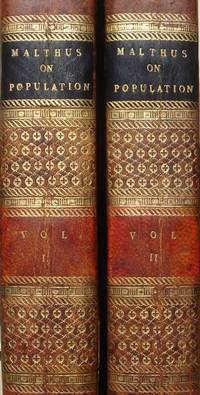
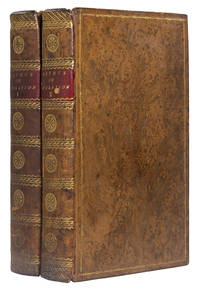
1718réf. 149970London: John Murray Eden: London J. Wright 1817 Eden: 1800. An excellent copy in contemporary calf Fourth edition of Malthus's Essay first published in 1798 one of the most important and influential works in the history of economic thought and the foundation text of modern demography. The second volume is appended with the first edition of Frederick Morton Eden's An Estimate of the Number of Inhabitants in Great Britain an appropriate pairing by the contemporary owner - Eden's population census preceded the first national decennial population census by a year but undershot the official figure by five million. It nonetheless marks like Malthus's Essay an important milestone in the study of population. Two works bound in 2 vols octavo 210 x 128 mm. Bound without half-titles. Contemporary sprinkled calf orange and dark green morocco labels gilt in compartments gilt roll border to covers blind serrated turn-ins marbled endpapers brown speckled edges. Contemporary ownership signature of Thomas Entwisle to title pages later small ink notation to front free endpapers versos. Minor patch of abrasion to rear cover of vol. I joints just beginning to split but holding firm light browning to Eden else contents fresh. An excellent copy. unknown
1807réf. 52022HANDSOME COPY IN CONTEMPORARY BOLDLY SPECKLED CALF 2 vols. tall 8vo. iii-xvi 580; iii-viii 484 58 indexpp. contemporary boldly speckled calf smooth spines richly decorated in gilt in panels using two different designs black lettering and russet numbering labels gilt board edges gilt rolled spines a trifle chaffed at headbands some cracking at ends of some joints but overall a very nice copy. Near contemporary pencilled shelf number "D198" of Lord Dunraven of Adare Manor Co. Limerick on endpaper. KRESS B5219 This is edition incorporates the substantial revisions and additions which Malthus had made for his third edition of 1806. They are listed and described in full in his preliminary 'Advertisement' to that edition also printed here. The most substantial of the changes made was that "The chapters which were the fourth and sixth of the second book are nearly rewritten on account of an error into which the author had fallen in an attempt to estimate the fruitfulness of marriages and the number born living to be married from the data in registers" 'Advertisement'. Furthermore he added as an appendix here vol.2 p.429-484 his important Reply to the Chief Objections to the second edition of 1803. This appendix he had also published separately in quarto "for the accomodation of the purchasers of the former edition" 'Advertisement'.Malthus recommends that "those who have not the leisure or inclination to read the entire work will find in the appendix such notice of its most prominent arguments as will give them a good general idea of the aim and bent of the whole". In it he writes "My object is to correct some of the misrepresentations which have gone abroad respecting two or three of the most important points of the Essay. . The first grand objection that has been made to my principles is that they contradict the original command of the Creator to increase and multiply and replenish the earth . The next grand objection which has been urged against me is my denial of the right of the poor to support. . and lastly and rather a matter of feeling than of argument. Many persons have accused him of excessive pessimism in throwing a darker shade over our views of human nature and tending particularly to narrow our prospects of future improvement". All of these objections he attempts to refute. From the library of Edwin R. W. Wyndham-Quin Viscount Adare F.R.S. of Adare Manor Co. Limerick. Printed for J. Johnson .. by T. Bensley hardcover
réf. 1346187452.Ghardcover. Good. Access codes and supplements are not guaranteed with used items. May be an ex-library book. hardcover
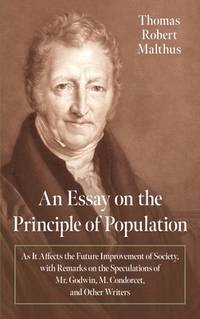
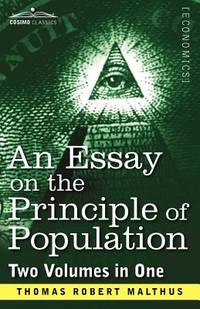
2011réf. x-1616405708Cosimo Inc 2011. Paperback. New. 610 pages. 8.43x5.51x1.57 inches. Cosimo Inc paperback
1983réf. Q-014043206XPenguin Classics 1983-06-30. Paperback. New. In shrink wrap. Looks like an interesting title! Penguin Classics paperback
1999réf. Q-0192837478Oxford University Press 1999-11-11. Paperback. New. New. In shrink wrap. Looks like an interesting title! Oxford University Press paperback
réf. 1680922580.Gpaperback. Good. Access codes and supplements are not guaranteed with used items. May be an ex-library book. paperback
2008réf. Q-0199540454Oxford University Press 2008-08-01. Paperback. New. In shrink wrap. Looks like an interesting title! Oxford University Press paperback
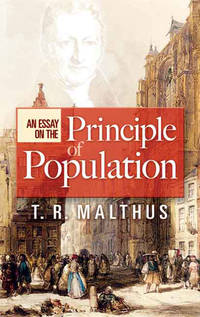
2007réf. Q-0486456080Dover Publications 2007-07-30. Paperback. New. In shrink wrap. Looks like an interesting title! Dover Publications paperback
réf. 104064London T. Bensley for J. Johnson 1806. . Third edition 2 vols 8vo xvi 501 63; vii 559 pp. contemporary tree calf gilt red morocco labels some pale foxing a very good set. The first two-volume edition. Contains important additions and corrections to the earlier editions including replies to his critics. 'The central idea of the essay -- and the hub of Malthusian theory -- was a simple one. The population of a community Malthus suggested increases geometrically while food supplies increased only arithmetically. If the natural increase in population occurs the food supply becomes insufficient and the size of the population is checked by 'misery' -- that is the poorest sections of the community suffer disease and famine. The Essay was highly influential in the progress of thought in early nineteenth-century Europe' PMM. 'His work was an important influence on both Darwin and Wallace in their formulation of the concept of natural selection. It also had a profound influence on the decrease in size of families down to the present time' Garrison-Morton. Garrison-Morton 1693; Goldsmiths' 19210; Kress B5067; Cf. PMM 251. London, T. Bensley for J. Johnson, 1806. unknown
1826réf. 149989London: John Murray 1826. The definitive text in original boards Sixth edition the final lifetime edition and the definitive text with Malthus's final revisions marking a significantly expanded and amended text from the first edition of 1798. The Essay is one of the most important and influential works in the history of economic thought and the foundation text of modern demography. 2 vols octavo. Original purple cloth-backed drab grey paper boards printed spine labels. Ownership signature dated 1882 to front free endpaper old price label to front cover of vol. II. Spines lightly sunned label of vol. II chipped with loss paper covering on front cover of vol. II peeling around front joint tips a little worn light foxing partly unopened. A very good copy. hardcover
1798réf. 116955London: J. Johnson 1798. First edition of this cornerstone text of modern economics. Octavo bound in three quarters calf. Laid in is a clipping from an original manuscript signed by Malthus and entirely in his hand which reads in part "If at one time such a given product would make an effectual demand for certain commodities the conditions of the supply of which are supposed to remain the same it would immediately cease to make such effectual." Signed by Malthus in the lower right corner "Malthus." The verso features two further partial lines of text relating to supply and demand. In near fine condition. First editions of Malthus' magnum opus are exceptionally scarce. “Malthus was one of the founders of modern economics. His Essay was originally the product of a discussion on the perfectibility of society with his father who urged him to publish. Thus the first edition published anonymously was essentially a fighting tract but later editions were considerably altered and grew bulkier as Malthus defended his views against a host of critics… The Essay was highly influential in the progress of thought in early 19th-century Europe and his influence on social policy was considerable… Both Darwin and Wallace clearly acknowledged Malthus as a source of the idea of ‘the struggle for existence” PMM 251. J. Johnson unknown
1807réf. 314917London: Printed for J. Johnson in St. Paul's Church-Yard by T. Bensley 1807. Fourth edition. 2 vols. 8vo. Contemporary mottled calf marbled edges. Rebacked in gilt calf one hinge tender. Fourth edition. 2 vols. 8vo. Malthus is as controversial as he is influential. "The central idea of the essay . was a simple one. The population of a community . increases geometrically while food supplies increase only arithmetically. If the natural increase in population occurs the food supply becomes insufficient and the size of the population is hecked by 'misery'" PMM. PMM 251 first edition; Kress 5219 Printed for J. Johnson in St. Paul's Church-Yard, by T. Bensley unknown
réf. Z1-S-008-02812W. Pickering. Used - Good. Volume Three. Part II. Ships from UK in 48 hours or less usually same day. Your purchase helps support Sri Lankan Children's Charity 'The Rainbow Centre'. Ex-library so some stamps and wear but in good overall condition. 100% money back guarantee. We are a world class secondhand bookstore based in Hertfordshire United Kingdom and specialize in high quality textbooks across an enormous variety of subjects. We aim to provide a vast range of textbooks rare and collectible books at a great price. Our donations to The Rainbow Centre have helped provide an education and a safe haven to hundreds of children who live in appalling conditions. We provide a 100% money back guarantee and are dedicated to providing our customers with the highest standards of service in the bookselling industry. W. Pickering unknown
1817réf. 71430Volume I xvi 496 pages. Volume II iv 507 pages. Volume III iv 500 pages. Published by John Murray hardcover
1807réf. 85583J. Johnson in St. Paul's Church Yard 1807. Hardcover. Very Good. 1807 2 volume set full leather bindings 4th edition London. Bookplates to front pastedowns both volumes. Volume one shows borer damage to margins not to text. Also shows contemporary ownership ink to title. Text is unmarked bindings are tight. Spines are sunfaded. oversized and overweight. Please email for photos. J. Johnson in St. Paul's Church Yard hardcover
1817réf. 51078London John Murray 1817. 8vo. Bound in three nice uniform contemporary half calf with five raised bands and gilt lettering to spine. Spines with wear. Front board and spine detached from book-block on volume 1. Ex-libris pasted on to pasted down front free end-paper on all three volumes. A fine set. The fifth edition of this political and economic classic which constitutes Malthus' first major publication and his main work because of which he is considered the father of demography and one of the main sources of inspiration for Darwin and Wallace.This present fifth edition contain several important additions price of grain and the third chapter of Book III was completely rewritten. The book then as now is considered highly controversial and it has influenced all demographers ever since as well as being of immense importance to the study of economic theory and genetic inheritance. "The "Essay" was highly influential in the progress of thought in the early nineteenth-century Europe. "Parson" Malthus as Cobbett dubbed him was for many a monster and his views were often grossly misinterpreted. But his influence on social policy whether for good or evil was considerable. The Malthusian theory of population came at the right time to harden the existing feeling against the Poor Laws and Malthus was a leading spirit behind the Poor Law Amendment Act of 1834." PMM 251.Thomas Robert Malthus 1766-1834 called the "enfant terrible" of the economists was an English demographer statistician and political economist who is best known for his groundbreaking views on population growth presented in his "Essays on the Principle of Population" which is based on his own prediction that population would outrun food supply causing poverty and starvation. Among other things this caused the legislation which lowered the population of the poor in England. Malthus actually turned political economic and social thought upside down with this work which has caused him to be considered one of the 100 most influential persons in history Hart The 100: A Ranking of the most Influential Persons in History 1978. Of course he was condemned by Marx and Engels and opposed by the socialists universally but the work was of immense impact on not only politics economics social sciences etc but also on natural sciences. "Later in the "Origin of Species" he Darwin wrote that the struggle for existence "is the doctrine of Malthus applied with manifold force to the whole animal and vegetable kingdoms; for in this case there can be no artificial increase of food and no prudential restraint from marriage" p. 63. Alfred Russel Wallace who arrived at a worked-out formulation of the theory of evolution at almost precisely the same time as Darwin acknowledged that "perhaps the most important book I read was Malthus's "Principles of Population" My Life p. 232. Although there were four decennial censuses before Malthus' death he did not himself analyze the data although he did influence Lambert Quetelet and Pierre Verhulst who made precise statistical studies on growth of populations in developed countries and showed how the early exponential growth changed to an S curve." DSB IX p. 69. As Malthus realized that his theories were not satisfactorily presented or sufficiently demonstrated in the first edition from 1798 he travelled for three years through Europe gleaning statistics and then published the second edition in 1803. Among other places he travelled through Northern Germany and his detailed diaries of these journeys provided him with some of the evidence necessary for the development of his theory on population growth. The observational information that he gathered on his travels in Europe were crucial to the development of his theories which also means that the work is of great interest for other European countries and not only Britain. "In 1819 the Royal Society elected Malthus to a fellowship. He was also a member of the French Institute and the Berlin Academy and a founding member of the Statistical Society 1834." DSB IX p. 67. Printing and the Mind of Man 251 first edition. Einaudi 3670Mattioli 2210Goldsmith 21761Kress B6974 hardcover
1701réf. 1508040041John Murray 1817-01-01. 5th. Hardcover. Acceptable. 2 volumes of 3. Vol. 1 and 3 only. 1/4 contemporary leather over marbled boards. Boards detached. 22 cm. 5th edition with important additions. John Murray hardcover
1806réf. 236862London: Printed for T. Johnson 1806. Third edition. xvi 505 1 blank 60 index pp.; vii 1 blank 559 1 pp. 2 vols. 8vo. Contemporary three-quarter calf; joints cracked two boards detached; rubbed and scuffed; scattered foxing throughout; withal a good serviceable copy. Third edition. xvi 505 1 blank 60 index pp.; vii 1 blank 559 1 pp. 2 vols. 8vo. GERITS: Third edition the first to be published in 2 volumes and the first published after the Great Quarto edition of 1803 of one of the most important and influential books in the history of economic thought. The third edition contained numerous revisions among which was a text entitled A Reply to the Chief Objections which have been urged against the Essay on the Principle of Population which was also published separately so that it might be bound with earlier ones. Kress B.5067; Goldsmiths 19210; Einaudi 3669; Carpenter Economic Bestsellers XXXII 3; PMM 251 for the first edition; Blaug Great Economists before Keynes p. 141ff Printed for T. Johnson unknown
2011réf. SONG1616405708Cosimo Classics 2011-12-01. paperback. Used: Good. 5.50x1.35x8.50. Buy with confidence. Excellent Customer Service & Return policy. Cosimo Classics paperback
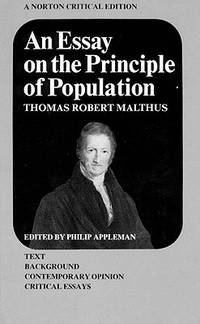
1976réf. 56124W. W. Norton & Company Inc. . As New. Paperback. FREE UPGRADE to Courier/Priority Shipping Upon Request – – IN STOCK AND IMMEDIATELY AVAILABLE FOR SHIPMENT - AS NEW THE TEXT BLOCK IS PRISTINE CLEAN UNMARKED AND IN EXCELLENT CONDITION - appears unread - 260 pages. -- with a bonus offer-- . 1976. 039309202X . W. W. Norton & Company Inc. paperback