Malthus, T RBiblio.com

596 résultats
1998réf. DADAX0521581389Cambridge University Press 1998-02-13. hardcover. New. 6.50x0.75x9.50. Buy with confidence. Excellent Customer Service & Return policy. Cambridge University Press hardcover
2008réf. DADAX0521075939Cambridge University Press 2008-09-04. 1. paperback. New. 6.00x1.29x9.00. Buy with confidence. Excellent Customer Service & Return policy. Cambridge University Press paperback
2008réf. DADAX0521071321Cambridge University Press 2008-09-04. 1. paperback. New. 6.00x1.01x9.00. Buy with confidence. Excellent Customer Service & Return policy. Cambridge University Press paperback
2011réf. DADAX0521187478Cambridge University Press 2011-02-17. 1. paperback. New. 6.00x0.38x9.00. Buy with confidence. Excellent Customer Service & Return policy. Cambridge University Press paperback
2011réf. DADAX052118410XCambridge University Press 2011-02-17. paperback. New. 6.00x0.82x9.00. Buy with confidence. Excellent Customer Service & Return policy. Cambridge University Press paperback
2004réf. DADAX0521588715Cambridge University Press 2004-07-19. hardcover. New. 6.25x1.00x9.25. Buy with confidence. Excellent Customer Service & Return policy. Cambridge University Press hardcover
2008réf. DADAX0521075912Cambridge University Press 2008-09-04. 1. paperback. New. 6.00x1.70x9.00. Buy with confidence. Excellent Customer Service & Return policy. Cambridge University Press paperback
2008réf. SONG0521075939Cambridge University Press 2008-09-04. 1. paperback. Used: Good. 6.00x1.29x9.00. Buy with confidence. Excellent Customer Service & Return policy. Cambridge University Press paperback
2011réf. SONG052118410XCambridge University Press 2011-02-17. paperback. Used: Good. 6.00x0.82x9.00. Buy with confidence. Excellent Customer Service & Return policy. Cambridge University Press paperback
1997réf. 446740Cambridge : Cambridge University Press 1997. First Edition. Hardcover. Maggs Bros. manuscript note regarding the collection's provenance to front free end paper. Fine cloth copy in a near-fine very slightly edge-dulled dust wrapper. Remains particularly well-preserved overall; tight bright clean and strong. Physical description; xxiv140 p 24 cm. Notes; English text with English and Japanese preface. Subjects; Malthus T. R. Thomas Robert 1766-1834 Correspondence. Population. Economists Great Britain. Correspondence. Economics. History. Religion. Cambridge : Cambridge University Press hardcover
1807réf. 185282London: Printed for Longman Hurst Rees and Orme 1807. Though his theories were so cruel his heart and manners were most kindly and courteous Second edition presented and inscribed by Thomas Malthus: "East India College Awarded to Mr John Trotter at the Public Examination of December 1817 as the first of his Class in Political Economy T. Rob. Malthus". Malthus taught as professor of history and political economy at the East India Company College at Haileybury from 1805 to his death in 1834 training generations of EIC management. Writing many years later a former student recalled "We called him Pop; not in derision for we had a great but rather distant respect for him. Though his theories were so cruel his heart and manners were most kindly and courteous" quoted in Maureen Alexander Turner p. 54. John Trotter 1800-1825 entered the college in 1816 and subsequently joined the EIC; he died seven years later aboard the Royal George just off Penang in Malaya which was then an EIC port. Trotter was the son of Alexander Trotter d. 1842 the financially imaginative paymaster of the Royal Navy. His engraved armorial bookplate is in both volumes; Malthus's ink inscription is on the front free endpaper verso. The History of the Anglo-Saxons by Sharon Turner 1768-1847 was originally published from 1799 to 1805. It quickly became "a powerful influence on historical thought for the succeeding half-century" ODNB and remains acknowledged as a turning point in Anglo-Saxon studies and a benchmark in historiography. Writing with a clear eye on the British Empire of his own day - in which Trotter's East India Company played so prominent a role - Turner presents the Anglo-Saxons as central to the historical development that set England on its imperial course. 2 vols quarto 271 x 213 mm pp. x 499 1; viii 472 8. Large hand-coloured engraved folding map by Neele showing "Territory inhabited by the Ancient Saxons north of the Elbe" as frontispiece of vol. I. Contemporary calf rebacked spines ruled and lettered in gilt covers with double-rule panel in gilt crest of the East India Company College blocked in gilt to centre turn-ins in blind marbled endpapers edges sprinkled in brown and red. Light rubbing extremities neatly restored infrequent damp staining to otherwise clean contents short closed tear to inner margin of folding map: just about a very good copy. Maureen Alexander Turner The Educational Ideas and Influence of Thomas Robert Malthus 1766-1834 University of Glasgow Department of Education PhD thesis 1991. unknown
réf. 1169181341.Ghardcover. Good. Access codes and supplements are not guaranteed with used items. May be an ex-library book. hardcover
réf. 79636Urbana University of Illinois Press 1980. Gr.8° XXIX 686 XVIII S. Brosch. Einband gebrauchsspurig Kanten tlw. berieben Stempel a. Innendeckel innen sonst tadellos. 010 Urbana, University of Illinois Press, 1980 unknown
réf. 0267285485.Ghardcover. Good. Access codes and supplements are not guaranteed with used items. May be an ex-library book. hardcover
réf. 1162254408.Ghardcover. Good. Access codes and supplements are not guaranteed with used items. May be an ex-library book. hardcover
1966réf. 106186London:: Cambridge University Press. Very Good in Very Good dust jacket. 1966. Hardcover. Edited by Patricia James. First edition thus. Previous owner's book-plate on front paste-down else very good in a very good price clipped dust jacket. . Cambridge University Press, hardcover
1966réf. 200571Cambridge at the University Press 1966. Hardcover. Very good plus condition with text clean & binding sound / price clipped & chipped dust jacket. 316pp. plus fold-out geneology. Cambridge at the University Press hardcover
1986réf. 394863London : W. Pickering 1986. 1st edition. Hardcover. Fine copies in the original gilt-blocked cloth. The set remains particularly well-preserved overall; tight bright clean and strong. Series: The Pickering Masters. Physical description: 8 volumes : facsimiles ; 24 cm. Notes: Reprint of works originally published 1798-1836. Includes bibliographical references and indexes. Edited by E. A. Wrigley and David Souden. Contents: v. 1. An essay on the principle of population 1798 -- v. 2-3. An essay on the principle of population 1826 -- v. 4. Essays on population -- v. 5-6. Principles of political economy -- v. 7. Essays on political economy -- v. 8. Definitions in political economy. Subjects: Malthus T. R. Thomas Robert 1766-1834; Population; Economics; Economics History; Economics Study and teaching; Demography Great Britain. London : W. Pickering hardcover
réf. 1017662444.Ghardcover. Good. Access codes and supplements are not guaranteed with used items. May be an ex-library book. hardcover
réf. 1017616892.Ghardcover. Good. Access codes and supplements are not guaranteed with used items. May be an ex-library book. hardcover
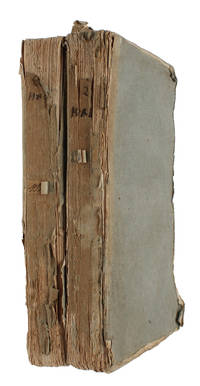
1807réf. 60615Altona J.F. Hammerich 1807. 8vo. 2 volumes both uncut in the original blank wrappers. Wear to extremities front wrapper on vol. 1 detached and with tear. Missing ab. half of the paper on spines. Internally fine and clean. XVI 368; VIII 358 1 pp. Rare first German edition of this political and economic classic which constitutes Malthus' first major publication and his main work because of which he is considered the father of demography and one of the main sources of inspiration for Darwin and Wallace. It is the first translation of the "Principle on Population" into any language and it influenced German politics tremendously.The first edition was printed anonymously in London in 1798 and in 1803 the second edition which also according to Malthus himself can be said to constitute a new work appeared; -the great quarto edition from 1803 is thoroughly revised and much enlarged the title has been changed and Malthus' name appears on the title-page for the first time it is on this edition that all the preceding editions are based and in consequence also the early translations. All the later editions were minor revisions of the second one. In 1806 the third edition appeared and as soon as 1807 the first German one which is translated from the revised third edition "Die gegenwärtige Uebersetzung ist nach der dritten Ausgabe Oktav London 1806. Die Quartausgabe ist minder vollständig" Vorwort p. V. New revisions of the text kept appearing till the sixth edition in 1826. The book then as now is considered highly controversial and it has influenced all demographers ever since as well as being of immense importance to the study of economic theory and genetic inheritance. "The "Essay" was highly influential in the progress of thought in the early nineteenth-century Europe. "Parson" Malthus as Cobbett dubbed him was for many a monster and his views were often grossly misinterpreted. But his influence on social policy whether for good or evil was considerable. The Malthusian theory of population came at the right time to harden the existing feeling against the Poor Laws and Malthus was a leading spirit behind the Poor Law Amendment Act of 1834." PMM 251.Thomas Robert Malthus 1766-1834 called the "enfant terrible" of the economists was an English demographer statistician and political economist who is best known for his groundbreaking views on population growth presented in his "Essays on the Principle of Population" which is based on his own prediction that population would outrun food supply causing poverty and starvation. Among other things this caused the legislation which lowered the population of the poor in England. Malthus actually turned political economic and social thought upside down with this work which has caused him to be considered one of the 100 most influential persons in history Hart The 100: A Ranking of the most Influential Persons in History 1978. Of course he was condemned by Marx and Engels and opposed by the socialists universally but the work was of immense impact on not only politics economics social sciences etc but also on natural sciences. "Later in the "Origin of Species" he Darwin wrote that the struggle for existence "is the doctrine of Malthus applied with manifold force to the whole animal and vegetable kingdoms; for in this case there can be no artificial increase of food and no prudential restraint from marriage" p. 63. Alfred Russel Wallace who arrived at a worked-out formulation of the theory of evolution at almost precisely the same time as Darwin acknowledged that "perhaps the most important book I read was Malthus's "Principles of Population" My Life p. 232. Although there were four decennial censuses before Malthus' death he did not himself analyze the data although he did influence Lambert Quetelet and Pierre Verhulst who made precise statistical studies on growth of populations in developed countries and showed how the early exponential growth changed to an S curve." DSB IX p. 69. As Malthus realized that his theories were not satisfactorily presented or sufficiently demonstrated in the first edition from 1798 he travelled for three years through Europe gleaning statistics and then published the second edition in 1803. Among other places he travelled through Northern Germany and his detailed diaries of these journeys provided him with some of the evidence necessary for the development of his theory on population growth. The observational information that he gathered on his travels in Europe were crucial to the development of his theories which also means that the work is of great interest for other European countries and not only Britain. "In 1819 the Royal Society elected Malthus to a fellowship. He was also a member of the French Institute and the Berlin Academy and a founding member of the Statistical Society 1834." DSB IX p. 67. Printing and the Mind of Man 251 first edition. unknown
réf. 0366353764.Gpaperback. Good. Access codes and supplements are not guaranteed with used items. May be an ex-library book. paperback
réf. 1017986878.Ghardcover. Good. Access codes and supplements are not guaranteed with used items. May be an ex-library book. hardcover
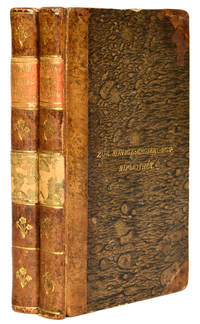
réf. 95379Altona I. F. Hammerich 1807. . First German edition 2 vols 8vo 20 x 12.5 cm. pp. xvi 368; pp. vii 358; very slight spotting to vol. 1. Contemporary half-brown leather binding; flat spine gilt bands separating compartments compartments 1 3 5 and 6 contain gilt floral decoration compartments 2 and 4 contain gilt lettering including translator's name and title gilt library stamp to both upper boards library stamps to verso of both upper boards and title pages pencil markings to verso of upper boards and endpapers; rubbed water or possibly glue marks to verso of upper boards and endpapers. Rare first German edition and first translation into a foreign language of this important work by the father of Malthusianism. Malthus' original work written in English was first published anonymously in 1798. It discusses the problem of the gap between population growth which is potentially exponential and the growth of food supply which is not. The work arose from a discussion between Malthus and his father about the possibility of a better society and went on to have an enormous impact on social policy. Ultimately Malthus believed population growth would always outrun food supply and therefore the betterment of society was impossible without stern limits on reproduction. For this reason he is often associated with Darwin. His views became popular again in the XX century largely due to the work of John Maynard Keynes. 'The essay exercised a strong influence on European intellectual development at the beginning of the nineteenth century. the Socialists fought him unanimously. and the Conservatives were happy that somebody was fighting against the spread of revolutionary ideas from the continent.' Carter/Muir. Thomas Malthus 1766 - 1834 was born into a family of intellectuals and his father was a great friend of the philosopher David Hume. He took holy orders in 1797 but in 1805 decided to become a professor teaching history and the relatively new subject of political economy at the East India Company college in Haileybury. He was elected a member of the Royal Society in 1819 and in 1834 founded the Statistical Society of London. Altona, I. F. Hammerich, 1807. hardcover
1807réf. 52195Altona J.F. Hammerich 1807. Contemp. hcalf. Gilt spine titlelabel in leather letters worn. Light wear to top of spine and corners. Spine rubbed. Some wear to edges of covers. A stamp on title-page. XVI 368; VIII 358 2 pp. A few leaves in the first quire disbound. Scattered brownspots and a few marginal underlinings on the first 20 leaves. Rare first German edition of this political and economic classic which constitutes Malthus' first major publication and his main work because of which he is considered the father of demography and one of the main sources of inspiration for Darwin and Wallace. It is the first translation of the "Principle on Population" into any language and it influenced German politics tremendously.The first edition was printed anonymously in London in 1798 and in 1803 the second edition which also according to Malthus himself can be said to constitute a new work appeared; -the great quarto edition from 1803 is thoroughly revised and much enlarged the title has been changed and Malthus' name appears on the title-page for the first time it is on this edition that all the preceding editions are based and in consequence also the early translations. All the later editions were minor revisions of the second one. In 1806 the third edition appeared and as soon as 1807 the first German one which is translated from the revised third edition "Die gegenwärtige Uebersetzung ist nach der dritten Ausgabe Oktav London 1806. Die Quartausgabe ist minder vollständig" Vorwort p. V. New revisions of the text kept appearing till the sixth edition in 1826. The book then as now is considered highly controversial and it has influenced all demographers ever since as well as being of immense importance to the study of economic theory and genetic inheritance. "The "Essay" was highly influential in the progress of thought in the early nineteenth-century Europe. "Parson" Malthus as Cobbett dubbed him was for many a monster and his views were often grossly misinterpreted. But his influence on social policy whether for good or evil was considerable. The Malthusian theory of population came at the right time to harden the existing feeling against the Poor Laws and Malthus was a leading spirit behind the Poor Law Amendment Act of 1834." PMM 251.Thomas Robert Malthus 1766-1834 called the "enfant terrible" of the economists was an English demographer statistician and political economist who is best known for his groundbreaking views on population growth presented in his "Essays on the Principle of Population" which is based on his own prediction that population would outrun food supply causing poverty and starvation. Among other things this caused the legislation which lowered the population of the poor in England. Malthus actually turned political economic and social thought upside down with this work which has caused him to be considered one of the 100 most influential persons in history Hart The 100: A Ranking of the most Influential Persons in History 1978. Of course he was condemned by Marx and Engels and opposed by the socialists universally but the work was of immense impact on not only politics economics social sciences etc but also on natural sciences. "Later in the "Origin of Species" he Darwin wrote that the struggle for existence "is the doctrine of Malthus applied with manifold force to the whole animal and vegetable kingdoms; for in this case there can be no artificial increase of food and no prudential restraint from marriage" p. 63. Alfred Russel Wallace who arrived at a worked-out formulation of the theory of evolution at almost precisely the same time as Darwin acknowledged that "perhaps the most important book I read was Malthus's "Principles of Population" My Life p. 232. Although there were four decennial censuses before Malthus' death he did not himself analyze the data although he did influence Lambert Quetelet and Pierre Verhulst who made precise statistical studies on growth of populations in developed countries and showed how the early exponential growth changed to an S curve." DSB IX p. 69. As Malthus realized that his theories were not satisfactorily presented or sufficiently demonstrated in the first edition from 1798 he travelled for three years through Europe gleaning statistics and then published the second edition in 1803. Among other places he travelled through Northern Germany and his detailed diaries of these journeys provided him with some of the evidence necessary for the development of his theory on population growth. The observational information that he gathered on his travels in Europe were crucial to the development of his theories which also means that the work is of great interest for other European countries and not only Britain. "In 1819 the Royal Society elected Malthus to a fellowship. He was also a member of the French Institute and the Berlin Academy and a founding member of the Statistical Society 1834." DSB IX p. 67. Printing and the Mind of Man 251 first edition. hardcover