604 résultats
réf. PJH55320J. P. Aillaud Paris 1820. VG bright set in contemporary slightly worn and scuffed calf bindings with red and black title labels to each spine. 501 452pp. 1st French Edition published same year as the English Edition. Two Volumes. From the collection of Professor Malcolm Deas 1941-2023 an Emeritus Fellow of St Antony's College Oxford and University Lecturer in the Government and Politics of Latin America 1966-2008 J. P. Aillaud (Paris) 1820 unknown
1820réf. 76151Paris: Aillaud 1820. Due volumi di cm. 20 pp. 4 xxxii 501 1; 4 452. Solida ed elegante legatura coeva in mezza pelle dorsi a nervi con titoli ed impressioni a secco ed in oro. Poche arrossature ma esemplare genuino ed in ottimo stato di conservazione. Prima edizione francese apparsa l'anno dell'originale inglese. Cfr. Kress C 576; non in Einaudi. Aillaud unknown
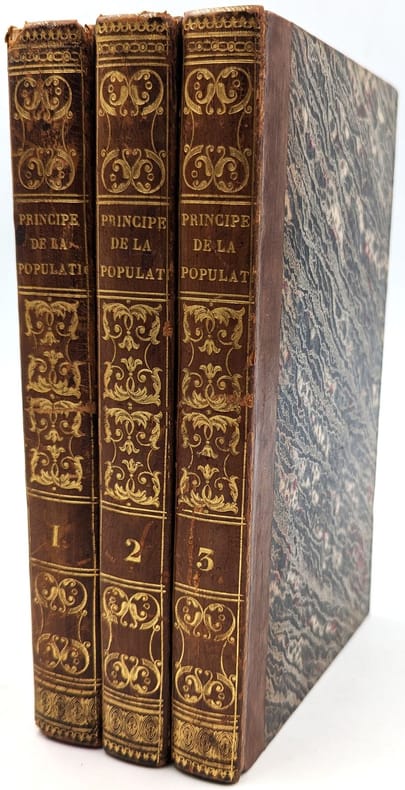
1809réf. 12840Paris and Geneva: Chez J.J. Paschoud 1809. 3 volumes. First Edition in French. Provenance: With the contemporary engraved bookplate of H. Trouchin and that of the subsequent owner Pierre Sciclounoff. 8vo very handsomely bound in a fine French binding of contemporary half calf over speckled boards spines with gilt ruled bands red morocco title label and green morocco volume label lettered in gilt. xxiii 424 3 ad; 395 3; 392. A very fine and handsome set very clean and sturdy in absolutely period state. The first French edition of Malthus’ landmark work. The translation from the English is by Pierre Prevost probably from the third English edition which was corrected and expanded by Malthus. French editions of Malthus are uncommon and this set is in exceptional condition in its original and contemporary state. Originally written in response to a discussion with the author's father on the perfectibility of society the book was reprinted several times with many alterations and additions as Malthus defended his views against a host of critics. "The central idea of the essay--and the hub of Malthusian theory--was a simple one. The population of a community Malthus suggested increases geometrically while food supplies increase only arithmetically. If the natural increase in population occurs the food supply becomes insufficient and the size of the population is checked by 'misery'--that is the poorest sections of the community suffer disease and famine. Malthus recognized two other possible checks to population expansion: first 'vice'--that is homosexuality prostitution and abortion all totally unacceptable to Malthus; and second 'moral restraint'--the voluntary limitation of the production of children by the postponement of marriage. This was the solution to the population problem that Malthus advocated. The 'Essay' was highly influential in the progress of thought in early nineteenth-century Europe" PMM. Marx Engels Paley Darwin Wallace Keynes and Ricardo were all influenced by Malthus--either working off his ideas or reacting against them. Chez J.J. Paschoud hardcover
1868réf. 154136Torino: Unione Tipografico-Editrice 1868. Cm. 235 pp. 4 929 1. Solida ed elegante legatura di fine '800 in mezza pergamena con piccole punte dorso liscio con titoli in oro e piatti in carta marmorizzata. Ottima conservazione. Volume appartenente alla collana: Biblioteca dell'Economista. Seconda serie voll. XI-XII. Il volume contiene: Malthus. Saggio sul principio della popolazione - J. Garnier. Del principio di popolazione. Unione Tipografico-Editrice unknown
First Edition, 4to, xxxvi, 227, [1]pp., 22 lithograph plates, [Malthus essay running from page 171-180]; orig. boards, covers detached, lacks spine, uncut, unopened, internally a nice clean copy. Malthus's first essay to the Royal Society of Literature in which he explains his theory of the source or cause of exchangeable value. As Patricia James in her biography of Malthus explains 'Anyone wishing to understand Malthus's doctrine that the of a commodity is composed of labour and profit, these short essays can be recommended for their comparative simplicity. As is often the case, enlightenment comes from a footnote - in this instance, at the beginning of the first paper (with Malthus's italics):- "The natural and necessary conditions of the supply of commodities are precisely the same as the natural and necessary costs of production, when reduced to the simplest elements; but I have preferred the former expression, because the term cost, if not well guarded, is too apt to convey the idea of Money expenditure."' The second paper On the Meaning which is most usually and most correctly attached to the term 'Value of a Commodity' was read two years later on the 7th November 1827.
réf. 37691J. Murray. 1827. First Edition 4to xxxvi 227 1pp. 22 lithograph plates Malthus essay running from page 171-180; orig. boards covers detached lacks spine uncut unopened internally a nice clean copy. Malthus's first essay to the Royal Society of Literature in which he explains his theory of the source or cause of exchangeable value. As Patricia James in her biography of Malthus explains 'Anyone wishing to understand Malthus's doctrine that the of a commodity is composed of labour and profit these short essays can be recommended for their comparative simplicity. As is often the case enlightenment comes from a footnote - in this instance at the beginning of the first paper with Malthus's italics:- "The natural and necessary conditions of the supply of commodities are precisely the same as the natural and necessary costs of production when reduced to the simplest elements; but I have preferred the former expression because the term cost if not well guarded is too apt to convey the idea of Money expenditure."' The second paper On the Meaning which is most usually and most correctly attached to the term 'Value of a Commodity' was read two years later on the 7th November 1827. J. Murray. 1827 hardcover
réf. 30964Paris & Genève J. J. Paschoud 1809. 3 vol. 120 x 195 mm de 424 395 et 392 p. Demi-veau brun dos ornés de fleurons à froid et roulettes dorées pièces de titre et de tomaison tranches jaunes mouchetées reliure légèrement postérieure. . Édition originale de la traduction française. . Au début des années 1790 le philosophe anglais William Godwin expose un « principe de population ». Réagissant principalement à la thèse alors développée par Godwin Malthus fait alors paraître la première édition de son Essai sur le principe de population un pamphlet qui paraît - anonymement - en 1798. Il y substitue en 1803 ce qui se veut un traité plus scientifique dans lequel il se réfère aussi à quatre autres sources importantes : Of the Populousness of Ancient Nations de David Hume A Dissertation on the Numbers of Mankind de Robert Wallace Observations on Reversionary Payments de Richard Price et An Inquiry into the Nature and Causes of the Wealth of Nations d'Adam Smith. Deux ans après cette parution l'Essai fait l'objet d'une traduction partielle par le Suisse Pierre Prévost qui fut professeur de physique et de philosophie à l'Université de Genève. Certains chapitres sont intégralement traduits tandis que d'autres ne le sont que partiellement. Prévost accompagne sa traduction de notes et commentaires personnels ; encouragé par Malthus il fait paraître en 1809 à Paris et à Genève cette nouvelle édition la première complète donnée d'après la dernière établie par Malthus en 1807 la quatrième édition anglaise. « Malthus m'a même autorisé en conséquence à y faire les changements que j'estimerais nécessaires. Je n'ai pas abusé de cette permission. Je me suis prescrit au contraire de faire connaître l'ouvrage de M. Malthus tel qu'il l'a lui-même publié. L'appendice est la seule partie où j'ai fait des retranchements et quelques modifications sans les indiquer en détail ; parce que les objections que l'auteur y discute m'ont paru quelquefois trop faibles ou trop particulières pour mériter d'être exposées et réfutées dans une traduction avec autant d'étendue qu'elles le sont dans l'original. Mais j'ai supprimé certains morceaux et même des chapitres entiers qui s'écartent un peu du sujet principal ou qui sont trop immédiatement relatifs à l'Angleterre. » « L'Essai du révérend Malthus causa en 1798 un véritable choc idéologique dans une Angleterre en crise traumatisée par la Révolution française. Ce texte contient la première formulation - inchangée dans les cinq éditions suivantes - du principe de population. Avancée fondamentale ce principe affirme que les vitesses de croissance de la population et des subsistances sont très différents la première augmentant plus rapidement que la seconde .» INED préface à l'édition critique de 2017. Son analyse des crises de surproduction l'oppose à Jean-Baptiste Say et en fait un précurseur de Keynes - par l'accent qu'il met sur l'insuffisance de la demande - ce dernier soulignant qu'il est « le premier des économistes de Cambridge ». Rare première traduction française de cette référence majeure dans l'histoire des idées. Bon exemplaire. De la bibliothèque Antoine Larue avec ex-libris. Dirigeant de plusieurs entreprises de l'industrie chimique dans la deuxième partie du XXe siècle sa bibliothèque sera dispersée en 1985 puis 1993 à l'Hôtel Drouot par Claude Guérin. Printing and the Mind of Man n° 251 pour l'édition originale anglaise de 1798 ; Kress B 5591. Paris & Genève, J. J. Paschoud, 1809. 3 vol. (120 x 195 mm) de 424, 395 et 392 p. Demi-veau brun, dos ornés de fleurons à fro unknown
1992réf. Cambridge-9780521429726Cambridge University Press 1992. PAPERBACK. New. Cambridge University Press paperback
réf. 53104Paris Cardin Besogne 1640. TITLE CONTINUED: De nouveau reveu corrige & augmente par l'autheur. 1640 first published in 1629 8vo approximately 170 x 100mm 6¾ x 4 inches French text added engraved pictorial title page of Neptune and Mars fireworks in the background dated 1629 6 full page illustrations 38 text engravings both illustrations and diagrams some decorated initials and headpieces pages: 10 1-277 5 pages 136 and 139 misnumbered 116 and 137 collation: A-S8 T4 T4 a blank bound in contemporary speckled calf raised bands to spine gilt decoration to spine pale red speckling to edges. Binding slightly worn small neat repair to top of spine gilt slightly worn pitting to sides small water stain to top of engraved title a larger one to top of letterpress title see image a very faint small intermittent stain to upper margin throughout very faint half page water stain on S8 - T3 small closed tear to margin of 2 pages neatly repaired very small blank corner missing on S2 verso T3 lightly browned. A very good sturdy copy. Francis Malthus d.1658 of English origin was an engineer in the royal French army and a captain general of mines and sapping. He was responsible for the French use of the mortar beginning in 1634. See: Chris Philip A Bibliography of Firework Books page 91 M 040.5; Spaulding and Karpinski Early Military Books in the University of Michigan Libraries page 19; John Eliot Hodgkin Rariora Volume 3 Books on Fireworks section page 15; Maurice Cockle A Bibliography of Military Books to 1642 page 93 No.118 referring to the English edition of 1629: "This work though in advance of anything so far written on the subject in English does not attain to the standard of Thibourel and Appier. Yet it is with foreign treatises it must be weighed for Malthus received his training in pyrotechnics abroad. It was Malthus who about the year 1634 introduced the mortar into the French service." 4 copies of our 1640 edition listed in Library Hub Discover. MORE IMAGES ATTACHED TO THIS LISTING ALL ZOOMABLE FURTHER IMAGES ON REQUEST. POSTAGE AT COST AND ALL PARCELS SENT FULLY TRACKED AND FULLY INSURED. Paris, Cardin Besogne, 1640. hardcover
1979réf. RO80260974Penguin Books. 1979. In-12. Broché. Bon état, Couv. convenable, Dos satisfaisant, Papier jauni. 291 pages. Annotation au stylo en page de titre. Texte en anglais.. . . . Classification Dewey : 420-Langue anglaise. Anglo-saxon
1803réf. 31325London, Printed for J. Johnson, by T. Bensley, 1803. Large 4to. Later brown hcalf with four raised bands, single gilt lines and red leather title-label to spine. First three and last 14 leaves a bit brownspotted, title-page and last two leaves marginally repaired at hinge, otherwise a very nice, clean, and solid copy. VIII, (4), 610 pp.
1803réf. 62792London, Printed for J. Johnson, by T. Bensley, 1803. Large 4to. Later brown hcalf with four raised bands, single gilt lines and red leather title-label to spine. First three and last 14 leaves a bit brownspotted, title-page and last two leaves marginally repaired at hinge, otherwise a very nice, clean, and solid copy. VIII, (4), 610 pp.
réf. R150030669GONTHIER.. 1964.. In-12. Broché. Bon état, Couv. convenable, Dos satisfaisant, Intérieur frais. 236 pages. 1ère de couverture illustrée en couleurs.. . . . Classification Dewey : 300-SCIENCES SOCIALES
1964réf. RO40084321Mediations. 1964. In-12. Broché. Etat d'usage, Couv. légèrement passée, Dos satisfaisant, Intérieur bon état. 236 pages. Page de titre manquante. Petite tache d'encre sur la tranche.. . . . Classification Dewey : 304.6-Démographie
2010réf. RO30314370Flammarion. 2010. In-8. Broché. Bon état, Couv. convenable, Dos satisfaisant, Intérieur frais. 284 pages.. . . . Classification Dewey : 301-Sociologie
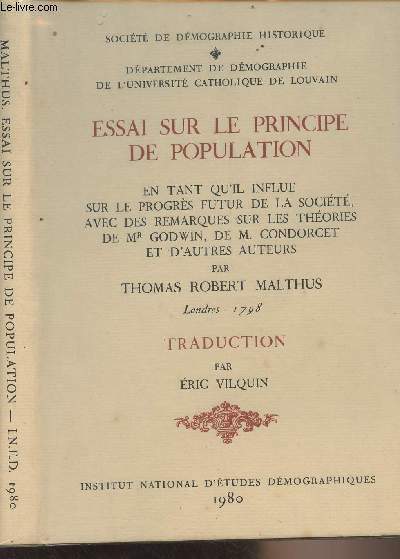
1980réf. R300278306Institut national d'études démographiques. 1980. In-8. Relié. Bon état, Couv. convenable, Dos satisfaisant, Intérieur acceptable. 166 pages. Jaquette convenable.. Avec Jaquette. . . Classification Dewey : 304.6-Démographie
1980réf. 104587P., INED, 1980, gr. in-8°, 166 pp, traduction par Eric Vilquin, avant-propos de Jacques Dupâquier, reliure toile crème imprimée de l'éditeur (salie), état correct (Société de démographie historique. Département de démographie de l'Université catholique de Louvain)
1963réf. 125826Seghers, 1963, in-8°, 373 pp, préface, introduction et traduction par le docteur Pierre Theil, broché, couv. illustrée, bon état
réf. 23022aafBruxelles, Société Typographique Belge, 1841, in-8°, titre + 430 p., non rogné, brochure originale.
réf. 237568Paris, Guillaumin, 1852 grand in-8, LX-688 pp., portrait, demi-chagrin rouge à coins, dos à nerfs orné, tête dorée (reliure de l'époque).
réf. 244594Paris, Guillaumin, 1845 grand in-8, LX-687 pp., broché. Dos abîmé. Rousseurs.
1809réf. 31327Paris & Genève, Chez J.J. Paschoud, 1809. 8vo. Bound in three nice uniform cont. hcalfbdgs. w. gilt backs, red leather title-labels w. gilt lettering and gilt round green tome-labels on backs. Capitals w. a bit of wear. Internally nice and clean. W. half-titles in all three volumes and advertisement-leaf in vol. one. XIII, (1), 424, (5) (6), 395, (1) (4), 392 pp.
1809réf. 103515A Paris et à Genève, chez J.J. Pashoud, 1809, in-8, 3 vol. de I : 424-[6] pp. + II: [4]-395-[3] pp. + III : [6]-392-[5] pp, Demi-veau de l'époque, dos lisses filetés ornés en doré de roulettes et fers rocaille, Première traduction française, très augmentée par Pierre Prévost, pour qui l'ouvrage magistral de Malthus "a pour objet principal de diriger la bienveillance, vertu familière". Thomas-Robert Malthus (1766-1834) avec un siècle d'avance annonçait le principe qui sera repris par Keynes, de la demande effective opposée à la loi des débouchés. Publié originellement en anglais de façon anonyme en 1798, cet essai phare de la pensée économique et démographique du XIXe siècle instaure une réflexion sur le rapport entre le développement de la population et celui des subsistances qui amène à la conclusion que ce sont les salaires qui déterminent le chiffre de la population. Le second thème essentiel de la pensée malthusienne est sa critique du système anglais de lois sur les pauvres (Poor Laws) qui, selon lui, amplifie la pauvreté de manière générale. Excellent exemplaire en jolie reliure de l'époque, dos très légèrement frottés, petit accroc en tête d'une coiffe. Couverture rigide
1809réf. 30964Un des ouvrages les plus influents de l'histoire de la pensée économique Paris & Genève, J. J. Paschoud, 1809. 3 vol. (120 x 195 mm) de 424, 395 et 392 p. Demi-veau brun, dos ornés de fleurons à froid et roulettes dorées, pièces de titre et de tomaison, tranches jaunes mouchetées (reliure légèrement postérieure). Édition originale de la traduction française.