593 résultats
1963réf. 045144Editions Gonthier broché Bristol illustré Paris 1963 bibliothèque médiations - 234 pages en format 11 - 18 cm
1980réf. R300278306Institut national d'études démographiques. 1980. In-8. Relié. Bon état, Couv. convenable, Dos satisfaisant, Intérieur acceptable. 166 pages. Jaquette convenable.. Avec Jaquette. . . Classification Dewey : 304.6-Démographie
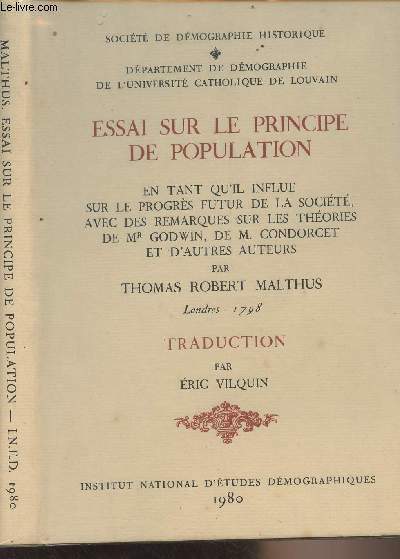
1980réf. 104587P., INED, 1980, gr. in-8°, 166 pp, traduction par Eric Vilquin, avant-propos de Jacques Dupâquier, reliure toile crème imprimée de l'éditeur (salie), état correct (Société de démographie historique. Département de démographie de l'Université catholique de Louvain)
1809réf. 31327Paris & Genève, Chez J.J. Paschoud, 1809. 8vo. Bound in three nice uniform cont. hcalfbdgs. w. gilt backs, red leather title-labels w. gilt lettering and gilt round green tome-labels on backs. Capitals w. a bit of wear. Internally nice and clean. W. half-titles in all three volumes and advertisement-leaf in vol. one. XIII, (1), 424, (5) (6), 395, (1) (4), 392 pp.
réf. 23022aafBruxelles, Société Typographique Belge, 1841, in-8°, titre + 430 p., non rogné, brochure originale.
1809réf. 30964Un des ouvrages les plus influents de l'histoire de la pensée économique Paris & Genève, J. J. Paschoud, 1809. 3 vol. (120 x 195 mm) de 424, 395 et 392 p. Demi-veau brun, dos ornés de fleurons à froid et roulettes dorées, pièces de titre et de tomaison, tranches jaunes mouchetées (reliure légèrement postérieure). Édition originale de la traduction française.
1963réf. 125826Seghers, 1963, in-8°, 373 pp, préface, introduction et traduction par le docteur Pierre Theil, broché, couv. illustrée, bon état
réf. R150030669GONTHIER.. 1964.. In-12. Broché. Bon état, Couv. convenable, Dos satisfaisant, Intérieur frais. 236 pages. 1ère de couverture illustrée en couleurs.. . . . Classification Dewey : 300-SCIENCES SOCIALES
réf. 237568Paris, Guillaumin, 1852 grand in-8, LX-688 pp., portrait, demi-chagrin rouge à coins, dos à nerfs orné, tête dorée (reliure de l'époque).
réf. 244594Paris, Guillaumin, 1845 grand in-8, LX-687 pp., broché. Dos abîmé. Rousseurs.
1809réf. 103515A Paris et à Genève, chez J.J. Pashoud, 1809, in-8, 3 vol. de I : 424-[6] pp. + II: [4]-395-[3] pp. + III : [6]-392-[5] pp, Demi-veau de l'époque, dos lisses filetés ornés en doré de roulettes et fers rocaille, Première traduction française, très augmentée par Pierre Prévost, pour qui l'ouvrage magistral de Malthus "a pour objet principal de diriger la bienveillance, vertu familière". Thomas-Robert Malthus (1766-1834) avec un siècle d'avance annonçait le principe qui sera repris par Keynes, de la demande effective opposée à la loi des débouchés. Publié originellement en anglais de façon anonyme en 1798, cet essai phare de la pensée économique et démographique du XIXe siècle instaure une réflexion sur le rapport entre le développement de la population et celui des subsistances qui amène à la conclusion que ce sont les salaires qui déterminent le chiffre de la population. Le second thème essentiel de la pensée malthusienne est sa critique du système anglais de lois sur les pauvres (Poor Laws) qui, selon lui, amplifie la pauvreté de manière générale. Excellent exemplaire en jolie reliure de l'époque, dos très légèrement frottés, petit accroc en tête d'une coiffe. Couverture rigide
1826réf. 857601826. MALTHUS Thomas Robert. An Essay on the Principle of Population; or A View of its Past and Present Effects on Human Happiness. London: John Murray 1826. Two volumes. Octavo contemporary full diced brown calf raised bands black and red morocco spine labels marbled endpapers and edges. Housed in a custom slipcase. $2600.1826 edition of Malthus controversial Essay the final one published in his lifetime in contemporary calf.""One of the founders of modern economics"" Malthus first published his highly contested Essay on the Principles of Population in 1798. This landmark work ""was originally the product of a discussion on the perfectibility of society with his father who urged him to publish. Thus the first edition published anonymously was essentially a fighting tract but later editions were considerably altered and grew bulkier as Malthus defended his views against a host of critics The Essay was highly influential in the progress of thought in early 19th-century Europe and his influence on social policy was considerable Both Darwin and Wallace clearly acknowledged Malthus as a source of the idea of 'the struggle for existence"" PMM 251. ""The achievement of Malthus was the exposition of the theory of population; and his name has been associated so closely with this theory that like Darwin's it has added a new adjective to the language of civilized peoples"" Palgrave II:670-1. This is the sixth edition the final one to be published in his lifetime. Lowndes 1459. Goldsmiths 24893. Early owner signatures dated 1874.Text quite fresh and clean Volume II with small chip to rear free endpaper slight rubbing edge-wear to contemporary boards. An extremely good copy. hardcover
réf. 1573922552.Gpaperback. Good. Access codes and supplements are not guaranteed with used items. May be an ex-library book. paperback
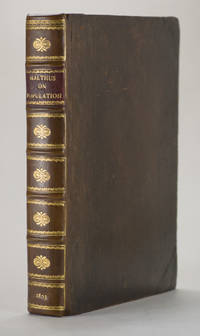
1803réf. 65276London: Printed for J. Johnson.by T. Bensley 1803. The Economics of Population MALTHUS Thomas Robert. An Essay on the Principle of Population; Or a view of its past and present effects on Human Happiness; With an Inquiry into our prospects respecting the future removal or mitigation of the evils which it occasions. A new edition very much enlarged. London: Printed for J. Johnson. by T. Bensley 1803. Second edition enlarged and revised. Quarto. viii 4 610 pp. Contemporary calf skillfully rebacked to style and with corners renewed. Spine decoratively tooled in gilt compartments with burgundy morocco gilt lettering label. Endpapers renewed. Occasional light foxing. Title-page with publisher's diagonal paper flaw crease. Overall very good. A completely revised and greatly expanded edition of the most influential work on population ever written. Malthus published the first edition of his Essay in 1798 and was apparently unprepared for the torrent of controversy that his ideas provoked. His response to the public outcry was to spend the next five years refining and expanding his theories for this second edition so much so that "in its present shape it may be considered a new work and I should probably have published it as such omitting the few parts of the former which I have retained but that I wished it to form a whole of itself and not to need a continual reference to the other." preface Malthus' basic argument--that population increases geometrically at a greater rate than does the means of subsistence which increases arithmetically--was one of the earliest modern economic and social theories and his contention that it would eventually become necessary for society to impose some form of restraint on over-population provided the premise for heated socio-economic debate for almost two centuries. Kress B4701. See Printing and the Mind of Man 251. HBS 65276. $6500. Printed for J. Johnson...by T. Bensley unknown
1826réf. 857601826. MALTHUS Thomas Robert. An Essay on the Principle of Population; or A View of its Past and Present Effects on Human Happiness. London: John Murray 1826. Two volumes. Octavo contemporary full diced brown calf raised bands black and red morocco spine labels marbled endpapers and edges. Housed in a custom slipcase. $2600.1826 edition of Malthus controversial Essay the final one published in his lifetime in contemporary calf.""One of the founders of modern economics"" Malthus first published his highly contested Essay on the Principles of Population in 1798. This landmark work ""was originally the product of a discussion on the perfectibility of society with his father who urged him to publish. Thus the first edition published anonymously was essentially a fighting tract but later editions were considerably altered and grew bulkier as Malthus defended his views against a host of critics The Essay was highly influential in the progress of thought in early 19th-century Europe and his influence on social policy was considerable Both Darwin and Wallace clearly acknowledged Malthus as a source of the idea of 'the struggle for existence"" PMM 251. ""The achievement of Malthus was the exposition of the theory of population; and his name has been associated so closely with this theory that like Darwin's it has added a new adjective to the language of civilized peoples"" Palgrave II:670-1. This is the sixth edition the final one to be published in his lifetime. Lowndes 1459. Goldsmiths 24893. Early owner signatures dated 1874.Text quite fresh and clean Volume II with small chip to rear free endpaper slight rubbing edge-wear to contemporary boards. An extremely good copy. hardcover books
1803réf. 65276London: Printed for J. Johnson.by T. Bensley 1803. The Economics of Population MALTHUS Thomas Robert. An Essay on the Principle of Population; Or a view of its past and present effects on Human Happiness; With an Inquiry into our prospects respecting the future removal or mitigation of the evils which it occasions. A new edition very much enlarged. London: Printed for J. Johnson. by T. Bensley 1803. Second edition enlarged and revised. Quarto. viii 4 610 pp. Contemporary calf skillfully rebacked to style and with corners renewed. Spine decoratively tooled in gilt compartments with burgundy morocco gilt lettering label. Endpapers renewed. Occasional light foxing. Title-page with publisher's diagonal paper flaw crease. Overall very good. A completely revised and greatly expanded edition of the most influential work on population ever written. Malthus published the first edition of his Essay in 1798 and was apparently unprepared for the torrent of controversy that his ideas provoked. His response to the public outcry was to spend the next five years refining and expanding his theories for this second edition so much so that "in its present shape it may be considered a new work and I should probably have published it as such omitting the few parts of the former which I have retained but that I wished it to form a whole of itself and not to need a continual reference to the other." preface Malthus' basic argument--that population increases geometrically at a greater rate than does the means of subsistence which increases arithmetically--was one of the earliest modern economic and social theories and his contention that it would eventually become necessary for society to impose some form of restraint on over-population provided the premise for heated socio-economic debate for almost two centuries. Kress B4701. See Printing and the Mind of Man 251. HBS 65276. $6500. Printed for J. Johnson...by T. Bensley unknown books
réf. Z1-S-008-02813W. Pickering. Used - Good. Spine hinge damaged. Ships from UK in 48 hours or less usually same day. Your purchase helps support Sri Lankan Children's Charity 'The Rainbow Centre'. Ex-library so some stamps and wear but in good overall condition. 100% money back guarantee. We are a world class secondhand bookstore based in Hertfordshire United Kingdom and specialize in high quality textbooks across an enormous variety of subjects. We aim to provide a vast range of textbooks rare and collectible books at a great price. Our donations to The Rainbow Centre have helped provide an education and a safe haven to hundreds of children who live in appalling conditions. We provide a 100% money back guarantee and are dedicated to providing our customers with the highest standards of service in the bookselling industry. W. Pickering unknown
1976réf. 2080502107001749Iwanamishoten 1976. Soft Cover. Fine. Number of pages: 295p Plate size: 15cm Iwanamishoten paperback
1926réf. 23332London: Macmillan 1926. hardbound. Very Good in G-VG dustwrapper/Dustwrapper. 8vo. Nice edition of Malthus' Essay on Population reprinting the 1798 original with additional notes by James Bonar; published by Macmillan for the Royal Economic Society; half cloth with grey sides title label to spine replacement label bound in to rear endpapers; endpapers prelims and text block foxed occasional foxing in text o.w. Very Good throughout; mild foxing to edges of boards; dustwrapper tanned to spine and top 4cm of front panel o.w. G-VG. Macmillan hardcover
réf. 94317London Macmillan & Co 1926. 8° IX 396 S. XXVII Notes HLwd. Stemp. a Vors. sonst tadell. 010 London, Macmillan & Co, 1926 unknown
1926réf. 022745London: Reprinted for the Royal Economic Society and Published By Macmillan & Co. 1926. Book. Half Cloth Paper-Covered Bds. Reprint of 1798 Edition. ix 396p. xxvii p. of notes. A near fine copy with an extra spine-label laid-in at the back and an attractive bookplate on the front paste-down endpaper no d.j. Size: 8vo - over 7¾" - 9¾" tall. Reprinted for the Royal Economic Society and Published By Macmillan & Co. hardcover
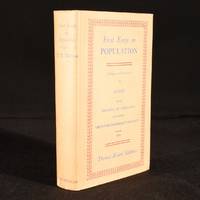
1966réf. 948Q29London: Macmillan 1966 . Cloth. Fine/Near Fine. 8.5" by 5.5". None. An excellent facsimile edition of Thomas Robert Malthus's eighteenth-century essay on population with the publisher's dust wrapper. A reprint in facsimile of Thomas Robert Malthus' 'An Essay on the Principle of Population'. Bound in the publisher's cloth with the original price-clipped dust wrapper. Originally published in 1798 this work was written by English economist scholar and cleric Thomas Robert Malthus. In 'An Essay on the Principle of Population' Malthus proposed that an increase in a nation's food production would lead to population growth meaning the initial benefits would only be temporary. With notes by Scottish historian and economist James Bonar to the rear of the work. Bound in the publisher's cloth with the original price-clipped dust wrapper. Externally excellent with minor shelf wear only. Dust wrapper is also excellent with light edge wear and a touch of sunning to the spine. Internally firmly bound. Pages are bright and clean. Fine Macmillan hardcover
1815réf. 181657London : Printed for John Murray Albemarle Street; and J. Johnson and Co. St. Paul's Church Yard 1815. First Edition. Hardback. Good copy in the original wrappers bound in later 19th century aniline calf over marble boards. Gilt-blocked black leather label to the spine. Spine bands and panels edges somewhat dust-dulled and rubbed as with age. Previous owner's notes/annotations attached to back of title page. Scattered marginal foxing. Remains particularly well-preserved overall; tight bright clean and strong. ; 8vo 8"" - 9"" tall; 48 pages; Description: 48p. 23cm. Subjects: Malthus T. R. Thomas Robert 1766-1834. - Observations on the corn laws. Corn laws Great Britain. Grain trade - Great Britain. Corn - Prices - Great Britain. Agriculture - Economic aspects - Great Britain. Publisher's 8 page catalogue to the rear and dated February 1815. Spine title reads: Malthus - Import of Corn - 1815. London : Printed for John Murray, Albemarle Street; and J. Johnson and Co. St. Paul's Church Yard hardcover
2013Mm 140x220 Collana "Campi del sapere" - Brossura editoriale con bandelle, 248 pagine. Copia in condizioni pari al nuovo, ovvero mai letta. SPEDIZIONE IN 24 ORE DALLA CONFERMA DELL'ORDINE.
1893réf. 11039Torino: Ermanno Loescher 1893. 1893. Good. - Small quarto 9-5/8 inches high by 6-3/4 inches wide rebound without original wraps in dark green cloth titled in gilt with decorations in gilt on the spine. The covers are slightly warped & the binding is bumped & rubbed affecting the titling. The head of the spine is chipped & frayed. 167 pages plus errata/corrigenda page. The pastedowns & endpapers are darkened & there is scattered foxing & light staining. Good. First edition. The text is in Italian. The book is inscribed by the author but the inscription & signature have been partially cut off in rebinding. "This interesting work proposes to examine by the light of scientific criticism the theory of Malthus and the principal objections that have been brought against it. The author turns his attention first to pointing out the irrefutability of the biological tendency as Malthus has shown it and the necessity which devolves upon political economy to recognize it as a fundamental law. Lebrecht does not ignore the objections raised by various writers against this tendency; on the contrary he estimates them with praiseworthy impartiality; yet after careful examination he believes that they are not destructive of the theory.He does not deny that the coefficient of procreation is essentially economic and that poverty is one of its potent factors; yet he affirms that the prolific action of poverty can be remedied by moral influences. From a review of the book by Achille Loria and Cornelia H. B. Rogers in "Annals of the American Academy of Political and Social Science Vol. 4 May 1894 p. 134. Rare. Torino: Ermanno Loescher, 1893. paperback