3.918 resultados
1886ref. 64-1089GPO 1886. 1886. 512p. Illustrations after photographs of the effects of artillery on armor. Folding Line drawings. Original black cloth. Heavy. Near Fine Copy. Hardcover. Near Fine. GPO, 1886. Hardcover
1969ref. 1912240003U.S. Govt. Print. Off 1969-01-01. First Edition. Paperback. Very Good. Signed. Warren E. Burger's personal copy of his confirmation hearings with additional ephemera; quite exceptional . Bound in publisher's green wraps. 116 pages ; 24 cm. Softcover. Good binding and cover. Clean unmarked pages. Warren E. Burger's bookplate inside front cover. Additional Burger ephemera: Contains two pages of hand written notes from Burger on his personal United States Court of Appeals stationary dated 1969. Also includes three additional blank sheets of Warren's Appeals Court stationary. In the written notes Burger talks about his experiences with a Bar investigation while in private practice earlier in his career. It is unclear if these notes were intended for Burger's confirmation hearing testimony or simply his personal biographic notes. Additionally contains a letter TLS from E.H. Gammons the Washington Director of CBS to Burger dated Feb 4 1944. Provenance: From the estate of Jim Graham former Washington D.C. City Council Member 1998-2014. Graham was head of Whitman-Walker Clinic 1984–1999 and a noted gay community pioneer. U.S. Govt. Print. Off paperback
1802ref. 004452Philadelphia: For E. Bronson printed by Thos. Smith 1802. Hardcover. Near Fine -. 2 324 p.; 21 cm. Modern binding; black spine label with gilt-tooled spine title; flax paper dyed brown with aniline dye over acid-free boards. Caption title: Debate on the Judiciary Bill. Perforated stamp of the Wilmington Institute Free Library on first 3 leaves. Early American Imprints ser. 2 Shaw & Shoemaker 3273; Cohen Bibliography of Early American Law 1058. Bronson's account of the debates in the U.S. Senate beginning on Jan. 4 1802 leading to the vote to repeal the Judiciary Act of 1801 which had reorganized and expanded federal jurisdiction. A supporter of the Federalist Party Enos Bronson 1774-1823 published the Gazette of the United States from 1801 to 1804 and with Elihu Chauncey The United States' Gazette for the Country from 1804 to 1818. In Near Fine- Condition: chipping to fore-edges of first two leaves; minor foxing and browning; otherwise clean and tight. For E. Bronson, printed by Thos. Smith hardcover
1945ref. 011025Washington D. C.: Government Printing Office 1945. Original self-wrappers stapled as issued. Corners slightly creased. This constitutes a fundamental document on postwar scientific research and was instrumental in the establishment of the National Science Foundation. First Edition. Soft Bound. Very Good. Government Printing Office
1861ref. 5501Place_Pub: Frederick MD: Beale H. Richardson 1861. Limited Edition. fair to poor. 4 wraps edges chipped tears repaired with tape pamphlet creased small tears edition of 1 000 copies. This is an extremely fragile item but the chips and tears with one exception have not impacted the text. The one exception has been repaired with tape so there is no loss of text. This was designated Document K. by the Maryland Senate on June 22 1861. While remaining in the Union Maryland was a slave state below the Mason-Dixon Line. There were many Confederate partisans and the loyalty of many including public officials was suspect by the Federal authorities. Beale H. Richardson paperback
1992ref. 65781Washignton DC: U.S. Government Printing Office 1992. Wraps. Good. No dust jacket as issued. Covers have some wear and soiling. Some minor creasing. 3 volume set. S. Hrg. 102-7899 3 volumes. Volume 1 0-16-039540-2 iv 961 p. ; Volume 2 0-16-039541-0 v 1 740 p.0; Volume 3 0-16-039542-9 iii 1 317 p. The Director of Central Intelligence commands vast capabilities to collect and analyze information far beyond those imagined by the earlier DCIs. On the basis of the information the DCI provides policy decisions are made diplomatic initiatives are mounted military operations are planned and carried out and research and development efforts are targeted. The DCI's job is unique interms of ranges of sensitive activities that the CIA is asked to carry out. The Committee felt that it must also examine the process by which intelligence analysis was developed for policymakers and felt that the DCI that they confirmed would need to preside over the first sweeping redesign of American intelligence since the National Security Act was passed in 1947. This three volume record of the hearings are increasingly scare and provide insight into Mr. Gates before he rose to the position of Secretary of Defense which he held over two administrations for Presidents of different parties. U.S. Government Printing Office paperback
1856ref. 1150221.10A. O. P. Nicholson Printer Washington 1856. Hardcover. Very Good. 4to hardcover no dj. Brown cloth w/ gilt title lettering on front board reading "Maps and views to accompany message and documents 1855-6" and blind-stamped "Senate Document". Vg condition. Board corners moderately bumped/rubbed through tiny chips at spine ends; boards otherwise clean gilt lettering bright binding & hinges firm. Maps lightly & uniformly age-toned as expected else clean & complete: very slight foxing to the first map only. Just 3 maps show a tear to one of the fold-lines roughly 3 inches long not affecting the integrity of the map as a whole at all. All state and territory maps present including California Oregon and Washington Territory. Consists of 35 maps & sketches most fold-out as follows: Illustrations accompanying the Reports of: The Commissioner of the General Land Office 16: the Government Hospital for the Insane 1; the Bureau of Topographical Engineers 13; the Quartermaster General 1; the Report of Doctor E. K. Kane to the Secretary of the Navy 2; and the Report of the Board of Examiners of the Naval Academy 2. A. O. P. Nicholson, Printer, Washington hardcover
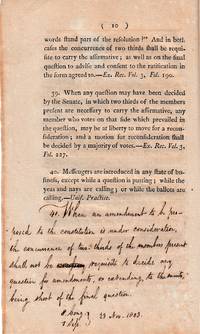
1801ref. 8084Washington: Senate 1801. Third Revision. Original blue wrappers. Very good with some browning. 8vo 13 1 - blank pp. This is the third revision of the Senate rules that are numbered 1 through 40 in the printed text accompanied by the joint rules for Congress. This copy is signed by John Gaillard the Senator from South Carolina see DAB who took office in 1804. It also has rule number 41 as a seven line manuscript addition on page 10. Rule 41 dealt with revisions to amendments to the Constitution !. There were two previous abbreviated printings of the Senate rules in the late 18th century. S & S #1560. [Senate] unknown books
2003ref. SBBI-SBL-006232Red Dress Ink 2003. Paperback. Good. Our good condition books are generally good for reading but not for gifting or collecting. They could have imperfections such as creasing fanning inscriptions margin notes yellowing staining on edge or cover or pages bumps scuffs etc etc sometimes multiple of these. It's a wide category that encompasses anything that isn't almost-new down to anything that is slightly better than poor. We would NOT recommend gifting Good books - these should be considered reading copies. Our books are dispatched from a Yorkshire former cotton mill. We list via barcode/ISBN so please note that the images are stock images and may not be the exact copy you receive furthermore the details about edition and year might not be accurate as many publishers reuse the same ISBN for multiple editions and as we simply scan a barcode or enter an ISBN we do not check the validity of the edition data when listing. If you're looking for an exact edition please don't order at least not without checking with us first although we don't always have time to check. We aim to dispatch prompty the service used will depend on order value and book size. We can ship to most countries see our shipping policies. Payment is via Abe only. Red Dress Ink paperback
1896ref. 2250066Washington DC: Government Printing Office 1896. 1st Edition . Soft cover. Good. 8vo - over 7¾ - 9¾" tall. See photos for condition details: staple bound government publication regarding the war claims and compensation of certain states. On the front cover is written "Complements of Captain Mullan". Captain John Mullan was involved for many years in the California Civil War claims as well as his own officer compensation. This government report was found amongst the collection from the Quackenbush family which was acquired in the 1970s. The book itself is a simple staple bound government publication. The front cover shows a lot of scuffing and soiling as does the rear to a lesser degree. The staples do show rust spots and the first page has small tears by the stapling as well as the check and a tear on the long edge. The remaining pages are toned with some spotting and edge wear but no other handwriting was found in the book. An extremely rare example of a slice of American history. Government Printing Office paperback
1791ref. 68761Philadelphia: John Fenno 1791. Many Important Early Laws Including on Whiskey An important early Congressional document describing the actions of the Senate in late 1791 and early 1792 at the height of the Federalist–Anti-Federalist struggle. As well George Washington's address to Congress printed here contains an interesting note about the tax on distilled spirits. Protests to this tax would result in the Whiskey Rebellion of 1794. Also contains important early legislation on frontier defenses Ohio fisheries lighthouses the Mint and militias. Folio. Contemporary sheep neatly rebacked in matching style spine gilt with raised bands morocco label. Boards lightly rubbed and stained edges a bit worn. Repaired hole to center of titlepage with "ENA" in "SENATE" repaired in manuscript facsimile. Light scattered foxing and soiling evidence of minor water damage throughout. About good. EVANS 24911. ESTC W20582. hardcover
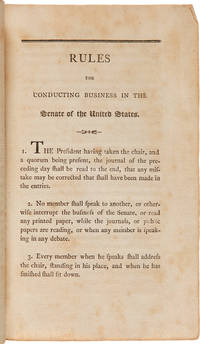
1801ref. 58452Washington. 1801. Rules for the Jeffersonian Senate The scarce 1801 edition of the rules for conducting Senate business following earlier printings in 1790 and 1798. Signed in print at the end by Secretary Samuel A. Otis and dated Dec. 7 1801 the text details forty rules for Senate business and concludes with three pages of "joint rules acted on between the two houses." Scarce. Shaw & Shoemaker list copies at LC and NYPL; OCLC adds copies at the University of Connecticut Yale and the Houghton Library. Contemporary blue paper wrappers. Light toning and scattered foxing. A near fine copy. SHAW & SHOEMAKER 1560. SABIN 74090. OCLC 36079611. unknown
1791ref. 68761Philadelphia: John Fenno 1791. Many Important Early Laws Including on Whiskey An important early Congressional document describing the actions of the Senate in late 1791 and early 1792 at the height of the Federalist–Anti-Federalist struggle. As well George Washington's address to Congress printed here contains an interesting note about the tax on distilled spirits. Protests to this tax would result in the Whiskey Rebellion of 1794. Also contains important early legislation on frontier defenses Ohio fisheries lighthouses the Mint and militias. Folio. Contemporary sheep neatly rebacked in matching style spine gilt with raised bands morocco label. Boards lightly rubbed and stained edges a bit worn. Repaired hole to center of titlepage with "ENA" in "SENATE" repaired in manuscript facsimile. Light scattered foxing and soiling evidence of minor water damage throughout. About good. EVANS 24911. ESTC W20582. hardcover books
1801ref. 58452Washington. 1801. Rules for the Jeffersonian Senate The scarce 1801 edition of the rules for conducting Senate business following earlier printings in 1790 and 1798. Signed in print at the end by Secretary Samuel A. Otis and dated Dec. 7 1801 the text details forty rules for Senate business and concludes with three pages of "joint rules acted on between the two houses." Scarce. Shaw & Shoemaker list copies at LC and NYPL; OCLC adds copies at the University of Connecticut Yale and the Houghton Library. Contemporary blue paper wrappers. Light toning and scattered foxing. A near fine copy. SHAW & SHOEMAKER 1560. SABIN 74090. OCLC 36079611. unknown books
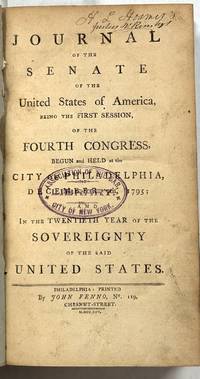
1796ref. 42223Philadelphia: Printed by John Fenno 1796. 346 vi xxi 3 blanks pp. Rubberstamp on title page and page 3. Otherwise a clean and Very Good copy. With the ownership signature of Congressman Hezekiah Hosmer. Evans 3155. bound with JOURNAL OF THE SENATE OF THE UNITED STATES OF AMERICA BEING THE SECOND SESSION OF THE FOURTH CONGRESS BEGUN AND HELD AT THE CITY OF PHILADELPHIA DECEMBER 5TH 1796 AND IN THE TWENTY-FIRST YEAR OF THE SOVEREIGNTY OF THE SAID UNITED STATES. Philadelphia: Printed by John Fenno. 1796 i.e. 1797. 175 1 blank iv 18pp. Mild occasional spotting Very Good. The two volumes bound together in legal buckram from the Association of the Bar of the City of New York. Evans 32971. These Journals are an excellent source for President Washington's closing administration. His Address of December 8 1795 announces the end of the War with the Indians northwest of the Ohio River and urges measures to prevent violence against them: "Unless the murdering of Indians can be restrained by bringing the murderers to condign punishment all the exertions by the government to prevent destructive retaliations by the Indians will prove fruitless." He urges Congress to devise "competent means of rendering justice" to the Indians. The speech is signed in type 'G. Washington.' The permanent Capitol in the District of Columbia the Whiskey Rebellion ratification of the Eleventh Amendment to the Constitution settlers' seizure of Cherokee lands trading with the Indians are all treated in the First Session. A charge that Kentucky Senator Humphrey Marshall had committed perjury-- arising from a suit brought by James Wilkinson in a Kentucky chancery court-- is examined in detail as are the admission to the Union of Tennessee and aspects of the Yazoo Claims. The Journal of the Second Session prints President Washington's Message "for the last time" to Congress in December 1796 summarizing "measures calculated to ensure a continuance of the friendship of the Indians and to preserve peace along the extent of our interior Frontier" as well as to "guard our advanced settlements from the predatory incursions of those unruly individuals who cannot be restrained by their Tribes." He reports on the implementation of the Treaty with England and on the boundary between the U.S. and the Floridas owned by Spain; urges "the gradual creation of a navy" development of American industry establishment of a National University and a Military Academy. Material is also considered on the southern and western boundaries of Georgia; ratification of the first ten amendments to the Constitution; inquiries on the proposed Eleventh Amendment immunizing States from suit without their consent; Vice-President Adams's farewell to the Senate before his installation as President; results of the 1796 election with electoral votes cast by each of the 16 States Tennessee Kentucky and Vermont having joined the Original Thirteen and announcement of the election of Adams and Thomas Jefferson as President and Vice President respectively. A comprehensive Index is included. Printed by John Fenno unknown
1796ref. 42223Philadelphia: Printed by John Fenno 1796. 346 vi xxi 3 blanks pp. Rubberstamp on title page and page 3. Otherwise a clean and Very Good copy. With the ownership signature of Congressman Hezekiah Hosmer. Evans 3155. bound with JOURNAL OF THE SENATE OF THE UNITED STATES OF AMERICA BEING THE SECOND SESSION OF THE FOURTH CONGRESS BEGUN AND HELD AT THE CITY OF PHILADELPHIA DECEMBER 5TH 1796 AND IN THE TWENTY-FIRST YEAR OF THE SOVEREIGNTY OF THE SAID UNITED STATES. Philadelphia: Printed by John Fenno. 1796 i.e. 1797. 175 1 blank iv 18pp. Mild occasional spotting Very Good. The two volumes bound together in legal buckram from the Association of the Bar of the City of New York. Evans 32971. These Journals are an excellent source for President Washington's closing administration. His Address of December 8 1795 announces the end of the War with the Indians northwest of the Ohio River and urges measures to prevent violence against them: "Unless the murdering of Indians can be restrained by bringing the murderers to condign punishment all the exertions by the government to prevent destructive retaliations by the Indians will prove fruitless." He urges Congress to devise "competent means of rendering justice" to the Indians. The speech is signed in type 'G. Washington.' The permanent Capitol in the District of Columbia the Whiskey Rebellion ratification of the Eleventh Amendment to the Constitution settlers' seizure of Cherokee lands trading with the Indians are all treated in the First Session. A charge that Kentucky Senator Humphrey Marshall had committed perjury-- arising from a suit brought by James Wilkinson in a Kentucky chancery court-- is examined in detail as are the admission to the Union of Tennessee and aspects of the Yazoo Claims. The Journal of the Second Session prints President Washington's Message "for the last time" to Congress in December 1796 summarizing "measures calculated to ensure a continuance of the friendship of the Indians and to preserve peace along the extent of our interior Frontier" as well as to "guard our advanced settlements from the predatory incursions of those unruly individuals who cannot be restrained by their Tribes." He reports on the implementation of the Treaty with England and on the boundary between the U.S. and the Floridas owned by Spain; urges "the gradual creation of a navy" development of American industry establishment of a National University and a Military Academy. Material is also considered on the southern and western boundaries of Georgia; ratification of the first ten amendments to the Constitution; inquiries on the proposed Eleventh Amendment immunizing States from suit without their consent; Vice-President Adams's farewell to the Senate before his installation as President; results of the 1796 election with electoral votes cast by each of the 16 States Tennessee Kentucky and Vermont having joined the Original Thirteen and announcement of the election of Adams and Thomas Jefferson as President and Vice President respectively. A comprehensive Index is included. Printed by John Fenno unknown books
1939ref. 91299Washington DC: United States Government Printing Office 1939. Presumed First Edition First Printing. Hardcover. Good. ii 613 7 pages. Fold-out. Marbled endpapers and edges. Minor moisture staining at lower right corner of some pages. Sturdy institutional binding. Tape residue at middle of spine. The Neutrality Acts were a series of acts passed by the US Congress in 1935 1936 1937 and 1939 in response to the growing threats and wars that led to World War II. They were spurred by the growth in isolationism and non-interventionism in the US following the US joining World War I and they sought to ensure that the US would not become entangled again in foreign conflicts. The legacy of the Neutrality Acts is widely regarded as having been generally negative since they made no distinction between aggressor and victim treating both equally as belligerents and limited the US government's ability to aid Britain and France against Nazi Germany. The Acts were largely repealed in 1941 in the face of the Lend-Lease Act. As noted by the Chairman "It is universally agreed by international lawyers that there should be no substantial change in the laws of a neutral as affecting a belligerent after declared or undeclared war takes place. Among the witnesses and participants are Bernard Baruch Henry Stimson Hugh Johnson Walter Judd; Breckinridge Long George Wharton Pepper James Shotwell Charles Tansill Edmund Walsh Raymond Buell Bainbridge Colby Paul Revere Sentinels and Dorothy Thompson. In philosophy neutrality is the tendency to not take a side in a conflict physical or ideological which may not suggest neutral parties do not have a side or are not a side themselves. In colloquial use neutral can be synonymous with unbiased. However bias is a favoritism for one side distinct from the tendency to act on that favoritism. Neutrality is distinct though not exclusive from apathy ignorance indifference doublethink equality agreement and objectivity. Apathy and indifference each imply a level of carelessness about a subject though a person exhibiting neutrality may feel bias on a subject but choose not to act on it. A neutral person can also be well-informed on a subject and therefore need not be ignorant. Since they can be biased a neutral person need not feature doublethink i.e. accepting both sides as correct equality i.e. viewing both sides as equal or agreement a form of group decision-making; here it would require negotiating a solution on everyone's opinion including one's own which may not be unbiased. Objectivity suggests siding with the more reasonable position except journalistic objectivity where reasonableness is judged by some common basis between the sides such as logic thereby avoiding the problem of incommensurability. Neutrality implies tolerance regardless of how disagreeable deplorable or unusual a perspective might be. In moderation and mediation neutrality is often expected to make judgments or facilitate dialogue independent of any bias emphasizing on the process rather than the outcome. For example a neutral party is seen as a party with no or a fully disclosed conflict of interest in a conflict and is expected to operate as if it has no bias. Neutral parties are often perceived as more trustworthy reliable and safe.38 Alternative to acting without a bias the bias of neutrality itself is the expectation upon the Swiss government in armed neutrality and the International Federation of Red Cross and Red Crescent Societies in non-interventionism. The Oxford English Dictionary documents that by at least 1897 "neutral" meant applying the rules to the facts as in football "Neutral linesmen shall officiate in all games." In the Supreme Court decision Board of Regents of the University of Wisconsin System v. Southworth based on the United States Constitution's First Amendment the court decided some funding decisions should be made through a neutral viewpoint. United States Government Printing Office hardcover
1793ref. 34630Philadelphia: John Fenno 1793-1794. Early Journals of the Senate Two Senate journals of the Federal period. The first contains a notice from George Washington that the Minister Plenipotentiary of the Republic of France Edmund Genêt has been recalled. Despite repeated warnings from both Washington and Jefferson Genêt persisted in outfitting private United States ships for naval raids on British vessels ultimately resulting in his being recalled. The second contains addresses by George Washington and John Adams on the Whiskey Rebellion. With an appendix and index. Folio. Modern three-quarter calf and marbled boards spine gilt leather labels. Small hole in titlepage affecting a few letters of imprint. Light foxing and scattered toning. Very good. EVANS 27911 29724. ESTC W20587 w020584. hardcover
1793ref. 34630Philadelphia: John Fenno 1793-1794. Early Journals of the Senate Two Senate journals of the Federal period. The first contains a notice from George Washington that the Minister Plenipotentiary of the Republic of France Edmund Genêt has been recalled. Despite repeated warnings from both Washington and Jefferson Genêt persisted in outfitting private United States ships for naval raids on British vessels ultimately resulting in his being recalled. The second contains addresses by George Washington and John Adams on the Whiskey Rebellion. With an appendix and index. Folio. Modern three-quarter calf and marbled boards spine gilt leather labels. Small hole in titlepage affecting a few letters of imprint. Light foxing and scattered toning. Very good. EVANS 27911 29724. ESTC W20587 w020584. hardcover books
1571ref. 486271571 (Lyon) Lugduni, Apud Ioan. Tornaesivm (Jean de Tournes), Typogr. Regium (Typographe royal). MDLXXI - 1571 - In-16, 12 x 8,5 x 3,8 cm - Edition Originale - Reliure vélin de récupération avec manque -Collationné complet des 110 gravures sur bois- 637 pagers + Index (3) manque pages d'index- fortes mouillures - Envoi rapide et soigné - Réf. 48627
1791ref. 1912180040Philadelphia: John Fenno 1791. First Edition. Hardcover. Good. Congress during the Washington Administration John Adams presiding Folio 32 x 20 cm 12 1/2 x 7 1/4 in. Bound in full contemporary sheepskin. Solid binding and cover. Inconsequential scrapes to the cover. Pages are clean and unmarked. 228 p. Marginal worming to 211 p. through the appendix doesn't effect text. Evans 24911. Includes an address by President George Washington a tax on distilled spirits a lead up to the Whiskey Rebellion acts that established the United States Mint the Post Office and the admission of Vermont as the 14th state. "First edition first issue of the rare journal containing numerous messages from Pres. Washington official ratifications of the Bill of Rights the Presidential Succession Act debate and passage the establishment of the U.S. mint and coinage the first militia act and foundation Northwest Territory Acts." - Jenkins 505. Philadelphia: John Fenno hardcover
1987ref. 28318Leal Senado De Macau; Museu Luis De Camoes. As New. Paperback. FREE UPGRADE to Courier/Priority Shipping Upon Request - IN STOCK AND IMMEDIATELY AVAILABLE FOR SHIPMENT - AS NEW THE TEXT BLOCK IS PRISTINE CLEAN UNMARKED AND IN EXCELLENT CONDITION - -- with a bonus offer--; T-Galmanet . 1987. Leal Senado De Macau; Museu Luis De Camoes paperback
ref. 18366Chambéry, Louis Du Four, 1674. 2 partie reliées en un tome petit in-4°, veau marbré, dos à nerf décoré et titré doré, tranches jaunes (reliure de l’époque) ; [24], 369 [i.e.359 : erreur de numérotation qui passe de 279 à 290 sans perte] ; 256, [4] pp. (feuillet Cc 3 découpé en biais avec perte partielle des notes de marges).
1840ref. 63277(Washington, D.C., Blair & Rives), 1840. 8vo (222 x 143 mm). 2 pp. (1 f.). Traces in inner margin from having been bound. Brownspotted.
1840ref. 63277Washington D.C. Blair & Rives 1840. 8vo 222 x 143 mm. 2 pp. 1 f. Traces in inner margin from having been bound. Brownspotted. Exceedingly rare first edition of the Senate Judiciary Committee's report on the petition submitted by Joseph Smith and Elias Higbee on behalf of the persecuted Mormons being a reply to Missouri Executive Order 44 also known as the Mormon Extermination Order. The report describes successive expulsions of the Mormons from their settlements in Missouri and the infamous order issued by Governor Lilburn W. Boggs that they are to be driven from the state or "exterminated." While acknowledging the losses and sufferings endured by the Mormons the committee declined to grant relief arguing that redress lay with the courts rather than Congress. A most important early document in Mormon history recording the federal government's response to one of the most formative episodes in the Latter-day Saints' struggle for legal recognition and protection. Missouri Executive Order 44 was a state executive order issued by Missouri Governor Lilburn Boggs on October 27 1838 in response to the Battle of Crooked River: “The Mormons must be treated as enemies and must be exterminated or driven from the State if necessary for the public peace - their outrages are beyond all description.” The battle had begun when a state militia unit from Ray County seized several Mormon hostages from Caldwell County and the subsequent attempt by the Mormons to rescue them. “Given the frequent removes of the early Mormon Church - from New York to Ohio Ohio to Missouri Missouri to Illinois and finally Illinois to Utah - it would be easy to overlook the unique character of the Missouri expulsion. Indeed the burgeoning Church faced varying degrees of persecution in all of these locales and occasionally as in Missouri and Illinois hostilities even reached the point of bloodshed. But none of the early Church’s temporary homes produced the degree of anti-Mormon violence witnessed in Missouri never did forces outside the Church mobilize so massively to expel the Mormons and nowhere else was the violence directed against the Mormons so racialized in nature.” Frampton Some Savage Tribe: Race legal violence and the Mormon War of 1838 Flake C.J. Mormon bibliography 1830-1930 second edition. No. 9187. unknown