3 928 résultats
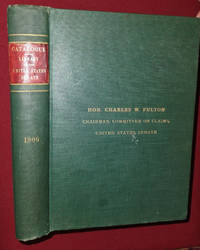
1906réf. 45681Washington: Government Printing Office. Very Good. First Edition Thus. Hardcover. 8vo; 508 pages; Original green library buckram red leather gilt-lettered label on the spine and the 1906 date of publication stamped in the center of the spine. There is a gilt-lettered stamping at the center of the front cover: "HON. CHARLES W. FULTON / CHAIRMAN COMMITTEE ON CLAIMS/ UNITED STATES SENATE." There is an oval rubber stamp on the title page: "Private Library of / Reed Paige Clark." The text is divided into three parts with three tabs of gilt-lettered brown leather glued to the fore-edges of sheets of pale blue stiff paper. The portions of the facing pages which touched any of these leather tabs is stained brown from contact with the acid which which the leather tabs were tanned. Otherwise an unmarked and well preserved copy. Senator Charles Fulton 1853-1918 served as a United States Senator from Oregon for a single term 1903-9. As stated on the front cover of this volume Fulton served as Chairman of the Senate Committee on Claims from 1905-9 Fifty-ninth and Sixtieth Congresses. Fulton left the Senate in 1909 and was succeded as Chairman of the Claims Committee by Senator Henry E. Burnham of New Hampshire 1844-1917 -- served as U.S. Senator 1901-1913. The eventual owner of this copy Reed Paige Clark 1878-1958 was born in New Hampshire and attended secondary schools in that state. He came to Washington at the end of the nineteenth century and became a student in the Columbian College now George Washington University in 1895. He took an A.B. degree from the College and an LLB from the Columbian Law School in 1901. He joined the U.S. Senate staff in that year serving as private secretary to Senator Burnham of N.H. Clark also served as Clerk to the Senate Committees on Claims -- also Industrial Exhibitions Cuban Relatons Agriculture and Forestry. It is not clear whether Senator Burnham or outgoing Claims Committee Chairman Fulton presented this copy to Reed Paige Clark. Clark left the staff of the Senate in 1911 to accept a Commission as General Receiver of Customs for the Republic of Liberia. He had a full and varied career in the U.S. Customs and Diplomatic Services. He was briefly in charge of the U.S. Embassy in Vienna Austria when the Ambassador was recalled after the Anschluss in 1938. He retired in 1944. . 1906. Government Printing Office hardcover
2002réf. 61975Washington DC: U. S. Government Printing Office 2002. Presumed first edition/first printing. Wraps. Very good. No dust jacket as issued. vi 558 p. Includes illustrations. S. Hrg. 107-315. These hearings were on the interaction between our environmental regulations and our nation's energy policy. U. S. Government Printing Office paperback
2006réf. 58747Washington DC: U. S. Government Printing Office 2006. Presumed First Edition First printing. Wraps. Very good. v 1 390 pages. Illustrations. Footnotes. References. Tabular Data. No dust jacket as issued. S. Hrg. 108-504. This hearing examined very high levels of lead in the public water supply of the District of Columbia with particular emphasis to the risk posed to children. From the hearing remarks by Senator Warner the acting Chair "My constituents particularly in Arlington County and the city of Falls Church because they are the primary customers of the Washington Aqueduct System along with the District of Columbia. The facts of this situation as they have unfolded over the past 2 months are really very disturbing. It is even more disturbing however that we and the public became aware of this ongoing problem only after reports in the local media. Every one of the government officials sitting before us on the first panel the EPA the Corps the Water and Sewer Authority had some measure of knowledge that testing showed some level of lead. That level we will hear more about today and that that water was used for drinking. The levels we understand here on the committee exceeded the Federal action levels. The rest we know there was no immediate action taken even though that knowledge was in the hands of responsible government officials. We will have the opportunity today to give a full explanation of that. While performing research into premature pipe corrosion for the District of Columbia Water and Sewer Authority WASA in 2001 Marc Edwards an expert in plumbing corrosion discovered lead levels in the drinking water of Washington D.C. at least 83 times higher than the accepted safe limit. He found that the decision to change from chlorine to chloramine as a treatment chemical had caused the spike in lead levels. The contamination has left thousands of children with lifelong health risks and led to a re-evaluation of the use of monochloramine in public drinking-water systems. After the Washington Post ran a series of front-page articles about Edwards's findings resulting in widespread public concern the United States House of Representatives conducted an investigation. The House found that the U.S. Centers for Disease Control and Prevention CDC had made "scientifically indefensible" claims in a report that had indicated there was no risk from the high lead levels. The Post investigation uncovered evidence of widespread misreporting of lead levels at water agencies across the United States leading to regulatory crackdowns and changes in Environmental Protection Agency policies. The problem was addressed in 2004 by adding additional treatments to the water preventing the chloramine from dissolving lead in the water mains solder joints and plumbing fixtures. U. S. Government Printing Office paperback
1945réf. 62738Washington DC: United States Government Printing Office 1945. Presumed first edition/first printing. Wraps. Fair. No dust jacket as issued. Stamps on front cover. Front cover worn torn and missing bottom right corner no loss of text. Tear at staple on last page. iii 29-141 p. This was one of several fact-finding hearings on the economic base for German aggression. Senator Kilgore stated that "Germany must be deprived of the devices and techniques whch she has used to menace world peace. Effective elimination of German econoic warfare is not only a first step toward national security but is indespensible to world prosperity. " United States Government Printing Office paperback
1978réf. 61976Washington DC: U.S. Government Printing Office 1978. Presumed first edition/first printing. Wraps. Good. No dust jacket as issued. Cover has some wear and soiling. Some corner creasing. iv 452 p.; 24 cm. Illustrations. These hearings addressed flexible and compressed work schedule options. U.S. Government Printing Office paperback
1979réf. 62008Washington: U.S. Government Printing Office 1979. Presumed first edition/first printing. Wraps. Very good. No dust jacket as issued. Item has light wear and soiling. Part I ONLY. iii 381. 23 cm. Illustrations. Maps. Serial No. 96-H9. The purpose of this hearing was to herar from people who have been directly affected by several different toxic waste dumps. In addition the Committee also heard from scientific and medical experts on the long-term consequences of such environmental 'catastrophes'. Then officers form the Environmental Protection provided their perspection on the socpe of the problem nationally. U.S. Government Printing Office paperback
1994réf. 62364Washington DC: U. S. Government Printing Office 1994. Presumed first edition/first printing. Wraps. Very good. No dust jacket as issued. 428 p. 103d Congress 2d Session Senate Report 103-317. Calendar No. 525. U. S. Government Printing Office paperback
1976réf. 67803Washington DC: U.S. Government Printing Office 1976. Presumed first edition/first printing. Wraps. Good. Letter J written in ink on front cover. Cover soiled and scuffed. VOLUME 1 ONLY. iv 245 pages. 24 cm. Title continues: "Storage of Toxic Agents September 16 17 and 18 1975." From a United States Senate website: "In 1973 CIA Director James Schlesinger told Senate Armed Services Chairman John Stennis that he wished to brief him on a major upcoming operation. No no my boy responded Senator Stennis. Don t tell me. Just go ahead and do it but I don t want to know. Similarly when Senate Foreign Relations Committee Chairman J.W. Fulbright was told of the CIA subversion of the Allende government in Chile he responded I don t approve of intervention in other people s elections but it has been a long-continued practice. Late in 1974 investigative reporter Seymour Hersh revealed that the CIA was not only destabilizing foreign governments but was also conducting illegal intelligence operations against thousands of American citizens. On January 27 1975 an aroused Senate voted overwhelmingly to establish a special 11-member investigating body along the lines of the recently concluded Watergate Committee. Under the chairmanship of Idaho Senator Frank Church with Texas Senator John Tower as vice-chairman the select committee was given nine months and 150 staffers to complete its work. The so-called Church Committee ran into immediate resistance from the Ford administration concerned about exposing American intelligence operations and suspicious of Church s budding presidential ambitions. The committee interviewed 800 individuals and conducted 250 executive and 21 public hearings. At the first televised hearing staged in the Senate Caucus Room Chairman Church dramatically displayed a CIA poison dart gun to highlight the committee s discovery that the CIA directly violated a presidential order by maintaining stocks of shellfish toxin sufficient to kill thousands. Lacking focus and necessarily conducting much of its work behind closed doors the panel soon lost any hope of becoming a second Watergate Committee. Critics from Bing Crosby to Paul Harvey accused it of treasonous activity. The December 1975 assassination of a CIA station chief in Greece intensified the public backlash against its mission. The panel issued its two-foot-thick final report in May 1976 without the support of influential Republican members John Tower and Barry Goldwater. Despite its shortcomings the inquiry demonstrated the need for perpetual surveillance of the intelligence community and resulted in the creation of the permanent Select Committee on Intelligence. Historian Henry Steele Commager assessed the Committee s legacy. Referring to executive branch officials who seemed to consider themselves above the law he said It is this indifference to constitutional restraints that is perhaps the most threatening of all the evidence that emerges from the findings of the Church Committee. " From Wikipedia: "The Church Committee was the United States Senate Select Committee to Study Governmental Operations with Respect to Intelligence Activities a U.S. Senate committee chaired by Senator Frank Church D-ID in 1975. A precursor to the U.S. Senate Select Committee on Intelligence the committee investigated intelligence gathering for illegality by the Central Intelligence Agency CIA National Security Agency NSA and Federal Bureau of Investigation FBI after certain activities had been revealed by the Watergate affair. By the early years of the 1970s the unpopularity of the Vietnam War and the unfolding Watergate scandal brought the era of minimal oversight to an abrupt halt. The United States Congress was determined to rein in the Nixon administration and to ascertain the extent to which the nation's intelligence agencies had been involved in questionable if not outright illegal activities. A series of troubling revelations started to appear in the press concerning intelligence activities. First came the revelations of Christopher Pyle in January 1970 of the U.S. Army's spying on the civilian population and Sam Ervin's Senate. U.S. Government Printing Office paperback
1944réf. 70408Washington DC: United States Government Printing Office 1944. Presumed first edition/first printing. Wraps. Good. Cover has some wear and soiling/foxing. Pencil erasure residue on t-p. v 1 581 1 p. Tables. Title continues: "of the National Defense Program: Third Annual Report Reported under authority of the order of the Senate of March 3 legislative day February 7 by Mr. Truman". 78th Congress 2d Session Senate Report No. 10 Part 16. United States Government Printing Office paperback
1980réf. 62324Washington DC: U.S. Government Printing Office 1980. Presumed first edition/first printing. Wraps. Very good. No dust jacket as issued. v 685 p. 24 cm. This hearing was in part driven by the recommentation of the Privacy Protection Study Commission that legislation was needed to better protect the confidentiality of health records. U.S. Government Printing Office paperback
1978réf. 62301Washington DC: U.S. Government Printing Office 1978. Presumed first edition/first printing. Wraps. Good. No dust jacket as issued. Sticker residue on front cover. iv 542 p.; 24 cm. Exhibits. This hearing was held on the premise that "The Inspector General bill focuses attention on the fact that Federal departments and agencies ahve long been deficient in the way they manitain financial accounts and records and in failing to audit them properly. A report was prepared for this subcommittee by the General Accounting Office. This report found that approximately one-third of the agencies it surveyed did not receive a proper financial audit during fiscal years 1974 1975 or 1976. " U.S. Government Printing Office paperback
1986réf. 67457Washington: U.S. G.P.O. 1986. Wraps. Good. Inkinitials on front cover. iv 681 p. 24 cm. Illustrations Maps. Title continues: "Ninety-ninth Congress First Session on S. 1517 and S. 1578 October 8 1985. S. Hrg. 99-349. This joint hearing was convened to address the serious issue of low-level radioactive waste disposal. The states had been negotiating regional compacts. The hearing was for the purpose of assisting the consideration of what courses of action the Congress should take with regard to those compacts that had been submitted to the Congress and to determine what interim measures might be taken to ensure that the remaining states moved forward to assume responsiblity for the wasts generated in their States. U.S. G.P.O. paperback
2005réf. 62736Washington DC: U.S. Government Printing Office 2005. Presumed first edition/first printing. Wraps. Very good. No dust jacket as issued. v 535 p. Includes illustrations. Occasional footnotes. S. Hrg. 109-544. This hearing looked at the issues of waste fraud and abuse which were seen as threatening both the financial sustainability and the quality of health care provided by Medicaid. In 2003 Medicaid was listed by the Government Accountability Office as a high-risk program. This hearing record contains a significant amount of data and a variety of perspectives. U.S. Government Printing Office paperback
1968réf. 70342Washington: U.S. Government Printing Office 1968. Presumed first edition/first printing. Wraps. Good. Signed by previous owner. Cover has some wear and soiling. iv 300 p. Title continued: "17 1968". From Wikipedia: "The Treaty on the Non-Proliferation of Nuclear Weapons commonly known as the Non-Proliferation Treaty or NPT is an international treaty whose objective is to prevent the spread of nuclear weapons and weapons technology to promote cooperation in the peaceful uses of nuclear energy and to further the goal of achieving nuclear disarmament and general and complete disarmament. Opened for signature in 1968 the Treaty entered into force in 1970. On 11 May 1995 the Treaty was extended indefinitely. More countries have adhered to the NPT than any other arms limitation and disarmament agreement a testament to the Treaty's significance. A total of 191 states have joined the Treaty though North Korea which acceded to the NPT in 1985 but never came into compliance announced its withdrawal in 2003. Four UN member states have never joined the NPT: India Israel Pakistan and South Sudan. The treaty recognizes five states as nuclear-weapon states: the United States Russia the United Kingdom France and China also the five permanent members of the United Nations Security Council." U.S. Government Printing Office paperback
1980réf. 62537Washington DC: U.S. Government Printing Office 1980. Presumed first edition/first printing. Wraps. Fair. No dust jacket as issued. Cover has some tears/chips/scuffs at front. with minor damage to following page. Rear cover chipped and creased. v 653 p. 24 cm. Illustrations. This hearing focussed attention on regulatory reform specifically agency compliance with Executive Order 12044 and the two-part agency report card that had been released shortly prior to the hearing by the Office of Management and Budget. U.S. Government Printing Office paperback
2000réf. 62779Washington DC: U.S. Government Printing Office 2000. Presumed first edition/first printing. Wraps. Very good. No dust jacket as issued. v 222 p. Includes illustrations. Footnotes. S. Hrg. 106-842. Medicare paid for medically necessary prescription drugs provided to inpatients of hospitals or skilled nursing facilities. At the time of the hearing Medicare was spending over $3 billion annually for this coverage. The Congress was interested in addressing Medicare outpatient prescription drug coverage. The Chairman wanted to be careful not to displace existing privately offered drug coverage. U.S. Government Printing Office paperback
1992réf. 63485U.S. Government Printing Office 1992. Presumed first edition/first printing. Wraps. Good. No dust jacket as issued. Highlighting/underlining. Three letters written in red on front cover. Some yellow highlighting noted on page one. vii 577 p. Illustrations. S. Hrg. 102-721. This hearing addressed legislation proposed by Senators David Boren and Arlen Specter. The legislation would require the Government to release records to the American public which are relevant to the assassination of President John F. Kennedy. The bill would have created a presumption on releasing documents. U.S. Government Printing Office paperback
1982réf. 70405Washington: U.S. Government Printing Office 1982. Wraps. Good. No dust jacket. Pencil erasure residue on cover. Some curling at the top corner. Item has some wear and soiling. v 1 232 2 p. 24 cm. Illustrations. Title continues: "nuclear arms January 20 21 and 25 1982. From Wikipedia: "Arms control is a term for international restrictions upon the development production stockpiling proliferation and usage of small arms conventional weapons and weapons of mass destruction. Arms control is typically exercised through the use of diplomacy which seeks to impose such limitations upon consenting participants through international treaties and agreements although it may also comprise efforts by a nation or group of nations to enforce limitations upon a non-consenting country." U.S. Government Printing Office paperback
2008réf. 66628Washington DC: U. S. Government Printing Office 2008. Presumed first edition/first printing. Wraps. Good. No dust jacket. iii 249 p. Illustrations. S. Hrg. 110-633. From Wikipedia: "The United States Department of Homeland Security DHS is a cabinet department of the United States federal government created in response to the September 11 attacks and with the primary responsibilities of protecting the United States of America and U.S. Territories including Protectorates from and responding to terrorist attacks man-made accidents and natural disasters. Despite the Department of the Interior's name DHS is the equivalent to the Interior ministries of other countries not the Department of the Interior. In fiscal year 2011 DHS was allocated a budget of $98.8 billion and spent net $66.4 billion. Where the Department of Defense is charged with military actions abroad the Department of Homeland Security works in the civilian sphere to protect the United States within at and outside its borders. Its stated goal is to prepare for prevent and respond to domestic emergencies particularly terrorism. On March 1 2003 DHS absorbed the Immigration and Naturalization Service and assumed its duties. In doing so it divided the enforcement and services functions into two separate and new agencies: Immigration and Customs Enforcement and Citizenship and Immigration Services. The investigative divisions and intelligence gathering units of the INS and Customs Service were merged forming Homeland Security Investigations. Additionally the border enforcement functions of the INS including the U.S. Border Patrol the U.S. Customs Service and the Animal and Plant Health Inspection Service were consolidated into a new agency under DHS: U.S. Customs and Border Protection. The Federal Protective Service falls under the National Protection and Programs Directorate. With more than 200 000 employees DHS is the third largest Cabinet department after the Departments of Defense and Veterans Affairs. Homeland security policy is coordinated at the White House by the Homeland Security Council. Other agencies with significant homeland security responsibilities include the Departments of Health and Human Services Justice and Energy. According to the Homeland Security Research Corporation the combined financial year 2010 state and local HLS markets which employ more than 2.2 million first responders totaled $16.5 billion whereas the DHS HLS market totaled $13 billion. According to the Washington Post "DHS has given $31 billion in grants since 2003 to state and local governments for homeland security and to improve their ability to find and protect against terrorists including $3.8 billion in 2010." According to Peter Andreas a border theorist the creation of DHS constituted the most significant government reorganization since the Cold War and the most substantial reorganization of federal agencies since the National Security Act of 1947 which placed the different military departments under a secretary of defense and created the National Security Council and Central Intelligence Agency. DHS also constitutes the most diverse merger of federal functions and responsibilities incorporating 22 government agencies into a single organization." Also from Wikipedia: Michael Chertoff born November 28 1953 was the second United States secretary of homeland security under President George W. Bush and co-author of the USA PATRIOT Act. He previously served as a judge on the United States Court of Appeals for the Third Circuit as a federal prosecutor and as Assistant U.S. Attorney General. He succeeded Tom Ridge as United States secretary of homeland security on February 15 2005. Since leaving government service Chertoff has worked as senior of counsel at the Washington D.C. law firm of Covington & Burling. He also co-founded the Chertoff Group a risk-management and security consulting company which employs several senior officials from his time as secretary of homeland security as well as Michael Hayden a former director of the National Security Agency and the Central. U. S. Government Printing Office paperback
2009réf. 64854Washington DC: U.S. Government Printing Office 2009. Presumed first edition/first printing. Wraps. Good. No dust jacket as issued. Minor chip on front edge. iii 124 p. S. Hrg. 111-189. The hearing was called to recieve testimony on the incidence of suicides amongunited states servicemembers and initiatives within the Services and the Department of Defense to prevent military suicides. The Subcommittee was alarmed at the rising suicide rates by military servicemembers. The Chairman while recognizing the focused efforts underway felt that more needed to be done to prevent military suicides. U.S. Government Printing Office paperback
1978réf. 62351Washington DC: U.S. Government Printing Office 1978. Presumed first edition/first printing. Wraps. Good. No dust jacket as issued. Cover has some wear and soiling. Some warping/undulation. iv 255 p. 24 cm. Illustrations. Bibliography. This hearing was on S. 3227 a bill that would authorize the established of 10 therapeutic communities in facilities administered by the Federal Bureau of Prisons for a trial period. U.S. Government Printing Office paperback
1979réf. 61974Washington DC: U. S. Government Printing Office 1979. Presumed first edition/first printing. Wraps. Good. No dust jacket as issued. Cover has some wear soiling and corner creases. viii 524 p. Occasion footnotes. 96th Congress 1st Session Senate Report No. 96-249. Calendar No. 261. U. S. Government Printing Office paperback
2002réf. 76905Washington DC: U. S. Government Printing Office 2002. Presumed First Edition First printing. Wraps. Good. iv 272 4 pages. S. Hrg. 107-622. The Chairman stated that these hearings were to begin its consideration of the Strategic Offensive Reductions Treaty SORT which the President submitted to the Senate on June 20 2002for its advice and consent to ratification. It was hoped that the treaty signed in May by Presidents Bush and Putin was a very important step forward in U.S>-Russian relations and toward a mores secure world. Cutting the number of each country's deployed strategic nuclear warheads from approximately 6000 to between 1700 and 2200 could move the U.S. another step away from the cold war preparations for massive nuclear exchange. The Treaty Between the United States of America and the Russian Federation on Strategic Offensive Reductions SORT also known as the Treaty of Moscow was a strategic arms reduction treaty between the United States and Russia that was in force from June 2003 until February 2011 when it was superseded by the New START treaty. At the time SORT was positioned as "representing an important element of the new strategic relationship" between the two countries with both parties agreeing to limit their nuclear arsenal to between 1700 and 2200 operationally deployed warheads each. It was signed in Moscow on 24 May 2002. After ratification by the U.S. Senate and the State Duma SORT came into force on 1 June 2003. It would have expired on 31 December 2012 if not superseded by New START. Either party could have withdrawn from the treaty upon giving three months written notice to the other. U. S. Government Printing Office paperback
1987réf. 61122Washington DC: U. S. Government Printing Office 1987. Hardcover. Good. No dust jacket as issued. Cover has some wear and soiling. vi 93 p. 24 cm. Portraits. U. S. Government Printing Office hardcover
1978réf. 63057Washington DC: U. S. Government Printing Office 1978. Presumed first edition/first printing. Wraps. Good. iv 194 p.; 24 cm. Tables. Among the organizations providing witnesses were: American Farm Bureau Federation Professional Drivers Council National Association of Regulatory Utility Commissioners Federal Highway Administration National Transportation Safety Board Private Truck Council of America American Trucking Associations Inc. Minor wear and soiling noted. Serial No. 95-132. This is a hearing on S.2970 the Truck Safety Act of 1978. This legislation was introduced by Senator Charles Percy and its purpose was to strengthen the power of the Federal Government in the truck safety area. Despite the scope of these truck safety problems S. 2970 goes beyond he issue of truck safety to apply to the safety of operation of all commercial motor vehicles over 10000 pounds gross vehicle weight rating. Thus this legislation would address the regulation of buses farm equipment and all other commercial vehicles above 10000 gross vehicle weight. In the course of these hearings the committee will be particularly interested in analyzing the adequacy of the Federal regulation of the commercial motor vehicles and what if anything is necessary in order to strengthen these programs. The committee is also concerned about how Federal programs interact with State regulation of commercial motor vehicles and whether this relationship is operating smoothly and effectively. As part of this overall examination the committee will seek to determine whether the funding and manpower allocated to these programs is adequate to carry out these important functions. The committee will also focus on how priorities are set in the regulation of commercial vehicles and what method of initiating investigations of improper behavior in this area would be most effective. n examining these issues the committee is fortunate to be receiving testimony today from an extremely wide spectrum of witnesses drawn from the Federal Government State agencies private trucking organizations farm representatives and private experts. U. S. Government Printing Office paperback