3 918 résultats
1960réf. 65381Washington DC: United States Government Printing Office 1960. Presumed first edition/first printing. Wraps. Fair. No dust jacket as issued. Ink notation on spine. Large tear/chip at bottom of spine impacting front and back covers repaired with tape. Some discoloration of the color. Pencil notation on front cover. Printing flaw at page 121/2 text complete. vi 520 p. Occasional footnotes. Summary index. S. Res. 94 was a resooluton to amend S. Res. 196 79th Congress 2d Session relationg to the recognition of the Jurisdiction of the International Court of Justice in certain Legal disputes January 27 and February 17 1960. This Hearing considered an amendment that would have the effect of deleting the so-called Connally amendment for the 1946 resolution authorizing U.S. acceptance of the compulsory jurisdition provisions of the Statute of the International Court of Justice under certain conditions. The Connally amendment inserted into the ratification the words "as determined by the United States". Without the Connally amendment questions of whether a particular issue before the Count might be essentially within the domestic jurisdiction of a State would be settled by a decision of the Court. United States Government Printing Office paperback
1980réf. 63934Washington DC: U.S. Government Printing Office 1980. Wraps. Good. No dust jacket as issued. Has some wear and soiling. iv 213 p.; 24 cm. Serial No. 96-45. This nomination was controversial with significant opposition from the Hispanic community. U.S. Government Printing Office paperback
2006réf. 63958Washington DC: U.S. Government Printing Office 2006. Presumed first edition/first printing. Wraps. Good. No dust jacket as issued. iii 385 p. Includes illustrations. S. Hrg. 109-846. This hearing examined domestic efforts to promote early diagnosis of HIV infection and ensure access to AIDS treatment. U.S. Government Printing Office paperback
1998réf. 63288Washington DC: U.S. Government Printing Office 1998. Presumed first edition/first printing. Wraps. Very good. No dust jacket as issued. iv 179 p. Illustrations. Occasional footnotes. S. Hrg. 105-703. This hearing looked at the effect of the measures taken after the first World Trade Center bombing of February 26 1993. This was about 3 and a half years before the Al Qaeda simultaneous attacks on New York City and Washington DC. U.S. Government Printing Office paperback
1987réf. 65780Washington DC: U.S. Government Printing Office 1987. Wraps. Good. No dust jacket as issued. Highlighting/underlining. Ink notation on spine. Contains underlining and other ink marks by a former Intelligence and National Security reporter for Time Inc. iii 186 p. : 1 form; 24 cm. S. Hrg. 100-241. This is the record of the hearings held for the purpose of considering the nomination of Mr. Robert M. Gates to be the Director of Central Intelligence. The Chairman expressed the hope that "the confirmation process.will materially contribute to restoring coherence bipartisanship and professionalism to American foreign policy and the intelligence gathering process which supports it." This includes MR. Gates' financial disclosure report. U.S. Government Printing Office paperback
1973réf. 68107Washington DC: U.S. Government Printing Office 1973. Presumed first edition/first printing. Wraps. Good. Rear cover and several back pages bent. Cover has some wear and soiling. iii 287 p. Title continues: 'May 9 10 14 15 21 and 22 1973" From Wikipedia: "Elliot Lee Richardson July 20 1920 December 31 1999 was an American lawyer and politician who was a member of the cabinet of Presidents Richard Nixon and Gerald Ford. As U.S. Attorney General he was a prominent figure in the Watergate Scandal and resigned rather than obey President Nixon's order to fire special prosecutor Archibald Cox. Richardson served as Secretary of Health Education and Welfare from 1970 to 1973 Secretary of Defense from January to May 1973 Attorney General from May to October 1973 and Secretary of Commerce from 1976 to 1977. That makes him one of only two individuals to have held four Cabinet positions within the United States government the other such individual being George Shultz." U.S. Government Printing Office paperback
1991réf. 65778Washington DC: U.S. Government Printing Office 1991. Wraps. Good. No dust jacket as issued. Cover has some wear and soiling. Edge tear at from page. Ink notation on spine. 225 p. 102d Congress 1st Session Senate Exec. Rept. 102-19. This is the Committee's favorable report on and recommendation of Robert M. Gates to be confirmed by the Senate at Director of Central Intelligence. U.S. Government Printing Office paperback
1955réf. 62750Washington DC: United States Government Printing Office 1955. Presumed first edition/first printing. Wraps. Good. No dust jacket as issued. Cover has some wear soiling and edge tear at top. iii 93 p. This hearing examined Protocol Executive L which had the effect of giving the Federal Republic of German full authority over its internal and external affairs. The second protocol had the effect of agreeing to the Federal Republic of Germany joining the North Atlantic Treaty Organization. United States Government Printing Office paperback
1979réf. 90557Washington DC: U. S. Government Printing Office 1979. Presumed First Edition First printing. Wraps. Good. 52 4 pages This Report expresses the approval of the Senate of the Department of Energy Standby Gasoline Rationing Plan No. 1. It addresses the Purpose of the Measure; Background and Need Legislative History and Committee Recommendation Cost and Budgetary Considerations Regulatory Impact Evaluation and Executive Communications. Rationing Plan No. 80-1 issued by the Office of Regulations and Emergency Planning Economic Regulatory Administration U.S. Department of Energy. The objectives of the rationing plan are to provide a mechanism capable of maintaining an orderly and equitable market for gasoline in a severe supply shortfall and capable of rapid implementation; and to comply with requirements of EPCA which mandates the development of a contingency rationing plan. Eligibility for ration allotments will be based principally on motor vehicle registration records maintained in a national vehicle registration file. Supplemental allotments will be granted for certain priority activities to ensure the maintenance of essential public services. Supplemental allotments will also be granted to businesses and government organizations with significant off-highway gasoline requirements. Local rationing boards or other offices will be established by states to provide special allotments to hardship applicants within DOE guidelines. The background and history of the plan are described. The Economic Regulatory Administration issues rules with respect to standby gasoline rationing. The plan is designed for and would be used only in the event of a severe gasoline shortage. The plan provides that eligibility for ration allotments will be primarily on the basis of motor vehicle registrations. DOE will mail government ration checks to the parties named in a national vehicle registration file to be maintained by DOE. Ration recipients may cash these checks for ration coupons at various designated coupon issuance points. Retail outlets and other suppliers will be required to redeem the ration coupons received in exchange for gasoline sold. Supplemental gas will be given to high-priority activities. A ration banking system will be established with two separate and distinct of ration accounts: retail outlets and other suppliers will open redemption accounts for the deposit of redeemed ration rights; and individuals or firms may open ration rights accounts which will operate in much the same manner as monetary checking accounts. A white market will be permitted for the sale of transfer of ration rights. A percentage of the total ration rights to be issued will be reserved for distribution to the states as a State Ration Reserve to be used by the states primarily for the relief of hardship. A National Ration Reserve will also be established. U. S. Government Printing Office paperback
2008réf. 64602Washington DC: U.S. Government Printing Office 2008. Presumed first edition/first printing. Wraps. Very good. No dust jacket as issued. iii 213 p. Includes illustrations. S. Hrg. 108-925. In this hearing the Judiciary Committee began its discussion of the portions of the 9/11 Commission's report and recommendations that related to areas under the Committee's jurisdiction such as border security and the rold of the FBI in the field of counterintelligence. U.S. Government Printing Office paperback
1979réf. mon0003412379Armed Services Comittee United 1979. Pamphlet. Very Good. . Armed Services Comittee, United unknown
1996réf. 76713Washington DC: U. S. Government Printing Office 1996. Presumed First Edition First printing. Wraps. Very good. iv 443 1 pages. Footnotes. Illustrations. COver has slight edgewear other wear and soiling. When this hearing was held the United States had exported nuclear materials equipment and technologies to the member states of the European Atomic Energy Community known as EURATOM for more than 35 years. This cooperation had been governed by an agreement for cooperation in the peaceful uses of nuclear energy which was first concluded in 1958 and had been amended several times. An agreement was reached to replace the agreement with a new one which was approved by the General Affairs Council of the European Union and by President Clinton. The Senate hearing was to consider the content and merits of the new agreement. U. S. Government Printing Office paperback
2006réf. 66482Washington DC: U.S. Government Printing Office 2006. Presumed first edition/first printing. Hardcover. Good. No dust jacket. Ex-library. Usual library markings. Cover has some wear and soiling. xvii 3 499 p. Includes illustrations. Oversized. Some illustrations in color. Selected Bibliography. Index of Artists & Subjects. Esasays by Diane K. Skvarla and Donald A. RItchie. 109th Congress 1st Session Senate Document 109-2. From the Senate website: " The United States Catalogue of Graphic Art marks the first comprehensive publication of the approximately 1 000 prints that constitute the Senate's collection. Offering a variety of perspectives on the Senate of the 19th and 20th centuries the prints provide insight into a time quite different than the media-saturated world of today. While politics was a major topic in the post-Revolutionary War press limitations in printing technology meant that engravings or other visuals were uncommon. Thus most people formed their views of the new government through written or oral sources. However in 1839 with the introduction of the daguerreotype the country was familiarized with the faces of notable senators such as Henry Clay Daniel Webster and John C. Calhoun. By the early 1850s further innovation in engraving procedures enabled publishers to create engravings in hours rather than days or weeks. At the same time the growth of railroads and improvements in roads allowed for relatively rapid distribution of illustrated magazines such as Harper's Weekly The Graphic Puck and Frank Leslie's Illustrated Newspaper and for the first time readers could "see" an event within a week and later within days of it happening. Like the print and broadcast media of today these illustrated news magazines included both hard news and softer features and the graphic art catalogue reflects this coverage mix. The catalogue includes prints depicting important events of the day such as the debate over slavery the impeachment trial of Andrew Johnson and presidential inaugurations. But also featured are prints capturing the daily rhythms of the Senate such as the crowded Capitol corridors Senate pages delivering documents lobbyist pleading their case meals in the Senate dining room and idyllic scenes of the Capitol building and grounds. The catalogue is organized into eight thematic chapters: Senate Chamber Capitol Interior Capitol Exterior & Grounds Senate Art Portraits Group Portraits Beyond Capitol Hill and Political Cartoons & Caricatures. Detailed information is given for each print including title creator date of publication printing technique and dimensions. In addition accompanying approximately 30 prints are short essays giving background and context for the scene people or events depicted in the illustration. For the chapter on political cartoons which includes the work of such notable artists as Thomas Nast and Joseph Keppler there is an introductory essay as well as brief commentaries on 15 cartoons. This catalogue will undoubtably become a valuable resource for anyone wanting to learn more about the history of the Senate the Capitol and American political history." From Wikipedia: "The United States Senate Curator is an employee of the United States Senate who is responsible for developing and implementing the museum and preservation programs for the Senate Commission on Art. The Curator Office collects preserves and interprets the Senate's fine and decorative arts historic objects and architectural features. Through exhibits publications and other programs the Office educates the public about the Senate and its collections. The current curator is Diane K. Skvarla." U.S. Government Printing Office hardcover
1902réf. 343885Washington DC: Government Printing Office 1902. Hardcover. 509p. first edition bound in half-leather which is rubbed marbled end papers last few pages have some wrinkling otherwise in very good condition. 57th Congress 1st session. Senate Rept. 776 part 2. Government Printing Office hardcover books
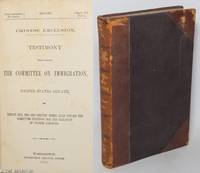
1981réf. 91175Washington DC: U.S. Government Printing Office 1981. Presumed First Edition First Printing. Wraps. Very good. iv 120 1 pages. Wraps. Tabular Data. The 1981 Senate hearings regarding the implementation of the nine-digit ZIP code ZIP4 were marked by intense debate over automation costs and mandatory versus voluntary usage. The hearings primarily held before the Subcommittee on Civil Service Post Office and General Services aimed to address public and Congressional concerns that the system was premature and overly burdensome. A major focus was ensuring the new longer code would be voluntary specifically for residential users to alleviate public fear of forced compliance. Postmaster General Bolger testified that he supported making it voluntary except for bulk mailers seeking discounts. Critics in the Senate such as Senator David Durenberger and Senator Roger Jepsen argued that the system was not fully tested might increase costs and that the public did not want it. The program was designed to cut costs through automated mail sorting using optical character readers OCRs. In April 1981 Congress considered legislation to block the June 1 1981 implementation date proposed by the Postal Service with leaders calling for a cost-benefit analysis. Despite the contention the Senate moved forward with the program with the legislative battle continuing through the end of the year eventually leading to the authorization of the program by late 1981 with full implementation planned for subsequent years. The hearings highlighted the transition from manual to automated mail processing and the friction caused by requiring the public to adopt a more detailed addressing system. The nine-digit zip code ZIP4 was introduced by the USPS in 1983 to improve mail sorting automation and speed up delivery. It adds a four-digit suffix to the original five-digit code identifying specific geographic segments—such as a city block apartment building or individual high-volume receiver. The first five digits define the region and local post office. The added 4 indicates a sector several blocks and a segment one side of a street. The system allows automated machinery to sort mail to smaller more precise delivery areas reducing manual handling. While proposed earlier the extended code was officially introduced in 1983. Initial uptake was slow due to a at the time small incentive for large-scale mailers. It provided increased accuracy faster delivery times sometimes up to two days faster and reduced costs for bulk mailers. While not mandatory for citizens it is heavily used by businesses for address verification mailing efficiency and better logistical analytics. The system evolved from the original 1963 five-digit Zone Improvement Plan ZIP to handle growing mail volumes. U.S. Government Printing Office paperback
1980réf. 91177Washington DC: U.S. Government Printing Office 1980. Presumed First Edition First Printing. Wraps. Very good. iii 1 196 pages. Wraps. The Senate Committee on Governmental Affairs held a hearing on November 20 1979 regarding the transfer of authorities for implementing Building Energy Performance Standards BEPS. This hearing often linked to S. 1604 focused on shifting responsibility for implementing energy standards for new buildings mandated by the 1976 Energy Conservation and Production Act. The hearing addressed the transfer of authority for implementing mandatory energy performance standards for new commercial and residential buildings. The discussions related to implementing energy conservation measures to reduce petroleum and natural gas dependence often associated with the oversight of standards mandated by Congress in the mid-1970s. The debate followed the 1976 Act Pub.L. 94-385 which required energy standards for new buildings. This period was characterized by federal attempts to strengthen energy conservation in the built environment through mandated standards which were later further developed in the early 1980s. Among the witnesses were Donald Carter Richard Fleming William Hanna Jr. Clinton Phillips Richard Rowberg Maxine Savitz John Sawhill Herman Smith and Grant Thompson. The transfer of authorities for implementing Building Energy Performance Standards BEPS involves shifting regulatory oversight to specialized environmental agencies such as in Maryland where the Department of the Environment establishes standards or in Montgomery County where the Department of Environmental Protection DEP manages compliance to achieve net-zero goals. These actions often transition authority from local departments to specialized energy/environmental departments to ensure adherence to energy reduction goals such as mandatory retrofits by 2040 and phased reporting for owners. These transfers often occurring through state or local legislation are intended to provide the necessary legal technical and regulatory infrastructure to achieve local or federal climate goals such as those mandated by Executive Order 14057 for federal buildings. U.S. Government Printing Office paperback
1973réf. 48505Washington DC: GPO 1973. First Edition. First Printing. good. 24 cm 340 wraps stiff paper covers illus. covers somewhat worn and soiled. Hearings held on May 9 10 and 11 1972. GPO paperback
2006réf. 47960Washington DC: GPO 2006. First Edition. First Printing. very good. 497 wraps illus. S. Hrg. 109-247. GPO paperback
1982réf. 52253Place_Pub: Washington DC: GPO 1982. good. 188 Part I only wraps figures tables crease to front cover and a few pages The purpose of this hearing was to lay out for the record the extent of protectionist barriers to U.S. exports and therefore to give American negotiators additional ammunition to combat them. This hearing focused on the service industries--data processing banking and insurance. GPO paperback
2003réf. 49176Washington DC: GPO 2003. good. 702 & 1012 2-vol. set wraps figures tables appendices v.1 rear cover and several pages creased in lower corner S. Hrg. 107-871. Hearing on deceptive transactions from December 2000 to June 2001 involving Enron ventures in the pulp and paper business. Citigroup and Chase actively aided Enron in these transactions despite knowing that they employed deceptive accounting or tax strategies. Volume I contains opening statements witness testimony an appendix and Exhibits 301-370; Volume II contains Exhibits 371-392. GPO paperback
2003réf. 51807Place_Pub: Washington DC: GPO 2003. very good. 183 wraps footnotes figures tables lower corner front cover bent. S. Hrg. 107-857. Complete subtitle: Hearing on the issues surrounding the uses and misuses of yield spread premiums in light of the Department of Housing and Urban Development's announced intention of putting out a proposed rule on the Real Estate Settlement Procedures Act. GPO paperback
1979réf. 52227Place_Pub: Washington DC: GPO 1979. good. 445 wraps tables slight wear and discoloration to cover edges slight waviness to entire document. Complete subtitle: Hearings on S. 377 S. 891 S. 937 S. 1471 S. 1493 and Reorganization Plan No. 3 of 1979. GPO paperback
1906réf. 45295Washington DC: GPO 1906. Third Edition. fair. 179 illus. including many fold-outs index ink notation on front endpaper front board somewhat weak tear at bottom of title pg boards somewhat worn and soiled. Fifth-seventh Congress First Session Senate Report No. 166. Contains: I.--Report of the Senate Committee on the District of Columbia and II.--Report of the Park Commission. GPO hardcover
1979réf. 49298Washington DC: GPO 1979. fair to good. 551 wraps figures tables covers worn front cover creased first 50 pages curled. Exec. Rept. No. 96-14. Topics covered include summary of SALT II Agreement Committee consideration Committee action Committee comments background and context major issues including legal and procedural issues strategic balance and military issues verification SALT and the Allies U.S. -Soviet relations and SALT and arms control section-by-section analysis of the SALT II Agreement budget impact statement summary statements of Committee members supplemental views and minority views. GPO paperback
1969réf. 87530Washington DC: U. S. Government Printing Office 1969. Presumed First Edition First printing. Wraps. Good. v 1 363 3 pages. Maps. Tabular data. Some page discoloration noted. The key witnesses were: Lt. Gen. Francis C. Gideon; Rear Adm. Draper L. Kauffman; Col. Ernest W. Pate; Lt. Gen. Robert H. Warren; and James M. Wilson. The hearings of the Subcomittee were designed to detail on a country-by-country basis United States programs personnel and facility in the troubled Far East excluding Vietnam. Their aim with the help of Administration witnesses was to gather for the Senate the best and most complete information available; and to this end Messrs. Pincus and Paul of the Subcommittee staff had already spent seven months gathering inforamtion.Becasue of the national security implications of some of the information to be dwelt on and in order to permit frank discussion of all pertinent matters the initial fact finding hearings were to be held in executive session. Let it be noted however that as complete a record as security consideration permit will be released to the public as rapidly as possible. U. S. Government Printing Office paperback