3.853 Ergebnisse
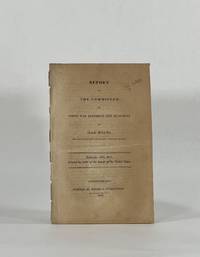
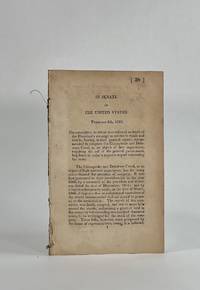
1816Best.-Nr. 8862Washington: William A. Davis 1816. Disbound. near Very Good binding. Octavo. 39 1 pp. First edition. Removed from volume. Toning throughout with occasional early tidelines in a few margins. Generally a reasonable copy. "Presumably printed by William A. Davis printer to the Senate during the first session of the Fourteenth Congress. Includes on p. 7-39 the report of the Senate committee on the memorial of the president and directors of the Chesapeake and Delaware Canal Company dated March 21st 1806; the memorial of the president and directors of the Chesapeake and Delaware Canal Company dated December 1st 1805; and 'Observations respecting the Chesapeake and Delaware Canal' of the same date and also by the president and directors" Shaw & Shoemaker 39394. [William A. Davis?] unknown
1830Best.-Nr. 8881Washington 1830. Disbound. Good binding. Octavo. 80 pp. Removed from volume the document proper is preceded by three blank leaves one with extensive writing by an early hand. Ink numeral in the top margin of the title page; foxed and dog-eared. Consists of the article of impeachment exhibited against District Judge James H. Peck in the House of Representatives the answer of James H. Peck and related documents. Peck was charged with exceeding his contempt powers by imprisoning and causing the suspension of a lawyer who had written an article critical of the judge. Senate failed to convict on a vote of 21 to 22. unknown
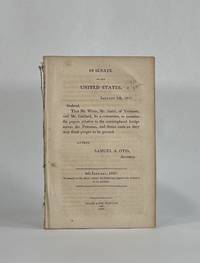
1811Best.-Nr. 9031Washington City: Roger C. Weightman 1811. Disbound. near Very Good binding. Octavo. 10 2 pp. Removed from binding. Title page is evenly toned else clean and generally quite nice. This memorial requests relief in settlement of the late "Mad" Anthony Wayne's accounts with the United States. Shaw & Shoemaker 24032. Roger C. Weightman unknown
1807Best.-Nr. 9005Washington City: Duane & Son 1807. Disbound. Very Good binding. Octavo. 49 1 pp. Removed from volume. Light toning throughout but generally quite clean. Uncommon document related to early Washington infrastructure. Shaw & Shoemaker 13910. Duane & Son unknown
1980Best.-Nr. 91177Washington DC: U.S. Government Printing Office 1980. Presumed First Edition First Printing. Wraps. Very good. iii 1 196 pages. Wraps. The Senate Committee on Governmental Affairs held a hearing on November 20 1979 regarding the transfer of authorities for implementing Building Energy Performance Standards BEPS. This hearing often linked to S. 1604 focused on shifting responsibility for implementing energy standards for new buildings mandated by the 1976 Energy Conservation and Production Act. The hearing addressed the transfer of authority for implementing mandatory energy performance standards for new commercial and residential buildings. The discussions related to implementing energy conservation measures to reduce petroleum and natural gas dependence often associated with the oversight of standards mandated by Congress in the mid-1970s. The debate followed the 1976 Act Pub.L. 94-385 which required energy standards for new buildings. This period was characterized by federal attempts to strengthen energy conservation in the built environment through mandated standards which were later further developed in the early 1980s. Among the witnesses were Donald Carter Richard Fleming William Hanna Jr. Clinton Phillips Richard Rowberg Maxine Savitz John Sawhill Herman Smith and Grant Thompson. The transfer of authorities for implementing Building Energy Performance Standards BEPS involves shifting regulatory oversight to specialized environmental agencies such as in Maryland where the Department of the Environment establishes standards or in Montgomery County where the Department of Environmental Protection DEP manages compliance to achieve net-zero goals. These actions often transition authority from local departments to specialized energy/environmental departments to ensure adherence to energy reduction goals such as mandatory retrofits by 2040 and phased reporting for owners. These transfers often occurring through state or local legislation are intended to provide the necessary legal technical and regulatory infrastructure to achieve local or federal climate goals such as those mandated by Executive Order 14057 for federal buildings. U.S. Government Printing Office paperback
1980Best.-Nr. 91174Washington DC: U.S. Government Printing Office 1980. Presumed First Edition First printing. Wraps. Very good. 203 1 pages. Tabular Data. Index. Wraps. Mailing label residue on front cover. This report by the Committee on Appropriations to which was referred the bill H.R. 4389 making appropriations for the Departments of Labor and Health Education and Welfare and Related Agencies for the fiscal year ending September 30 1980 and for other purposes reports the same to the Senate with various amendments and presents herewith information relative to the changes recommended. The Departments of Labor and Health Education and Welfare HEW Appropriations Act for FY 1980 H.R. 4389/H.R. 7998 faced significant delays due to disagreements over abortion funding. The bill which ultimately covered the redesignated Department of Health and Human Services HHS set funding for labor programs and health education and social services. Key aspects of the 1980 appropriations discussions included: Labor Appropriations: Funding for the Employment and Training Administration OSHA with restrictions on small business inspections and the Mine Safety and Health Administration; Health and Human Services: Funding for the CDC NIH and other health services; Transformation: The period marked the transition of HEW into the Department of Health and Human Services and the creation of the separate Department of Education. Intense debates over the "Hyde Amendment" abortion funding caused substantial delays in final passage. Hearings for the 1980 fiscal year covered detailed budgetary requirements for these departments. U.S. Government Printing Office paperback
1981Best.-Nr. 91175Washington DC: U.S. Government Printing Office 1981. Presumed First Edition First Printing. Wraps. Very good. iv 120 1 pages. Wraps. Tabular Data. The 1981 Senate hearings regarding the implementation of the nine-digit ZIP code ZIP4 were marked by intense debate over automation costs and mandatory versus voluntary usage. The hearings primarily held before the Subcommittee on Civil Service Post Office and General Services aimed to address public and Congressional concerns that the system was premature and overly burdensome. A major focus was ensuring the new longer code would be voluntary specifically for residential users to alleviate public fear of forced compliance. Postmaster General Bolger testified that he supported making it voluntary except for bulk mailers seeking discounts. Critics in the Senate such as Senator David Durenberger and Senator Roger Jepsen argued that the system was not fully tested might increase costs and that the public did not want it. The program was designed to cut costs through automated mail sorting using optical character readers OCRs. In April 1981 Congress considered legislation to block the June 1 1981 implementation date proposed by the Postal Service with leaders calling for a cost-benefit analysis. Despite the contention the Senate moved forward with the program with the legislative battle continuing through the end of the year eventually leading to the authorization of the program by late 1981 with full implementation planned for subsequent years. The hearings highlighted the transition from manual to automated mail processing and the friction caused by requiring the public to adopt a more detailed addressing system. The nine-digit zip code ZIP4 was introduced by the USPS in 1983 to improve mail sorting automation and speed up delivery. It adds a four-digit suffix to the original five-digit code identifying specific geographic segments—such as a city block apartment building or individual high-volume receiver. The first five digits define the region and local post office. The added 4 indicates a sector several blocks and a segment one side of a street. The system allows automated machinery to sort mail to smaller more precise delivery areas reducing manual handling. While proposed earlier the extended code was officially introduced in 1983. Initial uptake was slow due to a at the time small incentive for large-scale mailers. It provided increased accuracy faster delivery times sometimes up to two days faster and reduced costs for bulk mailers. While not mandatory for citizens it is heavily used by businesses for address verification mailing efficiency and better logistical analytics. The system evolved from the original 1963 five-digit Zone Improvement Plan ZIP to handle growing mail volumes. U.S. Government Printing Office paperback
Best.-Nr. 7757491like new. unknown
Best.-Nr. 1528070860.Gpaperback. Good. Access codes and supplements are not guaranteed with used items. May be an ex-library book. paperback
Best.-Nr. 1528141997.Gpaperback. Good. Access codes and supplements are not guaranteed with used items. May be an ex-library book. paperback
Best.-Nr. 1528251172.Ghardcover. Good. Access codes and supplements are not guaranteed with used items. May be an ex-library book. hardcover
Best.-Nr. 1528134923.Gpaperback. Good. Access codes and supplements are not guaranteed with used items. May be an ex-library book. paperback
Best.-Nr. 1528422384.Gpaperback. Good. Access codes and supplements are not guaranteed with used items. May be an ex-library book. paperback
Best.-Nr. 1528317890.Gpaperback. Good. Access codes and supplements are not guaranteed with used items. May be an ex-library book. paperback
Best.-Nr. 1528390180.Ghardcover. Good. Access codes and supplements are not guaranteed with used items. May be an ex-library book. hardcover
Best.-Nr. 1528293754.Gpaperback. Good. Access codes and supplements are not guaranteed with used items. May be an ex-library book. paperback
Best.-Nr. 1528037367.Gpaperback. Good. Access codes and supplements are not guaranteed with used items. May be an ex-library book. paperback
Best.-Nr. 1528566432.Ghardcover. Good. Access codes and supplements are not guaranteed with used items. May be an ex-library book. hardcover
Best.-Nr. 152814046X.Gpaperback. Good. Access codes and supplements are not guaranteed with used items. May be an ex-library book. paperback
Best.-Nr. 1528566335.Gpaperback. Good. Access codes and supplements are not guaranteed with used items. May be an ex-library book. paperback
Best.-Nr. 1527931501.Gpaperback. Good. Access codes and supplements are not guaranteed with used items. May be an ex-library book. paperback
Best.-Nr. 1528285816.Ghardcover. Good. Access codes and supplements are not guaranteed with used items. May be an ex-library book. hardcover
Best.-Nr. 1527865231.Gpaperback. Good. Access codes and supplements are not guaranteed with used items. May be an ex-library book. paperback
Best.-Nr. 1528366840.Ghardcover. Good. Access codes and supplements are not guaranteed with used items. May be an ex-library book. hardcover
Best.-Nr. 139199695X.Ghardcover. Good. Access codes and supplements are not guaranteed with used items. May be an ex-library book. hardcover