3 852 résultats
1898réf. 87011Washington DC: Government Printing Office 1898. Hardcover. Ex-library with minmal markings; traces of spine label removal to spine; stamps to top & bottom edges; exterior slightly rubbed & edge-worn; else clean tight and about very good to very good- overall. Small folio in brown quarter calf and marbled boards; 795 p color maps illustrations tables 19 mainly b&w large folding maps; 4 folding charts; 30 cm. Errate slip bound in. Map-making surveys geography. Alaska telegraph cables Hudosn River Montreal Pacific Caost San Diego Santa Moniva San Pedro San Francisco Bay Kansa Nebraksa Book weighs 7lbs prior to packing. Shipping at cost. Government Printing Office hardcover
réf. 25338Dated by another on reverse: ‘M.S.S. 22d. Apl 1853 / Massachusetts’. On 13 x 7.5 piece of paper cut down from the label of a packet containing a manuscript see the annotation on the reverse. On discoloured paper with glue staining from mount on reverse. Sumner's signature 'C. Sumner' is at top left with the top of the S slightly cropped. The address by Sumner reads 'W. S. Law Magazine / New York / N. Y.' Annotated in pencil on reverse: 'Charles Sumner / M.S.S. 22d Apl 1853 / Massachusetts / Lawyer'. See Image Dated by another on reverse: ‘M.S.S. 22d. Apl 1853 / Massachusetts’. unknown
1964réf. 242081964. Hardcover. Good. Hardcover/pub.1964/VG condition-autographed/911 pages - A compilation of addresses and tributes as given in the United States Senate and House Of Representatives on the life character and public ser vice of the late John Fitzgerald Kennedy. KI924208 hardcover
1979réf. 90557Washington DC: U. S. Government Printing Office 1979. Presumed First Edition First printing. Wraps. Good. 52 4 pages This Report expresses the approval of the Senate of the Department of Energy Standby Gasoline Rationing Plan No. 1. It addresses the Purpose of the Measure; Background and Need Legislative History and Committee Recommendation Cost and Budgetary Considerations Regulatory Impact Evaluation and Executive Communications. Rationing Plan No. 80-1 issued by the Office of Regulations and Emergency Planning Economic Regulatory Administration U.S. Department of Energy. The objectives of the rationing plan are to provide a mechanism capable of maintaining an orderly and equitable market for gasoline in a severe supply shortfall and capable of rapid implementation; and to comply with requirements of EPCA which mandates the development of a contingency rationing plan. Eligibility for ration allotments will be based principally on motor vehicle registration records maintained in a national vehicle registration file. Supplemental allotments will be granted for certain priority activities to ensure the maintenance of essential public services. Supplemental allotments will also be granted to businesses and government organizations with significant off-highway gasoline requirements. Local rationing boards or other offices will be established by states to provide special allotments to hardship applicants within DOE guidelines. The background and history of the plan are described. The Economic Regulatory Administration issues rules with respect to standby gasoline rationing. The plan is designed for and would be used only in the event of a severe gasoline shortage. The plan provides that eligibility for ration allotments will be primarily on the basis of motor vehicle registrations. DOE will mail government ration checks to the parties named in a national vehicle registration file to be maintained by DOE. Ration recipients may cash these checks for ration coupons at various designated coupon issuance points. Retail outlets and other suppliers will be required to redeem the ration coupons received in exchange for gasoline sold. Supplemental gas will be given to high-priority activities. A ration banking system will be established with two separate and distinct of ration accounts: retail outlets and other suppliers will open redemption accounts for the deposit of redeemed ration rights; and individuals or firms may open ration rights accounts which will operate in much the same manner as monetary checking accounts. A white market will be permitted for the sale of transfer of ration rights. A percentage of the total ration rights to be issued will be reserved for distribution to the states as a State Ration Reserve to be used by the states primarily for the relief of hardship. A National Ration Reserve will also be established. U. S. Government Printing Office paperback
2006réf. 90555Washington DC: U. S. Government Printing Office 2006. Presumed First Edition First printing. Wraps. Very good. iii 1 53 7 pages. The Chairman opened the hearing by saying "we’re anxious that this hearing be productive that while we explore these differences between the United States and our neighbor Canada we can better understand what is dividing us. And I think all of us hope for a new beginning with Canada. This is—however is an issue that has bedeviled people on both sides of the border. And a desire to have greater understanding and perhaps open up opportunities for further dialogue is the motive behind this hearing. So today’s hearing is going to examine the economic impacts of the Canadian softwood lumber dispute on the competitiveness and the survival of the American forest-products sector." The Chairman further stated "While I recognize the importance to consumers of an affordable supply of lumber that privilege neither outweighs nor is incompatible with trade laws of this country. Ultimately trade laws and trade agreements are to the advantage of American consumers but free trade assumes fair competition. Neither appears to be fully intact in the North American lumber market. This debate has lasted more than 20 years and we have two options before us. We can continue along a path of patchwork of tariffs and quotas or we can seek to resolve the differences in our lumber systems. We can continue to act as two countries with two markets or we can proceed as one continent with a shared market that abides by the same market rules. I realize that this dispute has strained relations with our neighbor to the north and that is most unfortunate. I deeply value our relationship with Canada which Churchill described once as the lynchpin of the English-speaking world. We share security and our democratic interests on this continent and throughout the world. Canada and the United States also have a very special economic relationship. Indeed we essentially form one large common market. For my part I want to extend to the new Canadian Government my sincere hope of a renewed North American relationship. The prompt resumption of negotiations with the United States on the softwood issue can and should be the inaugural act of that new relationship. The faster we can resolve our differences the sooner companies on both sides of the border can reassert themselves in the world market. If litigation is pursued at the expense of mutual settlement however I fear both countries and both economies will suffer. Mills on both sides of the border will continue to close and other nations beyond this continent will gladly fill in the gap. With respect to the U.S. Government I want to point out that the Canadian lumber dispute is the largest trade case in our history. This Administration and this Senator are both strong proponents of free trade. However my ability to continue supporting free-trade agreements rests upon confidence that U.S. industries are fully protected under U.S. trade law; by that meaning that they and their competitors are playing by the same rules. I applaud our officials at Commerce and USTR for the time and the gray hairs they have invested in this case and I very much look forward to their report." U. S. Government Printing Office paperback
2006réf. 58747Washington DC: U. S. Government Printing Office 2006. Presumed First Edition First printing. Wraps. Very good. v 1 390 pages. Illustrations. Footnotes. References. Tabular Data. No dust jacket as issued. S. Hrg. 108-504. This hearing examined very high levels of lead in the public water supply of the District of Columbia with particular emphasis to the risk posed to children. From the hearing remarks by Senator Warner the acting Chair "My constituents particularly in Arlington County and the city of Falls Church because they are the primary customers of the Washington Aqueduct System along with the District of Columbia. The facts of this situation as they have unfolded over the past 2 months are really very disturbing. It is even more disturbing however that we and the public became aware of this ongoing problem only after reports in the local media. Every one of the government officials sitting before us on the first panel the EPA the Corps the Water and Sewer Authority had some measure of knowledge that testing showed some level of lead. That level we will hear more about today and that that water was used for drinking. The levels we understand here on the committee exceeded the Federal action levels. The rest we know there was no immediate action taken even though that knowledge was in the hands of responsible government officials. We will have the opportunity today to give a full explanation of that. While performing research into premature pipe corrosion for the District of Columbia Water and Sewer Authority WASA in 2001 Marc Edwards an expert in plumbing corrosion discovered lead levels in the drinking water of Washington D.C. at least 83 times higher than the accepted safe limit. He found that the decision to change from chlorine to chloramine as a treatment chemical had caused the spike in lead levels. The contamination has left thousands of children with lifelong health risks and led to a re-evaluation of the use of monochloramine in public drinking-water systems. After the Washington Post ran a series of front-page articles about Edwards's findings resulting in widespread public concern the United States House of Representatives conducted an investigation. The House found that the U.S. Centers for Disease Control and Prevention CDC had made "scientifically indefensible" claims in a report that had indicated there was no risk from the high lead levels. The Post investigation uncovered evidence of widespread misreporting of lead levels at water agencies across the United States leading to regulatory crackdowns and changes in Environmental Protection Agency policies. The problem was addressed in 2004 by adding additional treatments to the water preventing the chloramine from dissolving lead in the water mains solder joints and plumbing fixtures. U. S. Government Printing Office paperback
1953réf. 90542Washington DC: United States Government Printing Office 1953. Presumed First Edition First printing. Wraps. Fair. PART 12 ONLY. iii 1 725-840 pages. Illustrations. Tabular Data. Cover is worn torn chipped and soiled. In this part 12 testimony was heard from Alice Prentice Barrows Saul Carson Irving Fajans Carl Aldo Marzani Margaret B. Porter Helen R. Tenney Craig S. Vincent and Milton Wolff. One of the purposes of these hearings was "to determine the extent of Communist infiltration of Government." The United States Senate's Special Subcommittee to Investigate the Administration of the Internal Security Act and Other Internal Security Laws 1951–77 known more commonly as the Senate Internal Security Subcommittee SISS and sometimes the McCarran Committee was authorized by S. 366 approved December 21 1950 to study and investigate 1 the administration operation and enforcement of the Internal Security Act of 1950 Pub. L. 81–831 also known as the McCarran Act and other laws relating to espionage sabotage and the protection of the internal security of the United States and 2 the extent nature and effects of subversive activities in the United States "including but not limited to espionage sabotage and infiltration of persons who are or may be under the domination of the foreign government or organization controlling the world Communist movement or any movement seeking to overthrow the Government of the United States by force and violence". The resolution also authorized the subcommittee to subpoena witnesses and require the production of documents. Because of the nature of its investigations the subcommittee is considered by some to be the Senate equivalent to the older House Un-American Activities Committee HUAC. The chairman of the subcommittee for the 82nd United States Congress was Patrick McCarran of Nevada. William Jenner of Indiana took over during the 83rd United States Congress after the Republicans gained control of the Senate in the 1952 election. When the Democrats regained control in the 84th Congress 1955–1957 James O. Eastland of Mississippi became chairman a position he had until the subcommittee was abolished during 1977. The subjects of its investigations during the 1950s include the formulation of U.S. foreign policy in Asia; the scope of Soviet activity in the United States; subversion in the Federal Government particularly in the Department of State and Department of Defense; immigration; the United Nations; youth organizations; the television radio and entertainment industry; the telegraph industry; the defense industry; labor unions; and educational organizations. The subcommittee published over 400 volumes of hearings and numerous reports documents and committee prints. During March 1951 FBI officials began a formal liaison program with the SISS in contract to the informal HUAC-FBI relationship whereby SISS agreed to focus its hearings on "matters of current internal security significance.and also to help the Bureau in every possible manner". This program reflected the FBI director's unqualified confidence in McCarran's ability to serve the cause of anticommunism and to protect the confidentiality of FBI sources. United States Government Printing Office paperback
réf. 6205700557.Gpaperback. Good. Access codes and supplements are not guaranteed with used items. May be an ex-library book. paperback

1956réf. 041528Washington D.C.: U.S. Senate 1956. Hardcover. Very Good/No Jacket. 8vo - over 7¾" - 9¾" tall. 849pp.; SC green w/blk.; rubbed & sunned on spine&edges; PONinscript.inside cover; cleantight pgs. "A survey of the extent to which the rights guaranteed by the First Amendment are being respected and enforced in the various government loyalty-security programs. U.S. Senate hardcover
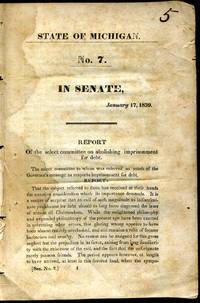
1839réf. 7738baLansing MI: State of Michigan 1839. Book. Very good- condition. Paperback. Michigania; 11 pages; dis-bound; not American imprints or in Michigan imprints. State of Michigan Paperback
1869réf. 299870Carson City.: Henry R. Mighels State Printer. 1869. Contemporary half sheep over marbled boards red and black spine labels with gilt title. Very good light wear to spine head and corners. 8vo. 23x14.5 cm. Appendix includes: Second Biennial message of H.G. Blasdell Governor of Nevada Biennial report of the Controller of the State of Nevada Report of the State Treasurer of Nevada Biennial Report of the Warden of the Nevada State Prison Report of the State Mineralogist of Nevada Biennial Report of the Surveyor General and State Register of the State of Nevada and First biennial report of the Secretary of State in relation to the indigent insane. weight: 2.7 lb. Several folding charts. Henry R. Mighels, State Printer. hardcover
réf. 117991581X.Gpaperback. Good. Access codes and supplements are not guaranteed with used items. May be an ex-library book. paperback
réf. 1984532669.Gpaperback. Good. Access codes and supplements are not guaranteed with used items. May be an ex-library book. paperback
réf. 1796078786.Ghardcover. Good. Access codes and supplements are not guaranteed with used items. May be an ex-library book. hardcover
réf. 1616405465.Gpaperback. Good. Access codes and supplements are not guaranteed with used items. May be an ex-library book. paperback
réf. 38536949like new. unknown
réf. A9781343940345Hardback. New. hardcover
réf. 1796073520.Ghardcover. Good. Access codes and supplements are not guaranteed with used items. May be an ex-library book. hardcover
réf. A9781345139778Hardback. New. hardcover
1969réf. 89990Washington DC: U. S. Government Printing Office 1969. Presumed First Edition First printing. Stiff Wraps. Very good. V 1 92 1 pages. Compiled by the Subcommitee on National Security and International Operations. From Foreword written by Chairman Henry M. Jackson- In our continuing study of the effectiveness of this country's national security methods staffing and processes we thought it would be useful to understand more fully the negotiating methods of the Soviet Union. In this connection the subcommittee staff was asked to prepare a short selection of analytic materials on the Soviet approach to international negotiation drawing on both Western and Russian sources. The National Security Subcommittee is an oversight committee that holds the federal government accountable to taxpayers with a focus on national security homeland security foreign operations immigration and emergency management. U. S. Government Printing Office paperback
1969réf. 87530Washington DC: U. S. Government Printing Office 1969. Presumed First Edition First printing. Wraps. Good. v 1 363 3 pages. Maps. Tabular data. Some page discoloration noted. The key witnesses were: Lt. Gen. Francis C. Gideon; Rear Adm. Draper L. Kauffman; Col. Ernest W. Pate; Lt. Gen. Robert H. Warren; and James M. Wilson. The hearings of the Subcomittee were designed to detail on a country-by-country basis United States programs personnel and facility in the troubled Far East excluding Vietnam. Their aim with the help of Administration witnesses was to gather for the Senate the best and most complete information available; and to this end Messrs. Pincus and Paul of the Subcommittee staff had already spent seven months gathering inforamtion.Becasue of the national security implications of some of the information to be dwelt on and in order to permit frank discussion of all pertinent matters the initial fact finding hearings were to be held in executive session. Let it be noted however that as complete a record as security consideration permit will be released to the public as rapidly as possible. U. S. Government Printing Office paperback
2006réf. 84998Washington DC: U. S. Government Printing Office 2006. Presumed First Edition First printing. Wraps. Very good/No dust jacket issued. iii 1 118 4 pages. Robert Jones Portman born December 19 1955 is an American attorney and politician serving as the junior United States senator from Ohio since 2011. A member of the Republican Party Portman was the 35th director of the Office of Management and Budget OMB from 2006 to 2007 the 14th United States trade representative from 2005 to 2006 and a U.S. representative from 1993 to 2005 representing Ohio's 2nd district. In 1993 Portman won a special election to represent Ohio's 2nd congressional district in the United States House of Representatives. He was reelected six times before resigning upon his appointment by President George W. Bush as the U.S. trade representative in May 2005. As trade representative Portman initiated trade agreements with other countries and pursued claims at the World Trade Organization. In May 2006 Bush appointed Portman the director of the Office of Management and Budget. In 2010 Portman announced his candidacy for the United States Senate seat being vacated by George Voinovich. He easily defeated then-Lieutenant Governor Lee Fisher and was reelected in 2016. On January 25 2021 he announced that he would not seek a third term in 2022. On April 18 2006 Bush nominated Portman for Director of the Office of Management and Budget replacing Joshua Bolten who was appointed White House Chief of Staff. Portman said that he looked forward to the responsibility adding "It's a big job. The Office of Management and Budget touches every spending and policy decision in the federal government". Bush expressed his confidence in Portman saying "The job of OMB director is a really important post and Rob Portman is the right man to take it on. Rob's talent expertise and record of success are well known within my administration and on Capitol Hill." The U.S. Senate confirmed him unanimously by voice vote on May 26 2006. As OMB director from May 2006 to August 2007 Portman helped craft a $2.9 trillion budget for fiscal year 2008. The Cincinnati Enquirer wrote "The plan called for making the 2001 and 2003 tax cuts permanent at a cost of more than $500 billion over the five-year life of the proposal. It requested a hefty increase in military spending along with reductions in low-income housing assistance environmental initiatives and health care safety-net programs." Portman is said to have been "frustrated" with the post calling the budget that Bush's office sent to Congress "not my budget his budget" and saying "it was a fight internally." Edward Lazear of Bush's Council of Economic Advisers said that Portman was the leading advocate for a balanced budget while other former Bush administration officials said that Portman was the leading advocate for fiscal discipline within the administration. On June 19 2007 Portman resigned as OMB director citing a desire to spend more time with his family and three children. Democratic Chairman of the Senate Budget Committee Kent Conrad expressed regret at Portman's resignation saying "He is a person of credibility and decency that commanded respect on both sides of the aisle." U. S. Government Printing Office paperback
1999réf. 84302Washington DC: U. S. Government Printing Office 1999. Presumed First Edition First printing. Wraps. New. 3121 total 4-volume set wraps footnotes. This is an unopened set shrink-wrapped with stiff cardboard at top and bottom sealed with tight plastic bands north/south and east/west. Some indentation of the cardboard brom the banding noted. This four-volume set contains the full record of the U.S. Senate proceedings in the impeachment trial of President Clinton the only Presidential impeachment trial of the 20th century. Volume I contains preliminary proceedings; Volume II contains floor trial proceedings; Volume III contains depositions and affidavits; Volume IV contains statements of Senators regarding the impeachment trial of President Clinton. The impeachment of Bill Clinton occurred when Bill Clinton the 42nd president of the United States was impeached by the United States House of Representatives of the 105th United States Congress on December 19 1998 for "high crimes and misdemeanors". The House adopted two articles of impeachment against Clinton with the specific charges against Clinton being lying under oath and obstruction of justice. Two other articles had been considered but were rejected by House vote. Clinton's impeachment came after a formal House inquiry which had been launched on October 8 1998. The charges for which Clinton was impeached stemmed from a sexual harassment lawsuit filed against Clinton by Paula Jones. During pre-trial discovery in the lawsuit Clinton gave testimony denying that he had engaged in a sexual relationship with White House intern Monica Lewinsky. The catalyst for the president's impeachment was the Starr Report a September 1998 report prepared by Ken Starr Independent Counsel for the House Judiciary Committee. Clinton was the second American president to be impeached the first being Andrew Johnson who was impeached in 1868. The approved articles of impeachment would be submitted to the United States Senate on January 7 1999. A trial in the Senate then began with Chief Justice William Rehnquist presiding. On February 12 Clinton was acquitted on both counts as neither received the necessary two-thirds majority vote of the senators present for conviction and removal from office—in this instance 67. On Article One 45 senators voted to convict while 55 voted for acquittal. On Article Two 50 senators voted to convict while 50 voted for acquittal. Clinton remained in office for the remainder of his second term. In April 1999 about two months after being acquitted by the Senate Clinton was cited by federal District Judge Susan Webber Wright for civil contempt of court for his "willful failure" to obey her orders to testify truthfully in the Paula Jones sexual harassment lawsuit. For this Clinton was assessed a $90000 fine and the matter was referred to the Arkansas Supreme Court to see if disciplinary action would be appropriate. U. S. Government Printing Office paperback