United States Congress Senate CommitteeBiblio.com
3 869 résultats
réf. B9781240612338Paperback / softback. New. paperback
réf. B9781240524327Paperback / softback. New. paperback
réf. B9781240567195Paperback / softback. New. paperback
réf. B9781240265046Paperback / softback. New. paperback
réf. B9781240332229Paperback / softback. New. paperback
réf. B9781240462964Paperback / softback. New. paperback
réf. B9781240389360Paperback / softback. New. paperback
réf. B9781240449705Paperback / softback. New. paperback
réf. B9781240300693Paperback / softback. New. paperback
réf. B9781298009272Paperback. New. paperback
réf. B9781296010546Paperback. New. paperback
réf. B9781286931400Paperback / softback. New. paperback
réf. 536034to. One page approximately 100 words in part: "I think there must be good and legal reason why you have not paid these taxes. I cannot think that you who has been selected to administer and declare and enforce the law can refuse to pay what the law requires." Folded. A little browned but very good. A native of Fauquier County Virginia Hunton practiced law serving as commonwealth's attorney and gained the upper ranks of the Virginia militia before the war; he commanded the 8th Virginia until gaining a brigade in 1863 fighting in most of the campaigns of the Army of Northern Virginia being wounded at Gettysburg. In addition to his national political service following the war he wrote an autobiography that was not published until 1933; it is one of the rarest and most sought after of Civil War memoirs. unknown
réf. 43974319-nnew. unknown
1939réf. 91299Washington DC: United States Government Printing Office 1939. Presumed First Edition First Printing. Hardcover. Good. ii 613 7 pages. Fold-out. Marbled endpapers and edges. Minor moisture staining at lower right corner of some pages. Sturdy institutional binding. Tape residue at middle of spine. The Neutrality Acts were a series of acts passed by the US Congress in 1935 1936 1937 and 1939 in response to the growing threats and wars that led to World War II. They were spurred by the growth in isolationism and non-interventionism in the US following the US joining World War I and they sought to ensure that the US would not become entangled again in foreign conflicts. The legacy of the Neutrality Acts is widely regarded as having been generally negative since they made no distinction between aggressor and victim treating both equally as belligerents and limited the US government's ability to aid Britain and France against Nazi Germany. The Acts were largely repealed in 1941 in the face of the Lend-Lease Act. As noted by the Chairman "It is universally agreed by international lawyers that there should be no substantial change in the laws of a neutral as affecting a belligerent after declared or undeclared war takes place. Among the witnesses and participants are Bernard Baruch Henry Stimson Hugh Johnson Walter Judd; Breckinridge Long George Wharton Pepper James Shotwell Charles Tansill Edmund Walsh Raymond Buell Bainbridge Colby Paul Revere Sentinels and Dorothy Thompson. In philosophy neutrality is the tendency to not take a side in a conflict physical or ideological which may not suggest neutral parties do not have a side or are not a side themselves. In colloquial use neutral can be synonymous with unbiased. However bias is a favoritism for one side distinct from the tendency to act on that favoritism. Neutrality is distinct though not exclusive from apathy ignorance indifference doublethink equality agreement and objectivity. Apathy and indifference each imply a level of carelessness about a subject though a person exhibiting neutrality may feel bias on a subject but choose not to act on it. A neutral person can also be well-informed on a subject and therefore need not be ignorant. Since they can be biased a neutral person need not feature doublethink i.e. accepting both sides as correct equality i.e. viewing both sides as equal or agreement a form of group decision-making; here it would require negotiating a solution on everyone's opinion including one's own which may not be unbiased. Objectivity suggests siding with the more reasonable position except journalistic objectivity where reasonableness is judged by some common basis between the sides such as logic thereby avoiding the problem of incommensurability. Neutrality implies tolerance regardless of how disagreeable deplorable or unusual a perspective might be. In moderation and mediation neutrality is often expected to make judgments or facilitate dialogue independent of any bias emphasizing on the process rather than the outcome. For example a neutral party is seen as a party with no or a fully disclosed conflict of interest in a conflict and is expected to operate as if it has no bias. Neutral parties are often perceived as more trustworthy reliable and safe.38 Alternative to acting without a bias the bias of neutrality itself is the expectation upon the Swiss government in armed neutrality and the International Federation of Red Cross and Red Crescent Societies in non-interventionism. The Oxford English Dictionary documents that by at least 1897 "neutral" meant applying the rules to the facts as in football "Neutral linesmen shall officiate in all games." In the Supreme Court decision Board of Regents of the University of Wisconsin System v. Southworth based on the United States Constitution's First Amendment the court decided some funding decisions should be made through a neutral viewpoint. United States Government Printing Office hardcover
2010réf. DADAX1160829764Kessinger Publishing 2010-03-19. paperback. New. 6.00x1.51x9.00. Buy with confidence. Excellent Customer Service & Return policy. Kessinger Publishing paperback
réf. SONG1984538926Xlibris Us 2018-07-11. paperback. Used: Good. 6.00x0.71x9.00. Buy with confidence. Excellent Customer Service & Return policy. Xlibris Us paperback
réf. 697494990Cosimo Incorporated . Hardback. New. pp. 666 Illustrated edition Cosimo, Incorporated hardcover
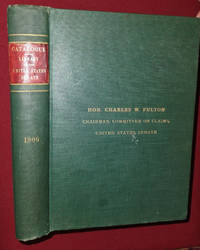
1906réf. 45681Washington: Government Printing Office. Very Good. First Edition Thus. Hardcover. 8vo; 508 pages; Original green library buckram red leather gilt-lettered label on the spine and the 1906 date of publication stamped in the center of the spine. There is a gilt-lettered stamping at the center of the front cover: "HON. CHARLES W. FULTON / CHAIRMAN COMMITTEE ON CLAIMS/ UNITED STATES SENATE." There is an oval rubber stamp on the title page: "Private Library of / Reed Paige Clark." The text is divided into three parts with three tabs of gilt-lettered brown leather glued to the fore-edges of sheets of pale blue stiff paper. The portions of the facing pages which touched any of these leather tabs is stained brown from contact with the acid which which the leather tabs were tanned. Otherwise an unmarked and well preserved copy. Senator Charles Fulton 1853-1918 served as a United States Senator from Oregon for a single term 1903-9. As stated on the front cover of this volume Fulton served as Chairman of the Senate Committee on Claims from 1905-9 Fifty-ninth and Sixtieth Congresses. Fulton left the Senate in 1909 and was succeded as Chairman of the Claims Committee by Senator Henry E. Burnham of New Hampshire 1844-1917 -- served as U.S. Senator 1901-1913. The eventual owner of this copy Reed Paige Clark 1878-1958 was born in New Hampshire and attended secondary schools in that state. He came to Washington at the end of the nineteenth century and became a student in the Columbian College now George Washington University in 1895. He took an A.B. degree from the College and an LLB from the Columbian Law School in 1901. He joined the U.S. Senate staff in that year serving as private secretary to Senator Burnham of N.H. Clark also served as Clerk to the Senate Committees on Claims -- also Industrial Exhibitions Cuban Relatons Agriculture and Forestry. It is not clear whether Senator Burnham or outgoing Claims Committee Chairman Fulton presented this copy to Reed Paige Clark. Clark left the staff of the Senate in 1911 to accept a Commission as General Receiver of Customs for the Republic of Liberia. He had a full and varied career in the U.S. Customs and Diplomatic Services. He was briefly in charge of the U.S. Embassy in Vienna Austria when the Ambassador was recalled after the Anschluss in 1938. He retired in 1944. . 1906. Government Printing Office hardcover
2010réf. DADAX1240300697Bibliogov 2010-12-27. paperback. New. 7.44x0.82x9.69. Buy with confidence. Excellent Customer Service & Return policy. Bibliogov paperback
2010réf. DADAX1240567197Bibliogov 2010-12-31. paperback. New. 7.44x0.95x9.69. Buy with confidence. Excellent Customer Service & Return policy. Bibliogov paperback