1.172 Ergebnisse
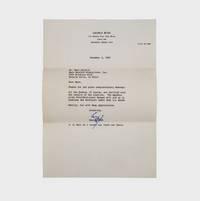
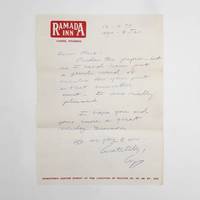
1979Best.-Nr. 375947Casper Wyoming 1979. 8vo. One sheet Ramada Inn letterhead written in blue ink recto only. 8vo. "Dear Mace- Pardon the paper-but as I head home just a quick word of thanks for your part in that successful event-I was really pleased. I hope you and yours have a great Holiday Season. We underlined are going to win. Gratefully George. unknown
1980Best.-Nr. 375940Washington D.C. 1980. 8vo. Single sheet his personal stationery signed in blue pen recto only. With a large franked envelope White House stationery. 8vo. "Dear Mace Thanks for the great congratulatory message. All the Bushes of course are thrilled with the results of the election. The mandate given President-elect Reagan will aid us in tackling the difficult tasks that lie ahead. Hastily but with deep appreciation. Sincerely George P. S. Well do I recall our lunch out there. unknown
1828Best.-Nr. 34260Albany: Printed for the Albany Argus 1828. 32pp disbound and stitched. Title and several other leaves browned widely scattered foxing. Good. This is one of three 1828 issues all scarce printed in the heated presidential race of that year. Anti-Jackson forces charged that his unrestrained martial personality-- highlighted by executing six militia men after the Battle of New Orleans-- unfitted him for the presidency. New York Democrats defend Jackson denounce the falsehoods surrounding that incident and call the official record of the inquiry "useless rubbish." Howes J4. Wise & Cronin 232. Sabin 56778. Printed for the Albany Argus unknown
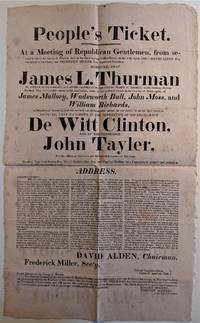
1820Best.-Nr. 703Caldwell New York 1820. Folio broadside. 465 x 280mm. 18" x 11 inches. Folded in quarters couple of tiny separations along folds. Lightly toned moderately foxing. An attractive untrimmed copy. Signed in type by David Alden and Frederick Miller Chairman and Sec'y of the meeting respectively as well as by members of the Republican Central Committee at conclusion. A handsome broadside utilizing a good deal of large bold type. Warren County is situated north of Glens Falls on the eastern border of New York encompassing almost all of Lake George. Caldwell N.Y. now the village of Lake George at the foot of the lake was for a time the county seat of Warren Co. It had a newspaper from the eighteen-teens and separate imprints from as early as 1820. The Lake George Coffee House served as the first county court and the Republican i.e. Democratic Central Committee had its office in Caldwell. Not in OCLC or American Imprints for 1820. unknown
1978354 pages. Signed and inscribed by author upon front free endpaper. "Takes us behind the scenes to witness the forbidden maneuvering for Peter's crown and its worldly power. We learn why the sweeping changes of Paul 6, made - he was convinced - to assure the very survival of the church, have pushed the Cardinals to one of the most critical decisions in our history." - from dust jacket. Book clean and unmarked with light wear. Light foxing to top edge. Moderate wear to dust jacket which is now preserved in a clear protective sleeve. A sound copy. Book
1964144 pages. Features: China's 'Manhattan Project', or, How Mao Learned to Love - and build - the Bomb; Communists of the World, Unite? - Richard Lowenthal concludes that Communism cannot put it right even with Krushchev out of the way; The Kremlin Plays Russian Roulette - Krushchev's ouster points to the Soviet's inability to transfer power without a self-destructive power struggle; When Man Steps out into Space; The Case Against Goldwater's Economics; Cassius Clay, Cassius X, Muhammad Ali; How an Advertising Agency handles the White House Account; How Big is the Bloc Vote (Re: the LBJ vs. Goldwater election); Vision of a Crashproof car - as the slaughter on our highways mounts; The Negro's Middle-Class Dream; Scenes from Mao's Chinese movies; Japan's birth rate turns lower; The American Communist Party Still Functions; Nice colour Cadillac ad; Playwright John Osborne of England looks forward in Anger. Crossword completed in pencil. Moderate wear. A sound copy. Book
1909Features: Vivillo, The Brigand; Walrus Hunt in the Arctic; Sporting Stories - iv - Corker's Alligator - v - A Brush With a Bear - vi - Man v. Python; Guardians of the Wilderness; The Legend of the Wailing Woman; Mountaineering by Telescope; Our Adventures at "Simplicity Hall" - III; Some Experiences in Malaya; "Jack Ashore"; A Daring Voyage Down the Grand Canyon; A Romance of Two Islands - II; Courtship and Marriage in Savage Africa; The Capture of Antonio Barracola; Barmaid's Steeplechase; The Greatest Horse-Race on Record; The Promotion of Petroff; The Humours of a Rectorial Election; The Adventures of "Wide World" Artists - I; Climbing in the "Land of Fire"; The Spider's Web; Dolphin-Hunting; A Tragedy of the Nile; A White Woman in Cannibal-Land - I; Recollections of a Texas Ranger; Short Stories - My Adventure at Arad, The Horror in the Pit; The Cruise of the "Crocodile"; Propitiating the Weather; The Affair at Greenville; The Terror in the Sanctuary; Across America by Airship; Fighting a Typhoon; A State Trial in Montenegro; Crossing the River; A Belgian Smoking Competition; The Adventures of "Wide World" Artists - II; Hunting the Hippopotamus; The Tale the Doctor Told; A White Woman in Cannibal-Land - II; Short Stories - A Bluff that Worked, and The Yellow Fiend; My Experinces in Algeria - I; My Alaskan Christmas; Short Stories - Whave v. Sharks, A Battle in Mid-Air, Up in a Balloon; Some "Freak" Memorials; Down the Chute; Where Women Wear Trousers; Retribution; Mountain Tragedies of the Lake District; Cupid and the Dentist; My Experiences in Algeria - III; Ways that are Dark - My Adventures in 'Frisco, A Sharp Lesson, Seeing it Out; In the Land of the Reindeer; "Tapu"; The Finches' Festival; The Fight at the A-T Ranch; How I Got My Jaguar Skin; Out of the Skies; A Night Adventure in Yokohama; Ten Lions in a Day!; My Friend Dalton; Two Girls in Japan; The Last Creek; The Romance of Wild Animal Catching; How We Captured the Rebel Chief; Round the World with a Billiard-Cue; When "Tenderfeet" Go Hunting Bears; The Life of a Steeplejack; The Longest Chase on Record; The Land of Superstition; and more. Average wear. Binding intact. Several pages partially loose, otherwise a sound copy. Book
175811 p. in-8° Musica di Michelangelo Vella, Parole di un brillante socio colombario.
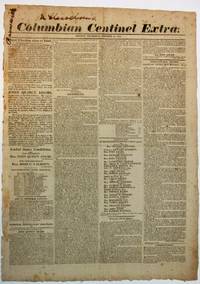
1824Best.-Nr. 37247Boston 1824. Elephant folio broadsheet printed in four columns on recto six columns on verso verso consisting of many advertisements several illustrated. 15-1/4" x 21-1/2." Very Good. Ownership signatures at top margin: "Mr. Cleaveland" and "Brunswick." The Centinel issued this rare Extra to urge the election of John Quincy Adams to the presidency. The list of Adams electors is printed along with the proceedings at the October 27 "Federal Republican Meeting" in Boston "friendly to the election of John Quincy Adams to the Presidency." The Address at that Meeting reviews the other presidential candidates. Henry Clay "is a stranger to your habits and interests." A man of the West "The star of your empire he would have go from your part of it far West." Andrew Jackson places "liberty in danger." Votes for Crawford of Georgia only "tend to make Jackson your President." Not in American Imprints. Not at the web sites of AAS or MA Hist. Soc. as of November 2020. unknown books
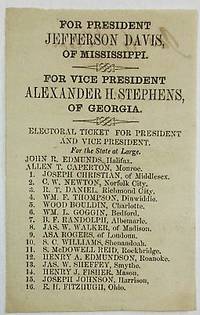
1861Best.-Nr. 33882Richmond 1861. Small broadside ticket 3" x 4-3/4". Very good. A rare Virginia Confederate electoral ticket for the Confederacy's first and only national election: Jefferson Davis for President Alexander Stephens for Vice President. Also listed are two at-large electors and sixteen others by District. Variant of Parrish & Willingham 5367 5368; Crandall 2744 noting "four variant printings and sizes"; and Hummel 4667-4669. OCLC 58833485 2- U GA Boston Ath. 702707722 1- Yale as of June 2017 different dimensions. unknown books
1953Best.-Nr. 18425Aoste, Imprimerie Valdôtaine, 1953 ; grand in-8, pleine basane havane, dos à nerfs décoré de motifs géométriques à froid, titre doré, premier plat décoré et doré, roulette dorée d'intérieur (reliure de l’éditeur) ; XXXII, 510, (6) pp., 36 illustrations dy compris le frontispice, dont 8 en couleurs.
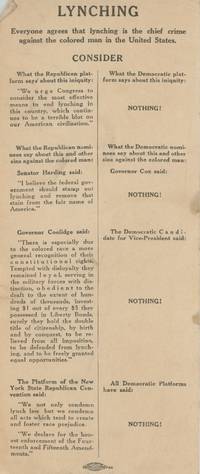
1920Best.-Nr. List2706Chicago or New York 1920. 6 x 9 inches single sided. Toning several small stains small fold at top left corner; near fine. An anonymous handbill decrying lynching in the United States and advertising the differences in anti-lynching policy between the Republican and Democratic parties. The header states that “Everyone agrees that lynching is the chief crime against the colored man in the United States” and the remainder illustrates the great disagreement over just what to do about it. The left column quotes the Republican platform and its then-nominees Warren G. Harding and Calvin Coolidge who would shortly be elected to office on their support for federal anti-lynching legislation. The right column points out that the Democratic platform and its nominees James M. Cox and Franklin D. Roosevelt all “said: NOTHING!” on this issue. Lynching would not be made a federal hate crime until 2022 nearly 100 years later. As of writing we find no other copies of this handbill in OCLC. unknown
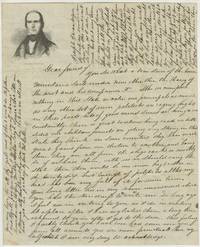
1844Best.-Nr. List3860N.p. 1844. Folded letter on Henry Clay campaign lettersheet with portrait of Clay and printed caption: "And Frelinghuysen." Addressed to Mr. Joseph Griswold Benson Rutland County Vermont. Blue circular postmark and manuscript postage. Milgram No. HC-2 with listing example illustrated in James W. Milgram's Presidential Campaign Illustrated Envelopes and Letter Paper 1840-1872 p. 41. Light toning to address panel minor fold flaws; very good. A long 1844 letter from T. W. Goodrich to Joseph Griswold written on a Henry Clay campaign lettersheet during the presidential contest between Clay and James K. Polk. The printed lettersheet shows Clay's portrait with the caption "And Frelinghuysen" referring to Theodore Frelinghuysen Clay's Whig running mate. The letter opens with direct campaign content identifying the writer as a supporter of "the Harry of the West and his companion F-": "You see what a true Son of the Green Mountains sails under none other than the Harry of the West and his companion F-. Altho we accomplish nothing in this State we value our principals as much as any other set of men. Politics are raging high in these parts. Bets of good round sums are being made constantly. There is great exertions being made on both sides." Goodrich then gives the letter its strongest political passage complaining that abolitionists were gaining strength and drawing support away from the Whig ticket: "Our abolition friends are getting very strong in this State. They think in some counties they have made great gains from one election to another and hang them they are all from the Whig ranks or mostly so. If we had them with us we should carry the State. Then there would be one more bright star in the twenty six." The remainder of the letter turns to family visits courtship gossip local marriages schoolteaching music lessons and delays in correspondence. Goodrich teases Griswold about his interest in "Say" or Sarah closing with the advice to "not sigh oftener for her than she does for you. Sigh not but act." A good 1844 campaign lettersheet combining a printed Clay-Frelinghuysen design with manuscript political content on the Whigs abolitionist defections and the electoral consequences of antislavery politics. . unknown
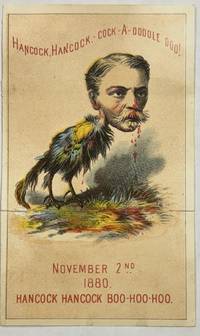
1880Best.-Nr. 40342New York: Copyright by Geo. H. Hanks 1880. Metamorphic card 3-1/4" x 5-3/8" fully opened. Richly colored light wear Very Good. The unopened illustration depicts a dignified serious Hancock as a rooster in elaborate feathers. But when opened Hancock has lost his feathers is emaciated and bleeding from the mouth. The caption reads "November 2nd. 1880 Hancock Hancock Boo-Hoo-Hoo." Winfield Scott Hancock a decorated Civil War general and a hero of Gettysburg was the losing Democrats' presidential candidate in 1880 opposing Republican James A. Garfield. The verso entitled 'Rhymes for Young Democrats' brilliantly skewers the overt racism of the Democratic Party. It begins: "Sing a song of shotguns Pocket full of knives Four-and- twenty black men Running for their lives; When the polls are open Shut the nigger's mouth Isn't that a bully way To make a solid South" OCLC 32320004 1- Brown as of August 2024. Copyright by Geo. H. Hanks unknown
1861Best.-Nr. 33882Richmond 1861. Small broadside ticket 3" x 4-3/4". Very Good. A rare Virginia Confederate electoral ticket for the Confederacy's first and only national election: Jefferson Davis for President Alexander Stephens for Vice President. Also listed are two at-large electors and sixteen others by District. Variant of Parrish & Willingham 5367 5368; Crandall 2744 noting "four variant printings and sizes"; and Hummel 4667-4669. unknown
1724Best.-Nr. 16349Roma, Typis Reu. Cam. Apostolicae (Stamperia della reveranda Camera apostolica), 1724 ; in-4 ; vélin ivoire de l’époque, titre manuscrit au dos ; (2) ff. d’Index. Suivi par : Compendio delle cose principali Contenute nel Ceremoniale di Gregorio XV. De electione Romani Pontificis. Per facilitare alli Signori Cardinali il nuovo modo di elegere il Papa, e per istruttione delli Maestri di Ceremonie. Roma, nella Stamperia della Reu. Cam. Apost., 1724 ; (6) ff. y compris le titre séparé, 11 pp., (1 bl.) ; (10) ff.: Riforma delle Spese solite farsi in tempo di Sede Vacante, e per il Conclave. Vignette sur bois identique aux deux titres, aux armes du Vatican.
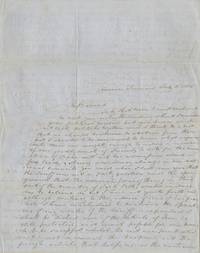
1845Best.-Nr. List3867Hanover Furnace New Jersey 1845. 3 pp autograph letter signed "Richard Jones" written on an embossed Henry Clay campaign lettersheet from the 1844 presidential election. Letter written on Henry Clay lettersheet identified as HC-9 in Milgram's reference on presidential letterhead. 8 ¼ x 10 ½ inches. Some small tears to final page intersecting with text; else Near Fine condition. A strong post-election Whig letter written shortly before James K. Polk's inauguration discussing Texas annexation slavery the tariff manufacturing and the defeat of Henry Clay. Jones writes to a friend whose "political heresies" he rejects asking what could have induced "a member of our goodly society of Friends" to support annexation. His objection is not only to territorial expansion but to the political consequences of adding Texas to the Union: "will not her admission secure a free trade & slavery ascendency always in our national councils." He then turns to the tariff from the perspective of a furnace operator or manufacturer worrying that repeal would damage his works and the broader market for manufactured goods. The Clay campaign lettersheet is itself part of the letter's content: Jones calls it paper "with the brand of the last campaign upon it" declares himself "a true Whig" and says he may save some sheets until 1848 though he dislikes "that silly looking coon in the corner." Full text follows. "Hanover Furnace Feby 5 1845 Resp. Friend "For by that term I must continue to call you notwithstanding what I consider your political heresies but you know we do not talk politicks together and I think it is best that we should continue to abstain from them but I should like very much to know what arguments there are weighty enough to induce a member of our goodly society of Friends to vote for the annexation of Texas will not her admission secure a free trade & slavery ascendency always in our national councils. You said when I last saw you that the tariff was not a party question and the open ground that the advocates some of them in this part of the country of I or V. Polk would induce me to believe so but I have not quite found so and although contrary to the advice of some of my friends I have concluded to continue the operations of my works if the tariff is repealed I shall be dished even if the article of is still protected as it is not possible for one branch to be successful whilst the rest are prostrated as it is not so much the keeping out the foreign article that helps us as the customers that general prosperity enables to consume the article manufactured. I did not sit down to write a political letter but would like your judgment with regard to the course which will be pursued by the next administration & congress with regard to the Tariff. "I do not think it requires an apology from me for writing to you upon paper with the brand of the last campaign upon it for you know me to be a true Whig and as such shall keep my Banner flying to the last. I am come of a Welsh tribe who have never been conquered and I think of keeping a few of these sheets until 48 although I do not like that silly looking coon in the corner and I hope by that time that nothing but sterling argument will be used and our congressional candidates will be forced to stump it face to face but I will not tire you with my foolishness. I cannot give you much information as to the tone of Public conversation but I never knew any matter of great importance to be before congress that has excited so little feeling as the annexation of Texas there is not one man in twenty that knows any thing about it. The Whigs beaten and disappointed feel themselves powerless for the present and do not think it worth while to agitate themselves about things they cannot help but let me assure you that they feel themselves only beaten but not conquered and when the occasion comes they will raise in their might mighty and woe unto those who legislate for any other view than the good of their country. But I am like a lady I have come to the postscript before I begin to write about what I commenced for. Mr. Spencer says you have been making some enquiries about some Atkins claims upon McDonald Branch and I have promised Black that I will commence proceedings against him as soon as I have your opinion now if you have formed one upon the subject let me have it if not will you give it your attention when you come home and can also devote some time to the Polebridge affair in the Spring. I am very desirous that should be settled as well as some other things and you are the only man that can do it for me.I remain as I always have been and always hope to be your personal friend Richard Jones" An interesting letter from the aftermath of the 1844 election with unusually direct content on Texas annexation slavery free trade tariff protection and Whig political identity. The letter is also a good use of campaign stationery: Jones not only writes on a Henry Clay lettersheet but comments on the "brand of the last campaign" the Whig "Banner" and the campaign imagery itself. . unknown
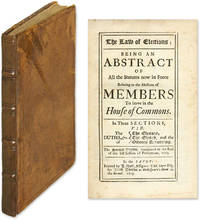
1713Best.-Nr. 539311713. London 1713. 2d ed. London 1713. 2d ed. Scarce Eighteenth-Century English Treatise on Election Law Election Law. Great Britain. The Law of Elections: Being an Abstract of All the Statutes Now in Force Relating to the Election of Members to Serve in the House of Commons: In Three Sections Viz. The Duties &c. of the Electors The Elected And the Officers Returning. London: Printed for J. Nutt Assignee of Ed. Sayer Esq. for Jacob Tonson 1713. vi 126 6 21 3 pp. Half-title lacking. Octavo 6-1/2" x 4". Contemporary sheep blind frames and fillets to boards raised bands to spine rebacked retaining original backstrip hinges mended. Some rubbing with wear to corners a few large scuffs to boards. Toning to portions of text light foxing to a few leaves internally clean. $650. Second edition "continued to the end of the last session of Parliament 1713" which adds an addenda to the first edition of 1708. It was one of the earliest books on the subject. According to Sweet & Maxwell the first studies were Freedom of Elections to Parliament 1680 and Observations Concerning the Regulation of Elections for Parliament 1689 a work attributed to the Earl of Shaftsbury. OCLC locates 6 copies 3 in North America at the Library of Congress Harvard Law School and Stanford University. The ESTC locates 9 copies 8 in Great Britain 1 in North America at the University of Indiana. Sweet & Maxwell A Legal Bibliography of the British Commonwealth 1:151 20. English Short-Title Catalogue T108633. unknown books
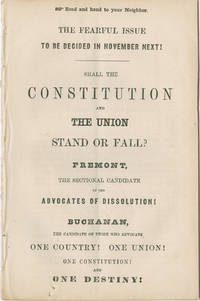
1856Best.-Nr. 24482"What a Combination! Seward Greeley Bennet Watson Webb H. Ward Beecher &c. There can be no doubt that this goodly company will speedily be increased by the addition of Fred. Douglass and his black republicans… The only candidate to arrest this tide of demoralization and sectionalism is James Buchanan." This pro-Buchanan election of 1856 pamphlet attacks the first Republican presidential candidate John C. Frémont. Quoting from the speeches and writings of William Lloyd Garrison Horace Greeley Wendell Phillips Salmon P. Chase Henry Ward Beecher William H. Seward Joshua R. Giddings this pamphlet ignores distinctions between abolitionists racial egalitarians more limited opponents just of the expansion of slavery into the territories or those who fought the kidnapping of free African Americans under the Fugitive Slave Law. It paints all with the same broad brush as "Black Republican" extreme abolitionists who were willing to destroy the Union rather than remain in it with slaveholders. ELECTION OF 1856.Printed Document. The Fearful Issue to Be Decided in November Next! Shall the Constitution and the Union Stand or Fall Fremont The Sectional Candidate of the Advocates of Dissolution! Buchanan The Candidate of Those Who Advocate One Country! One Union! One Constitution! and One Destiny! 1856. 24 pp. 5 x 8½ in. Excerpts: Before Title: "Read and hand to your Neighbor." "We propose showing by indubitable testimony that John C. Fremont's leading friends are now the open enemies of the Federal Constitution… the enemies of one-half of the States of the Union; the enemies of the laws of Congress; and the enemies to equality of the States." 3 "In a speech delivered at the New England Anti-Slavery Convention on the 29th of May 1856 by Wm. Lloyd Garrison we have a flood of light shed on the relation between abolitionism and republicanism which divests the subject of all doubt or uncertainty." 4 "William H. Seward was known at the Abolition Convention at Philadelphia… as one of Fremont's warmest supporters. Indeed it is well known that to Chase Seward and Greeley Fremont is mainly indebted for his nomination: they defeated McLean." 7 "Nathaniel P. Banks Abolitionist and Disunionist was elected Speaker of the House by a solid sectional vote: he did not get one vote from the South.No man has exhibited such ferocious hostility to the fugitive slave law to the compromise measures and to the Federal Constitution. His speeches full of treason and of war would fill a volume." 8 and 9 "Every leading committee has an Abolition Disunionist for chairman and a Disunion majority! There some thirty-five committees in the House… Black Republicans monopolized all the great committees. Thus was the work of Disunion formally begun in the Congress of the United States! This monstrous act unprecedented in all our history was the deliberate work of the men who now surround Fremont." 10 "The reverend agitator Ward Beecher is out for Fremont in the last number of his 'Independent.' He is probably next to Garrison and Phillips the most profligate calumniator of the Constitution and the Union." 19 "What a Combination! Seward Greeley Bennet Watson Webb H. Ward Beecher &c. There can be no doubt that this goodly company will speedily be increased by the addition of Fred. Douglass and his black republicans. Every Black Republican in Congress from New York is now the earnest advocate of Fremont." 20 "We aver that there is not an Abolitionist or Disunionist in Pennsylvania who is not an active and open friend of John C. Fremont for the Presidency. David Wilmot and William F. Johnston lead the motley crew both recreants from the Democratic party because the Democratic party respected the Constitution of the United States and would not desert its injunctions… The only candidate to arrest this tide of demoralization and sectionalism is James Buchanan. It is against him and against the Constitution that this combination has been formed." 23 "in the South every vote thrown for Mr. Fillmore is more or less an aid to John C. Fremont to the extent that it may weaken James Buchanan." 24 "We would speak of Mr. Fillmore with entire respect. His speech at Albany was patriotic and forcible but it cannot be denied that out of New York in the North all those who pretend to support him will be called upon in the State elections to unite against the Democratic party with the friends of Fremont otherwise known as the Black Republicans." 24 Historical Background James Buchanan won with 1.8 million votes and 174 electoral votes from 19 states. Fremont received 1.3 million votes winning 11 northern states with 114 electoral votes. American Party "Know Nothing" candidate and former President Millard Fillmore received 873000 votes winning Maryland's 8 electoral votes. Frémont received no votes at all in 10 of the 14 slave states and fewer than 1200 votes total in the other 4 slave states. John C. Frémont 1813-1890 "the Pathfinder" was a legendary explorer who achieved military victories in California during the Mexican War. He entered politics as California's first senator and then became the first Republican presidential candidate in 1856. During the Civil War Lincoln removed Frémont from command in Missouri after he unilaterally declared martial law and threatened to confiscate all property including slaves of Southern sympathizers. Lincoln gave Frémont command of an army in western Virginia where he was defeated by Stonewall Jackson in the Battle of Cross Keys. After Frémont refused to serve under General John Pope Lincoln never again gave him a field command contributing to a personal grudge. In 1864 Frémont abandoned his third-party campaign for the presidency in September after Lincoln agreed to remove U.S. Postmaster General Montgomery Blair from office. Condition Disbound minor pin holes very good. books
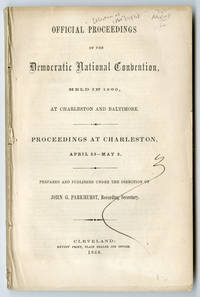
1860Best.-Nr. WRCAM45168Cleveland: Nevins' Print Plain Dealer Job Office 1860. 188pp. Dbd. Ink pen trial on titlepage. Light wear in fore-edge of titlepage and upper margin of final text leaf. Two text leaves printed on slightly folded paper resulting in obscuration of some text. Good. The official record of a crucially important moment in American politics the 1860 Democratic Conventions at which Stephen A. Douglas won the nomination and faced Republican nominee Abraham Lincoln in the general election. The first convention was held in Charleston in late April and early May and was a rancorous affair. Douglas led the field of nine total candidates at Charleston over the opposition of militant Southern Democrats so-called "Fire Eaters". Despite the fact that fifty-seven separate ballots were held Douglas could not secure the necessary two-thirds majority of delegates. The delegates therefore adjourned and reconvened in Baltimore in June where the committee voted to exclude certain delegates from Louisiana and Alabama who had been disruptive in Charleston. Douglas finally secured the nomination on the second ballot in Baltimore and went on to lose the general election to Lincoln. The present text prints all the proceedings of the Charleston and Baltimore conventions offering a detailed picture of American politics at their most fractious. Nevins' Print, Plain Dealer Job Office unknown books
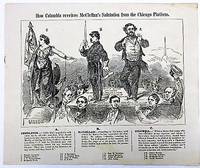
1864Best.-Nr. 34855New York 1864. Broadside wood engraving oblong 9-5/8" x 7-7/8". Blank verso uniformly toned Very Good. "Columbia repudiates Democratic presidential candidate George Brinton McClellan's endorsement of the platform devised at the August 1864 Democratic convention in Chicago. The text below the picture provides the dialogue descriptive notes and identification of the main characters. Columbia: 'What a shame that a man who was educated at my expense and whom I have since honored and petted should have allowed himself to be allured by ambition into such company and upon such a Platform! His Letter cannot conceal his real position nor hide those odious 'planks;' neither can it reconcile me to his traitorous companions. I DISCARD BOTH HIM AND THEM FOREVER'." Reilly Onlookers include the discredited James Buchanan Fernando Wood Horatio Seymour Clement Vallandigham Franklin Pierce and other Copperheads. Reilly 1864-22. Weitenkampf 144. OCLC 299946973 2- Lib. Cong. W. Res. Hist. Soc. 881054411 1- UCSB 81099323 1- Am. Phil. Soc. as of April 2018. unknown books
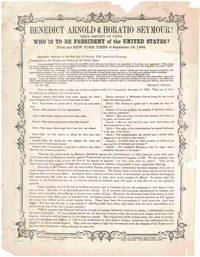
1868Best.-Nr. WRCAM48472Brooklyn: D.S. Holmes 1868. Broadside 13 x 10 inches. Some small tears chipping and loss at top and right edges. Minor foxing. Very good. Broadside printed for the U.S. Presidential Campaign of 1868 which pitted former New York governor Horatio Seymour against Gen. Ulysses S. Grant. This broadside points out Seymour's Copperhead tendencies and statements made by him in 1864 linking him to similar sentiments made by the notorious traitor Benedict Arnold. Seymour's Copperhead utterances during the war haunted his campaign and he lost decisively to Grant. The text printed here strives to demonstrate: ".the points made by Horatio Seymour against the Administration in 1864 are identical point by point with those made by Benedict Arnold against Washington and the Continental Congress in 1780.The Copperhead chiefs of these times who draw so lavishly upon the sophistries and fallacies of 1780 for the furtherance of their factious designs cannot too well understand that the sequel to all this is endless disgrace. They must not expect to fight the Government with weapons of the Tories and of the blue-light Federalists without sharing the same fate." D.S. Holmes unknown books
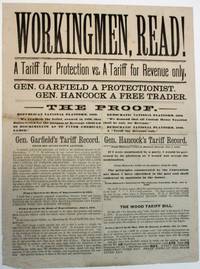
1880Best.-Nr. 36539Concord NH 1880. Broadside 11-3/8" x 15-1/4". Printed in a variety of type sizes and fonts. Bit of wrinkling else Very Good. General James Garfield was the Republicans' 1880 presidential candidate; General Winfield Scott Hancock ran for the Democrats. Garfield's supporters claim here that protective tariffs "favor American labor." Garfield's laudable support for tariffs is contrasted with the views of Hancock and his party. Reduction or elimination of tariffs would "be a movement to equalize wages here with the lowest prevailing in the Old World." We suggest a New Hampshire imprint because that State's Democratic candidate for Governor Frank Jones is pilloried here for opposing protective legislation. Not located on OCLC or the online sites of AAS New Hampshire Historical Society or Rauner Library as of April 2020. unknown books
1736Best.-Nr. 633391736. Maryland Colonal Period;. Maryland Colonal Period;. Three Eighteenth-Century Works on English Election Law With an Interesting Maryland Association Great Britain. Election Law. Maryland Colonial Period. Orders and Resolutions of the Honourable House of Commons On Controverted Elections and Returns: Determining the Qualifications of Candidates and Voters; The Rights of Election for the Several Cities and Boroughs; The Nature of Evidence Proper on the Hearing; And the Duty of Returning Officers. The Statutes in Force Concerning Elections Are Also Pointed Out Under Proper Heads. With Additions. London: Printed for J. Stagg 1736. ix i 3-48-48 49-209 8 pp. Bound With The Statutes at Large Concerning Elections of Members to Serve in the House of Commons; Containing A Compleat Collection of All the Acts of Parliament Now in Force Which Relate Thereto Continued to the End of the Last Session of Parliament 1734. London: Printed by John Baskett Printer to the King's Most Excellent Majesty And Sold by Him Robert Gosling in Fleetstteet sic and John Stagg in Westminster-Hall 1734. vi 73 64-109 17 10 pp. The text is continuous despite pagination. And Cowley John Attributed. The Candidates Guide: Or The Electors Rights Decided. Shewing the Determination of the Rights of Elections By the Hon'ble the Commons of Great Britain in Parliament In All Contraverted Elections for the Counties and Boroughs in South Britain From the Year 1624 to 1730. Corrected and Improved. To Which is Added The Like Determinations in Contraverted Elections for North Britain Since the Union. With Several Resolutions and Standing Orders Relating to Elections Qualifications Returns Petitions and Proceedings in General. Together with the Head of the Statutes Now in Force Concerning the Same; And Several Adjusted Cases in Disputed Points of Admitting of Evidence on Hearings at the Bar of the House. The Whole Digested into Alphabetical Order With Proper References and Genuine Quotations. London: Printed for J. Brindley in New Bond-Street And Sold by Mrs. Dodd Without Temple-Bar And by the Booksellers of London and Westminster: Likewise in Most Great Towns in England 1735. 64 pp. 12mo. 6" x 4". Contemporary calf gilt spine with raised bands and lettering pieces. Moderate rubbing to extremities with some wear to spine ends unknown books
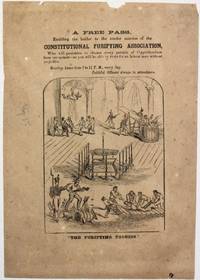
1864Best.-Nr. 40035np 1864. Broadside 6.25" x 9" with two-thirds of the sheet consisting of a wood engraving entitled "The Purifying Process." Toned with a few short blank edge chips. Good. This scarce political broadside mocks the Copperheads who opposed the Lincoln Administration and the Civil War. The broadside depicts humorous rituals imposed on the Copperheads designed to purge Copperhead-ism from their natures. Weitenkampf and OCLC call this an 1864 broadside with the Lincoln-McClellan election the subject of this piece. Weitenkampf page 140. OCLC 14137917 4- Lincoln Presidential Library Brown U IL Princeton 1360327631 1- DLC 1085916488 1- AAS as of May 2024. unknown