[Election of 1840]Biblio.com
1.172 Ergebnisse
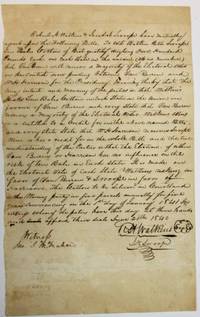
1840Best.-Nr. 39023Courtland Lawrence Cty. Alabama 1840. Single page 7-3/4" x 12-3/4." Entirely in ink manuscript. Dated June 20 1840 and signed at the end by Watkins and Swoope with Jno. J. McMahon as witness. Inner edge is irregular. Closed tear no loss repaired expertly at blank bottom margin. Very Good. This documents records the terms of a wager on the outcome of the 1840 presidential election. "Watkins betts Swoope Ten Bales Cotton of Best quality weighing Five Hundred Pounds Each on each State in the union 26 in number that Van Buren will receive a majority of the Electoral votes in the contest now pending between Van Buren and Wm. H. Harrison for the Presidency." In case that's not entirely clear "The true intent and meaning of the parties is that Watkins risks Ten Bales Cotton in each State in the Union in favour of Van Buren and every state that Van Buren receives a majority of the Electoral votes." The bet is made on the electoral vote of each State. Watkins risking in favor of Van Buren & Swoope in favor of Harrison. . . The cotton to be delivered in Courtland to the winning party in five parcels annually for five years commencing on the 1st day of January 1841." A calculation of States and bales can be seen at the bottom left corner in pencil. Robert Herndon Watkins 1782-1855 was a farmer in Courtland. Jacob Kuhn Swoope 1800-1841 partnered with his two brothers in the successful Courtland mercantile firm of J & J Swoope in Courtland. John T. McMahon c.1805-1857 was a Courtland commission merchant in the firm of Bierne & McMahon for many years. Saunders Col. James E.: EARLY SETTLERS OF ALABAMA WITH NOTES AND GENEALOGIES New Orleans:1899 accessed online. unknown
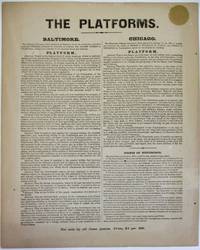
1864Best.-Nr. 38115New York: For sale by all News Agents. Price $1 per 100 1864. Broadside 9" x 11 1/2". One margin spot from removal of a gum label light uniform toning. Very Good. Printed in two columns separated by a rule. The Column on the left is headed "Baltimore Platform" for the National Union Republican Party; the right hand column is headed "Chicago Platform" for the Democrat-Copperhead Party. A Republican recitation of the Democrats' Platform and the Republicans' Platform in 1864 and an analysis of their 'Points of Difference.' "The Union platform looks to the ending of the war through the defeat and overthrow of the Rebellion while the Democratic contemplates peace through the virtual triumph of the traitors." The broadside exhorts "Freemen of the United States! read mark weigh resolve and VOTE! This is preeminently a contest regarding important principles and measures compared with which personal considerations are of small account." We conclude that this broadside was printed in New York as the legend "For sale by all News Agents. Price $1 per 100" appears in similar broadside material with a New York imprint. Sabin 63348. Not in Bartlett. For sale by all News Agents. Price, $1 per 100 unknown
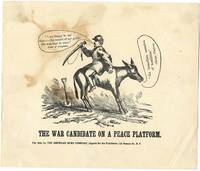
1864Best.-Nr. 40123New York: For Sale by the AMERICAN NEWS COMPANY Agents for the Publishers. 121 Nassau St. 1864. Oblong broadside 8" x 9-3/8." Couple of light fox spots not affecting illustration. Very Good. The broadside mocks the dissonance in the Democrats' 1864 presidential campaign. Candidate McClellan's acceptance speech supported a continued War Effort; but his Party's platform called for an end to the War. McClellan sitting backward on a jackass says "I am happy to say that -- the record of my public life was kept in view". The jackass however facing the other direction says quoting from the Chicago Platform "An immediate cessation of hostilities." Weitenkampf 145. Not in Reilly. OCLC 57744783 2- Boston Ath. NYHS as of June 2024. AAS also owns a copy For Sale by the AMERICAN NEWS COMPANY, (Agents for the Publishers.) 121 Nassau St. unknown
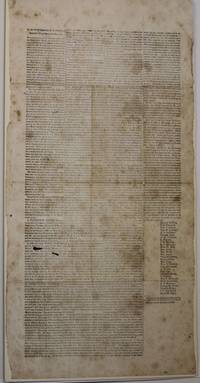
1828Best.-Nr. 35196Bangor 1828. Folio broadside 9-1/4" x 20". Matted hinged at upper edge. Printed in three full columns. A few old folds Very Good. The Convention met in Bangor on July 9 1828. After endorsing candidates for various State offices the Convention issued and printed its 'Address. to the Electors of the Counties of Somerset and Penobscot' focusing on the upcoming presidential contest. Praising the incumbent John Quincy Adams the Address proclaims "It is sufficient to say of him that talents of the highest order are joined to uncommon attainments. We would ask you to turn from the rantings of demagogues the bold fictions of an irresponsible press. Is not our country moving on peacefully and prosperously in the great march of improvement" Adams's opponent General Jackson is unsuited for the presidency: "His character has been formed as a military chieftain. He is rash headstrong impetuous and unreflecting-- that he knows no law but his own will." Example after example demonstrates Jackson's unfitness Not in American Imprints Sabin Wise & Cronin Jackson Adams or on the online sites of OCLC AAS Harvard Boston Athenaeum Bowdoin U Maine as of July 2018. unknown books
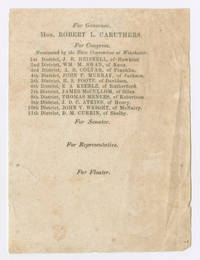
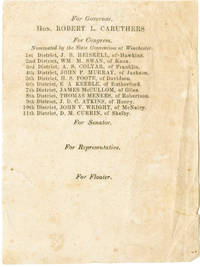
1863Best.-Nr. WRCAM53688Winchester 1863. Broadside 5 x 3 3/4 inches. Toned minor soiling and wrinkling. Very good. An exceedingly rare Confederate Tennessee state election ticket from 1863 nominating Robert L. Caruthers for governor and eleven others as state senators. In 1863 state elections were due in Tennessee. The state was fractured by war and secession and both Unionists and Confederates expressed the desire to hold elections for state government. Confederate supporters held a convention in Winchester and nominated a governor the State Legislature and members for the Confederate Congress. It was a bit of a fool's errand. Isham G. Harris who still considered himself the governor of Tennessee issued a proclamation calling for the election to be held on the first Thursday in August. Just who voted and how many or how few will probably never be known. According to historians the State Archives in Nashville are scant and inconclusive; returns from only thirty-two counties are found some of which reported the vote of only one civil district. Not a single report was from West Tennessee counties and only eight Middle Tennessee counties made returns. Robert L. Caruthers was elected governor on the face of returns but he was never inaugurated and thus never served a day as governor of Tennessee. No Confederate State Legislature ever convened either. The Confederate Congressmen were the only lucky ones. Those who were elected in 1863 took their seats in Richmond however briefly. George Webb notes this copy in his NOT IN ALLEN bibliography in 2013. Not in Parrish & Willingham. The only other copy or shall we say copies resides at the Library of Virginia in an uncut sheet of six tickets. This will likely be the only copy ever available in the marketplace. WEBB NOT IN ALLEN 199 this copy. unknown books
1823Best.-Nr. 34261Raleigh 1823. 15 1 blank pp. Caption title as issued. Disbound. Scattered light and moderate foxing. Good. Signed at the end in type: "November 1823. CAROLINA." An extremely scarce pro-Calhoun anti-Crawford piece for the 1824 presidential election. When Calhoun decided to seek the presidency in 1824 "both Crawford and Adams the acknowledged front-runners felt betrayed" Crawford because Calhoun had reportedly assured him that he would defer to the older man and wait his turn; and Adams because Calhoun had said that "for the good of the country.the next President should come from the North." Peterson THE GREAT TRIUMVIRATE 116. Miles 3. Thornton 1750. AI 12071 1- DLC. OCLC 42212191 3- NYHS Duke UNC as of February 2021. unknown books
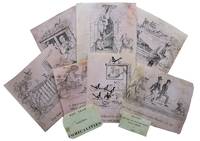
1833Best.-Nr. AQ25008Birmingham: Printed by William Wood 1833. Seven trimmed woodcut engravings printed on pink paper with a further trimmed title and imprint panel on white paper. Browned and marked. An apparently unknown example of pictorial electoral satire removed from an album by a previous owner where the items were by repute grouped together with the title and imprint panel albeit printed on different paper - suggesting that these perhaps issued in book form but have since sunk without trace. The seven captioned images are: 'Reading the Riot Act' 'A Crane two Walkers and a Barker or the Political Dis-Union' 'A Fry-er setting a trap for the Consumers of Corn and longing for a Broil' 'A Maiden Speech or an Orator and his note book' 'A windfall to the Friars assistant in the shape of a Stoner' 'Cock Robin and Cock Robin's son' 'Negro head short cut pigtail and York returns or a boat about until the ferry no glee' The issues raised including radicalism the corn laws and the riot act all and the reference to a 'new year' election all suggest that these were issued around the time of the 1832/3 General Election; the first conduced after the introduction of the Reform Act which expanded the electorate especially in cities like Birmingham where in this election two radicals were elected unopposed. Entirely unrecorded in OCLC; neither the title nor the captions of any of the seven images elicits any locations in institutional collections. . Dimensions at maximum 100 x 110 mm. Printed by William Wood unknown
1944Contents: Seattle will build 15,000 fine new homes (ad); Schlitz beer ad - in color with lovely model; New York Central Railroad ad - "Black Magic" - 95,000,000 tons of coal per year; Block votes tipped teh balance in closest election since 1916 - photo of FDR with Harry Truman; Photos of voting shenanigans in Chicago; V-2 weapons may win next war but come too late for this one - detailed article with air photo; Ignorant men and modern weapons - the inside story of the Chinese Army - with photos of refugees fleeing the Japanese; White trucks - color ad; France given more say in Europe in prelude to Big Three Meeting; Reprieve for the Canadian Zombies; Doukhobor mass disrobing; Cuban housecleaning - Grau purges Batista henchmen; Long-suffering victims of sinus problems can be cured; Nikola Tesla - prophet of tomorrow; Very military ad by Bankers Trust Company shows a soldier pulling the pin from a grenade with his teeth; Color Sheaffer's pen ad inside back cover. Average wear. Address label atop front cover. Unmarked. A sound copy. Book
1863Best.-Nr. 53688Winchester 1863. Running for State Office in Confederate Tennessee An exceedingly rare Confederate Tennessee state election ticket from 1863 nominating Robert L. Caruthers for governor and eleven others as state senators. In 1863 state elections were due in Tennessee. The state was fractured by war and secession and both Unionists and Confederates expressed the desire to hold elections for state government. Confederate supporters held a convention in Winchester and nominated a governor the State Legislature and members for the Confederate Congress. It was a bit of a fool's errand. Isham G. Harris who still considered himself the governor of Tennessee issued a proclamation calling for the election to be held on the first Thursday in August. Just who voted and how many or how few will probably never be known. According to historians the State Archives in Nashville are scant and inconclusive; returns from only thirty-two counties are found some of which reported the vote of only one civil district. Not a single report was from West Tennessee counties and only eight Middle Tennessee counties made returns. Robert L. Caruthers was elected governor on the face of returns but he was never inaugurated and thus never served a day as governor of Tennessee. No Confederate State Legislature ever convened either. The Confederate Congressmen were the only lucky ones. Those who were elected in 1863 took their seats in Richmond however briefly. George Webb notes this copy in his NOT IN ALLEN bibliography in 2013. Not in Parrish & Willingham. The only other copy or shall we say copies resides at the Library of Virginia in an uncut sheet of six tickets. This will likely be the only copy ever available in the marketplace. Toned minor soiling and wrinkling. Very good. WEBB NOT IN ALLEN 199 this copy. unknown
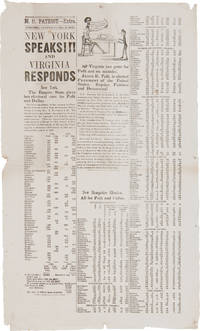
1844Best.-Nr. 66208Concord: Hill & Moore November 9 1844. New Hampshire Democrats Celebrate Polk's Victory An ebullient "Extra" issue of the staunchly Democratic New Hampshire Patriot & Daily Gazette celebrating the not-quite-confirmed victory of James K. Polk in the 1844 presidential election. Published by lifelong Democratic partisan and former New Hampshire governor Isaac Hill the New Hampshire Patriot was a long-running political newspaper in that stronghold of Northern Democracy and this illustrated extra issue printed on Saturday November 9 displays the extent to which the editors and indeed the people of Concord rejoiced at the news. The main headline "New York Speaks!!!" refers to the pivotal flip of New York state from Whig to Democrat a fact which when combined with the expected news of a comfortable victory in Virginia more or less clinched the victory for Polk despite the results being out on several other states. While the optimistic figures in this article report a whopping majority for Polk in reality the Democrats won New York by a narrow margin of just one percent. A short article following this news offhandedly reports on a fatal local celebration noting that "A most shocking casualty occurred in Concord last evening while the democrats were celebrating the triumph of Polk and Dallas in New York by the firing of cannon. Mr. John L. Haynes of this town one of the officers of the Columbian Artillery had his left arm almost entirely blown off his right arm dreadfully shattered and his face shockingly burned in the act of ramming down a cartridge. The discharge took place in consequence of the vent not being stopped in the excitement and hurry of the firing." At the top of the central column a small cartoon depicts a man with an oversized steak knife and glass of wine declaring "That roast beef fetch it on!-and them 'two dollars a day!'" referencing William Henry Harrison's 1840 campaign slogan of "Harrison two dollars a day and roast beef." The remainder of the text reports the election results by county in New Hampshire which voted for Polk by a margin of nearly nineteen percent including votes for the ballot issues "On amending Constitution" and "On abolishing capital punishment." An entertaining and ephemeral piece printed at the culmination of a pivotal election. Old folds. Light tanning a few small chips and tears at edges. Very good. BRIGHAM p.444. unknown
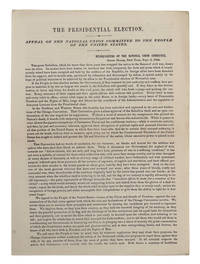
1864Best.-Nr. 68899New York: National Union Executive Committee Sept. 9 1864. National Union Party Denounces the Chicago Platform A scarce National Union Party circular from the 1864 presidential election responding to the infamous Democratic Nation Convention in Chicago and asserting that "every rebel organ in the rebel States or in foreign lands-- every hater of Democratic Freedom and the Rights of Man longs and labors for the overthrow of the Administration and the expulsion of Abraham Lincoln from the Presidential chair." The committee urges voters "not to arrest the blow which is just ready to descend upon the rebellion now tottering to its fall; not to give the rebels time to renew their strength for fresh conflicts; not to aid those who would aid them in overthrowing our Government in destroying our Union in plunging into a chaos of anarchy the great communities of which the Constitution makes one great and glorious nation and in thus extinguishing finally and forever the hopes of all who have faith in Freedom and the Rights of Man." The missive is signed in type by Henry J. Raymond as Chairman and twenty other members of the National Union Committee. Whether thanks to their extensive literature output or merely a reflection of the existing public will the National Union Party's aim was carried in 1864 by a historic margin with Lincoln winning over ninety percent of the electoral vote. An uncommon fine piece of Civil War political ephemera. Light foxing and soiling to edges. Near fine. unknown
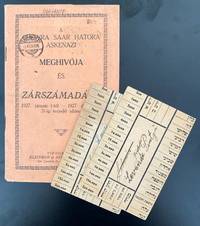
1928Best.-Nr. 43241Satu-Mare Szatmar/Satmar Romania: No Publisher The Chevra Sa’ar HaTorah Ashkenazi; printed by Tipográfia Kleinman si Heimlich 1928. 1st edition. Original orange printed paper wrappers 8vo 10 pages. Primarily in Hungarian with 2-page statement & closing speech also in Yiddish. WITH LAID IN: Two aliyah to the Torah Ark pledge cards one for Ephraim Lavii and one for Levende Pinty Title translates roughly as “The Saar Hatora Ashkenazi Society Financial Statement and Closing Speech. For The Period From January 1 1927 To December 31 1927.” From the strife-ridden year of 1928 in Satu Mare see below a budget report including tables and lists for the Chevra Sa’ar HaTorah Ashkenazi with heartfelt call to action by the President Yosef Chaim Mayer asking the community to support its efforts to raise funds to build a new Beit HaMidrash. The plea is also undersigned by Eli Mandelbaum and by the two gabbais David Spiegel and Yona Weiss. A total of 11 names of leaders of the society are named. Society members are asked for their support in the upcoming election; presumably this is the controversial election of a new chief rabbi which famously split the community and resulted in the appointment of Hasidic Joel Teitelbaum and the creation of the Satmar Dynasty under him. In 1715 when Sathmar became a royal town the Jews were expelled but they began to resettle in the 1820s."In 1841 several Jews obtained the permission to settle permanently in Sathmar; the first Jewish community was formally established in 1849 and in 1857 a synagogue was built. After a great number of traditional Ashkenazic Jews had settled in the town the Jewish community split in 1898 when a supporter of the Hasidic movement was elected chief rabbi into an Orthodox and a Status Quo community led by a Zionist rabbi which erected a synagogue in 1904. In the 1920s there were several Zionist organizations in Satu Mare and the yeshiva one of the largest in the region was attended by 400 students. In 1930 the city had five large synagogues and about 20 shtiebels. In 1928 a conflict within the Orthodox community broke out over the election of a new chief rabbi lasting six years and ending in 1934 with the appointment of the Hasidic rabbi Joel Teitelbaum a traditionalist and anti-Zionist who later re-founded the Satmar Hasidic dynasty in Williamsburg New York. Another Hasidic rabbi Aharon Roth the founder of the Shomrei Emunim and Toldot Aharon communities in Jerusalem was also active in Satu Mare” Wikipedia. We could not locate another copy of this publication anywhere not in OCLC not in KVK not in the Hungarian National Library not in the Romanian National Library and not with a google search. Perhaps a unique surviving copy. Adressee’s name and “Satu Mare” penned on rear cover for mailing stamp clipped out of corner of blank rear wrapper no text loss. Postal cancellation stamp “Satu Mare 5. Feb 1928” on front cover as well as some other ink notations. Paper remains bright and strong about Very Good Condition. Exceedingly Rare with important connection to Satmar Hasidism. B Holo2-163-11-'LG. Satu-Mare [Szatmar/Satmar, Romania]: No Publisher [The Chevra Sa’ar HaTorah Ashkenazi; printed by Tipográfia Kleinman si Heim unknown
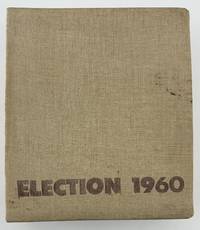
1960Best.-Nr. 4337Various locations in and around Chicago Il: likely early November 1960. Very good plus. Title leaf plus 25 leaves illustrated with forty-seven silver gelatin photographs pasted one per leaf or page all about 5.5 x 7.5 inches plus five loose images two duplicates and three other images not pasted in. Square quarto. Contemporary tan cloth custom photograph album metal-hinged spine front cover printed with title reading "ELECTION 1960." Minor wear and soiling to album. Light occasional thumb-soiling to album leaves ownership signature reading "G. Robert Hillman" on title leaf. Photographs in excellent condition. An utterly charming vernacular photograph album assembled during the seminal Presidential Election of 1960 one of the closest presidential elections in United States history which pitted Vice President Richard Nixon against the junior Senator from Massachusetts John F. Kennedy. The album features about fifty original photographs on the campaign trail in Illinois beginning with about a dozen-and-a-half images of Richard Nixon and his local supporters. The photographs capture various angles of Nixon during his stump speech a young boy waving an "I'm for Nixon" handmade sign another young boy with a Nixon button on his coat crowd scenes a large campaign sign for Nixon-Lodge outside a local store and more. One image featuring a mixed crowd of Nixon and Kennedy supporters transitions into the next section of photographs which concentrates on JFK's campaign. The first image in this section is a closeup of a "Kennedy for President" hat followed by four images of JFK's campaign manager Robert Kennedy making a speech three images of Eleanor Roosevelt stumping for Kennedy five images of Lyndon Johnson and his airplane numerous shots of Kennedy supporters and crowd shots outside Chicago Blackhawks stadium. The photographs then feature the inside of Chicago Auditorium where the first three images depict John F. Kennedy - the first shaking hands with Chicago's longtime Mayor Richard Daley and two during his speech likely his speech of November 4 1960 - just four days before Election Day. The final three images show supporters of both candidates. The 1960 United States Presidential Election was a watershed moment for the campaign politics of the country. Senator Kennedy won the election with a clear Electoral College margin of 303 to 219. However Vice President Nixon won three more states than Kennedy and lost the popular vote only by about 110000 votes out of more than 68 million votes cast. The election set the course for most of the remainder of the 1960s but left Nixon soured and suspicious that the election had been stolen from him - a feeling he never let go and one with ominous echoes today. As indicated in the present album the 1960 presidential election was passionate on both sides with each candidate drawing large enthusiastic crowds for their appearances. The signature on the title leaf of the present album likely identifies the compiler. G. Robert Hillman is a Senior Editor for Politico. Hillman was born in Peoria and grew up on a farm near Flanagan Illinois about a hundred miles from Chicago. He went to college at the University of Illinois at Urbana-Champaign and began his career at Chicago Today and the Chicago Sun-Times. Hillman would have been in middle school during the 1960 election campaign not too precocious for a young man obsessed with politics especially during one of the most heated and media-intensive campaigns of the 20th century. likely early November unknown
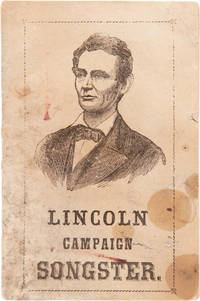
1864Best.-Nr. 62679Philadelphia: Published by Mason & Co. 1864. Singing for Lincoln in '64 A pocket songster printed to support Lincoln's reelection campaign in 1864 featuring a rather youthful portrait of the president on the front wrapper and twelve spirited pro-Union songs. The titles largely military in theme include such works as "Give us Noble Leaders" "The Veteran Volunteer" "Cast Your Votes for Abraham" "For Lincoln or McClellan you'll be called on to decide/ The one to save the union the other to divide" and "We are Coming Father Abraham 600000 More." The advertisements on the rear wrapper encourage readers to purchase a wide variety of Lincoln campaign badges emblems pins and photographs from the publishers. Despite Lincoln's overwhelming electoral victory in 1864 the race was rather close in Pennsylvania where this was printed – Lincoln took Philadelphia County by a scant few percent and actually failed to secure a majority in neighboring Montgomery and Bucks counties. 16mo. Original pictorial wrappers. Wrappers soiled and stained. Largely clean internally. Advertisements on rear wrapper shaved slightly at outer edge as issued. Good plus. MONAGHAN 323. unknown
1844Best.-Nr. 39908Towanda PA 1844. Folio broadside 10-1/8" x 21." Printed in four columns each column separated by a rule. Light to moderate foxing light wear. Good. Signed in type at the bottom by thirty disillusioned local Democrats. Towanda is the county seat of Bradford County the residence of many of the signers including Judge Edward Herrick the first signer. This evidently unrecorded broadside illustrates the impending split in the Democratic Party along sectional lines over the issue of slavery. The signers are "steadfast" Democrats distraught that their Party has nominated James K. Polk of Tennessee as its 1844 presidential candidate. Polk known as the "Dark Horse" candidate "was thrust upon the party as the candidate by the intrigues and management of the NULLIFIERS! italics in original. The instructions and pledges of the delegates were disregarded and Mr. V. Buren and the Democratic party betrayed!" Clay "a statesman of the first order" has always sought to advance the national interest as opposed to parochial concerns. The signers defend his support of protective tariffs and the American System. They applaud his opposition to the annexation of Texas and his warnings that a war with Mexico would result in an expansion of the "odious" system of slavery. Not in Sabin or American Imprints. Not located on OCLC or the online sites of AAS U Penn U TN as of March 2025. unknown
1944Original Progressive Conservative Party of Canada Speakers' Handbook for use in the run-up to the Canadian federal election of 1945. Printing date not stated but was most likely 1944, possibly 1945. Unpaginated. Two inches thick. Provides the full spectrum of PC policies and points with which to attack the Liberal and C.C.F. parties. Contents divided into the following sections: Table of Contents; Leadership - with considerable biographical information on PC leader John Bracken; War Policy and Veterans; Agriculture; Labour; Reconstruction and Natural Resources; Transportation; International Problems; Liberal Policy; C.C.F. Policy. The sections on Liberal and C.C.F. policies extensively document the perceived weaknesses of these parties and were no-doubt intended to serve as the arsenal of attack ads and talking points to be used against these parties. Unmarked. Average wear and soiling. Due to wartime restrictions these handbooks were string-bound. Provides a comprehensive snapshot of the Canadian federal political scene prior to the election of 1945, as seen from the PC perspective. A unique and highly-informative WWII-era Canadian federal political memento. Book
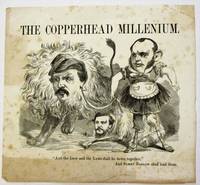
1864Best.-Nr. 36781New York 1864. Broadside 9" x 8-3/8." Lightly foxed. lower margin browned Good McClellan the 1864 Democratic Party presidential candidate is depicted as a lion. His running mate George Pendleton as a lamb; and a wizard-like Sammy Barlow as their handler. "Sammy Barlow" is Samuel Latham Mitchell Barlow 1826-1889 an owner of the New York World newspaper a successful lawyer and a noisy Democrat-Copperhead. He is occasionally called "Sammy Barlow" in satiric verse "the great peace-shrieker of New York city" vociferously advocating a Copperhead platform Philadelphia Evening Telegraph 24 September 1864. Not in Reilly or Weitenkampf. Located at the online sites of Library Company of Philadelphia Brown University and Free Library of Philadelphia which identifies the artist as Henry Louis Stephens a New Yorker . OCLC 77530460 1- Lincoln Pres. Lib. as of June 2020. unknown books
1823Best.-Nr. 34261Raleigh 1823. 15 1 blank pp. Caption title as issued. Disbound. Scattered light and moderate foxing. Good. Signed at the end in type: "November 1823. CAROLINA." A scarce pro-Calhoun anti-Crawford piece for the 1824 presidential election. When Calhoun decided to seek the presidency in 1824 "both Crawford and Adams the acknowledged front-runners felt betrayed" Crawford because Calhoun had reportedly assured him that he would defer to the older man and wait his turn; and Adams because Calhoun had said that "for the good of the country.the next President should come from the North." Peterson THE GREAT TRIUMVIRATE 116. Miles 3. Thornton 1750. AI 12071 1- DLC. OCLC 42212191 3- NYHS Duke UNC as of December 2024. unknown
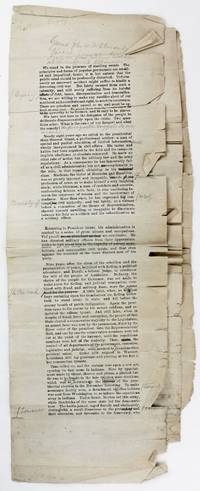
1877Best.-Nr. 5770N.p. likely Springfield Il: ca. January 8 1877. Good. Three long galley leaves each approximately 6.5 x 19 inches and printed on rectos only with numerous pencil emendations. Old folds and creases numerous chips and tears to margins pervasive wrinkling making reading a bit challenging at times but with no loss to text. Small portion of third leaf containing the last eight lines of text detached but present. Not in great shape but seemingly unique. A galley proof of a speech by General John A. McClernand in the midst of the contentious Election of 1876 which was so far as we can determine neither delivered nor published. A pencil note at top reveals his authorship and notes the speech was intended to be delivered January 8 at the “Great Citizens Convention” in Springfield Illinois almost certainly in 1877 following the recent election in the Fall of 1876. McClernand was an Illinois contemporary of Lincoln's a Democratic Congressman and War Democrat. He was also an ally of another Illinois politician and Lincoln adversary Stephen A. Douglas. He was appointed a general during the Civil War largely through political maneuvering and was generally considered incompetent. McClernand greatly resented the authority of Grant who finally relieved him of command in June 1863. Following the war McClernand became a leading critic of Congressional Reconstruction as well as the Grant Administration in general. He also chaired the 1876 Democratic National Convention which nominated Tilden for the presidency. Here McClernand bitterly attacks Grant his presidential Administration and Reconstruction. According to McClernand Grant's "tastes and habits had been acquired in the field and the camp -- in implicit obedience or absolute command. He knew no other rule of action but the military law and army regulations. As a consequence he has lamentably failed as a civil administrator." As President fraudulently and illegally Grant "joined with Kellog a political adventurer and Durell a federal judge to overthrow the will of the people of Louisiana." Law and order says McClernand "lay prostrate and panting at the feet of her remorseless tyrants." McClernand also assails Grant's highhanded tactics in the other Southern States. Now says McClernand "the president and his accomplices have now applied themselves to defeat the will of the people by a parliamentary device. They claimed for the President of the Senate the right and power to count the electoral votes and to declare the result and by implication that that right and power would be so exercised as to count Tilden out of his election and to count Hayes into one." He wasn't wrong. In one of the closest most hotly-contested and highly-controversial elections in American history to put it simply Hayes effectively stole the election by agreeing to remove northern soldiers from the South and end Reconstruction. It would be interesting to know what McClernand thought of the ultimate result -- he didn't get Tilden but he did get the end of Reconstruction. "Yet another prominent Illinoian who played a role in the Civil War John Alexander McClernand was born in Breckinridge County Kentucky before moving to Shawneetown Illinois at a young age. Similar to fellow Illinoian Abraham Lincoln McClernand was a largely self-taught lawyer who began practicing in Shawneetown in 1835. Also like Lincoln McClernand served in the Black Hawk War. However McClernand was a staunch Democrat. In 1835 he established the newspaper Shawneetown Democrat. He was active in Democratic politics at both the state and federal level serving in the Illinois House of Representatives and eventually Congress. In Congress McClernand was a stalwart Jacksonian Democrat who strongly disliked abolitionists. He strongly opposed the Wilmot Proviso which banned slavery in the territory gained after the Mexican-American War. He became a key ally of fellow Democrat and Illinoian Stephen A. Douglas helping him pass the Compromise of 1850. As tensions rose approaching the election of 1860 McClernand campaigned for Douglas’s presidency and became a Unionist. After war broke out in the following April McClernand helped raise volunteers for the Union Army. Because Lincoln needed to retain a wide base of support and retain connections with Democrats in Illinois he appointed McClernand a brigadier general on May 17 1861. McClernand’s military career would be defined by an ongoing clash with fellow Illinoian General Ulysses S. Grant. Grant a seasoned West Pointer who served in Mexico was irritated by McClernand a political general with little military experience. Further exacerbating relations was McClernand’s tendency to boast about his exploits and diminish the achievements of other commanders" - American Battlefield Trust's entry on John A. McClernand. ca. January 8 unknown
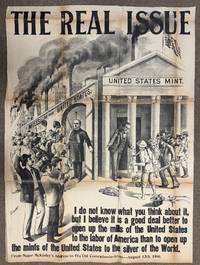
1896Best.-Nr. 41421Chicago: Edwards Deutsch & Heitmann 1896. Elephant folio broadside 36" x 48" mounted on linen at time of manufacture. A graphic black-and-white campaign broadside for Republican William McKinley's 1896 presidential contest against Democrat William Jennings Bryan. Early folds with significant wear and splitting along folds including the backing several archival cloth tape repairs on verso. Moderate toning at the fold lines. Good only. "McKinley welcomes workers to U.S. mills W.J. Bryan welcomes foreign silver." Library of Congress copy of this print but reprinted in 1900 with the addition of large red type "McKinley was Right in 1896." Democrat Bryan favoring free coinage of silver and elimination of tariffs welcomes foreigners bringing to the Mint silver from India Germany England Mexico Japan China and elsewhere. Republican McKinley favoring the gold standard and tariffs to protect American industries welcomes prosperous American workers to American mills. "From Major McKinley's Address to His Old Comrades = In = Arms. - August 12th 1896." OCLC 20499606 1- Detroit Pub. Lib. as of April 2026. Edwards, Deutsch & Heitmann unknown
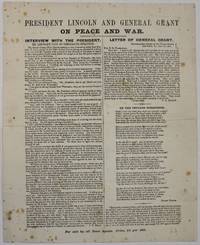
1864Best.-Nr. 40032New York: For sale by all News Agents. Price $1 per 100. 1864. Broadside 9 1/2" x 11 1/4". Printed in two columns. Light foxing Old white tape remnants at upper margin of blank verso. Very Good. The broadside prints Judge Mills's report of his interview with President Lincoln who strongly defends the use of black troops in the war effort. General Grant's letter to E.B. Washbourne sic reports "The Rebels have now in their ranks their last man. The little boys and old men are guarding prisoners guarding railroad bridges and forming a good part of their garrisons for entrenched positions." Bayard Taylor's poem on the Democrats' presidential nominating convention 'On the Chicago Surrender' is also printed. "Judge Mills" was Joseph T. Mills of Wisconsin an attorney and judge who had also been a State Assemblyman. Bartlett 2725. Sabin 41157. Weinstein Against the Tide 141. Not in Monaghan. For sale by all News Agents. Price, $1 per 100. unknown
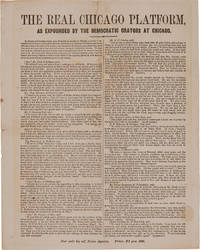
1864Best.-Nr. 65929New York: National Union Executive Committee 1864. Scarce Anti-Copperhead Broadside A scarce anti-Copperhead broadside printed during the election of 1864 purporting to reveal "the real Chicago Platform" and providing excerpts from speeches given at the Democratic National Convention. The convention met in Chicago on August 29 1864 where the Copperheads quickly established dominance over the outnumbered War Democrats and established peace with the South at any cost as the core of their platform. McClellan accepted the nomination alongside staunch Copperhead George Pendleton despite his open opposition to the peace platform; this seeming hypocrisy was mercilessly lampooned by the opposition contributing to the abject failure of the joint War and Peace ticket. The present broadside presents statements made at the convention by "a number of distinguished Democratic orators" which they deem "sufficient to show the temper and purpose of all." Some choice excerpts include: "I love our Southern friends; they are a noble a brave and a chivalrous people cheers" Representative James S. Rollins of Missouri; "Show me a War Democrat to-day and I will show you a shoddy Abolitionist in disguise.He is a Judas and should be cast out as an enemy to humanity and to God.Soon the net is to be drawn that will gather in its half million more to feed the insatiable thirst for blood of the Negro God" J.A. McMaster arrested for libel at the start of the war; "If Democrats catch Lincoln's bloody satrap spies among them they must cut their damned throats that's all. Applause" Captain William J. Kountz known troublemaker and personal antagonist of General Grant dishonorably discharged in 1863; and "We are one and all for peace and with this magic word upon our banner we shall sweep over the course and roll into oblivion the black negro-loving negro-hugging worshippers of old Abe Lincoln" Isaiah Rynders Tammany Hall tough and former Know-Nothing. The broadside was clearly printed with intention of wide dispersal among potential Lincoln supporters with a noted price of "$1 per 100." The American Antiquarian Society reasonably suggests that this broadside was printed by the National Union Executive Committee of New York based on typographically similar items in their collection. A representative document from one of the nation's most fraught elections. Old folds. Light tanning and staining. Small holes at two cross-folds short closed tear to upper margin and left edge. About very good. SABIN 68234. unknown
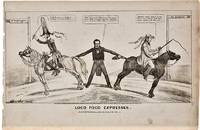
1838Best.-Nr. 38949New York: H.R. Robinson 1838. Oblong lithograph broadside 13-1/4" x 20." Shallow blank left margin chips from a prior mounting. Light outer margin darkening. A clean image signed 'Blanks fecit' perhaps Edward Williams Clay. Very Good. A satiric commentary on thwarted Democratic hopes to control New York City. Whigs dashed Democratic expectations in the New York municipal elections of spring 1838. Successful Whig mayoral candidate Aaron Clark holds and restrains two horses by their tails: 'Stop my good fellows you are going on a fools errand you are counting your chickens before they are hatched'." His victory has delayed if not destroyed Loco Foco hopes of political dominance. On the right a Loco Foco supporter in the garb of a carman or driver sits on a horse and tries to ride toward Albany to fulfill his ambitions: 'Marcy must resign in my favor and I'll be next Governor myself for this job!' Reilly suggests the man is either Isaac Varian the Loco Foco mayoral candidate or Democratic Congressman C.C. Cambreling. On the left a uniformed Jacksonian Democrat sits on his horse. He wants to go to Washington: 'I shall insist on Matty's making me next Collector.' He is probably Tammany leader Jesse Hoyt who indeed was successful in his quest to be Collector of the Port of New York. Reilly 1838-11. Weitenkampf 52. OCLC 299944597 1- DLC 1136565725 1- AAS as of December 2025. Not at NYPL or NYHS web sites. H.R. Robinson unknown
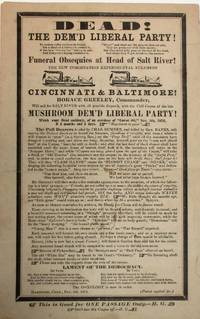
1872Best.-Nr. 38915Hartford 1872. Broadside 6" x 9-1/2" text surrounded by mourning border. A few spots Very Good. Illustrations of two steamers. At the bottom: "This is Good for ONE PASSAGE Only. - H.G." Dated at Hartford November 5 1872. "Salt River" is 19th century American slang: a losing candidate for office was taking a trip "up Salt River." Tickets for passage "up Salt River" were frequently printed to mock supporters of losing candidates. This humorous scarce broadside taunts Horace Greeley and other defectors from the Republican Party for their support of Greeley in 1872. "On the overwhelming defeat of the Liberal Republican Party and its candidate Horace Greeley in the presidential election of 1872. Greeley had been nominated at a Liberal Republican convention at Cincinnati in May and at the Democratic National Convention at Baltimore in July 1872" AAS description. Pall bearers include Charles Sumner and General Banks prominent Republican supporters of Greeley. OCLC 191231113 2- AAS Middlebury 47090036 1- CT Hist. Soc. as of August 2025. unknown
1936Best.-Nr. 24942This sheet contains five rough sketches of graphics calling on the workers and voters of America to support Franklin D. Roosevelt's reelection in 1936. They did in record numbers. PRESIDENTIAL ELECTION OF 1936.Typed Document Signed. Artwork by Franz Felix and Ideas and Copy by Richard Barron "Set of Rough Sketches Containing Some Suggested Promotion Ideas to be Used in the 1936 Democratic Presidential Campaign" July 2 1936. 1 p. 12 x 10½ in. Excerpts: "1. Sounding the call against 'economic royalists' in the spirit of 1776." "2. Appropriating the well-known symbol of violence upraised fist diverting it to peaceful democratic use. To include the farmer phrase the appeal: TOILERS OF AMERICA – UNITE FOR ROOSEVELT." "3. The statue of 'The Thinker' as a symbol of the man today who thinks the toiler with brawn and brain.everyman." "4. Direct appeal to radical labor and leftists in general." "5. Another way of appealing to the working class men and women." "This collaborative effort respectfully submitted for consideration to the Chairman of the Democratic National Committee Mr. James A. Farley." Historical Background After unseating incumbent Republican President Herbert Hoover in 1932 President Franklin D. Roosevelt ran for reelection in 1936. His Republican opponent was Governor Alf Landon of Kansas. Although the Great Depression had entered its eighth year Roosevelt's New Deal policies were broadly popular. He won the highest share of the popular and electoral vote since the uncontested 1820 election. Roosevelt attracted more than 60 percent of the popular vote and won the electoral votes of 46 states; Landon won the electoral votes of only Maine and Vermont. Democratic Party chairman James Farley had predicted that Roosevelt would lose only Maine and Vermont. After the results of the 1936 election Farley quipped that the nation needed to revise the conventional political wisdom of "As Maine goes so goes the nation" to "As Maine goes so goes Vermont." These ideas for campaign imagery employed or modified common images to support Roosevelt's campaign. One drew on the imagery of artist Archibald Willard's 1875 painting The Spirit of '76 and employed three figures of workers to match the subjects of Willard's image. Another appropriated the upraised fist as a symbol of violence and repurposed it as a symbol of defiant unity against "economic royalists." A third used an image of The Thinkerby French sculptor Auguste Rodin 1840-1917 to appeal to thinking voters. Another image appeals to the fears of radicals that the alternative to Roosevelt is "Reaction." Richard Barron and artist Franz Felix submitted these ideas to Democratic National Committee chairman James A. Farley on July 2 1936 three weeks before the Democratic Party held its convention in Philadelphia. There is no evidence that these images were used in the campaign and it is possible that Farley rejected them. At the end of the campaign the Democratic National Committee had a campaign deficit of approximately $850000. To help offset those expenses the treasurer convinced President Roosevelt to sign 2500 brief Forewords which were bound into The Democratic Book 1936 and sent to donors of $250. Purchases brought in more than $400000 for the party and led Republicans to charge corrupt practices for allowing corporations to contribute to the campaign by buying copies. Franz Felix 1892-1967 was born in Vienna Austria and developed an ability as a child to draw portraits in charcoal. He studied portraiture in Vienna and immigrated to the United States shortly after World War I. He settled in San Francisco where he established himself as a portrait artist and commercial illustrator. In the late 1920s he moved to New York and established a studio in the suburb of Spring Valley where he produced book and magazine illustrations. During World War II he painted a series of murals of wartime activities of Spring Valley residents. James A. Farley 1888-1976 was born in New York into an Irish Catholic family. After his father died he helped his mother with a small business to support the family. After graduating from Packard Business College in New York City where he studied bookkeeping and other business skills Farley got a job with the U.S. Gypsum Corporation. He served as a Democratic town clerk in Stony Point New York and became chairman of the county's Democratic Party in 1918. He organized upstate Democrats and helped elect Alfred E. Smith as Governor that year. He served in the New York State Assembly in 1923 but was defeated at the next election for supporting the repeal of Prohibition. As chair of the state Athletic Commission Farley fought for the civil rights of African American athletes. Farley founded he General Builders Corporation from smaller firms to become New York City's largest building supply company. Farley directed Franklin D. Roosevelt's narrowly successful New York gubernatorial campaign in 1928 and his reelection in 1930. Farley served as chairman of the New York State Democratic Committee from 1930 to 1944 and helped build the national New Deal coalition that elected Roosevelt to the Presidency four times. In 1932 Farley became the chairman of the Democratic National Committee and in 1933 U.S. Postmaster General. He held both positions until 1940. Farley and Roosevelt broke on the two-term tradition of the Presidency in 1940 and he later helped propose the 22nd Amendment to the U.S. Constitution limiting a person to two elections as president approved by Congress in 1947 and ratified in 1951. Farley became chairman of the board of the Coca-Cola Export Corporation in 1940 and held that position for more than thirty years. books