ALNWICK ELECTION, 1826Biblio.com
1.177 Ergebnisse
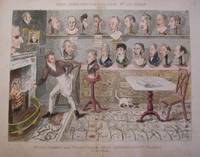
Best.-Nr. elala2053Alnwick: 1826-32. An album containing 36 engraved and etched caricatures including at least 25 dealing with the Alnwick Northumberland election of 1826 some additional dealing with the Northumberland election of 1832 and 3 broadsides 2 illustrated. various sized sheets 25 hand-coloured most mounted on larger uniform sheets. bound as an oblong folio in later half morocco extremities worn short splits in lower joints scattered soiling & foxing several sheets folded & some torn but with no loss of image. ownership entry of William Graham Richardson North Shields. The 1826 Alnwick election for two parliamentary representatives for Northumberland was a hotly contested one marked by much rancour and animosity among the candidates and the voters. Some voters engaged in the practice of plumping or voting for only a single candidate rather than two. Of the four contestants Henry Thomas Liddell Liddle Tory Matthew Bell Tory Thomas Wentworth Beaumont at the time an Independent Reformer and Henry George Grey Viscount Howick Whig Liddell and Bell emerged victorious. Another figure appearing in some of the caricatures is John George Lambton later first Earl of Durham Governor General of Canada 1837 and author of the celebrated Durham Report 1839. While supporting the candidature of his brother-in-law Lord Howick Lambton fought a bloodless duel with T.W.Beaumont. A full listing of the broadsides and caricatures some of which carry the imprint of W.Stephenson or W.Davison is available upon request. [Alnwick]: 1826-32. unknown
Best.-Nr. 8525Paris, de l’imprimerie Royale, le 24 janvier 1789. Placard in folio, 565x860mm.Sur papier fort. Texte sur 4 colonnes séparées par un filet noir. Pliures, ainsi qu’une mouillure (sans gravité). Il s’agit de l’acte initial de la Révolution Française. La détresse financière à la veille de la Révolution. Il ne se trouve plus personne qui veuille prêter au ROI et les privilèges résistent opiniâtrement à toute création d’impôt les atteignant dans leur privilège ; le gouvernement de Louis XVI se trouve ainsi acculé à la nécessité de s’adresser à la Nation pour en obtenir de l’argent et convoquer pour cela, les Etats-Généraux. Cette convocation, aboutissement d’un conflit d’ordre fiscal entre le ROI et les privilégiés, est l’acte décisif qui ouvre l’ère Révolutionnaire. Les privilégiés, en la réclamant, le ROI en l’accordant, fournissent à la Nation l’instrument nécessaire avec lequel elle va faire la REVOLUTION. Cette grande affiche règle les modalités d'élection des députés aux Etas-Généraux et la confection des cahiers de doléances. Rare et précieux document
