1374 resultados
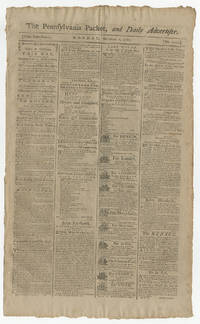
1787ref. 24135U.S. CONSTITUTION.Newspaper. The Pennsylvania Packet and Daily Advertiser. October 1 1787 No. 2700 Philadelphia: John Dunlap and David C. Claypoole including the September 28 resolution of the Confederation Congress to send to the states for ratification the recently completed U. S. Constitution. 4 pp. 12 x 18¾ in. "The United States in Congress Assembled. Friday September 28 1787. CONGRESS having received the Report of the CONVENTION lately assembled in Philadelphia Resolved unanimously THAT the said report with the resolutions and letter accompanying the same be transmitted to the several legislatures in order to be submitted to a convention of delegates chose in each state by the people thereof in conformity to the resolves of the convention made and provided in that case. CHARLES THOMSON Secretary." p2/c3 The convention called to revise the Articles of Confederation met in the Pennsylvania's State House in Philadelphia starting on May 25 1787. After many delegates agreed that the Articles could not be sufficiently improved they started to draft an entirely new structure. Maintaining their pledge of secrecy after months of private deliberations over trade defense taxation representation separation of powers the election of a president the slave trade international relations and many other issues the proposed United States Constitution was signed by thirty-nine of the fifty-five delegates on September 17. Two days later the Constitution was first published by the Pennsylvania Packetand four other Philadelphia newspapers. The cover letter sent by George Washington president of what came to be called the Constitutional Convention submitting the plan to Arthur St. Clair the President of the Congress of the Confederation in New York was also printed then. Congress received and read the proposed Constitution on September 20th. As a sampling of their deliberations William Grayson of Virginia thought it was too weak while Richard Henry Lee of Virginia and Nathan Dane of Massachusetts thought it was too strong. On September 27 Virginia's Richard Henry Lee proposed that the Constitution be sent to the executives of each of the states. A Delaware representative quickly added "in order to be by them submitted to conventions of delegates to be chosen agreeably to the said resolutions of the convention." Ten of the twelve states then represented in Congress voted in favor. Before Congress adjourned for the day the majority of Virginia's representatives and a minority of New York's representatives also indicated their support. On September 28 Federalists holding out for a unanimous vote found a way to compromise with anti-Federalists: Congress unanimously resolved to send the Constitution to the states but without any recommendation or approval. Arider from New York City arrived in Philadelphia with the resolution that same day. George Clymer presented his own resolution to the Pennsylvania Assembly noting that "the late Federal Convention has digested a plan of government for the United States and recommended that it should be referred to the consideration of State Conventions…" After a "very long and animated debate" Clymer's resolution passed by a vote of 43 to 19 and adjourned until 4:00 p.m. But only 44 members returned falling two shy of the necessary quorum. The Assembly's sergeant-at-arms was sent to show the resolution to absent members. Two who still refused to attend were seized by the public dragged through the streets and thrust into the assembly room. The involuntarily completed quorum voted that "it is the sense of great numbers of the grand people of this state already signified in petitions & declarations to this house that the earliest steps should be taken to assemble a convention within the state for the purpose of deliberating and determining on the said constitution." They called for the election of deputies who would assemble for that purpose "on the third Tuesday of November at the State-house in the city of Philadelphia…" p2/c3-4 Other articles of interest in this issue include news from Europe and a brief piece against Indians "from the western country who still continue their depredations on the whites…" p2/c3 The Pennsylvania Packet or the General Advertiser1771-1839 was founded by John Dunlap in late 1771 as a weekly newspaper in Philadelphia though it relocated to Lancaster during the British occupation of Philadelphia in 1777-1778. On May 30 1783 Benjamin Towne turned the Pennsylvania Evening Post into the first daily newspaper in the United States. However with Towne branded a traitor and forced to hawk his own papers on the street the newspaper collapsed the following year. John Dunlap and David Claypoole then made their Pennsylvania Packet the first successful daily on September 21 1784. It underwent numerous name changes in the 1790s until sold in 1800 and renamed Poulson's American Daily Advertiser. John Dunlap and David C. Claypoole books
1787ref. 24135U.S. CONSTITUTION.Newspaper. The Pennsylvania Packet and Daily Advertiser. October 1 1787 No. 2700 Philadelphia: John Dunlap and David C. Claypoole including the September 28 resolution of the Confederation Congress to send to the states for ratification the recently completed U. S. Constitution. 4 pp. 12 x 18¾ in. "The United States in Congress Assembled. Friday September 28 1787. CONGRESS having received the Report of the CONVENTION lately assembled in Philadelphia Resolved unanimously THAT the said report with the resolutions and letter accompanying the same be transmitted to the several legislatures in order to be submitted to a convention of delegates chose in each state by the people thereof in conformity to the resolves of the convention made and provided in that case. CHARLES THOMSON Secretary." p2/c3 The convention called to revise the Articles of Confederation met in the Pennsylvania's State House in Philadelphia starting on May 25 1787. After many delegates agreed that the Articles could not be sufficiently improved they started to draft an entirely new structure. Maintaining their pledge of secrecy after months of private deliberations over trade defense taxation representation separation of powers the election of a president the slave trade international relations and many other issues the proposed United States Constitution was signed by thirty-nine of the fifty-five delegates on September 17. Two days later the Constitution was first published by the Pennsylvania Packetand four other Philadelphia newspapers. The cover letter sent by George Washington president of what came to be called the Constitutional Convention submitting the plan to Arthur St. Clair the President of the Congress of the Confederation in New York was also printed then. Congress received and read the proposed Constitution on September 20th. As a sampling of their deliberations William Grayson of Virginia thought it was too weak while Richard Henry Lee of Virginia and Nathan Dane of Massachusetts thought it was too strong. On September 27 Virginia's Richard Henry Lee proposed that the Constitution be sent to the executives of each of the states. A Delaware representative quickly added "in order to be by them submitted to conventions of delegates to be chosen agreeably to the said resolutions of the convention." Ten of the twelve states then represented in Congress voted in favor. Before Congress adjourned for the day the majority of Virginia's representatives and a minority of New York's representatives also indicated their support. On September 28 Federalists holding out for a unanimous vote found a way to compromise with anti-Federalists: Congress unanimously resolved to send the Constitution to the states but without any recommendation or approval. Arider from New York City arrived in Philadelphia with the resolution that same day. George Clymer presented his own resolution to the Pennsylvania Assembly noting that "the late Federal Convention has digested a plan of government for the United States and recommended that it should be referred to the consideration of State Conventions…" After a "very long and animated debate" Clymer's resolution passed by a vote of 43 to 19 and adjourned until 4:00 p.m. But only 44 members returned falling two shy of the necessary quorum. The Assembly's sergeant-at-arms was sent to show the resolution to absent members. Two who still refused to attend were seized by the public dragged through the streets and thrust into the assembly room. The involuntarily completed quorum voted that "it is the sense of great numbers of the grand people of this state already signified in petitions & declarations to this house that the earliest steps should be taken to assemble a convention within the state for the purpose of deliberating and determining on the said constitution." They called for the election of deputies who would assemble for that purpose "on the third Tuesday of November at the State-house in the city of Philadelphia…" p2/c3-4 Other articles of interest in this issue include news from Europe and a brief piece against Indians "from the western country who still continue their depredations on the whites…" p2/c3 The Pennsylvania Packet or the General Advertiser1771-1839 was founded by John Dunlap in late 1771 as a weekly newspaper in Philadelphia though it relocated to Lancaster during the British occupation of Philadelphia in 1777-1778. On May 30 1783 Benjamin Towne turned the Pennsylvania Evening Post into the first daily newspaper in the United States. However with Towne branded a traitor and forced to hawk his own papers on the street the newspaper collapsed the following year. John Dunlap and David Claypoole then made their Pennsylvania Packet the first successful daily on September 21 1784. It underwent numerous name changes in the 1790s until sold in 1800 and renamed Poulson's American Daily Advertiser. John Dunlap and David C. Claypoole
ref. 19152, Brasilia, Centro grafico do senado federal 1988, in-8, br., neuf, ENVOI, 292p.
ref. 8640Beijing, Editions en Langues etrangeres, 1983. 1 volume in-12, 81 pp., reliure moderne blanche toile, dos lisse, un tampon sur la page de titre, très bon état.
ref. 22845, Santiago de Chile, Université du Chili 1958, in-8, br., bon état, 88p.
ref. 51787, Buenos Aires, Sous-Secrétariat de l’Information - Présidence de la Nation 1949, in-8, fascicule agrafé, (papier jauni et fragile), 14p.
ref. 56983, Ankara, Direction générale de l’Information [1970], in-8, br., assez bon état, 69p.
ref. 144633Mâcon, J. Galand, s.d. (1799) in-8, 40 pp., en feuilles.
ref. 215214Carcassonne, Imprimerie de P. Polère, an IV (1795) in-8, 62 pp., en feuilles, cousu, petite tache d'encre sur le feuillet de titre.
ref. 220148Angers, Imprimerie de Jahyer, an VIII (1800) in-8, 20 pp., dérelié.
ref. 222920Dijon, Imprimerie de Capel, 1791 in-4, 35 pp., dérelié.
ref. 226756Lille, Typographie F. Bracke, s.d. (1848) in-folio (47 x 31 cm), [2] pp. n. ch., texte sur 3 colonnes, sommé d'allégories républicaines (dont deux tétragrammes...), en feuille.
ref. 244351Paris, Corréard [Imprimerie de P.-F. Dupont], 1820 in-8, [2] ff. n. ch., 62 pp., broché sous couverture d'attente de papier rose.
1959ref. ys1353Imprimerie des Journaux officiels Broché 1959 In-8 (13.5x21 cm), broché, 136 pages ; une pliure au dos insolé, plats en partie insolés, assez bon état. Livraison a domicile (La Poste) ou en Mondial Relay sur simple demande.
ref. 8527aquatinte par BINET rue Aubry le boucher, 34. Format 365x440mm, sans date.
ref. 8528format 363x442mm, aquatinte par BINET rue Aubry-le-Boucher, 34.
1956ref. 11624ÉDITIONS CORRÉA BUCHET CHASTEL 1956 364 pages in8. 1956. broché. 364 pages.
ref. 17163Paris, Imprimerie Nationale, 1848.
1795ref. 177010De l'Imprimerie de la République A Paris, de l'Imprimerie de la République, 1795 - An IV. In-16 relié demi-basane blonde à petits coins, dos lisses, filets dorés, pièces de titre. 1 ff blanc, titre, X + 360 page, 1 ff blanc. Constitution de l'an III, qui contient une Déclaration des "droits" de l'homme revue et corrigée, mais aussi des "devoirs" de l'homme. C'est la seule Constitution française qui définit le territoire, c'est aussi la plus longue constitution. Adoptée le 5 fructidor an II (22 août 1795), elle sera appliquée durant quatre ans, jusqu'au coup d'État de Bonaparte, le 18 brumaire an VIII. Bel exemplaire très propre et bien relié.
ref. c4977Paris, Imprimerie de l' Assemblée Nationale, sans date (1963) ; livret in-12° broché, couverture gris pale imprimée en noir avec timbre-poste 0, 20+0, 10 F, oblitéré à la date du 20 décembre 1963; 34pp. ( dont les derniers feuillets roses.Livret fixant règlement et édité à l' occasion du Congrès du Parlement tenu à Versailles le décembre 1963, avec, oblitarétion philatélique " premier jour ".Très bon état.
ref. 4364In 8 demi-chagrin rouge à nerfs,titre doré,filets à froid. Faux-titre,titre,XXII ,218 pages,suivis de Essai sur le principe générateur des Constitutions politiques.Faux-titre,titre,XVI,91 pages.Lyon J.B Pelagaud & Cie 1846. Quelques rousseurs en marge supérieure aux dernières pages
1647ref. 28786BOURGES 1647 1 document d'un feuillet manuscrit à l'encre brune sur vélin parcheminé, format : 20,7 x 22,5 + attaché avec un document de 4 pages (un feuillet plié en deux) manuscrit à l'encre brune sur velin parcheminé, format : 29,7 x 20,5 cm, signature à la fin du texte par FRANCOIS GUYARD, NOTAIRE, TABELLION, GARDE-NOTES DE LA GENERALITE DU BERRY, RESIDANT A BOURGES, BOURGES, LE 28 DECEMBRE 1647, CONSTITUTION DE RENTE CONSENTIE PAR ANDRE MONTAGNE, LABOUREUR DEMEURANT EN LA PAROISSE DE SAINT-JUST AU PROFIT DE L'HONORABLE HOMME ETIENNE PONCET, PROCUREUR DE L'ELECTION ET GRENIER A SEL DE BOURGES, DEMEURANT A SAINT PIERRE LE MARCHÉ, BOURGES, LE 28 DECEMBRE 1647,
ref. 18278Broché - 13,5 x 21 - 156 pp - année 1963 - Edité par Le Grand Secrétariat - 25 ème tirage
ref. 18279Broché - 14 x 21,5 - 171 pp - année 1924 - Edité par le Secrétariat général du Grand Orient de France - 25 ème tirage
1552ref. 182811552 Broché - 15,5 x 24 - 180 pp - année 1957 - Edité par le Secrétariat général du Grand Orient de France -