CONSTITUTIONBiblio.com
1.230 Ergebnisse
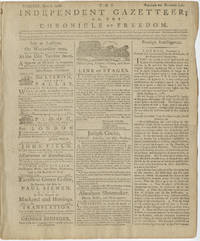
1788Best.-Nr. 30007.003Philadelphia PA 1788. No binding. Fine. Independent Gazetteer; or The Chronicle of Freedom. Newspaper. Independent Gazetteer; or The Chronicle of Freedom Philadelphia Pa. May 6 1788. 4 pp. 9 1/2 x 11 1/2 in. The Maryland ratifying convention suggests some amendments along with their approval of the Constitution. ExcerptsFrom page 3:""From the MARYLAND GAZETTE or April 29 1788. The CONVENTION of this state on Saturday last determined to ratify the proposed plan of Federal Government. -YEAS 63 NAYS 11-And then appointed a committee of thirteen members to consider and report amendments to be recommended to the people. -The following amendments were proposed by a member and referred to the committee who are now sitting-And it is hoped that the great and essential rights of the people will be declared and secured.- PROPOSED AMENDMENTS.Wherefore whenever the ends of Government are perverted and public liberty manifestedly endangered and all other means of redress are ineffectual the people may and of right ought to object to reform the old or establish a new Government-that the doctrine of nonresistance against arbitrary power and oppression is absurd slavish and destructive of the good and happiness of mankind. All imposts and duties laid by Congress shall be placed to the credit of the state in which the same be collected. That there shall be no national religion established by law; but that all persons be equally entitled to protection in their religious liberty. That the Supreme Federal Courts shall not admit to fictions to extend its jurisdiction; nor shall citizens of the same state having controversies with each other be suffered to make collusive assignments of their rights to the citizens of another state for the purpose of defeating the jurisdiction of the State Courts; nor shall any matter or question already determined in the State Courts be revived or agitated in the Federal Courts. That Congress have no power to lay a Poll-Tax. That the people have a right to freedom of speech of writing and publishing their sentiments and therefore that the freedom of the PRESS ought not to be restrained and the printing presses ought to be free to examine the proceedings of Government and the conduct of its officers.""From page 2: Protesting the Slave Trade by Boycotting West Indian Produce""A CAUTION.WHEREAS in the year 1787 some vessels were fitted out at the port of Philadelphia for the iniquitous purpose of stealing the inhabitants of Africa from all the endearments of domestic life; one of which vessels has succeeded in obtaining a number of poor blacks and has taken the to a port in the West Indies where they are under the iron hand of oppression. From this shameful traffic this horrid source the proprietors of the vessel have purchased some West India produce which after landing at Wilmington they have brought up to this city and offered for sale. It is a grateful circumstance to the supporters of the common rights of mankind that the virtuous inhabitants of the city reprobate the horrid idea.-A correspondent hopes that the citizens will further testify their disapprobation of the practice by turning with indignation from the purchase of any property thus basely procured by men so lost to the common feelings of humanity; notwithstanding the patriotic convention at which Washington presided have declared that this abominable traffic shall be continued for TWENTY years by the people of America.From page 1:An advertisement with engraving for a ""Line of Stages"" between Philadelphia and New York started by four partners who split off from an established stage line and promising better service. From page 4:An advertisement for another different ""New Line of Stages."" And a report on the creation of a Philadelphia committee for the relief of the nearly 100 Americans captured by Algerian corsairs and Barbary pirates. unknown
1827Best.-Nr. 374087Philadelphia: R. Desilver 1827. Typeset frontispiece within typographic border approx. 15x18-1/2 inches detached from the accompanying almanac. 67 1pp. 8vo. Disbound. Old folds tear to gutter. Typeset frontispiece within typographic border approx. 15x18-1/2 inches detached from the accompanying almanac. 67 1pp. 8vo. Shaw & Shoemaker 27484; Drake 11567 R. Desilver unknown
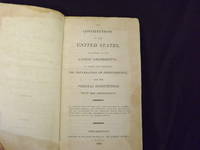
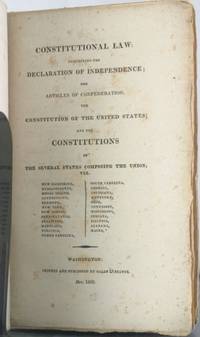
1802Best.-Nr. 1063758vo period calf rebacked with leather 2 266 pp. Joints cracked rebacking crude some wear to covers paper slightly fragile front endpaper detached other front endpaper with piece missing ink name on front pastedown some darkening to contents; otherwise about very good. This is a rich volume of early American government. In addition to the United Sates Constitution and Declaration of Independence this volume also contains the constitutions of the original states and the ordinances for the government of the North West Territory. Printed under the title is the notation that "This edition contains the constitutions of Vermont Delaware Georgia and Kentucky with the regulations for the government of the territory north west of the river Ohio." This material was not in any other edition. William Duane,
2006Best.-Nr. 76533Washington DC: U. S. Government Printing Office 2006. Presumed First Edition First printing. Wraps. Good. Serial No. 109-79. Two volumes. Volume I v 1 1684 6 pages Volume II v 1 1685-3375 pages. During this hearing Representative John Lewis of Georgia stated "The Voting Rights Act helped expand our democracy and open up our democracy to elect hundreds of thousands and millions of our citizens who had been kept out let them in. The Voting Rights Act was needed then and it is needed now. The purpose of section 5 is very unique and very important. It prevents discriminatory plans from being enacted in the first place. It put the burden on the judiciary to show that the plan does not discriminate against minority voters. Congress Lewis continued "Prior to section 5 the burden was on the minority voters to challenge the voting practice; and every section was good at coming up with different procedures that had the same result discrimination. Anita Earls' testimony talks in some detail about the recent example how this is still happening. The difference is that we have section 5 to prevent these practices from harming minority voters. Many people like the court said that we have come a long ways; and again today I would say that we've come a distance. We've come a long way and that is true. We're not the same Nation that we were 40 years ago but it's clear today that we have not come far enough. Section 5 is still needed. Today section 5 prevents discrimination and redistricting and changes that move voting locations out of minority neighborhoods into less accessible areas. These are issues that are different from the fight to register to vote but they are no less fundamental." U. S. Government Printing Office paperback
Best.-Nr. 57471, Paris, Dusillion ss date [1841], in-plano, 60x 45cm, cartonnage d’époque, dos lisse orné d’une frise dorée, 2 tableaux, 9 planches gravées, (rel. et plats usés, dos décollé avec des mq. de cuir, coupes frottées, mq. un coin, taches sur la p. de tit. et des mouillures sur le papier de protection), int. frais hormis qq. rousseurs sur les papiers de protection, gravures très bien conservées, 3p.[et] 9pl.
Best.-Nr. DROIT306M1791, de l'Imprimerie de Didot Jeune, chez Garnery, Paris. In-32, reliure d'époque plein maroquin, dos lisse orné de fers révolutionnaires, pièce de titre, plats encadrés de filets, coiffes et chasses ornées, roulettes intérieures, signet, 160pp. Première Constitution française, acceptée par le Roi dans une lettre puis un serment et comprenant la Déclaration des Droits de l'Homme et du Citoyen puis les différents articles. Intérieur très frais. Infimes frottements d'usage aux coins et coiffes. Très bon exemplaire de ce superbe témoignage.
Best.-Nr. 55971276 pages en un fort volume in 4 plein cuir fauve raciné à nerfs, pièce de titre et tomaison absentes. Fers dorés. Raccommodages,coiffes,coins, mors;Intérieur très bon état, à signaler,cependant, quelques pâles mouillures en marge inférieure en fin de volume.Ensemble très correct et très solide.1754:2janvier au 31 décembre, 212 pages. 1755:2 janvier au 25 décembre 208 pages, 1756 2janvier au 26 décembre,212 pages,1757:vignette en tête 2 janvier 23 décembre 208 pages.Suite des additions aux nouvelles ecclésiastiques des années 1750 & 1753,24 pages.1758: vignette en tête 2 janvier 24 décembre ,208pages. 1759 2 janvier 22 décembre 204 pages. Rare "Fondateurs, collaborateurs, directeurs, contributeurs Jacques FONTAINE DE LA ROCHE; de 1761 à 1793, Marc-Claude GUENIN DE SAINT-MARC, Louis GUIDI, Pierre-Etienne GOURLIN, Noël CASTERA DE LARRIÈRE, Jean HAUTEFAGE Les N.E. se proposent de faire l'histoire des persécutions subies par les jansénistes de France depuis la promulgation de la bulle Unigenitus en 1713. Elles se composent d'abord de témoignages des fidèles persécutés, des martyrs de la foi; chaque suite est généralement faite de plusieurs lettres particulières, souvent regroupées autour d'un thème, d'un événement, d'un livre. Elles imitent en cela, comme l'avaient fait les Suppléments à la Gazette d'Hollande imprimés par les jésuites, la forme traditionnelle des gazettes. De plus en plus, sous l'influence de Fontaine de La Roche, elles se rapprochent d'une revue ecclésiastique; les comptes rendus d'ouvrages et d'assemblées, la controverse sur des points de dogme y tiennent une place grandissante. L'imitation des Provinciales de Pascal, qui était assez nette dans les premiers numéros (oct. 1728, 24 févr. 1731, p. 38), disparaît au profit de l'argumentation doctrinale Les Nouvelles ecclésiastiques sont fondées en 1728 par l'abbé Alexis Désessarts (1687-1774) pour lutter contre la mise en application de la Bulle Unigenitus (1713) et soutenir les jansénistes inquiétés par le pouvoir royal ou ecclésiastique. La périodicité des Nouvelles ecclésiastiques est hebdomadaire et le périodique est tiré rapidement à 6000 exemplaires. Elles sont publiées de manière clandestine. Les rédacteurs des Nouvelles ecclésiastiques ont la particularité pour l'époque d'être particulièrement bien informés, y compris de ce qui se passait dans les milieux gouvernementaux. L'influence de ce journal a largement dépassé les milieux ecclésiastiques concernés par le jansénisme. Les historiens considèrent qu'il a contribué à la naissance de l'esprit public à Paris. Les Nouvelles ecclésiastiques sont caractérisées par un ton polémique et partial. Elles sont militantes et fustigent les jésuites, accusés de tous les maux. Les partisans de la Bulle Unigenitus sont unanimement critiqués, sans qu'on leur trouve jamais le moindre côté positif. À l'inverse, les jansénistes sont toujours injustement persécutés et les curés jansénistes inquiétés sont vus comme de véritables martyrs. Les Nouvelles ecclésiastiques sont assez réservées au sujet des convulsionnaires. Les rédacteurs estiment qu'il ne faut pas exclure l'intervention divine dans ces événements mais ils critiquent les excès des convulsionnaires. Au long du XVIIIe siècle, les Nouvelles ecclésiastiques jouent le rôle du seul journal populaire d'opposition religieuse et politique en France. Les Nouvelles ecclésiastiques sont considérées comme un modèle d'organisation de journal clandestin. L'organisation était très aboutie et exemplaire : le responsable de la publication n'était connu que de trois personnes qui passaient chez lui à une demi-heure d'intervalle et recevaient ensuite de la même manière les sous-correspondants qui étaient à leur tour visités par les sept imprimeurs. Enfin, neuf colporteurs se rendaient selon le même processus auprès des imprimeurs prendre livraison du journal pour le diffuser. Chaque individu ne connaissait que le correspondant auquel il avait affaire et si, dans la demi-heure indiquée, il ne l'avait pas vu, il se rendait immédiatement dans une maison qui servait de refuge et d'où on pouvait donner l'alerte. Ainsi, toute arrestation isolée ne pouvait provoquer le démantèlement du réseau. Malgré le harcèlement de la police, qui traquait rédacteurs et imprimeurs, le journal pouvait se diffuser et les échecs de la police provoquaient l'ironie narquoise du peuple. Une anecdote est révélatrice de l'efficacité de ce réseau clandestin: un jour, un lieutenant de police effectue une perquisition chez un imprimeur clandestin. Il arrête celui-ci et est occupé dans la cave où étaient imprimées les Nouvelles ecclésiastiques à saisir le matériel. Lorsqu'il ressort, il trouve sur le siège de son carrosse un exemplaire des Nouvelles ecclésiastiques si fraîchement imprimé que l'encre est encore humide. On voit bien que l'efficacité du réseau se doublait d'une ironie cinglante envers le pouvoir considéré comme persécuteur."
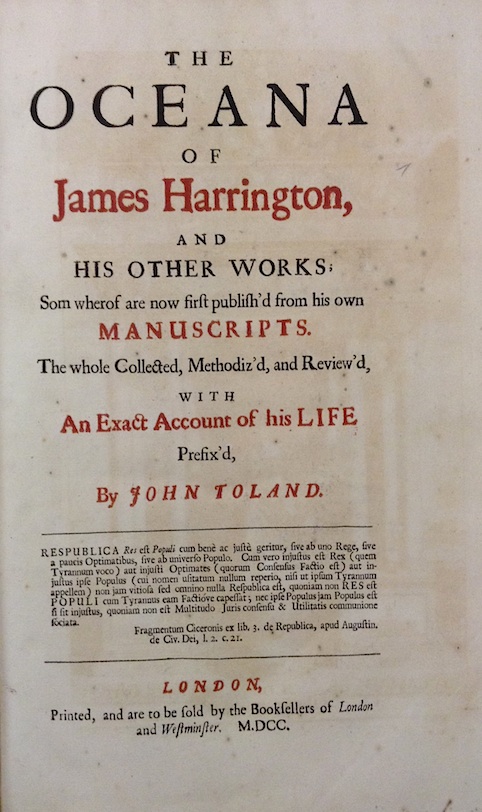
1700Best.-Nr. 49512London, 1700. Folio. 1 Bl., XLIV, 546 S., 1 Bl. Mit gestochenem Frontispiz, gestochenem Porträt (mitpaginiert) u. 1 Kupfertafel. Moderner Halbleder mit Rückenvergoldung. [4 Warenabbildungen]
1822Best.-Nr. 12181Lisboa: Impresa Nacional 1822. Lisboa Imprensa Nacional 1822. En 8º mayor. 100 pp. Encuadernación en cartoné tejuelo de piel en el plano superior con letrería dorada. Primera edición de la primera Constitución Portuguesa votada en Cortes extraordinarias y constituyentes el 23 de Septiembre de 1822 y aceptada por el rey D. João VI en octubre del mismo año. Considerada como un triunfo de los liberales contenía 240 artículos en su mayoría inspirados cuando no directamente copiados de la constitución española de 1812: cesión de soberanía al pueblo e independencia de los poderes legislativo ejecutivo y judicial. Esta es la Constitución que los Andradas y otros diputados brasileños se negaron a firmar. Bien acogida en un principio por los brasileños supuso al final el detonante de la independencia de Brasil. Varios días antes de la publicación del "Suplemento" en Lisboa las Cortes declararon el gobierno brasileño subordinado a la constitución lo que fue rechazado por los representantes brasileños quienes comandados por Andradas declararon la independencia de Brasil en 1822. Inscripción en tinta en la portada ligeras manchas ocasionales papel ligeramente tostado. Impresa Nacional unknown
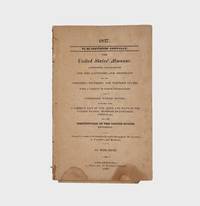
1820Best.-Nr. SP561Gales and Seaton 1820. Second Edition. Hardcover. Good. Washington 1820. 12mo iv 409 pp. Contemporary paper covered boards. Expanded to include 23 states including Alabama and North Carolina. The first edition published a year earlier included just 21 states. A good copy with fraying and chipping to paper at spine foxing to contents and contemporary ownership marks to endpapers. Contents complete. Please contact us for additional pictures or information. Seven copies in OCLC. Cohen Bibliography of Early American Law 3014. Gales and Seaton hardcover
1749Best.-Nr. P1-4A-7Genève, Barrillot et fils, 1749. 2 parties en 1 volume in-4 (270x210 mm) de XXIII-(1)-1 grande carte dépliante, 326 pp. ; (2)-XIV-398 pp. relié d’époque plein veau brun granité, dos à nerfs orné de fers dorés, pièce de titre charnières faibles. Édition parue un an après l’originale. « ..Nouvelle édition. Corrigée par l’auteur. Et augmentée d’une table des matières, et d’une carte géographique, pour servir à l’intelligence des articles qui concernent le commerce. ».
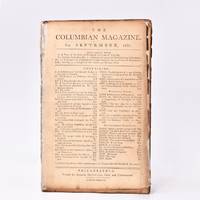
1787Best.-Nr. 365066Philadelphia: Seddon Spotswood Cist and Trenchard 1787. 3 618-674. Without 2 plates. 8vo. Disbound fire damage at edges leaves detached. 3 618-674. Without 2 plates. 8vo. Along with a printing in the American Magazine among the earliest printings of the Constitution in a periodical. "One of the best of the eighteenth century magazines was the Columbian of Philadelphia. Considered from beginning to end the Columbian Magazine with its sequel the Universal Asylum affords an extremely valuable treasury of materials which reflect its own times and the war years immediately preceding. it was the handsomest American magazine of its century" Mott. Seddon, Spotswood, Cist and Trenchard unknown
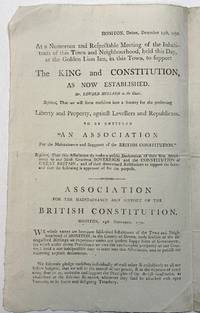
1792Best.-Nr. 41771Honiton England 1792. Folio leaf 16" x 13." Folded to 4 pp. Printed on verso of first leaf and recto of second leaf only. Light old folds spine with early reinforcement tape. Text clean and bright. Very Good. Public enthusiasm for the tenets of the French Revolution and Thomas Paine worried those who supported the established monarchy and British parliamentary government. In response Loyalists created local Societies like this one pledging "that we will to the utmost of our power & at the expence of every thing dear to us maintain and support the Principles of the British Constitution as established at the Glorious Revolution whenever they shall be attacked with open Violence or be secret and designing Treachery." The Association expresses its "deepest Abhorrence of the Authors and Publishers of those seditious Pamphlets which under the specious disguise of Liberty are calculated only to promote Licentiousness and Disorder to encourage Rebellion against the State and Treason against Society." More than thirty supporters sign in type. E. Holland and C. Gidley sign in type as Chairman and Secretary respectively. ESTC records this rare document only at the British Library. OCLC does not list it. ESTC T22340 1- British Library. Not on OCLC as of March 2026. unknown
1791Best.-Nr. 117509Didot jeune 1791 A Paris, De l'Imprimerie de Didot jeune, 1791, 1 volume in-quarto de 170x265 mm environ, VII, 118 pages. Reliure postérieure, demi chagrin vert bouteille, dos à cinq nerfs portant titres et tomaisons dorés, fers dorés, gardes marbrées. Menus frottements sur le dos, mors interne fendillé, coins frottés, des rousseurs, bon état général malgré les défauts signalés.
1741Best.-Nr. 629710Lüneburg, Stern, 1741-45. 4to. Mit gestochenem Porträt (Georg II.) u. 1 gefalteten Tabelle. Zusammen über 7300 Seiten. Pergament d. Zeit (fleckig u. etwas berieben, Bd. 3/4 im Format etwas kleiner, Innengelenke verstärkt). [3 Warenabbildungen]
1767Best.-Nr. 309408Göttingen, Vandenhoeck, 1767. 8nn. Bl. 254 S. Neuer Pappband.
1783Best.-Nr. 106382Small 8vo modern calf spine in gilt spine label title 2 1 3-257 pp. Rebound A1 cropped only affecting the running head binder stamp on endpaper Some browning and foxing otherwise very good in a near fine modern binding. This is a first Scottish edition of this work originally published in Philadelphia in 1781. There were two London editions prior to this printing. In addition to the Constitutions of the various colonies this work includes a copy of The Declaration of Independence and the Articles of Confederation. As a preface this edition includes two pages of Scottish verse. This appears to be a somewhat scarce edition as the OCLC locates only two copies. Sabin 16091. OCLC. ohn Bryce, books
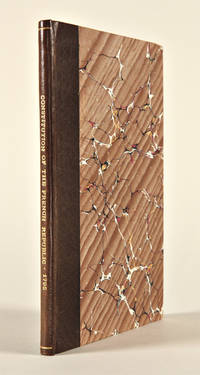
1795Best.-Nr. WRCAM11233Philadelphia: Printed and sold by Benj. Franklin Bache 1795. 59pp. Modern half morocco and marbled boards. Minor tanning to text. Very good. The events of the French Revolution were followed with the keenest interest in America. As the excesses in France grew American reaction split along emerging political lines with the Federalists expressing revulsion while the Democrats were more supportive. The French Constitution of 1793 collapsed with the end of the Terror and this new constitution which created the Directory was instituted. This is the first American edition in English of that new constitution published by the Democratic grandson of Franklin Benjamin Franklin Bache. Bache also published an edition in French the same year. It would have keenly interested the politicians of that year both from a party and foreign relations viewpoint. The NUC locates eight copies. EVANS 28694. Printed and sold by Benj. Franklin Bache hardcover books
1814Best.-Nr. FANarFRA8Paris: M.Ponce & P.Didot L'Aîné 1814. 1814. 4to. large-paper copy. pp. 48. 9 plates engraved by Helman & N.Ponce after C.Monnet incl. 3 before letters. A fine copy bound in modern half morocco by Rivière & Son t.e.g. others uncut original wrs. bound in at end 2 leaves with small marginal stains. armorial bookplate of Sir David Lionel Goldsmid-Stern-Salomons Baronet. FINELY PRINTED AND ILLUSTRATED EDITION OF THE 'RESTORATION' CHARTER OF 1814 PROMULGATED UNDER LOUIS XVIII. INSERTED IN THIS COPY ARE THREE ADDITIONAL PLATES WITH FIGURES BEFORE LETTERS. COHEN-DE RICCI 228. Paris: M.Ponce & P.Didot L'Aîné, 1814.
1787Best.-Nr. 67677London: Printed for D. Henry 1787. UNITED STATES CONSTITUTION; URBAN Sylvanus. One of The First Means by Which The British People Learned of The Enactment of The Constitution of The United States of America UNITED STATES CONSTITUTION subject. URBAN Sylvanus editor. The Gentleman's Magazine "New Constitution of the United States of America". Printed by John Nichols for D. Henry November December 1787. First edition of these November and December 1787 issues. Two small octavo volumes 8 1/2 x 5 1/8 inches; 215 x 130 mm. 941-1035 1; 1037-1131 1 pp. With woodcut text illustration on front wrapper of each volume. November issue with one fold-out plate and lacking plate I entitled "S.W. View of Aconbury Chapel 5 Miles from Here." The December issue with two plates plate II and Supp. but lacking plate I Illustrations of the Royal Charter School Near Dublin Clontarfe Castle Dublin and others. Text of American Constitution on pp. 1008-1011; 1110-1112. Self-wrappered. Newer stitching. Some very minor toning and light occasional spotting. Overall very good. This is the first English magazine printing of the U.S. Constitution. The November issue on pages 1008-1011 prints George Washington's Letter and the first Article. The December issue on pages 1110-1112 contains articles two through seven and the delegates names. "The following is the new Plan of the Constitution of the United States of America upon which the Convention of all the most distinguished men in the States have been deliberating for several months and by which if finally adopted the Constitution of the Union is totally changed." From the introduction Einaudi. Goldsmiths'. Howes. Howes. Kress. Streeter. Streeter. HBS 67677. $1500. Printed for D. Henry unknown
2006Best.-Nr. 76619Washington DC: U. S. Government Printing Office 2006. Presumed First Edition First printing. Wraps. Good. Serial No. 109-103. 3 of 4 volume set. Volume I v 1 1453 5 pages. Volume II v 1. 1455-2388 2. Volume III v 1 2389-4296. Volume IV NOT PRESENT. Footnotes. Illustrations. The Subcommittee will be holding its tenth hearing examining the Voting Rights Act of 1965 and the temporary provisions that are to expire. They're set to expire in 2007 unless we reauthorize by Congress which I think most of us anticipate will occur. The Subcommittee examined each of the expiring provisions in great detail. This afternoon we examine the evidence of continued discrimination against racial and language minority citizens since 1982 that have been compiled by a number of non-governmental organizations who will be testifying. I'd thank these organizations for the time and effort that they have put into completing these reports and in making sure that this Committee and Congress has before it a complete and accurate record of discrimination over the last 25 years. In continuing to reauthorize the temporary provisions Congress on four separate occasions examined the extent to which discrimination continued to exist by analyzing information such as enforcement statistics minority voter registration rates minority voter turnout and litigation pursued to protect minority voting rights. Federal agencies such as the United States Commission on Civil Rights were instrumental in investigating analyzing and reporting back to Congress on the state of minority voting during each consideration. Each time Congress concluded based upon the evidence presented that the exceptional conditions which existed in 1966 continued to exist in 1970 1975 1982 and in 1992 when it was last reauthorized. This afternoon the Committee continues to examine whether the exceptional conditions warranting the extension of the temporary provisions continue to exist in 2006. U. S. Government Printing Office paperback
1847Best.-Nr. 1239761847. First Edition. CONSTITUTION PHILLIPS Wendell. Review of Lysander Spooner's Essay on the Unconstitutionality of Slavery. Reprinted from the ""Anti-Slavery Standard"" With Additions. Boston: Andrews & Prentiss 1847. Octavo modern half calf gilt marbled boards; pp. 1-3 4-95 1. $1600.First edition in book form of Phillips' bold and influential antebellum work on the U.S. Constitution and the question of slavery revised and ""with additions"" to its serialization in the Anti-Slavery Standard.Controversy over slavery ""was the most important single influence on American constitutional development before the Civil War"" Wiecek Sources 15. Leaders in that controversy were William Lloyd Garrison Wendell Phillips and Lysander Spooner. As an anti-constitutionalist Phillips deemed ""Prophet of Liberty Champion of the Slave"" made his ""first public pronouncement that the Constitution should be abandoned"" when in 1842 he asserted the ""'spirit of liberty' is 'chained down in the iron links of the United States Constitution'"" and subsequently argued the Constitution was a ""'compromise' between freedom and slavery"" Knowles Securing the 'Blessings'"" 41. Phillips' 1844 work Constitution: A Pro-Slavery Compact prompted Spooner to author Unconstitutionality of Slavery First Part: 1845 Second Part: 1847 arguing it was instead slavery that was unconstitutional not the founding document. Phillips quickly countered with this Review.""Phillips insisted the only path to justice 'is over the Constitution trampling it under foot'. and raised pertinent questions about the processes of constitutionalism. Must a just person reject an imperfect constitution or even one that sanctioned and protected an evil like slavery to work effectively for constitutional reform and to abolish injustice Or was it possible to regard the constitution as an imperfect but amendable instrument the only thing available in the here and now of a heterogeneous secular society that can serve as a means of changing a society's goals and structuring"" Wiecek 246. To Phillips Spooner's approach essentially ""leaves every one to do 'what is right in his own eyes.'"" Spooner and Phillips also disagreed on remedies to immoral laws. ""Spooner did not consider an immoral contract binding"" and argued for example that judges rely instead on natural law for their decisions. Phillips felt that in such circumstances a judge should resign. In this Review Phillips also offers ""a new area in which antislavery and anarchy"" could be connected when he describes Spooner's ""antislavery constitutionalism as 'the first step toward anarchy'"" Perry Radical Abolitionism 165-66. First edition first printing. Serialized earlier the same year in the Anti-Slavery Standard the official weekly newspaper of the American Anti-Slavery Society which was co-founded by William Lloyd Garrison and Arthur Tappen. Sabin 62524. Dumond 93. Not in Blockson. Text fresh and about-fine. hardcover
1823Best.-Nr. 28505Santiago de Chile: Imprenta Nacional 1823 or 1824. Small 4to 22 cm; 8". 81 1 blank pp. Sixth Chilean constitution the first having been the Reglamento para el arreglo de la Autoridad Ejecutiva Provisoria de Chile 1811. The author here was Mariano Egaña 17931846 "one of the two or three best-read Creole intellectuals of the time. . . . but The constitution was far too complex to be applied to Chile or anywhere else" Collier & Sater History of Chile pp. 4849. This constitution and its 277 articles were replaced by the Ensayo Federal de 1826. Briseño I 74; Palau 59709. 20th-century Spanish sheep. Stitching holes in inner margins. Very clean. A very good copy. Imprenta Nacional unknown books
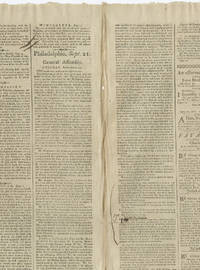
1787Best.-Nr. 21449.18Philadelphia PA 1787. No binding. Fine. Pennsylvania Packet and General Advertiser. Newspaper. Pennsylvania Packet and General Advertiser September 21 1787. John Dunlap Philadelphia Pa. 4 pp. 12 x 18 3/4 in. Pennsylvania's representatives to the Constitutional Convention including Benjamin Franklin present the Constitution to the Representatives of the Pennsylvania State legislature. A contemporary report of the end result of the Philadelphia Convention's efforts over the summer of 1787 less than a week after the Convention concluded. ""Sir we have now the honor to present to this house the plan of government for the United States which has been determined upon by the federal convention. As soon as the speaker had concluded Dr. Franklin rose and delivered a letter from the delegates to the house which being read consisted of a recommendation to the legislature."" p. 2 col. 4Reports on the proposal of the Constitution to Pennsylvania. ""To the Honorable the Representatives of the Freemen of the Commonwealth of Pennsylvania.your petitioners have seen with great pleasure the proposed constitution of the United States and as they conceive it to be wisely calculated to form a perfect union of the states as well as to secure to themselves and posterity the blessings of peace liberty and safety they have taken this method of expressing their earnest desires that the said constitution may be adopted as speedily as possible by the state of Pennsylvania."" p. 3 col.1.Contains a section entitled: ""Origin of the Island of Nantucket. An Indian Tradition."" ""On the west end of Martha's Vineyard are high cliffs of variegated coloured earths known by the name Gayhead.The Indians who live about this spot have a tradition that a certain deity resided there before the Europeans came into America."" p. 3 col.4.Benjamin Franklin 1706-1790 Born in Boston he originally worked as a printer for his older brother. After moving to Philadelphia he started his own newspaper the Pennsylvania Gazette in which he published his ideas in support of American independence. He was very involved in the writing of the Declaration of Independence and during the Revolutionary War was appointed Ambassador to France where he negotiated the important alliance between the two nations. Franklin was also known for his science experiments most notably with regards to electricity.ConditionNear fine books
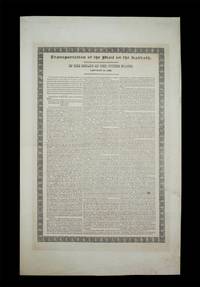
1829Best.-Nr. 69246Kentucky 1829. UNITED STATES CONSTITUTION; BROADSIDE. BROADSIDE. Transportation of the Mail on the Sabbath. In the Senate of the United States. Kentucky: 1829. Full Description: UNITED STATES CONSTITUTION. BROADSIDE. Transportation of the Mail on the Sabbath. In the Senate of the United States. Kentucky: January 19 1829. An important and interesting broadside supporting the separate of church in state in so as it applies to the delivery of mail on Sunday the Sabbath. Broadside folio 16 3/4 x 10 1/2 inches; 428 x 266 mm. With a caption title printed above three columns separated by rules. All within a decorative woodcut border. Mounted at the top edge within a portfolio mat. Some minor toning and a few small spots of dampstaining. A One and one half-inch closed tear at right-hand margin just touching the border. Overall very good. This is a significant document in the history of the United States Constitution in relation to the concept of the separation of church and state. Christian leaders demanded that the Government institution of the Postal Office not work on Sunday as their God had deemed this the Sabbath. The following document discusses that while many Christians observe the Sabbath on Sunday others including their Jewish neighbors observe the Sabbath on Saturday. Demanding that the government institution not work on Sunday for religious reasons goes directly against the Constitution. The report states "With these different religious views the committee are of opinion that congress cannot interfere.-It is not the legitimate province of the legislature to determine what religion is true or what false. Our government is a civil and not a religious institution. Our constitution recognizes in every person the right to choose his own religion and to enjoy it freely without molestation. Whatever may be the religious sentiments of citizens and however variant they are alike entitled to protection from the government so long as they do not invade the rights of others." It goes on to powerfully state "Extensive religious combinations to effect a political object are in the opinion of the committee always dangerous. This first effort of the kind calls for the establishment of a principle which in the opinion of the committee would lay the foundation for dangerous innovations upon the spirit of the Constitution and upon the religious rights of the citizens. If admitted it may be justly apprehended that the future measures of government will be strongly marked if not eventually controlled by the same influence. All religious despotism commences by combination and influence; and when that influence begins to operate upon the political institutions of a country the civil power soon bends under it and the catastrophe of other nations furnishes an awful warning of the consequence." The five-person committee for this report consisted of Richard Johnson of Kentucky who later went on to serve as the country's 9th vice president under Martin Van Buren as well as future President John Tyler of Virgina Ellis of Mississippi Silsbee of Massachusetts and Johnson of Louisiana. "The opening of post offices on Sunday led to a national debate about the relationship of the federal government to the Sabbath day. The argument which raged from 1810 to 1830 involved whether the national government would exist as a secular commercial republic committed to a separation of church and state or as a Christian commonwealth. The U.S. postmaster general Gideon Granger responded by persuading Congress in 1810 to pass legislation to open all 2300 post offices seven days a week and transport mail every day. Congress immediately began to receive petitions from numerous religious denominations urging repeal of the law. Under strong public pressure House and Senate committees formed to study the postal law. While the chair of the House committee waffled on the subject the head of the Senate committee swayed Congress to keep the law. Gen. Richard M. Johnson of Kentucky a devout Baptist wrote in the committee's 1829 report that congressional action to stop Sunday mail would be unconstitutional. Johnson reminded Americans that they had religious freedom and that government had no right to coerce the religious homage of anyone. The invention of the telegraph in 1844 ultimately spelled the end of Sunday mail. It was now possible to get market information without the mail system. By the 1850s postmaster generals were eliminating the movement of most mail on Sunday." Free Speech Center Caryn E. Neumann. HBS 69246. $1750. Kentucky unknown