1230 risultati
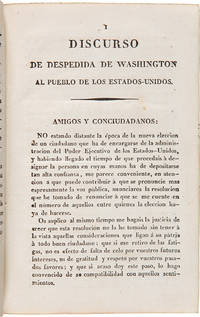
rif. WRCAM55421Mexico: Imprenta a cargo de Martin Rivera 1823. 466pp. Small octavo. Contemporary mottled Mexican sheep spine gilt. Minor edge wear light scuffing to boards short wormtrack on front board. Small ownership mark reading "JNB" branded on front and rear pastedowns ink ownership signature of "De Francisco Gonzalez de Cossio" on front flyleaf. Internally clean. Very good. This is the first Mexican printing of the United States Constitution accompanied by two important addresses by George Washington. This work was produced in anticipation of Mexican independence from Spain and the U.S. Constitution in particular provided inspiration to the drafters of the constitution of newly-independent Mexico. Written in 1824 it was the first constitution of Mexico as a sovereign state and the constitution under which the colonization of Texas by Americans would take place. It is ample evidence of the transnational influence on the United States Constitution on emerging democracies in this case America's neighbor to the south. All seven articles of the United States Constitution are printed in full in Spanish in a section that is headed by a Federal garland ornament. The names of all the signers are given at the conclusion of the main text. This is followed by a section printing the first twelve amendments entitled here as "Correcciones" an interesting interpretation of the role of constitutional amendments. The final page contains the text of an amendment passed by the House and Senate and signed in print by Senate President pro tem John Gaillard and House Speaker J.B. Varnum prohibiting any American citizen from accepting a title of nobility or honor from a foreign government under threat of losing ones American citizenship and holding any further elective office. This "Titles of Nobility" amendment was passed by Congress in 1810 and came close to ratification by two-thirds of the states in the 1810s but has to this day never been ratified. The inclusion of this amendment is an interesting commentary on the priorities and concerns of Mexican lawmakers. The U.S. Constitution is preceded by two chapters printing addresses by George Washington whose actions following the American Revolution and his two terms as President were influential well beyond the borders of the United States. The first chapter prints Washington's 1796 Farewell Address to the United States "Discurso de Despedida de Washington al Pueblo de los Estados-Unidos". Designed by Washington and his principal advisors in drafting it - James Madison and Alexander Hamilton - as both a valedictory and advice to succeeding generations the address served as a guidepost to Americans from the point of its publication. The Farewell Address would have been of particular interest to the Mexican Constitutional framers. The second section prints Washington's Address to the Continental Army in 1783 "Carta Circular del General Washington a los Gobernadores de los Estados fecha en el Cuartel General de Newburgh 18 de Junio de 1783". In this circular letter General Washington announces his intention to resign his command of the Continental Army and retire into private life. He also expounds in detail on the serious issues facing the nascent United States government. Both of Washington's addresses are printed fully in Spanish as is the constitution. OCLC records just eight actual copies over three records. This is the first copy that we can find in the market in over a century and the first copy we have handled of this first Mexican printing of the United States Constitution. OCLC 24072481 503926127 1097838706. SABIN 16060. PALAU 59641 374086. Imprenta a cargo de Martin Rivera hardcover books
rif. 55421Mexico: Imprenta a cargo de Martin Rivera 1823. First Mexican Printing of the U.S. Constitution This is the first Mexican printing of the United States Constitution accompanied by two important addresses by George Washington. This work was produced in anticipation of Mexican independence from Spain and the U.S. Constitution in particular provided inspiration to the drafters of the constitution of newly-independent Mexico. Written in 1824 it was the first constitution of Mexico as a sovereign state and the constitution under which the colonization of Texas by Americans would take place. It is ample evidence of the transnational influence on the United States Constitution on emerging democracies in this case America's neighbor to the south. All seven articles of the United States Constitution are printed in full in Spanish in a section that is headed by a Federal garland ornament. The names of all the signers are given at the conclusion of the main text. This is followed by a section printing the first twelve amendments titled here as "Correcciones" an interesting interpretation of the role of constitutional amendments. The final page contains the text of an amendment passed by the House and Senate and signed in print by Senate President pro tem John Gaillard and House Speaker J.B. Varnum prohibiting any American citizen from accepting a title of nobility or honor from a foreign government under threat of losing one's American citizenship and holding any further elective office. This "Titles of Nobility" amendment was passed by Congress in 1810 and came close to ratification by two-thirds of the states in the 1810s but has to this day never been ratified. The inclusion of this amendment is an interesting commentary on the priorities and concerns of Mexican lawmakers. The U.S. Constitution is preceded by two chapters printing addresses by George Washington whose actions following the American Revolution and his two terms as President were influential well beyond the borders of the United States. The first chapter prints Washington's 1796 Farewell Address to the United States "Discurso de Despedida de Washington al Pueblo de los Estados-Unidos". Designed by Washington and his principal advisors in drafting it—James Madison and Alexander Hamilton—as both a valedictory and advice to succeeding generations the address served as a guidepost to Americans from the point of its publication. The Farewell Address would have been of particular interest to the Mexican Constitutional framers. The second section prints Washington's Address to the Continental Army in 1783 "Carta Circular del General Washington a los Gobernadores de los Estados fecha en el Cuartel General de Newburgh 18 de Junio de 1783". In this circular letter General Washington announces his intention to resign his command of the Continental Army and retire into private life. He also expounds in detail on the serious issues facing the nascent United States government. Both of Washington's addresses are printed fully in Spanish as is the Constitution. OCLC records just ten holding institutions over three records. This is the first copy that we can find in the market in over a century and the first copy we have handled of this first Mexican printing of the United States Constitution. Small octavo. Contemporary mottled Mexican sheep spine gilt. Minor edge wear light scuffing to boards short worm track on front board. Small ownership mark reading "JNB" branded on front and rear pastedowns ink ownership signature of "De Francisco Gonzalez de Cossio" on front flyleaf. Internally clean. Very good. OCLC 24072481 503926127 1097838706. SABIN 16060. PALAU 59641 374086. hardcover
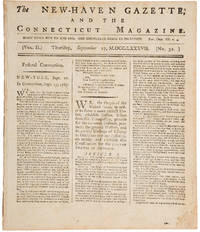
1787rif. 26098"WE the People of the United States in order to form a more perfect union establish justice insure domestic tranquility provide for the common Defence promote the general welfare and secure the blessings of liberty to ourselves and our posterity do ordain and establish this constitution of the United States of America." CONSTITUTION.Newspaper. The New-Haven Gazette and The Connecticut Magazine. September 27 1787. M.DCC.LXXXVII No 32. Printed and Published by Josiah Meigs. Signed in type by George Washington and the other 38 delegates who signed the Constitution. 8 pp. Quarto 8.625 x 10.125 inches. 249-256 though what should be page 255 is mis-numbered 247 as is the case with the other copies we have seen of this edition. Accompanied by title and index leaves printed slightly later for binding after end of year. Historical Background Having just been approved by the Constitutional Convention on September 17th the complete text of the Constitution was published in the New-Haven Gazettejust ten days later along with the transmitting documents conveying the Convention's request that it be laid before Congress and afterwards submitted to "a convention of Delegates chosen in each state by the People thereof." Resolved that if nine States ratify electors should be chosen for a presidential election and that the machinery of the new government be set in place. The Articles of Association Congress in New York debated for two days and a day after this printing officially sent the Constitution to the states for ratification. State ratification conventions would soon pit Federalist against Anti-Federalist in impassioned debates over the implications of the Constitution and its extension of national government power and influence. This is the earliest available Connecticut printing of the Constitution. The Connecticut Journal printed it one day earlier but we can find no copies in market sales records of the last 30 years. The text of the Constitution is preceded here by George Washington's letter to Congress and followed by the Resolution for ratification. Evans 20563; Lomazow 18b. Condition Gathering of four leaves paginated 249-252 and two loose leaves. Mild yellowing with a hint of discoloration and spot or two of foxing; soft crease each vertically and horizontally bisecting all leaves; small handful of faint dampstains at margins of first and final leaf; barely perceptible inked signature at lower corner of recto of first leaf; hint of residue discoloration along center fold where newspaper was removed from bound volume. Title and index leaves softly browned and a bit brittle with edges roughened where removed from bound volume; both bisected by soft horizontal crease; faint staining to leaves particularly recto of title; some mild chipping to edges of title-leaf particularly fore-edge with fold starting to split at either end about two inches in from either direction; previous owner inking at recto of both leaves; corners of index leaf creased. Newspaper in fine condition remarkably clean and bright with very good title and index leaves. Housed in custom red leather case cover stamped in gilt. books
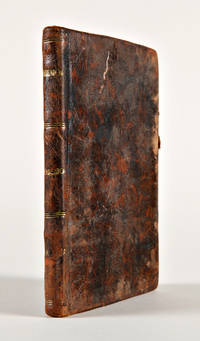
1799rif. 39795Knoxville 1799. 7 works bound together octavo. 7 3/8 x 4 5/8 inches. First work lacks titlepage contemporary ownership inscription on first leaf present. Light foxing A few leaves trimmed closely at bottom edge affecting text. Contemporary calf spine gilt with red morocco label skillful repair to joints and corners. Housed within a black modern full morocco box. Provenance: J. Hamilton two signatures Possibly the greatest single volume of early Tennessee material with the second known complete copy of the First Tennessee Constitution in fine original condition. Seven works from the earliest pioneer press of Tennessee including the first printing of the National Constitution printed in the state as well as the first State Constitution here in the second known complete copy. Such imprints have not appeared on the market since World War II. In February 1790 North Carolina ceded its western land holdings to the United States. A few months later the area became the newly created Territory of the United States South of the River Ohio. William Blount was appointed territorial governor by President Washington and in 1795 he called a meeting of the territorial legislature to request a referendum for statehood. Thus the state of Tennessee was born on June 1 1796. George Roulstone the first printer in Tennessee began a newspaper in Knoxville in late 1791. The earliest Tennessee imprint noted by McMurtrie is a set of acts passed by the territorial government printed after March 25th 1793. Since then two earlier items have come to light; a broadside owned by Thomas W. Streeter dated Jan. 28 1793 and a broadside dated March 13 1793. The earliest dateable book present here was issued in 1794. The Tennessee State Constitution here in the first of three editions; it was to be revisited in 1835 and 1869 was created by Congress at the time Tennessee was admitted as a state and became effective on June 1 1796 when Tennessee entered the Union. It was not universally well received although Thomas Jefferson described it as the "least imperfect and most republican of the state constitutions." The first leaf and one title have the early ownership inscription of J. Hamilton possibly James Hamilton Jr. congressman and governor of South Carolina who read law in Charleston and was admitted to the bar in 1810. The individual titles are as follows: 1 Acts Passed at the First Session of the General Assembly of the Territory of the United States of America South of the River Ohio. Began and Held at Knoxville on Monday the Twenty Fifth day of August MDCCXCIV. Knoxville: George Roulstone 1794. 3-101pp. Lacks titlepage and preliminary viii pp. containing "Acts and ordinances of the governor and judges.as issued by William Blount." Evans accords this item its own number however so it is possible that it wasn't issued as a part of this copy. Copies noted by ESTC and Allen at Harvard Law the Huntington Library of Congress State Library of Tennessee and University of Tennessee. Allen 7; ESTC W9956; Evans 27724; McMurtrie 5. 2 Acts Passed at the Second Session of the First General Assembly of the Territory of the United States of America South of the River Ohio. Begun and Held at Knoxville on Monday the Twenty Ninth day of June 1795. Knoxville: George Roulstone 1795. 31pp. Copies noted by ESTC and Allen at Harvard Law the Huntington Library of Congress and University of Tennessee. Allen 15; ESTC W5409; Evans 29551; McMurtrie 8. 3 The Constitution of the United States of America. to which is Prefixed the Constitution of the State of Tennessee. Knoxville: Roulstone & Parrington 1799. 30pp. Copies noted by ESTC and Allen at State Library of Tennessee and University of Tennessee lacking titlepage.Allen 45; ESTC W30527; Evans 36404; McMurtrie 30. 4 Acts Passed at the Second Session of the Second General Assembly of the State of Tennessee. Knoxville: Roulstone & Parrington 1798. 70pp. The Table of Contents comprising the last ten pages and present here not present in two of the four recorded copies which may have been issued without it. Copies noted by ESTC and Allen at Library of Congress Harvard Law New York Public Library State Library of Tennessee and University of Tennessee. Allen 38; ESTC W23338; Evans 36403; McMurtrie 27. 5 Acts Passed at the First General Assembly of the State of Tennessee. Knoxville: George Roulstone 1796. 78pp. Copies noted by ESTC and Allen at Library of Congress Knoxville Public Library and University of Tennessee. Allen 21; ESTC W23331; Evans 31277; McMurtrie 21 6 Acts Passed at the Second Session of the First General Assembly of the State of Tennessee. Knoxville: George Roulstone 1796. 13pp. Copies noted by ESTC and Allen at Harvard Law University of Tennessee and Centre College of Kentucky. Allen 22; Bristol B9722; ESTC W23332; McMurtrie 22; Shipton & Mooney 47935. 7 Acts Passed at the First Session of the Second General Assembly of the State of Tennessee. Knoxville: George Roulstone 1797. 120pp. Copies noted by ESTC and Allen at American Antiquarian Society Library of Congress Harvard Law Knoxville Public Library and State Library of Tennessee. Allen 33; ESTC W9891; Evans 32913; McMurtrie 24. These works are essentially unprocurable and this volume provides a rare opportunity to acquire seven significant imprints from the first press in Tennessee. All are of the utmost rarity in any condition. Check List of Tennessee Imprints 5 8 30 27 21 22 24. unknown books
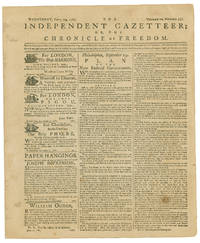
1787rif. 21085.99"We the People of the United States…" This rare complete printing of the Constitution appeared on the first day it was publicly available Wednesday September 19 1787. That same morning the Constitution was published by four other papers the Pennsylvania Packet and Daily Advertiser Pennsylvania Journal Pennsylvania Gazette and Freeman's Journal. The Independent Gazetteeris unique in that it is the only one of the five first-day printings whose type was evidently not used to print another stand-alone edition. U.S. CONSTITUTION.Newspaper. The Independent Gazetteer or the Chronicle of Freedom. Philadelphia: Eleazer Oswald September 19 1787. 4 pp. Historical Background This issue of The Independent Gazetteer and Chronicle of Freedom a daily Anti-Federalist newspaper prints the "Plan of the New Federal Government" in full followed by the Federal Convention's resolution submitting the Constitution to Congress and the accompanying transmittal letter. All three are signed in type by George Washington as president of the Convention. The Constitution was approved by the Convention on Monday September 17. The text of the official version was set that evening and a very limited number were printed for the use of the delegates. After being drafted in complete secrecy the Constitution was first made public on the morning of Tuesday September 18 when it was read before the Pennsylvania General Assembly. The next morning Wednesday September 19 the five newspapers mentioned above all published the Constitution. It is often assumed that the Pennsylvania Packet was the first public printing as the publishers Dunlap and Claypoole were the official printers to the Constitutional Convention. In fact there is no evidence that the Packet actually was published first or appeared on the streets of Philadelphia that day any earlier than its four rivals. All five are considered first editions with surviving copies of the Packet the most common. The dissemination of the Constitution in newspapers is of considerable interest and importance as it was through this medium that most Americans became familiar with the new form of government proposed by the Convention. One careful researcher Leonard Rapport of the National Archives has identified four Philadelphia newspapers which also carried the text of the Constitution on the same day this was after all news of the highest importance and one the Philadelphia Evening Chronicle which may hypothetically have carried the text in an issue dated 18 September "Printing the Constitution" pp. 69-90. But to date no copy of the Evening Chronicle of that date is known to be extant see Rapport's other article "Newspaper Printings of the Constitution". The Pennsylvania Packet printing has been accorded primacy for two principal reasons. First the Packetwas printed by John Dunlap and David C. Claypoole official printers to the Convention itself. Together as partners or separately Claypoole may originally have been a junior partner they had printed nearly everything issued by Congress since 1775 including the 1776 Declaration of Independence. Second with the exception of the Constitution's six-line preamble "We the people…" the text is entirely printed from the same setting of type used for the official Congressional printing.As Rapport notes the 5000 words of the Constitution represented "nearly one man-day of composition time" for the printer so sensibly to make use of the wider margins of the Packet's larger sheets they reset the preamble in large type with a large capital "W" below the masthead and simply reimposed the rest of their standing type to fit onto the paper's four larger-size pages. The case might be summed up by emphasizing that the present Pennsylvania Packet text of the Constitution was struck from the identical setting of lead type that had printed the sheets of the official Congressional printings sheets that Jacob Shallus calligrapher used when he copied onto parchment the engrossed document to which the delegates signed their names. "By October 6 only twenty days after the Federal Convention at least fifty-five of the approximately eighty newspapers of the period had printed the.Constitution." Rapport "Printing the Constitution" p.89. With the text of the Constitution before the people thanks to a free press the great debate on its ratification would begin a debate which continued until ratification by the original thirteen states was completed in 1790 and culminated in 1791 by the adoption of the Bill of Rights. Despite the tremendous changes since 1787 in the nation and the people governed by the Constitution Bernstein meaningfully notes "the evolution of American politics and society continues to be shaped by the Constitution and by the principles and doctrines built into it by the men who drafted it. That the Constitution has worked as well as it has is a tribute to its flexibility and to the foresight of those who created it. That it may still be defective or capable of improvement is a challenge to us to equal the courage imagination and versatility of the Revolutionary generation of Americans" Are We To Be A Nation p.272. Eleazer Oswald books