1365 risultati
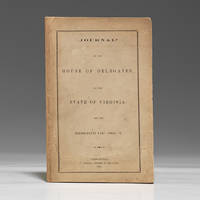
1865rif. 1260191865. First Edition. CONSTITUTION. Journal of the House of Delegates of the State of Virginia. for the Session of 1864Ñ5. Alexandria: D. Turner 1865. Octavo original front printed wrapper respined renewed rear wrapper original string stitching; pp. 1-3 4-83 1. Housed in a custom chemise and clamshell box. $4500.First edition one of 500 copies of the momentous Journal featuring its February 9 1865 entry on the Alexandria Virginia government's passage of the 13th Amendment mere days after the U.S. Congress the first of the four Unionist southern states to pass the Amendment also featuring the governor's Message noting: ""though we have in inherited from our fathers of the revolution the blessings of a great nation yet they also left to us an inheritance of African slavery which has proved a bitter dreg in our cup of freedom"" a vital record of forces for constitutional change near the end of the Civil War.Soon after the 1860 election amidst southern secession ""the great questions of union or disunion war or peace hung in the balance. Probably the crucial weight on the scale was VirginiaÉ as long as the federal government did not seek to coerce the states Virginia secessionists were unable to achieve a majority. When Lincoln responded with force to the attack on Fort Sumter however the vote in Virginia went in favor of secession."" Subsequently a Virginia convention ""met in Wheeling on May 13 1861É it elected as Governor Francis Pierpont a western Virginian and ardent Unionist and arranged for the creation of a legislature to replace the body sitting in RichmondÉ in July 1861 the new legislature met at the 'Restored Virginia' capital of Wheeling in a special session called by Pierpont."" Against its ""claim to represent a majority of Virginians"" a new state of West Virginia was created in 1863 and Pierpont's government moved to Alexandria to govern areas of Virginia under Union occupation Harrison Lawfulness of the Reconstruction Amendments 380-83.Scholars observe that the 13th Amendment its fellow amendments and Reconstruction as ""both a political process made possible by military successes and constitutional thought grew from wartime as well as post-Appomattox developments"" Hyman and Wiecek Equal Justice 247. This rare first edition of Journal of the House of Delegates substantiates that in documenting passage of the 13th Amendment by Pierpont's Virginia government mere days after the U.S. Congress passed the Amendment on January 31 1865. With that Virginia became the first of the four Unionist southern states that ratified the 13th Amendment. Of those Louisiana followed on February 17 with Arkansas and Tennessee that April. The 13th Amendment is the focus of the Journal's entry for February 9 1865 which states: ""Mr. Brownley called up Senate bill No. 12 entitled 'An Act to ratify the joint resolution of Congress passed January 31 1865 proposing an amendment to the Constitution of the United States.' The bill was read the first and second timeÉ and the rules were suspended and the bill read the third timeÉ and the bill passed."" Also notable herein is the complete printing of Governor Pierpont's opening Message where he notes: ""though we inherited from our fathers of the revolution the blessings of a great nation yet they also left to us an inheritance of African slavery which has proved a bitter dreg in our cup of freedom."" He speaks at length of the rights due people of color and the abolition of laws such as those that prohibit ""negro testimony"" or proscribe a ""different punishmentÉ for persons of African dissent"" from that of ""white persons.""""The legislature met for its second session on December 5 1864É The governor's message was a long and important document and indicated the changes of opinion that the war was bringing about. Pierpont gave his views upon the all-important negro question. He congratulated the constitutional convention which had met in the spring on the abolition of slavery in Virginia and advocated sweeping changes in the laws concerning negroes. The act prescribing different punishments for blacks should he said be altered in accordance with the amended constitution as well as the law for apprenticing them. The law prohibiting the education of negroes should be abolishedÉ His language was on the whole very moderate. He advised the legalizing of the marital relations of negroes and most important the establishment of public schoolsÉ Notwithstanding the governor's advice no acts of great importance passed the legislatureÉ On February 9 1865 the assembly ratified the 13th Amendment to the Constitution of the United States. It adjourned on March 7"" Eckenrode Political History of Virginia During the Reconstruction. Faint ""U.N.C. Duplicate"" stamp to front wrapper.Text fine; just a bit of faint soiling and a tide line to fragile front wrapper. An excellent copy of this elusive item. unknown books
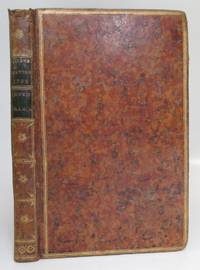
1791rif. 262411Paris: Baudoin 1791. hardcover. near fine. 2 37 4 4 151 82 pages. 12mo handsomely bound in full contemporary mottled calf chipped at top of spine; gilt-stamped spine with leather spine labels; marbled end-papers. Paris: Baudouin Imprimeur de L'Assemblee Nationale 1791. First written constitution of France. Many different printings appeared within days of the original folio edition this is likely the first 12mo edition. Included in this volume with separate paginations are: Message du Roi a l'Assemblee 13 Set. 1791; Discours et Serment du Roi. 14 Sept 1791; La Declaration des Droits de L'Homme et du Citoyen Includes comparison of the laws of many peoples ancient and modern and particularly the declarations of different American states Paris l'an troisieme de la liberte. Also Bound-in is another copy of the Declaration des Droits de l"Homme Paris: Chez Baudoin 1790. Baudoin unknown
1791rif. 262411Paris: Baudoin 1791. hardcover. near fine. 2 37 4 4 151 82 pages. 12mo handsomely bound in full contemporary mottled calf chipped at top of spine; gilt-stamped spine with leather spine labels; marbled end-papers. Paris: Baudouin Imprimeur de L'Assemblee Nationale 1791. First written constitution of France. Many different printings appeared within days of the original folio edition this is likely the first 12mo edition. Included in this volume with separate paginations are: Message du Roi a l'Assemblee 13 Set. 1791; Discours et Serment du Roi. 14 Sept 1791; La Declaration des Droits de L'Homme et du Citoyen Includes comparison of the laws of many peoples ancient and modern and particularly the declarations of different American states Paris l'an troisieme de la liberte. Also Bound-in is another copy of the Declaration des Droits de l"Homme Paris: Chez Baudoin 1790. Baudoin unknown books
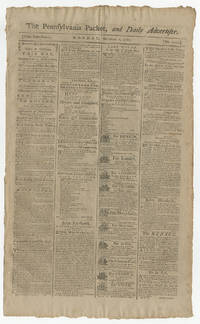
1787rif. 24135U.S. CONSTITUTION.Newspaper. The Pennsylvania Packet and Daily Advertiser. October 1 1787 No. 2700 Philadelphia: John Dunlap and David C. Claypoole including the September 28 resolution of the Confederation Congress to send to the states for ratification the recently completed U. S. Constitution. 4 pp. 12 x 18¾ in. "The United States in Congress Assembled. Friday September 28 1787. CONGRESS having received the Report of the CONVENTION lately assembled in Philadelphia Resolved unanimously THAT the said report with the resolutions and letter accompanying the same be transmitted to the several legislatures in order to be submitted to a convention of delegates chose in each state by the people thereof in conformity to the resolves of the convention made and provided in that case. CHARLES THOMSON Secretary." p2/c3 The convention called to revise the Articles of Confederation met in the Pennsylvania's State House in Philadelphia starting on May 25 1787. After many delegates agreed that the Articles could not be sufficiently improved they started to draft an entirely new structure. Maintaining their pledge of secrecy after months of private deliberations over trade defense taxation representation separation of powers the election of a president the slave trade international relations and many other issues the proposed United States Constitution was signed by thirty-nine of the fifty-five delegates on September 17. Two days later the Constitution was first published by the Pennsylvania Packetand four other Philadelphia newspapers. The cover letter sent by George Washington president of what came to be called the Constitutional Convention submitting the plan to Arthur St. Clair the President of the Congress of the Confederation in New York was also printed then. Congress received and read the proposed Constitution on September 20th. As a sampling of their deliberations William Grayson of Virginia thought it was too weak while Richard Henry Lee of Virginia and Nathan Dane of Massachusetts thought it was too strong. On September 27 Virginia's Richard Henry Lee proposed that the Constitution be sent to the executives of each of the states. A Delaware representative quickly added "in order to be by them submitted to conventions of delegates to be chosen agreeably to the said resolutions of the convention." Ten of the twelve states then represented in Congress voted in favor. Before Congress adjourned for the day the majority of Virginia's representatives and a minority of New York's representatives also indicated their support. On September 28 Federalists holding out for a unanimous vote found a way to compromise with anti-Federalists: Congress unanimously resolved to send the Constitution to the states but without any recommendation or approval. Arider from New York City arrived in Philadelphia with the resolution that same day. George Clymer presented his own resolution to the Pennsylvania Assembly noting that "the late Federal Convention has digested a plan of government for the United States and recommended that it should be referred to the consideration of State Conventions…" After a "very long and animated debate" Clymer's resolution passed by a vote of 43 to 19 and adjourned until 4:00 p.m. But only 44 members returned falling two shy of the necessary quorum. The Assembly's sergeant-at-arms was sent to show the resolution to absent members. Two who still refused to attend were seized by the public dragged through the streets and thrust into the assembly room. The involuntarily completed quorum voted that "it is the sense of great numbers of the grand people of this state already signified in petitions & declarations to this house that the earliest steps should be taken to assemble a convention within the state for the purpose of deliberating and determining on the said constitution." They called for the election of deputies who would assemble for that purpose "on the third Tuesday of November at the State-house in the city of Philadelphia…" p2/c3-4 Other articles of interest in this issue include news from Europe and a brief piece against Indians "from the western country who still continue their depredations on the whites…" p2/c3 The Pennsylvania Packet or the General Advertiser1771-1839 was founded by John Dunlap in late 1771 as a weekly newspaper in Philadelphia though it relocated to Lancaster during the British occupation of Philadelphia in 1777-1778. On May 30 1783 Benjamin Towne turned the Pennsylvania Evening Post into the first daily newspaper in the United States. However with Towne branded a traitor and forced to hawk his own papers on the street the newspaper collapsed the following year. John Dunlap and David Claypoole then made their Pennsylvania Packet the first successful daily on September 21 1784. It underwent numerous name changes in the 1790s until sold in 1800 and renamed Poulson's American Daily Advertiser. John Dunlap and David C. Claypoole
1787rif. 24135U.S. CONSTITUTION.Newspaper. The Pennsylvania Packet and Daily Advertiser. October 1 1787 No. 2700 Philadelphia: John Dunlap and David C. Claypoole including the September 28 resolution of the Confederation Congress to send to the states for ratification the recently completed U. S. Constitution. 4 pp. 12 x 18¾ in. "The United States in Congress Assembled. Friday September 28 1787. CONGRESS having received the Report of the CONVENTION lately assembled in Philadelphia Resolved unanimously THAT the said report with the resolutions and letter accompanying the same be transmitted to the several legislatures in order to be submitted to a convention of delegates chose in each state by the people thereof in conformity to the resolves of the convention made and provided in that case. CHARLES THOMSON Secretary." p2/c3 The convention called to revise the Articles of Confederation met in the Pennsylvania's State House in Philadelphia starting on May 25 1787. After many delegates agreed that the Articles could not be sufficiently improved they started to draft an entirely new structure. Maintaining their pledge of secrecy after months of private deliberations over trade defense taxation representation separation of powers the election of a president the slave trade international relations and many other issues the proposed United States Constitution was signed by thirty-nine of the fifty-five delegates on September 17. Two days later the Constitution was first published by the Pennsylvania Packetand four other Philadelphia newspapers. The cover letter sent by George Washington president of what came to be called the Constitutional Convention submitting the plan to Arthur St. Clair the President of the Congress of the Confederation in New York was also printed then. Congress received and read the proposed Constitution on September 20th. As a sampling of their deliberations William Grayson of Virginia thought it was too weak while Richard Henry Lee of Virginia and Nathan Dane of Massachusetts thought it was too strong. On September 27 Virginia's Richard Henry Lee proposed that the Constitution be sent to the executives of each of the states. A Delaware representative quickly added "in order to be by them submitted to conventions of delegates to be chosen agreeably to the said resolutions of the convention." Ten of the twelve states then represented in Congress voted in favor. Before Congress adjourned for the day the majority of Virginia's representatives and a minority of New York's representatives also indicated their support. On September 28 Federalists holding out for a unanimous vote found a way to compromise with anti-Federalists: Congress unanimously resolved to send the Constitution to the states but without any recommendation or approval. Arider from New York City arrived in Philadelphia with the resolution that same day. George Clymer presented his own resolution to the Pennsylvania Assembly noting that "the late Federal Convention has digested a plan of government for the United States and recommended that it should be referred to the consideration of State Conventions…" After a "very long and animated debate" Clymer's resolution passed by a vote of 43 to 19 and adjourned until 4:00 p.m. But only 44 members returned falling two shy of the necessary quorum. The Assembly's sergeant-at-arms was sent to show the resolution to absent members. Two who still refused to attend were seized by the public dragged through the streets and thrust into the assembly room. The involuntarily completed quorum voted that "it is the sense of great numbers of the grand people of this state already signified in petitions & declarations to this house that the earliest steps should be taken to assemble a convention within the state for the purpose of deliberating and determining on the said constitution." They called for the election of deputies who would assemble for that purpose "on the third Tuesday of November at the State-house in the city of Philadelphia…" p2/c3-4 Other articles of interest in this issue include news from Europe and a brief piece against Indians "from the western country who still continue their depredations on the whites…" p2/c3 The Pennsylvania Packet or the General Advertiser1771-1839 was founded by John Dunlap in late 1771 as a weekly newspaper in Philadelphia though it relocated to Lancaster during the British occupation of Philadelphia in 1777-1778. On May 30 1783 Benjamin Towne turned the Pennsylvania Evening Post into the first daily newspaper in the United States. However with Towne branded a traitor and forced to hawk his own papers on the street the newspaper collapsed the following year. John Dunlap and David Claypoole then made their Pennsylvania Packet the first successful daily on September 21 1784. It underwent numerous name changes in the 1790s until sold in 1800 and renamed Poulson's American Daily Advertiser. John Dunlap and David C. Claypoole books
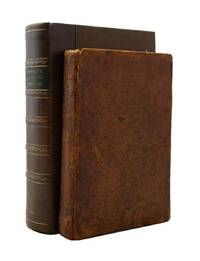
1788rif. 69689Boston: Adams and Nourse 1788. UNITED STATES CONSTITUTION. First edition of the proceedings leading to the Massachusetts Compromise being the ratification of the U.S. Constitution by the sixth of the needed nine States. Octavo in fours 7 1/8 x 4 1/2 inches; 180 x 115 mm. 219 1 blank pp. An early printing of the proposed Constitution appears on pages 3-19. Contemporary full speckled sheep. Boards scuffed and worn. Front outer hinge is cracked but holding firm. Without front free endpaper. Leaf U2 with one-inch closed tear no loss. Leaves are foxed and toned as usual for American paper of this time. Still overall a very good copy. Housed in a custom brown quarter calf clamshell. "Getting approval for the new Constitution was no small feat. Anti-federalists feared that the Constitution would over-centralize government and restrict individual liberties. They demanded changes and a Bill of Rights to guarantee personal freedoms. Federalists on the other hand argued that states should accept the proposed Constitution without further changes. When these opposing views clashed in Massachusetts an agreement- known as the Massachusetts Compromise- was brokered by two famous local statesmen John Hancock and Samuel Adams. Under it Massachusetts ratified the Constitution becoming the sixth U.S. state while also proposing future amendments including a Bill of Rights. The Massachusetts Compromise was used as a model by other states to reach similar agreements. Without it the U.S. Constitution may never have been ratified at all." from Bridgewater State University "Although the delegates to the Constitutional Convention in Philadelphia finished their work in September 1787 a ratification process of many months remained ahead before the Constitution could become the system of government for the new country. For this to happen at least 9 of the 13 states had to approve the document and Massachusetts was at the crux of that lineup. In January 1788 the Massachusetts convention met in the Old State House to address the matter; at that time Delaware Pennsylvania New Jersey Georgia and Connecticut had already ratified the Constitution. The remaining states watched the proceedings in Boston closely anticipating a close vote that could fall either way. Massachusetts had the largest convention of any state and a fundamental disagreement divided the 364 delegates: Federalists supported a strong central government and the Constitution as written; Anti-Federalists held that a centralized government would concentrate power in the hands of the elite and lead to the dissolution of the democratic ideals espoused during the Revolution. The turning point in the debate in Boston came when Gov. John Hancock proposed that Massachusetts recommend several amendments to the Constitution including a Bill of Rights. This proposal effectively gave voice to many of the Anti-Federalist concerns and after Revolutionary leader Samuel Adams spoke in favor of Hancock's "conciliatory proposition" a sufficient number of delegates shifted their positions to approve ratification. Massachusetts ratified the United States Constitution on February 6 1788 by a vote of 187 to 168. In June when New Hampshire came on board as the ninth state to ratify adoption of the Constitution was guaranteed. Its formal enactment on April 30 1789 coincided with George Washington's inauguration as the first president of the United States." Massachusetts Historical Society "In Massachusetts anti-federalist opposition to the Constitution was significant. In order to mollify their concerns convention delegate Theophilus Parsons added nine amendments which were presented by John Hancock. The Constitution was ratified by Massachusetts with the amendments added as a recommendation to "remove the fears and quiet the apprehensions of many of the good people of this Commonwealth and more effectually guard against an undue administration of the federal government." Three of these recommendations would become the Fifth Seventh and Tenth Amendments of the Constitution. The sixth state to ratify the Constitution Massachusetts was the first to suggest amendments which in turn led directly to the passage of the Bill of Rights." Freemans Evans 21242. Sabin 45702. HBS 69689. $5000. Adams and Nourse unknown
1788rif. 69689Boston: Adams and Nourse 1788. UNITED STATES CONSTITUTION. First edition of the proceedings leading to the Massachusetts Compromise being the ratification of the U.S. Constitution by the sixth of the needed nine States. Octavo in fours 7 1/8 x 4 1/2 inches; 180 x 115 mm. 219 1 blank pp. An early printing of the proposed Constitution appears on pages 3-19. Contemporary full speckled sheep. Boards scuffed and worn. Front outer hinge is cracked but holding firm. Without front free endpaper. Leaf U2 with one-inch closed tear no loss. Leaves are foxed and toned as usual for American paper of this time. Still overall a very good copy. Housed in a custom brown quarter calf clamshell. "Getting approval for the new Constitution was no small feat. Anti-federalists feared that the Constitution would over-centralize government and restrict individual liberties. They demanded changes and a Bill of Rights to guarantee personal freedoms. Federalists on the other hand argued that states should accept the proposed Constitution without further changes. When these opposing views clashed in Massachusetts an agreement- known as the Massachusetts Compromise- was brokered by two famous local statesmen John Hancock and Samuel Adams. Under it Massachusetts ratified the Constitution becoming the sixth U.S. state while also proposing future amendments including a Bill of Rights. The Massachusetts Compromise was used as a model by other states to reach similar agreements. Without it the U.S. Constitution may never have been ratified at all." from Bridgewater State University "Although the delegates to the Constitutional Convention in Philadelphia finished their work in September 1787 a ratification process of many months remained ahead before the Constitution could become the system of government for the new country. For this to happen at least 9 of the 13 states had to approve the document and Massachusetts was at the crux of that lineup. In January 1788 the Massachusetts convention met in the Old State House to address the matter; at that time Delaware Pennsylvania New Jersey Georgia and Connecticut had already ratified the Constitution. The remaining states watched the proceedings in Boston closely anticipating a close vote that could fall either way. Massachusetts had the largest convention of any state and a fundamental disagreement divided the 364 delegates: Federalists supported a strong central government and the Constitution as written; Anti-Federalists held that a centralized government would concentrate power in the hands of the elite and lead to the dissolution of the democratic ideals espoused during the Revolution. The turning point in the debate in Boston came when Gov. John Hancock proposed that Massachusetts recommend several amendments to the Constitution including a Bill of Rights. This proposal effectively gave voice to many of the Anti-Federalist concerns and after Revolutionary leader Samuel Adams spoke in favor of Hancock's "conciliatory proposition" a sufficient number of delegates shifted their positions to approve ratification. Massachusetts ratified the United States Constitution on February 6 1788 by a vote of 187 to 168. In June when New Hampshire came on board as the ninth state to ratify adoption of the Constitution was guaranteed. Its formal enactment on April 30 1789 coincided with George Washington's inauguration as the first president of the United States." Massachusetts Historical Society "In Massachusetts anti-federalist opposition to the Constitution was significant. In order to mollify their concerns convention delegate Theophilus Parsons added nine amendments which were presented by John Hancock. The Constitution was ratified by Massachusetts with the amendments added as a recommendation to "remove the fears and quiet the apprehensions of many of the good people of this Commonwealth and more effectually guard against an undue administration of the federal government." Three of these recommendations would become the Fifth Seventh and Tenth Amendments of the Constitution. The sixth state to ratify the Constitution Massachusetts was the first to suggest amendments which in turn led directly to the passage of the Bill of Rights." Freemans Evans 21242. Sabin 45702. HBS 69689. $5000. Adams and Nourse unknown books
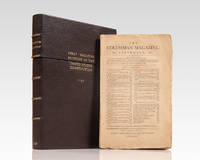
1787rif. 153385Philadelphia: Seddon Spotswood Cist and Trenchard 1787. Rare first periodical printing of the United States Constitution likely published within a week of its issuance as a broadside. Octavo disbound with a later string binding. The Constitution first appeared as a broadside followed quickly by its first newspaper appearance in The Pennsylvania Packet; later that same week it appeared in two magazines The Columbian Magazine and The American Museum and it remains unclear which of the two came first. The Columbian Magazine printed the Constitution in Philadelphia in 1787 on pages 659 to 665 under the title “The new plan for a Federal Government proposed by the Convention” together with the letter of George Washington transmitting the document from the Constitutional Convention to the Congress. In good condition with toning wear and chipping to the edges several leaves unopened including the Constitution leaves scattered soiling and foxing the meteorological table chipped at the left margin with some loss of text and the upper portion of the final leaf chipped away with loss not affecting the Constitution. Housed in a modern brown morocco pull-off case with chemise. Evans 20280. Mott A History of American Magazines I pp. 94-99. With the meteorological table and one of two plates lacking the View of the Natural Bridge in the State of Virginia. A rare and fragile survival of one of the earliest printings of the founding document of the United States. The Columbian Magazine published in Philadelphia from 1786 was among the earliest and most ambitious American monthly magazines mixing essays literature history and engraved plates. Its 1787 number carries one of the first printings of the United States Constitution which the Constitutional Convention had signed on September 17 of that year accompanied by George Washington’s letter transmitting the document from the Convention to the Congress. In the weeks after the signing the Constitution was rushed into print as a broadside in newspapers and in the new monthly magazines carrying the text to a public that would spend the following year debating and ratifying it and making these earliest appearances landmarks in the founding of the United States. Seddon, Spotswood, Cist, and Trenchard unknown
1961Signed and inscribed by author upon front free endpaper to Swedish journalist Arvid Fredborg, dated 1982 in Berlin. 570 pages. A National Review Panel ranked this work as the ninth best non-fiction book of the twentieth century. "A positive statement of the principles of society that in scope and breadth is more like a new Wealth of Nations... A thorough exposition of a social philosophy which ranges from ethics and anthropology through jurisprudence and the history of ideas to the economics of the modern welfare state." - Publisher. Moderate wear to clean and unmarked book. Binding sound. Dust jacket in poor condition with numerous defects.. Book
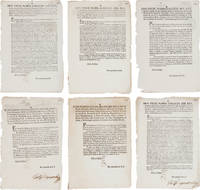
1561rif. 63610México. March 15 - November 6 1813. Rare Mexican Printings of Twenty-One Decrees from Spain's First Constitutional Government A substantial and significant collection of twenty-one rare Mexican printings of Spanish decrees issued by the short-lived but deeply influential constitutional government established in 1812. Each of these decrees was promulgated in Mexico by the Viceroy of New Spain Félix María Calleja del Rey y de la Gándara primer conde de Calderón in 1813. Drafted and ratified in the absence of any monarch Joseph Bonaparte had been rejected by the Spanish and the ousted Ferdinand VII had yet to return the constitution of 1812 followed a period of great political upheaval and married the liberal ideals of the French Revolution with an abiding fear of its outcome resulting in Spain's first ever constitutional monarchy. While the constitution left some power in the hands of the King his absence at the time of its implementation meant that Spain was effectively ruled by a constituent congress and regency council which notably included for the first time representatives from all of Spain's overseas dominions as well as the provinces on the Iberian Peninsula. The considerable majority of the proclamations in this group deal with the repercussions of this dramatically new form of government including clarifying details of the constitution publicly printing some of its laws and regulations and organizing programs meant to protect its legitimacy and longevity. While changes in home government and the Napoleonic Wars were certainly relevant to colonies in the New World a handful of these decrees also relate more materially to the Western Hemisphere including some related to colonial trade and the ongoing war for independence in Venezuela. All of the present documents were promulgated in Mexico City and are signed in type and most of them rubricked in manuscript by the Viceroy Félix María Calleja. Calleja was a general sent to New Spain in 1810 to put down the early rumblings of Mexican independence which he did with ruthless efficiency. He was Viceroy from 1813 to 1816 when he was replaced for fear that his merciless stamping of the insurrection would only further stoke the fires of anti-Spanish sentiment. The full list of decrees in this group ordered by the date they were promulgated by Calleja and accompanied by brief notes on their contents is as follows: All twenty-one documents share the same caption title: Don Felix Maria Calleja del Rey Bruder Losada Flores Campeño Montero de Espinosa Mariscal de Campo de los Exércitos Nacionales Virey Gobernador y Capitan General de Esta N.E. Presidente de Su Audiencia Superintendente General Subdelegado de la Hacienda Pública Minas Azogues y Ramo del Tabaco Juez Conservador de Éste Presidente de Su Junta y Subdelegado General de Correos en el Mismo Reyno. 1 El Orden de las Cortes Generales y Extraordinarias Comunicada…Que en los Papeles de Oficio Usen Siempre el Gobierno y Todas las Autoridades del Mismo Lenguage Que Usa la Constitucion.first lines of main text. March 15. Decrees that all official government papers should follow the language of the new constitution. 2 La Regencia del Reyno Se Ha Servido Levantar el Riguroso Bloqueo en Que Se Hallaba Puerto Cabello en la Provincia de Caracas. March 31. Lifts the Spanish blockade of Caracas now that a peace arrangement had been made with the insurgents in Venezuela. While the Royalists took back the province and the "First Republic of Venezuela" was officially ended in late 1812 it would only be a few months before Simon Bolívar returned and Caracas changed hands once again in the ongoing war for independence. 3 El Consejo de Estado y el Supremo Tribunal de Justicia Que Con Arreglo à la Constitution Política de la Monarquía Española Se Sirvieron Crear las Córtes Generales. March 31. Announcing that the Córtes Generales created by the new constitution and which was effectively the new governing body of the empire is officially in effect and performing duties as described in that document. 4 Las Córtes Generales y Extraordinarias Convencidas de la Necesidad y Utilidad de Que los Expedientes Sobre Infraccion de la Constitucion Sean Determinados Con la Mayor Prontitude Decretan. April 27. Declares that courts will prioritize cases regarding constitutional infractions above all others—one of many decrees particularly concerned with maintaining loyalty to the constitution. 5 Las Córtes Generales y Extraordinarias Queriendo Fixar Por Todos los Medios Posibles en la Memoria de los Españoles la Feliz Época de la Promulgacion de la Constitucion. May 22. In celebration of "the joyous event of the promulgation of the constitutional monarchy" this decree renames the public plaza in which the document was promulgated in every city in the empire to the "Plaza de Constitucion" and orders that a stone marker or monument be built to commemorate the event. When Ferdinand VII was reinstated as absolute monarch in 1814 monarchists tore down many of these monuments in celebration. Others remain to the present day including one in St. Augustine Florida which was still in Spanish hands in 1813. 6 Las Córtes Generales y Extraordinarias Con el Justo Fin de Redimir los Montes y Plantíos de Dominio Particular. May 25. 17 × 12 inches. A notable law removing all regulations on the use of private lands. Land owners would now be allowed to farm collect lumber hunt fish or otherwise profit from their land however they choose. The body of the decree begins our translation: "All laws and ordinances of forests and plantations are repealed and annulled in all their parts insofar as they concern those of private ownership and as a consequence the owners are left in full and absolute freedom to do with them what best suits them without subjection." 7 Las Córtes Decretan Que Ecsen los Individuos Que Actualmente Coponen la Regencia del Reyno y Que Se Encarguen de Ella Provisionalmente los Tres Consejeros de Estado Mas Antiguos Que en el Dia Se Hallan en Deicho Consejo Que Son. July 2. 17 × 12 inches. Appointing a new provisional regency to replace the regency which preceded the constitution to consist of Pedro Agar Gabriel Ciscar and the Archbishop of Toledo. 8 Atendiendo las Córtes Generales y Extraordinarias à la Importancia y Necesidad de Que No Solo los Individuos del Supremo Tribunal de Justicia Sino Tambien los Demas Magistrados y Jueces de Qualquiera Otro Tribunal. July 8. Establishes qualifications for judges and magistrates at all levels. In an attempt to reduce nepotism and ensure the proper enforcement of the new constitution all employees of the judiciary "must enjoy a positive public reputation be accredited in their field possessed of selflessness and good morals dedicated to the Constitution and to have proven themselves in reality to be friends of independence and the political freedom of the nation" our translation. 9 S.M. C D. Fernando VII Rey de España y de las Indias y S.M. el Emperador de Todas las Rusias Igualmente Animados del Deseo de Restablecer y Fortificar las Antiguas Relaciones de Amistad Que Han Subsistido Entre Sus Monariquías. July 13. 16 × 12 inches. The Mexican printing of this treaty between Spain and the Russian Emperor Nicolas I. It is a treaty of amity and commerce as well as a formal military alliance "with the express intention of waging a vigorous war with the Emperor of France their common enemy." 10 La Clase de Guerra Que el Enemigo Comun de los Pueblos de Europa Ha Heco y Hace a Esta Heroycion: Los Exquisitos Pero Siempre Pérfidos Medios Que Ha Puesto en Practica Para Dominarla. August 5. 17 × 12 inches. A solemn and dramatic public warning about the perfidious effects of disloyalty and internal division. Other governmental decrees are referenced including specific reference to numbers four and eight described above. 11 Deseando S.A. Dar un Testimonio Indudable de Su Religiosa Puntualidad en el Cumplimiento de Quanto Prescribe la Constitucion Politíca de la Monarquía. August 11. States that the secretary of state does not have the authority to pardon deserters who present themselves for trial. They will be sent to their respective companies to be judged by them in accordance with the severity of their crime notwithstanding special cases where an individual might be pardoned by the Regency. 12 Las Córtes Generales y Extraordinarias Decretan: El Supremo Tribunal de Justicia Debe Conocer de los Recursos de Nulidad Que Se Interpongan de las Sentencias Dadas en Última Instancia. August 21. Decrees that the supreme court will hear appeals from the previous session's special courts. 13 Las Córtes Generales y Extraordinarias Considerando Que la Reduccion de los Terrenos Communes á Dominio Particular Es Una de las Providencias Que Mas Imperiosamente Reclaman el Bien de los Pueblos. August 23. 21½ × 16¾ inches printed in two columns. A monumentally important law decreeing that all publicly owned lands in Spain the outlying islands and all of her colonies in the New World would be converted to private property. The broadside prints the full text of the law and begins: "The Córtes Generales.considering that the reduction of common lands to private ownership is one of the provisions that most imperiously demand the good of the people and the promotion of agriculture and industry and wanting at the same time to provide with this type of land an aid to public needs a reward for worthy defenders of the country and relief for non-proprietary citizens." Despite the lofty language realistically this law formed part of an ongoing program of confiscation of lands in order to defray mounting debts from the internal and external conflicts of the late 18th and early 19th centuries. The law divided the confiscated property into two even portions: one would be sold at auction and the proceeds contributed directly to the national debt the other would be divided into lots and apportioned to veterans or sold for a fee to landless citizens. 14 Las Córtes Generales y Extraordinarias…Se Propusieron Abrir la Carrera del Honor y Da la Gloria á los Hijos de las Familias Honradas de la Monarquía. September 2. 17 × 12 inches. In order to sustain the "positive feelings and equality" won by the war the government decrees that college university and military admissions cannot take into account whether or not someone is nobility even if that information is offered voluntarily. Along the same lines they also are not allowed to "permit expressions or distinctions which contribute to the fomentation in their ranks of the perfidious ideals of legal inequality or class rivalry." 15 Las Córtes Generales y Extraordinarias Considerando Que el Aniversario del Diez y Nueve de Marzo en Que Se Publicó la Constitucion. September 7. With Calleja's manuscript rubric but not signed. Outlines ceremonies for the upcoming first anniversary of the constitution. Every church is to sing a solemn Te Deum and an artillery salvo is to be fired in the public square of each city. 16 Las Córtes Generales y Extraordinarias Decretan: 1. La Regencia Actual de las Españas Compuesto Del. September 8. Decrees that the provisional regency is no longer provisional but actual and appoints the Archbishop of Toledo as its president. 17 Debiendo las Córtes Generales y Extraordinarias Fixar los Términos en Que la Regencia del Reyno Ha de Exercer Su Autoridad. September 10. 22¾ × 16 inches printed in two columns. Prints the rules and regulations related to the now official Regency council its composition and the extents of its power. The Regency's chief mission is described as to "Uphold the Constitution and its laws protect the individual liberty of the citizens and to elevate these over both the conservation of public order within and the security of the nation without." 18 Habiendo Ocurrido á la Regencia del Reyno el Diputado en Córtes Por Maracaybo D. José Domingo Rús. September 28. No rubric or signature. Responding to a petition by a citizen of Venezuela the Regency grants free import and export of all tools machines and artifacts for agriculture and industry to the province of Maracaybo. 19 Hemos Dado Cuenta á las Córtes Generales y Extraordinarias de la Consulta. September 30. No rubric or signature. Decrees that all persons involved in cases regarding a constitutional infraction should be suspended from employment and duties for the duration. 20 Las Córtes Generales y Extraordinarias Enteradas de Que Quasi en Todos los Puertos de la Península Se Cobraba Por Cuenta de la Inquisicion. October 20. No rubric or signature. Repeals certain duties levied by the Inquisition which was abolished by the new constitution. The text begins our translation: "The General Courts aware that in almost all the ports of the Peninsula vessels were charged on behalf of the Inquisition upon entering them and when they were foreigners or coming from foreign ports a right known as the Right of Inquisition and tax on on boxes of books assortments of prints handkerchiefs and printed fabrics boxes of tobacco and other effects." 21 Las Córtes Generales y Extraordinarias Decretan Por Punto General: Que la Facultad Que Segun la Pragmática de Matrimonios. November 6. In an unusual move for the generally liberal new government this text states that the Real Pragmática Sanción de Matrimonios continues in effect. The Pragmática required all males under the age of twenty-five and all females under the age of twenty-five of any class or race to secure formal consent from their fathers in order to marry and applied to Spain as well as all of its overseas possessions. As of 1803 the father was not required to supply any reason whatsoever for denying a marriage proposal and the law was generally seen as a tool to maintain strict class divisions. These broadside decrees printed in Mexico at an important moment in Spanish constitutional history are rare in the market and institutionally. We locate only a few copies of each in OCLC. A remarkably thorough and continuous set of rare Mexican printings of Spanish decrees from this time of great political and military turmoil and clearly demonstrating the direct influence of affairs in Europe on colonies in the Western Hemisphere. Old folds. Varying degrees of edge wear. Scattered tanning and staining. Very good. unknown
1561rif. 63610México. March 15 - November 6 1813. Rare Mexican Printings of Twenty-One Decrees from Spain's First Constitutional Government A substantial and significant collection of twenty-one rare Mexican printings of Spanish decrees issued by the short-lived but deeply influential constitutional government established in 1812. Each of these decrees was promulgated in Mexico by the Viceroy of New Spain Félix María Calleja del Rey y de la Gándara primer conde de Calderón in 1813. Drafted and ratified in the absence of any monarch Joseph Bonaparte had been rejected by the Spanish and the ousted Ferdinand VII had yet to return the constitution of 1812 followed a period of great political upheaval and married the liberal ideals of the French Revolution with an abiding fear of its outcome resulting in Spain's first ever constitutional monarchy. While the constitution left some power in the hands of the King his absence at the time of its implementation meant that Spain was effectively ruled by a constituent congress and regency council which notably included for the first time representatives from all of Spain's overseas dominions as well as the provinces on the Iberian Peninsula. The considerable majority of the proclamations in this group deal with the repercussions of this dramatically new form of government including clarifying details of the constitution publicly printing some of its laws and regulations and organizing programs meant to protect its legitimacy and longevity. While changes in home government and the Napoleonic Wars were certainly relevant to colonies in the New World a handful of these decrees also relate more materially to the Western Hemisphere including some related to colonial trade and the ongoing war for independence in Venezuela. All of the present documents were promulgated in Mexico City and are signed in type and most of them rubricked in manuscript by the Viceroy Félix María Calleja. Calleja was a general sent to New Spain in 1810 to put down the early rumblings of Mexican independence which he did with ruthless efficiency. He was Viceroy from 1813 to 1816 when he was replaced for fear that his merciless stamping of the insurrection would only further stoke the fires of anti-Spanish sentiment. The full list of decrees in this group ordered by the date they were promulgated by Calleja and accompanied by brief notes on their contents is as follows: All twenty-one documents share the same caption title: Don Felix Maria Calleja del Rey Bruder Losada Flores Campeño Montero de Espinosa Mariscal de Campo de los Exércitos Nacionales Virey Gobernador y Capitan General de Esta N.E. Presidente de Su Audiencia Superintendente General Subdelegado de la Hacienda Pública Minas Azogues y Ramo del Tabaco Juez Conservador de Éste Presidente de Su Junta y Subdelegado General de Correos en el Mismo Reyno. 1 El Orden de las Cortes Generales y Extraordinarias Comunicada…Que en los Papeles de Oficio Usen Siempre el Gobierno y Todas las Autoridades del Mismo Lenguage Que Usa la Constitucion.first lines of main text. March 15. Decrees that all official government papers should follow the language of the new constitution. 2 La Regencia del Reyno Se Ha Servido Levantar el Riguroso Bloqueo en Que Se Hallaba Puerto Cabello en la Provincia de Caracas. March 31. Lifts the Spanish blockade of Caracas now that a peace arrangement had been made with the insurgents in Venezuela. While the Royalists took back the province and the "First Republic of Venezuela" was officially ended in late 1812 it would only be a few months before Simon Bolívar returned and Caracas changed hands once again in the ongoing war for independence. 3 El Consejo de Estado y el Supremo Tribunal de Justicia Que Con Arreglo à la Constitution Política de la Monarquía Española Se Sirvieron Crear las Córtes Generales. March 31. Announcing that the Córtes Generales created by the new constitution and which was effectively the new governing body of the empire is officially in effect and performing duties as described in that document. 4 Las Córtes Generales y Extraordinarias Convencidas de la Necesidad y Utilidad de Que los Expedientes Sobre Infraccion de la Constitucion Sean Determinados Con la Mayor Prontitude Decretan. April 27. Declares that courts will prioritize cases regarding constitutional infractions above all others—one of many decrees particularly concerned with maintaining loyalty to the constitution. 5 Las Córtes Generales y Extraordinarias Queriendo Fixar Por Todos los Medios Posibles en la Memoria de los Españoles la Feliz Época de la Promulgacion de la Constitucion. May 22. In celebration of "the joyous event of the promulgation of the constitutional monarchy" this decree renames the public plaza in which the document was promulgated in every city in the empire to the "Plaza de Constitucion" and orders that a stone marker or monument be built to commemorate the event. When Ferdinand VII was reinstated as absolute monarch in 1814 monarchists tore down many of these monuments in celebration. Others remain to the present day including one in St. Augustine Florida which was still in Spanish hands in 1813. 6 Las Córtes Generales y Extraordinarias Con el Justo Fin de Redimir los Montes y Plantíos de Dominio Particular. May 25. 17 × 12 inches. A notable law removing all regulations on the use of private lands. Land owners would now be allowed to farm collect lumber hunt fish or otherwise profit from their land however they choose. The body of the decree begins our translation: "All laws and ordinances of forests and plantations are repealed and annulled in all their parts insofar as they concern those of private ownership and as a consequence the owners are left in full and absolute freedom to do with them what best suits them without subjection." 7 Las Córtes Decretan Que Ecsen los Individuos Que Actualmente Coponen la Regencia del Reyno y Que Se Encarguen de Ella Provisionalmente los Tres Consejeros de Estado Mas Antiguos Que en el Dia Se Hallan en Deicho Consejo Que Son. July 2. 17 × 12 inches. Appointing a new provisional regency to replace the regency which preceded the constitution to consist of Pedro Agar Gabriel Ciscar and the Archbishop of Toledo. 8 Atendiendo las Córtes Generales y Extraordinarias à la Importancia y Necesidad de Que No Solo los Individuos del Supremo Tribunal de Justicia Sino Tambien los Demas Magistrados y Jueces de Qualquiera Otro Tribunal. July 8. Establishes qualifications for judges and magistrates at all levels. In an attempt to reduce nepotism and ensure the proper enforcement of the new constitution all employees of the judiciary "must enjoy a positive public reputation be accredited in their field possessed of selflessness and good morals dedicated to the Constitution and to have proven themselves in reality to be friends of independence and the political freedom of the nation" our translation. 9 S.M. C D. Fernando VII Rey de España y de las Indias y S.M. el Emperador de Todas las Rusias Igualmente Animados del Deseo de Restablecer y Fortificar las Antiguas Relaciones de Amistad Que Han Subsistido Entre Sus Monariquías. July 13. 16 × 12 inches. The Mexican printing of this treaty between Spain and the Russian Emperor Nicolas I. It is a treaty of amity and commerce as well as a formal military alliance "with the express intention of waging a vigorous war with the Emperor of France their common enemy." 10 La Clase de Guerra Que el Enemigo Comun de los Pueblos de Europa Ha Heco y Hace a Esta Heroycion: Los Exquisitos Pero Siempre Pérfidos Medios Que Ha Puesto en Practica Para Dominarla. August 5. 17 × 12 inches. A solemn and dramatic public warning about the perfidious effects of disloyalty and internal division. Other governmental decrees are referenced including specific reference to numbers four and eight described above. 11 Deseando S.A. Dar un Testimonio Indudable de Su Religiosa Puntualidad en el Cumplimiento de Quanto Prescribe la Constitucion Politíca de la Monarquía. August 11. States that the secretary of state does not have the authority to pardon deserters who present themselves for trial. They will be sent to their respective companies to be judged by them in accordance with the severity of their crime notwithstanding special cases where an individual might be pardoned by the Regency. 12 Las Córtes Generales y Extraordinarias Decretan: El Supremo Tribunal de Justicia Debe Conocer de los Recursos de Nulidad Que Se Interpongan de las Sentencias Dadas en Última Instancia. August 21. Decrees that the supreme court will hear appeals from the previous session's special courts. 13 Las Córtes Generales y Extraordinarias Considerando Que la Reduccion de los Terrenos Communes á Dominio Particular Es Una de las Providencias Que Mas Imperiosamente Reclaman el Bien de los Pueblos. August 23. 21½ × 16¾ inches printed in two columns. A monumentally important law decreeing that all publicly owned lands in Spain the outlying islands and all of her colonies in the New World would be converted to private property. The broadside prints the full text of the law and begins: "The Córtes Generales.considering that the reduction of common lands to private ownership is one of the provisions that most imperiously demand the good of the people and the promotion of agriculture and industry and wanting at the same time to provide with this type of land an aid to public needs a reward for worthy defenders of the country and relief for non-proprietary citizens." Despite the lofty language realistically this law formed part of an ongoing program of confiscation of lands in order to defray mounting debts from the internal and external conflicts of the late 18th and early 19th centuries. The law divided the confiscated property into two even portions: one would be sold at auction and the proceeds contributed directly to the national debt the other would be divided into lots and apportioned to veterans or sold for a fee to landless citizens. 14 Las Córtes Generales y Extraordinarias…Se Propusieron Abrir la Carrera del Honor y Da la Gloria á los Hijos de las Familias Honradas de la Monarquía. September 2. 17 × 12 inches. In order to sustain the "positive feelings and equality" won by the war the government decrees that college university and military admissions cannot take into account whether or not someone is nobility even if that information is offered voluntarily. Along the same lines they also are not allowed to "permit expressions or distinctions which contribute to the fomentation in their ranks of the perfidious ideals of legal inequality or class rivalry." 15 Las Córtes Generales y Extraordinarias Considerando Que el Aniversario del Diez y Nueve de Marzo en Que Se Publicó la Constitucion. September 7. With Calleja's manuscript rubric but not signed. Outlines ceremonies for the upcoming first anniversary of the constitution. Every church is to sing a solemn Te Deum and an artillery salvo is to be fired in the public square of each city. 16 Las Córtes Generales y Extraordinarias Decretan: 1. La Regencia Actual de las Españas Compuesto Del. September 8. Decrees that the provisional regency is no longer provisional but actual and appoints the Archbishop of Toledo as its president. 17 Debiendo las Córtes Generales y Extraordinarias Fixar los Términos en Que la Regencia del Reyno Ha de Exercer Su Autoridad. September 10. 22¾ × 16 inches printed in two columns. Prints the rules and regulations related to the now official Regency council its composition and the extents of its power. The Regency's chief mission is described as to "Uphold the Constitution and its laws protect the individual liberty of the citizens and to elevate these over both the conservation of public order within and the security of the nation without." 18 Habiendo Ocurrido á la Regencia del Reyno el Diputado en Córtes Por Maracaybo D. José Domingo Rús. September 28. No rubric or signature. Responding to a petition by a citizen of Venezuela the Regency grants free import and export of all tools machines and artifacts for agriculture and industry to the province of Maracaybo. 19 Hemos Dado Cuenta á las Córtes Generales y Extraordinarias de la Consulta. September 30. No rubric or signature. Decrees that all persons involved in cases regarding a constitutional infraction should be suspended from employment and duties for the duration. 20 Las Córtes Generales y Extraordinarias Enteradas de Que Quasi en Todos los Puertos de la Península Se Cobraba Por Cuenta de la Inquisicion. October 20. No rubric or signature. Repeals certain duties levied by the Inquisition which was abolished by the new constitution. The text begins our translation: "The General Courts aware that in almost all the ports of the Peninsula vessels were charged on behalf of the Inquisition upon entering them and when they were foreigners or coming from foreign ports a right known as the Right of Inquisition and tax on on boxes of books assortments of prints handkerchiefs and printed fabrics boxes of tobacco and other effects." 21 Las Córtes Generales y Extraordinarias Decretan Por Punto General: Que la Facultad Que Segun la Pragmática de Matrimonios. November 6. In an unusual move for the generally liberal new government this text states that the Real Pragmática Sanción de Matrimonios continues in effect. The Pragmática required all males under the age of twenty-five and all females under the age of twenty-five of any class or race to secure formal consent from their fathers in order to marry and applied to Spain as well as all of its overseas possessions. As of 1803 the father was not required to supply any reason whatsoever for denying a marriage proposal and the law was generally seen as a tool to maintain strict class divisions. These broadside decrees printed in Mexico at an important moment in Spanish constitutional history are rare in the market and institutionally. We locate only a few copies of each in OCLC. A remarkably thorough and continuous set of rare Mexican printings of Spanish decrees from this time of great political and military turmoil and clearly demonstrating the direct influence of affairs in Europe on colonies in the Western Hemisphere. Old folds. Varying degrees of edge wear. Scattered tanning and staining. Very good. unknown books
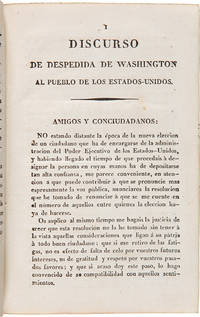
rif. 55421Mexico: Imprenta a cargo de Martin Rivera 1823. First Mexican Printing of the U.S. Constitution This is the first Mexican printing of the United States Constitution accompanied by two important addresses by George Washington. This work was produced in anticipation of Mexican independence from Spain and the U.S. Constitution in particular provided inspiration to the drafters of the constitution of newly-independent Mexico. Written in 1824 it was the first constitution of Mexico as a sovereign state and the constitution under which the colonization of Texas by Americans would take place. It is ample evidence of the transnational influence on the United States Constitution on emerging democracies in this case America's neighbor to the south. All seven articles of the United States Constitution are printed in full in Spanish in a section that is headed by a Federal garland ornament. The names of all the signers are given at the conclusion of the main text. This is followed by a section printing the first twelve amendments titled here as "Correcciones" an interesting interpretation of the role of constitutional amendments. The final page contains the text of an amendment passed by the House and Senate and signed in print by Senate President pro tem John Gaillard and House Speaker J.B. Varnum prohibiting any American citizen from accepting a title of nobility or honor from a foreign government under threat of losing one's American citizenship and holding any further elective office. This "Titles of Nobility" amendment was passed by Congress in 1810 and came close to ratification by two-thirds of the states in the 1810s but has to this day never been ratified. The inclusion of this amendment is an interesting commentary on the priorities and concerns of Mexican lawmakers. The U.S. Constitution is preceded by two chapters printing addresses by George Washington whose actions following the American Revolution and his two terms as President were influential well beyond the borders of the United States. The first chapter prints Washington's 1796 Farewell Address to the United States "Discurso de Despedida de Washington al Pueblo de los Estados-Unidos". Designed by Washington and his principal advisors in drafting it—James Madison and Alexander Hamilton—as both a valedictory and advice to succeeding generations the address served as a guidepost to Americans from the point of its publication. The Farewell Address would have been of particular interest to the Mexican Constitutional framers. The second section prints Washington's Address to the Continental Army in 1783 "Carta Circular del General Washington a los Gobernadores de los Estados fecha en el Cuartel General de Newburgh 18 de Junio de 1783". In this circular letter General Washington announces his intention to resign his command of the Continental Army and retire into private life. He also expounds in detail on the serious issues facing the nascent United States government. Both of Washington's addresses are printed fully in Spanish as is the Constitution. OCLC records just ten holding institutions over three records. This is the first copy that we can find in the market in over a century and the first copy we have handled of this first Mexican printing of the United States Constitution. Small octavo. Contemporary mottled Mexican sheep spine gilt. Minor edge wear light scuffing to boards short worm track on front board. Small ownership mark reading "JNB" branded on front and rear pastedowns ink ownership signature of "De Francisco Gonzalez de Cossio" on front flyleaf. Internally clean. Very good. OCLC 24072481 503926127 1097838706. SABIN 16060. PALAU 59641 374086. hardcover
rif. 55421Mexico: Imprenta a cargo de Martin Rivera 1823. First Mexican Printing of the U.S. Constitution This is the first Mexican printing of the United States Constitution accompanied by two important addresses by George Washington. This work was produced in anticipation of Mexican independence from Spain and the U.S. Constitution in particular provided inspiration to the drafters of the constitution of newly-independent Mexico. Written in 1824 it was the first constitution of Mexico as a sovereign state and the constitution under which the colonization of Texas by Americans would take place. It is ample evidence of the transnational influence on the United States Constitution on emerging democracies in this case America's neighbor to the south. All seven articles of the United States Constitution are printed in full in Spanish in a section that is headed by a Federal garland ornament. The names of all the signers are given at the conclusion of the main text. This is followed by a section printing the first twelve amendments titled here as "Correcciones" an interesting interpretation of the role of constitutional amendments. The final page contains the text of an amendment passed by the House and Senate and signed in print by Senate President pro tem John Gaillard and House Speaker J.B. Varnum prohibiting any American citizen from accepting a title of nobility or honor from a foreign government under threat of losing one's American citizenship and holding any further elective office. This "Titles of Nobility" amendment was passed by Congress in 1810 and came close to ratification by two-thirds of the states in the 1810s but has to this day never been ratified. The inclusion of this amendment is an interesting commentary on the priorities and concerns of Mexican lawmakers. The U.S. Constitution is preceded by two chapters printing addresses by George Washington whose actions following the American Revolution and his two terms as President were influential well beyond the borders of the United States. The first chapter prints Washington's 1796 Farewell Address to the United States "Discurso de Despedida de Washington al Pueblo de los Estados-Unidos". Designed by Washington and his principal advisors in drafting it—James Madison and Alexander Hamilton—as both a valedictory and advice to succeeding generations the address served as a guidepost to Americans from the point of its publication. The Farewell Address would have been of particular interest to the Mexican Constitutional framers. The second section prints Washington's Address to the Continental Army in 1783 "Carta Circular del General Washington a los Gobernadores de los Estados fecha en el Cuartel General de Newburgh 18 de Junio de 1783". In this circular letter General Washington announces his intention to resign his command of the Continental Army and retire into private life. He also expounds in detail on the serious issues facing the nascent United States government. Both of Washington's addresses are printed fully in Spanish as is the Constitution. OCLC records just ten holding institutions over three records. This is the first copy that we can find in the market in over a century and the first copy we have handled of this first Mexican printing of the United States Constitution. Small octavo. Contemporary mottled Mexican sheep spine gilt. Minor edge wear light scuffing to boards short worm track on front board. Small ownership mark reading "JNB" branded on front and rear pastedowns ink ownership signature of "De Francisco Gonzalez de Cossio" on front flyleaf. Internally clean. Very good. OCLC 24072481 503926127 1097838706. SABIN 16060. PALAU 59641 374086. hardcover books
1787rif. 69121London: Sold by T. Wilkie 1787. UNITED STATES CONSTITUTION. The London Chronicle "The New Plan for the Constitution of the United States of America". Vo. LXII. No. 4834-4835. From Saturday October 27 to Tuesday October 30 1787 and From Tuesday October 30 to Thursday November 1 1787. Pages 409-424. London: Sold by T. Wilkie 1787. Likely the first public printing of the United States Constitution in England. This newspaper printing precedes the know first edition pamphlet published by Debrett as well as the first magazine printing in "The Gentleman's Magazine." It is broadly stated that news of the United States Constitution hit England early in November however the dates of the Chronicle precede this by a few days. This copy also contains the preliminary cover letter from George Washington to the president of Congress which is usually included with early printings of the Constitution and which states Washington's strong support of ratification. "The Plan" is printed in its entirety without comment or explanation from the publisher. Together two issues no. 4834 and 4834. Each issue self bound along left margin. 11 3/8 x 8 5/8 inches; 288 x 222 mm. Number 4834 is four leaves pages 409-416 and number 4835 is four leaves pages 417-424. The first part of the Constitution is printed on pages 413-414 of the first part with the end stating "To be concluded in our next" and the second part is printed on pages 420-421. Both issues very good with just some slight toning. Page 421-422 trimmed close at top margin just touching header. A small red stamp on verso of first leaf of each issue along bottom margin. Overall about fine. We could find no other copies of this or any earlier British newspaper containing the US Constitution on Rare Book Hub. We could not locate any copies on OCLC or ESTC. Housed in a custom quarter red morocco clamshell. At the time of the Constitutional Convention John Adams was living in England as a diplomat. In a letter to John Adams from Elbridge Gerry dated September 20th 1787 just one day after the first newspapers in America printed the Constitution he states "The proceedings of the Convention being this day published I embrace the Oppertunity of transmitting them by a Vessel which is to sail this morning for London." According to the National Archives "Gerry enclosed a copy of the new U.S. Constitution. Gerry likely sent this letter to John Adams via the Prince George Capt. Strong which departed New York City in late September and arrived in London on 3 Nov. New York Independent Journal 1 Sept. 1787 2 Feb. 1788." This shows that it would have been impossible for news of the Constitution to arrive in England much before this date of November 3rd. Lengthy searches turn up no indication that any other British publication has a copy of the US Constitution before this London Chronicle printing. The National Archives go on to state "The U.S. Constitution was adopted on 17 Sept. 1787 and British newspapers first published the text in late autumn. The London Chronicle printed the preamble and the first article in its 27-30 Oct. issue and the remaining articles and signatures in its 30 Oct. - 1 Nov. issue. " The London Chronicle was a thrice weekly newspaper also known for being " one of the first to break the news that the United States had declared independence from the British Empire reporting on the event in its 13 August 1776 edition. It was also one of the first to publish the declaration in its entirety in the 15-17 August 1776 edition but containing no explanation or comment as to what it was" Wikipedia. This holds true for their publication of the Constitution as well. United States Constitution now the longest continuing charter of a national government in the world and "the product of a revolution in political thought at least as important and far-reaching as the winning of American independence from Great Britain and the culmination of the intellectual ferment and political experimentation in the new republic" Richard B. Bernstein Are We to Be a Nation. HBS 69121. $20000. Sold by T. Wilkie unknown
1787rif. 69121London: Sold by T. Wilkie 1787. UNITED STATES CONSTITUTION. The London Chronicle "The New Plan for the Constitution of the United States of America". Vo. LXII. No. 4834-4835. From Saturday October 27 to Tuesday October 30 1787 and From Tuesday October 30 to Thursday November 1 1787. Pages 409-424. London: Sold by T. Wilkie 1787. Likely the first public printing of the United States Constitution in England. This newspaper printing precedes the know first edition pamphlet published by Debrett as well as the first magazine printing in "The Gentleman's Magazine." It is broadly stated that news of the United States Constitution hit England early in November however the dates of the Chronicle precede this by a few days. This copy also contains the preliminary cover letter from George Washington to the president of Congress which is usually included with early printings of the Constitution and which states Washington's strong support of ratification. "The Plan" is printed in its entirety without comment or explanation from the publisher. Together two issues no. 4834 and 4834. Each issue self bound along left margin. 11 3/8 x 8 5/8 inches; 288 x 222 mm. Number 4834 is four leaves pages 409-416 and number 4835 is four leaves pages 417-424. The first part of the Constitution is printed on pages 413-414 of the first part with the end stating "To be concluded in our next" and the second part is printed on pages 420-421. Both issues very good with just some slight toning. Page 421-422 trimmed close at top margin just touching header. A small red stamp on verso of first leaf of each issue along bottom margin. Overall about fine. We could find no other copies of this or any earlier British newspaper containing the US Constitution on Rare Book Hub. We could not locate any copies on OCLC or ESTC. Housed in a custom quarter red morocco clamshell. At the time of the Constitutional Convention John Adams was living in England as a diplomat. In a letter to John Adams from Elbridge Gerry dated September 20th 1787 just one day after the first newspapers in America printed the Constitution he states "The proceedings of the Convention being this day published I embrace the Oppertunity of transmitting them by a Vessel which is to sail this morning for London." According to the National Archives "Gerry enclosed a copy of the new U.S. Constitution. Gerry likely sent this letter to John Adams via the Prince George Capt. Strong which departed New York City in late September and arrived in London on 3 Nov. New York Independent Journal 1 Sept. 1787 2 Feb. 1788." This shows that it would have been impossible for news of the Constitution to arrive in England much before this date of November 3rd. Lengthy searches turn up no indication that any other British publication has a copy of the US Constitution before this London Chronicle printing. The National Archives go on to state "The U.S. Constitution was adopted on 17 Sept. 1787 and British newspapers first published the text in late autumn. The London Chronicle printed the preamble and the first article in its 27-30 Oct. issue and the remaining articles and signatures in its 30 Oct. - 1 Nov. issue. " The London Chronicle was a thrice weekly newspaper also known for being " one of the first to break the news that the United States had declared independence from the British Empire reporting on the event in its 13 August 1776 edition. It was also one of the first to publish the declaration in its entirety in the 15-17 August 1776 edition but containing no explanation or comment as to what it was" Wikipedia. This holds true for their publication of the Constitution as well. United States Constitution now the longest continuing charter of a national government in the world and "the product of a revolution in political thought at least as important and far-reaching as the winning of American independence from Great Britain and the culmination of the intellectual ferment and political experimentation in the new republic" Richard B. Bernstein Are We to Be a Nation. HBS 69121. $20000. Sold by T. Wilkie unknown books