1.230 Ergebnisse
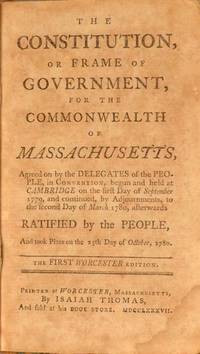
1787Best.-Nr. 768991787. MASSACHUSETTS Constitution of. THE CONSTITUTION OR FRAME OF GOVERNMENT FOR THE COMMONWEALTH OF MASSACHUSETTS . RATIFIED BY THE PEOPLE AND TOOK PLACE ON THE 25TH DAY OF OCTOBER 1780. Worcester Massachusetts: Isaiah Thomas 1787. "The first Worcester edition" stated on the t.p. preceded by three Boston editions 1880-84. 18mo. 107 pp. Worn contemporary binding of leather-backed paper-covered scabbard boards. Approximately half of the lower board is missing. Text leaves are age-browned occasionaly foxed and dampstained in the margin at the bottom fore-corner. The final page has some loss just affecting the final letters in some lines. Sabin 45691. unknown books
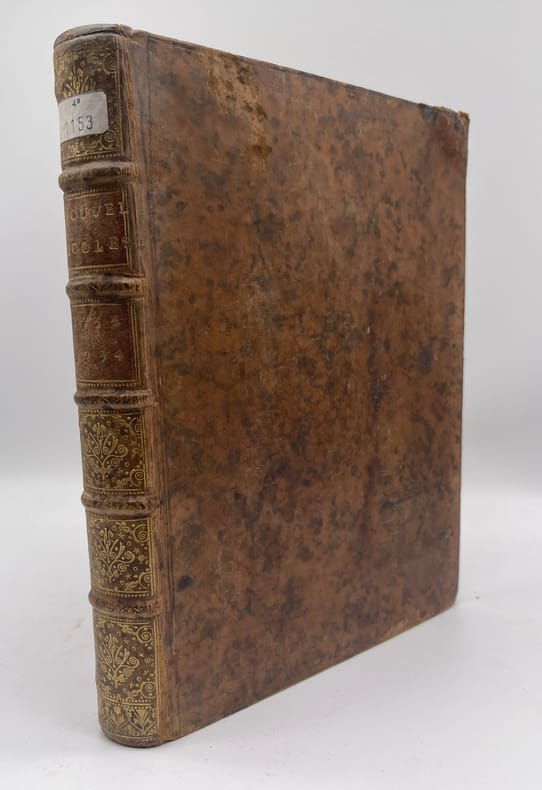
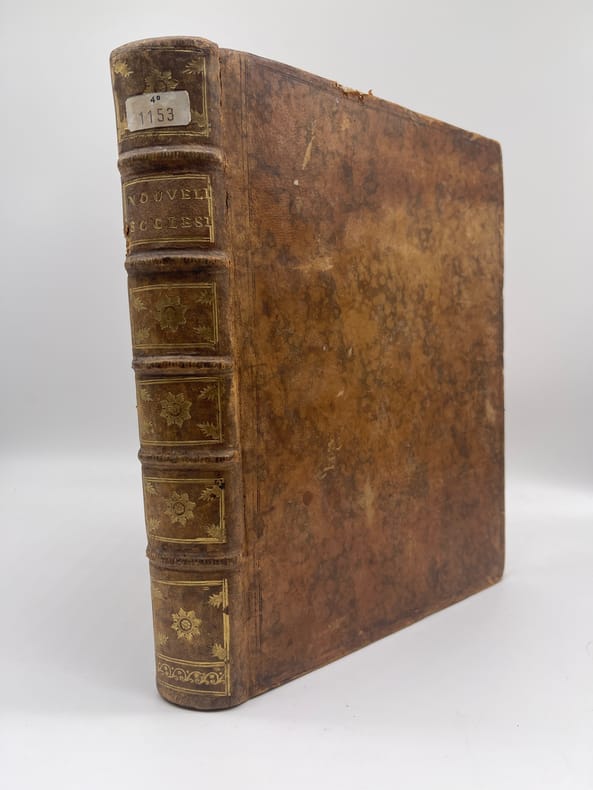
Best.-Nr. 017371[Jansénisme] Nouvelles ecclésiastiques ou mémoires pour servir à l'histoire de la Constitution Unigenitus pour l'année M.DCC.XXXIII. [et] M.DCC.XXXIV. Paris, s.n., 1733-1734. In-4, front.-220-front.-228p. Deux années complètes de cet important journal publié clandestinement à partir de 1728 et jusqu'en 1803, farouchement militant pour les jansénistes et contre les partisans de la Bulle Unigenitus. On notera la présence de 4 gravures dont 2 frontispices et 2 portraits, placés en 1733, d'Alexandre Levier (p.44) et Firmin Tournus (p.196). Les frontispices semblent être en supplément, l'un deux portant un prix, 6 sols, en pied. Ils sont néanmoins particulièrement révélateurs de l'esprit des rédacteurs. Le numéro du 10 janvier 1734 est absent et a été remplacé à l'époque par une copie manuscrit de 8p. Plein veau, dos à nerfs orné, pièces de titre, tranches rouges. Coins supérieurs écrasés par une chute, tache brune sur 3 feuilles de 1733, légers défauts. Etiquette sur le dos, cachet sur la première page, répété p.100 (petit séminaire de Caen).
Best.-Nr. 017372[Jansénisme] Nouvelles ecclésiastiques ou mémoires pour servir à l'histoire de la Constitution Unigenitus pour l'année M.DCC.XXXI. [et] M.DCC.XXXII. Paris, s.n., 1731-1732. In-4, 280-252-XIIp. Deux années complètes de cet important journal publié clandestinement à partir de 1728 et jusqu'en 1803, farouchement militant pour les jansénistes et contre les partisans de la Bulle Unigenitus. Ex-libris « Caroli Du Ruisseau in supremo senatu Patroni », Charles du Ruisseau, avocat au parlement de Paris en 1735 (base AFCEL D1915). Plein papier d'époque, dos à nerfs, pièces de titre, tranches rouges. Papier parfois un peu usé, reliure parfaitement solide. Etiquette sur le dos, cachet sur la première page, répété p.100 (petit séminaire de Caen). Quelques rares feuillets avec petit manque de papier marginal.
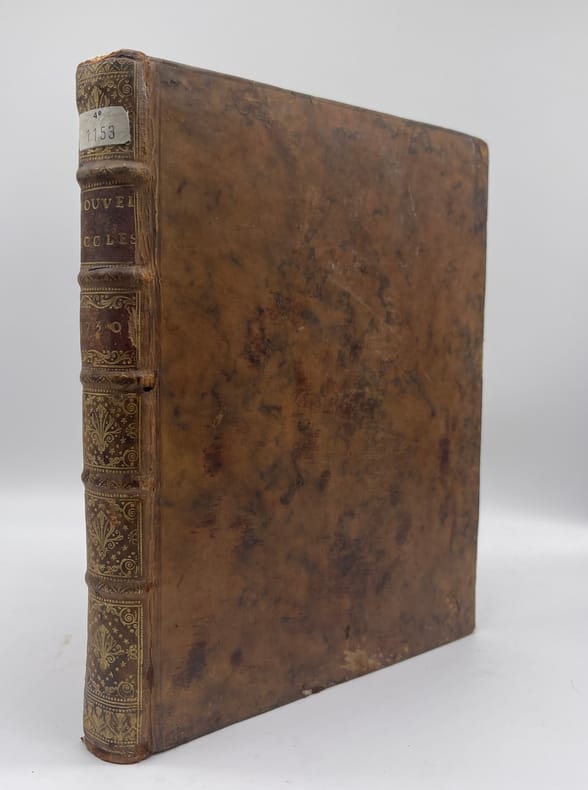
Best.-Nr. 017375[Jansénisme] Nouvelles ecclésiastiques ou mémoires pour servir à l'histoire de la Constitution Unigenitus pour l'année M.DCC.XXX. Paris, s.n., 1730. In-4, environ 353p, paginations diverses. Année 1730 complète, truffé de 3 belles gravures au format in-folio et donc pliées : « Les premiers deffenseurs de l'Eglise contre la Constitution Unigenitus » (p.1, portraits de 9 appelants, cartouche de titre ajouté, collé en tête) ; un portrait de Charles-Joachim Colbert de Croissy (1667-1738) entouré d'une liste de ses oeuvres (p.83) ; un portrait de Jean Soanen (1647-1740) entouré lui aussi de la liste de ses oeuvres (p.195). Après les 258p de l'année (numérotées à l'encre) se trouvent différents textes : « relation de ce qui s'est passé au parlement de Rouen » du 28 avril au 19 mai 1730 ; « Lettre du père Chamillart jésuite au sujet du bruit qui avait couru de sa mort. » ; « Lettre d'un jésuite de Paris à un prélat au sujet d'une calomnie atroce. » (Paris, Herault, 30 mars 1732) ; « déclaration du père Tournemine jésuite sur des écrits supposés. » (Paris, Herault, 19 mars 1732) ; « Lettre au révérend père de Tournemine jésuite. » ; « Mandement de Monseigneur l'archevêque de Paris portant condamnation de plusieurs libelles qui ont pour titre Nouvelles ecclésiastiques » (Paris, P Simon, 1732) et une table pour les années 1730 et 1731. Plein veau, dos à nerfs orné, pièces de titre, tranches rouges. Petits défauts usuels, accroc à la coiffe supérieure, petite mouillure claire en tête (marginale).
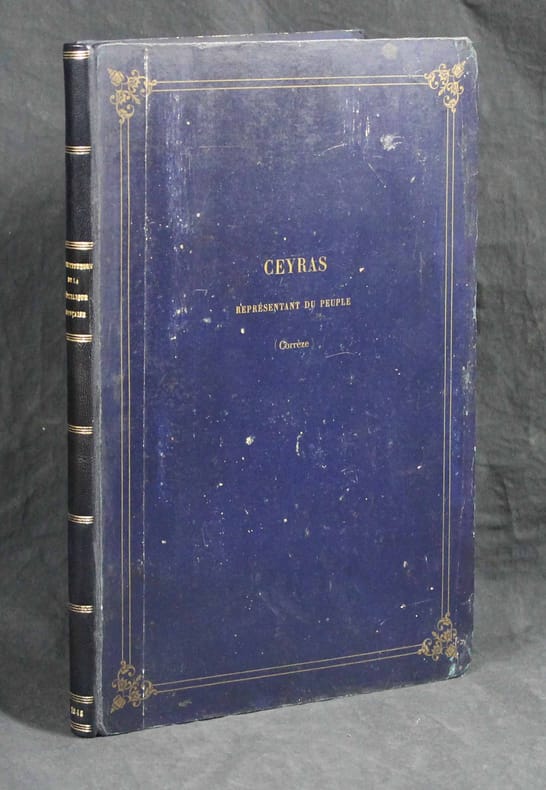
Best.-Nr. 17163Paris, Imprimerie Nationale, 1848.
1791Best.-Nr. 244691791 Paris, Desnos, 1791, in-16, veau marbré, dos lisse orné de faux-nerfs, pièce de titre en maroquin vert, roulette dorée sur les plats et les coupes, tranches dorée, 160 + 12 pages in-fine calendrier.
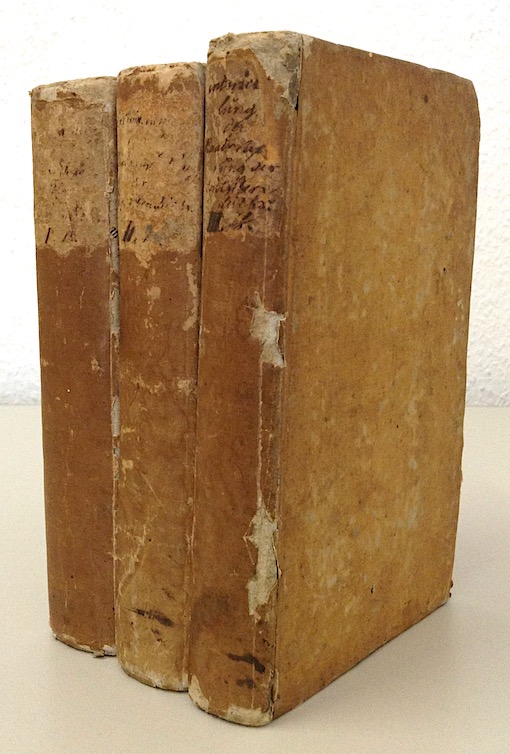
1786Best.-Nr. 99168Göttingen, Vandenhoeck, 1786-87. 12 Bl., 460 S.; 17 Bl., 454 S.; 13 Bl., 299 S., 22 Bl. Mit 3 wiederholten gestochenen Titelvignetten. Pappbände d. Zeit (stark beschabt u. bestoßen). [2 Warenabbildungen]
570 pages. Footnotes. Index. "...A thorough exposition of a social philosophy which ranges from ethics and anthropology through jurisprudence and the history of ideas to the economics of the modern welfare state." - from dust jacket (not included). A National Review Panel ranked this work as the ninth best non-fiction book of the twentieth century. Unmarked with average wear. Binding intact. Moderate external soiling, primarily to bottom edge. A sound copy. Book
1925Best.-Nr. 48025Berlin, Julius Springer, 1925. Contemp. hcloth. Gilt lettering to spine. In: ""Zeitschrift für Physik. Hrsg. von Karl Scheel"", 32. Band. VI,951 pp., textillustr. (Entire volume offered). Heisenberg's paper: pp. 841-860. A small erased stamp on titlepage leaving two small holes, no loss of text. Internally clean.
1925Best.-Nr. 49362Berlin, Julius Springer, 1925. Contemp. hcloth. In: ""Zeitschrift für Physik. Hrsg. von Karl Scheel"", 32. Band. VI,951 pp., textillustr. (Entire volume offered). Heisenberg's paper: pp. 841-860. A stamp to title-page and front free endpaper. Interally clean.
1925Best.-Nr. 48025Berlin Julius Springer 1925. Contemp. hcloth. Gilt lettering to spine. In: "Zeitschrift für Physik. Hrsg. von Karl Scheel" 32. Band. VI951 pp. textillustr. Entire volume offered. Heisenberg's paper: pp. 841-860. A small erased stamp on titlepage leaving two small holes no loss of text. Internally clean. First appearance of Heisenberg's importent paper on the complex spectra of many-electron atoms - the third paper Heisenberg submitted from Copenhagen on the Quantum Theory."The paper on multiplet structure and anomalous Zeeman effects. contained a complete discussion of the problem at that time. This paper had the blessing of Niels Bohr; also Pauli who wasin Copenhagen when the paper was completed agreed with its overall content. The central goal of the paper was to formulate what Bohr called 'the stress constraint which is not analogous to the action of external forces' and to derive quantitative conclusions from it." Mehra and rechenberg "The Historical development of Quantum Theory" vol. 2 p. 201.The volume contains another importent paper in the history of Quantum Physics: W. BOTHE und H. GEIGER "Über das Wesen des Comptoneffekts ein experimenteller Beitrag zur Theorie der Strahlung" pp. 639-663. hardcover
1925Best.-Nr. 49362Berlin Julius Springer 1925. Contemp. hcloth. In: "Zeitschrift für Physik. Hrsg. von Karl Scheel" 32. Band. VI951 pp. textillustr. Entire volume offered. Heisenberg's paper: pp. 841-860. A stamp to title-page and front free endpaper. Interally clean. First printing of Heisenberg's importent paper on the complex spectra of many-electron atoms - the third paper Heisenberg submitted from Copenhagen on the Quantum Theory."The paper on multiplet structure and anomalous Zeeman effects. contained a complete discussion of the problem at that time. This paper had the blessing of Niels Bohr; also Pauli who was in Copenhagen when the paper was completed agreed with its overall content. The central goal of the paper was to formulate what Bohr called 'the stress constraint which is not analogous to the action of external forces' and to derive quantitative conclusions from it." Mehra and Rechenberg "The Historical development of Quantum Theory" vol. 2 p. 201.The volume contains another importent paper in the history of Quantum Physics: W. BOTHE und H. GEIGER "Über das Wesen des Comptoneffekts ein experimenteller Beitrag zur Theorie der Strahlung" pp. 639-663. hardcover
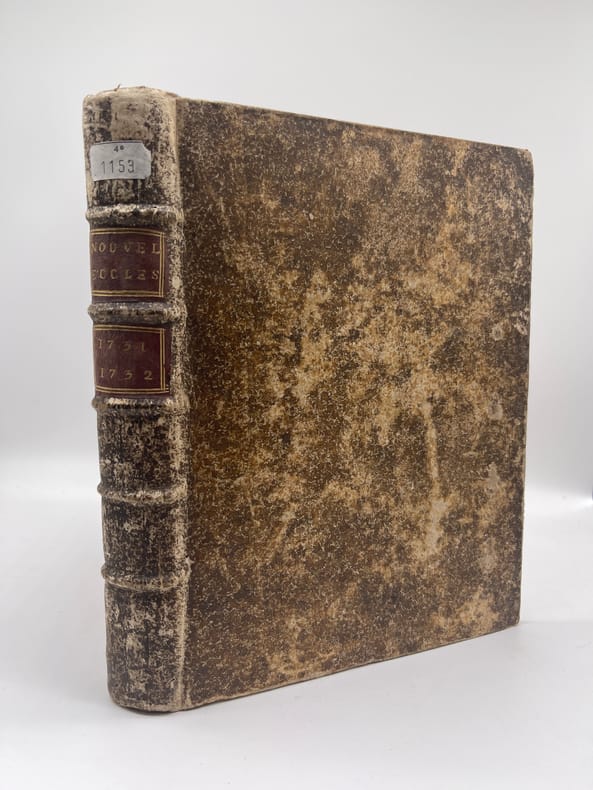
Best.-Nr. 017376[Jansénisme] Nouvelles ecclésiastiques ou mémoires pour servir à l'histoire de la Constitution Unigenitus pour l'année M.DCC.XLIX., M.DCC.L et M.DCC.LI Paris, s.n., 1749-1751. In-4, 208-208-204p. Trois années de cet important journal, la dernière étant incomplète (elle devrait avoir 208p). A la fin se trouvent des numéros éparses dont les pages 1 à 32 et 81 à 84 de 1752, 145 à 148 de 1732, 169 à 172 et 177 à 180 de 1753, 141 à 148, 153 à 160, 85 à 88, 61 à 68, 137 à 140, 181 à 184, 193 à196 de 1756. Plein veau, dos à nerfs orné, pièce de titre tranches rouges. Mors supérieur fendu en tête, manque à une coupe, quelques manques marginaux, quelques déchirures dans les numéros supplémentaires.
1781Best.-Nr. 629730Göttingen, Vandenhoeck & Ruprecht, 1781-85. 8 Bl., 366 S.; 1 Bl., S. 367-682, 1 Bl. Marmorierter Pappband d. Zeit mit Rückenschild (etwas berieben, 1 Ecke bestoßen). [2 Warenabbildungen]
Best.-Nr. 010236Londres, Paris Barrois - Desenne 0 fort in-8 Reliure d'époque
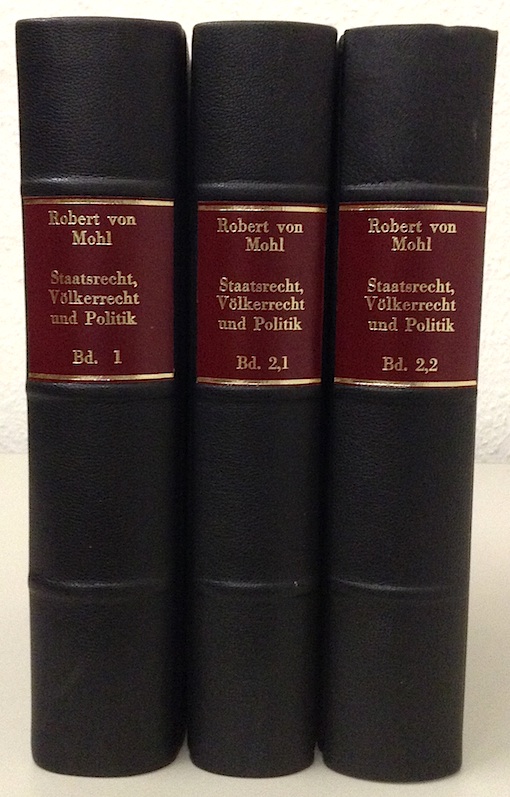
1860Best.-Nr. 86432Tübingen, Laupp, 1860-69. Moderne Leder mit rotem Rückenschild u. beigebundenen Originalumschlägen. [3 Warenabbildungen]
1733Best.-Nr. 96813Frankfurt, A. J. Felßeckers Erben, 1733-53. Mit Kupferporträt, 10 weiteren Tafeln u. 1 gefalteten Tabelle. Moderne Halbleder mit goldgeprägten Rückentiteln. [4 Warenabbildungen]
2006Best.-Nr. 76532Washington DC: U. S. Government Printing Office 2006. Presumed First Edition First printing. Wraps. Good. iv 1580 pages. Illustrations. Occasional footnotes. Serial No. 109-70. Format is approximately 5.75 inches by 9.25 inches. Cover has some wear and soiling. This is the first of a series of hearings that the Subcommittee planned to hold examining the Voting Rights Act also known as the VRA. It had been 25 years since Congress last extended the number of the temporary provisions of the VRA. Six provisions were scheduled to expire in 2007 including sections 4 5 6 7 8 and 203. These hearings will examine the impact of the Voting Rights Act over the last several decades and its continued role in protecting minority voting rights. The ability of our citizens to cast a ballot for their preferred candidate ensures that every voice is heard most importantly the right to vote safeguards our freedoms and all other rights enshrined in the Constitution. The sacredness of the right to vote is reflected in the protection afforded by the 15th amendment which States ''the right of citizens of the United States to vote shall not be denied or or abridged by the United States or by any State on account of race color or previous condition of servitude.'' For too many of our fellow citizens in our history this has not always been the case. Our country has had a troubled history of invidious and disparate treatment in the most fundamental process of a democracy namely voting. The VRA pushed back against this history and challenged racial discrimination from a number of different angles. U. S. Government Printing Office paperback
2006Best.-Nr. 76534Washington DC: U. S. Government Printing Office 2006. Presumed First Edition First printing. Wraps. Good. Serial No. 109-79. Volume I ONLY. Volume I v 1 1684 6 pages. During this hearing Representative John Lewis of Georgia stated "The Voting Rights Act helped expand our democracy and open up our democracy to elect hundreds of thousands and millions of our citizens who had been kept out let them in. The Voting Rights Act was needed then and it is needed now. The purpose of section 5 is very unique and very important. It prevents discriminatory plans from being enacted in the first place. It put the burden on the judiciary to show that the plan does not discriminate against minority voters. Congress Lewis continued "Prior to section 5 the burden was on the minority voters to challenge the voting practice; and every section was good at coming up with different procedures that had the same result discrimination. Anita Earls' testimony talks in some detail about the recent example how this is still happening. The difference is that we have section 5 to prevent these practices from harming minority voters. Many people like the court said that we have come a long ways; and again today I would say that we've come a distance. We've come a long way and that is true. We're not the same Nation that we were 40 years ago but it's clear today that we have not come far enough. Section 5 is still needed. Today section 5 prevents discrimination and redistricting and changes that move voting locations out of minority neighborhoods into less accessible areas. These are issues that are different from the fight to register to vote but they are no less fundamental." U. S. Government Printing Office paperback
2006Best.-Nr. 76535Washington DC: U. S. Government Printing Office 2006. Presumed First Edition First printing. Wraps. Good. Serial No. 109-83. Part I ONLY. Volume I iv 1446 22 pages. This Committee will focus on section 203 the provision authorizing bilingual language assistance to American citizens who are members of covered language minority groups and who have limited English proficiency. Section 203 has not been revisited by Congress since 1992 and like the sections that we have discussed in previous hearings is set to expire in 2007 unless reauthorized. The Voting Rights Act was enacted in 1965 in response to a history of racial discrimination against some of our Nation's citizens. In 1975 Congress expanded the Voting Rights Act to include section 203 and its companion section 4f. Section 203 requires certain jurisdictions to provide bilingual election assistance-including notices instructions information and ballots-to citizens who are members of a designated language minority group and who have limited English proficiency. As cited in the 1975 House Report section 203 was added in response to ''an extensive evidentiary record demonstrating the prevalence of voting discrimination and high illiteracy rates among language minorities.'' This record revealed that similar discrimination patterns and practices that had been used to prevent African-Americans from voting were being administered against Asian-Americans American Indians Native Alaskans and citizens of Hispanic origin. These citizens are more than likely to live in environments in which the dominant language is other than English. Section 203 breaks down these barriers by providing citizens in a language minority group with the assistance necessary to participate in the political process. Section 203 has enabled an increased number of minority citizens to register and cast ballots as revealed in the last Census and latest election records. U. S. Government Printing Office paperback
2006Best.-Nr. 76538Washington DC: U. S. Government Printing Office 2006. Presumed First Edition First printing. Wraps. Good. Serial No. 109-103. Volume IV ONLY. Volume IV v 1 4297-5711 3 pages. Footnotes. Illustrations. This volume contains the Appendix to Hearings: Table of Contents and Appendix Materials Continued from the National Commission on the Voting Rights Act. The Subcommittee will be holding its tenth hearing examining the Voting Rights Act of 1965 and the temporary provisions that are to expire. They're set to expire in 2007 unless we reauthorize by Congress which I think most of us anticipate will occur. The Subcommittee examined each of the expiring provisions in great detail. This afternoon we examine the evidence of continued discrimination against racial and language minority citizens since 1982 that have been compiled by a number of non-governmental organizations who will be testifying. I'd thank these organizations for completing these reports and in making sure that this Committee has before it a complete and accurate record of discrimination over the last 25 years. In continuing to reauthorize the temporary provisions Congress on four separate occasions examined the extent to which discrimination continued to exist by analyzing information such as enforcement statistics minority voter registration rates minority voter turnout and litigation pursued to protect minority voting rights. Federal agencies such as the United States Commission on Civil Rights were instrumental in investigating analyzing and reporting back to Congress on the state of minority voting during each consideration. Each time Congress concluded based upon the evidence presented that the exceptional conditions which existed in 1966 continued to exist in 1970 1975 1982 and in 1992 when it was last reauthorized. This afternoon the Committee continues to examine whether the exceptional conditions warranting the extension of the temporary provisions continue to exist in 2006. U. S. Government Printing Office paperback
1815Best.-Nr. CSP-1751Chez Alexis Eymery, Paris, mai 1815. Édition originale. "Sans conteste le plus important des écrits politiques de Constant"(A. Roulin, p. 1593). "Les principes ramassent dans un développement unifié les principaux thèmes de réflexions de Constant sur les vrais principes de la liberté (…). Le premier classique de la pensée libérale dans son état proprement contemporain; celui créé par l'évènement fondateur de la modernité politique: la Révolution française" (M. Gauchet, Dictionnaire des oeuvres politiques)
1760Best.-Nr. 11598Lyon, P. Valfray, 1760 ; 2 parties en 1 volume in-12 ; plein veau blond moucheté, dos à cinq nerfs orné d'une colombe dorée répétée, pièce de titre en maroquin rouge, triple filet doré d'encadrement des plats, armes dorées au centre, roulette décorative dorée sur les coupes, tranches rouges ; XIX, (5) de table, 241, 76 pp.
1806Best.-Nr. 184040Philadelphia PA: Wm. Duane 1806. Hardcover. Good- front board nearly split yet firmly held; rattled. boards edge-worn & rubbed; moisture spotted. portion of spine top missing & chipped; tail rubbed torn at edge & flapped. pastedowns & endpapers tanned & foxed w/ pencil notations & names; front pastedown has paper remnants & dampstaining; back pastedown & endpaper has dampstaining to upper edges. pgs 264 to closing have tanned dampstaining to upper edge. leather boards w/ gilt ruled spine & maroon leather gilt printed title plate. 307 pgs. Narrow previous owner's name label to spine. Some instances of dampstaining to lower page edges. Page 166 has black ink spattering to lower text and page edge A few pages darkly tanned with higher concentrations of foxing. Instances of light to moderate foxing throughout; text dark. An uncommon 1806 edition. Wm. Duane hardcover books
Very Good French Original journals. Folio. (32 x 25 cm). In French. 3 issues: (4 p.; 4 p.; 8 p.). Ahmet Riza Bey was an Ottoman-born Turkish political activist, scientist, statesman, educational reformer and a prominent member of the Young Turks, during the Second Constitutional Era of the Ottoman Empire. In 1908 he became the first President of the revived Chamber of Deputies, the lower house of the Ottoman Parliament, and in 1912, he was appointed as the President of the Senate (the upper house) as well. He also served as Minister of Education from the Liberal Union party, the main opposition party to the ruling Committee of Union and Progress. In 1908, his name was among the candidates' list for the next Grand Vizier. He was the leading negotiator during the failed agreement of coalition between the Ottoman Empire, France, and Britain for World War I. Ahmet Riza has been described as a polymath by some authors. He was born in Istanbul in 1858, the son of Ali Riza Bey. His father was nicknamed Ingiliz ("Englishman") because of his command of the English language and admiration of the British Empire. His mother, Fraulein Turban, was born in Munich but was of Hungarian origin. She moved to Vienna, where she met Ingiliz, and converted to Islam to marry him, taking the name Naile Sabika Hanim. He graduated from Galatasaray High School in Istanbul and subsequently studied agriculture in France. As a young man, he sought to improve the condition of the peasantry in the Empire. He was concerned with the conditions of the farmers and wanted to implement agricultural methods, supporting the ideas of the French sociologist, Auguste Comte. In 1894, he published a series of publications on unification of Islamic and Ottoman traditions of consultation. In 1895, Mesveret (Meshveret, or, Mechveret), the journal that he published, became a locus of the exiled Young Turks movement. Ahmet Riza opposed the maverick Prince Sabahaddin's calls for revolution and European intervention in the empire at the 1902 Congress of Ottoman Opposition in Paris. According to a customized book in 1889, on the pretext of participating in the exhibition organized for the centenary of the French Revolution, there was a customized letter, which indicated he escaped to Paris and did not return. He became an interpreter as he learned French. At the University of Paris, he continued his lectures on positivism, taught by mathematician Pierre Laffitte, as he was influenced by Laffitte's thoughts about Islam and Eastern civilization in particular. Laffitte believed that Islam was the most advanced religion, so it was easy for Muslims to pass through positivism. Ahmet Riza became one of the most active members of the Société Positiviste (Positivist Society), and since 1905 he has appeared as a "representative of Muslim communities" in the Comité Positif Occidental, establishing the spread of positivist international platitudes. During his first years in Paris, he attempted to respond to various newspapers and magazines, which were writing unfavourably about the Ottoman Empire. In 1891, he wrote a letter to the postal and telegraph chronicle in Istanbul as he did not obey the instructions of the center of Paris to return to his country due to his use of the expression "liberty" in a lecture on Ottoman women and stated that he did not belong to any secret cemetery. Ahmet Riza sent his thoughts to Sultan Abdul Hamid II in 1893. He continued to send sheets upon the request of his encouraging response and continuation; he tried to convince him that the constitutional regime was not a bad thing. In the case of sending the sixth party, he began to write political writings in French, which was published by the former Syrian deputy Halil Ganem. (Source: Wikipedia).