Schlegel, A.H.MareMagnum

1,374 results
193880 pages. Seventeen one-page black and white reproductions of photos of league officials including League President A.H. Schlegel, John Ross Robertson [in memoriam], George S. Dudley [Past President], and many others. Includes a review of O.H.A. year, 1936-37. Average wear. Binding intact. Writing atop orange front cover and on first blank leaf, with marginal markings to three pages. A sound copy of this wonderful and very informative memento of prewar Ontario hockey. Book
1982iv, 134 pages. "This book attempts to do four things: Trace the discovery and development of People's Law, which is basic to the effective governing of a free nation; Present the historical development of government in Canada; Present the Model Constitution for Canada; and List the advantages to be enjoyed by Canadians under the Model Constitution." - Preface. Written when Queen Elizabeth II had delivered the Canada Act to Canada. Clean and unmarked with somewhat above-average external wear. Binding tight. A sound copy of this fascinating study. Skousen is perhaps most notable for his "The Naked Capitalist" in which he distilled the essence of Carroll Quigley's "Tragedy and Hope", making it more accessible to the common man. Book
1935321p., illus. Hardcover Very good condition good
1980388p., illus. Martin was the Captain of the USS Constitution 1974-1978. Hardcover Very good condition good
1986346p., illus. New introduction by Henry Steele Commager Hardcover Very good condition good
1987348p. Hardcover Very good condition good
1937xxviii, 467 p. front., plates Hardcover Good condition
1948336pp. , ports. 22 cm. Hardcover Very good condition
1965Oversize. 255 p., illus. Hardcover Very good condition, covers lightly soiled
35p. Hardcover Very good condition, covers faded & discolored
1964viii, 274 p. 22 cm. Hardcover Very good condition good
1963DIDIER 1963 463 PP. FONDO DI MAGAZZINO: SEGNI DEL TEMPO ALLA COPERTINA, PER IL RESTO CONDIZIONI ECCELLENTISSIME, CONSIDERATI GLI OLTRE 50 ANNI DEL VOLUME. Parole e frasi comuni Alarcos Alroy amour anglais apparaît aspects Benjamin Disraeli Besso biographique Book Bradenham Byron caractéristique caractérologique Carlyle Carrier Pigeon Cazamian conception Coningsby Contarini Fleming critiques décors Dickens Disraëli doctrines doute Earl of Beaconsfield effet Egremont Endymion English essentiel faiblesse Fakredeen Falconet fantaisie George Eliot great haut Henrietta Temple héros disraéliens Hughenden Ibid idées imagination intellectuelle intrigues Ixion Jeune Angleterre Juifs l'action l'ambition l'aristocratie l'auteur l'esprit l'héroïne l'humour l'imagination l'intrigue l'ironie l'œuvre disraélienne Lady Bradford Leslie Stephen littéraire London Londres Lord Beaconsfield Lord Bentinck Lord Monmouth Lothair manifeste mentors Millbank Monypenny morale note Novels œuvre parfois Peel pensée personnages personnalité disraélienne philosophie Phoebus politique Popanilla psychologique race raciale réalité religieuses révèle rôle romancier romanesque romans de Disraëli romans disraéliens satire scène semble sentiment Sidonia social souplesse souvent style surtout Sybil Tancred tendances Thackeray thèmes Theodora thèse Torysme trilogie type valeur Venetia victorienne Vivian Grey Whig Young Duke
1847ref. 1239761847. First Edition. CONSTITUTION PHILLIPS Wendell. Review of Lysander Spooner's Essay on the Unconstitutionality of Slavery. Reprinted from the ""Anti-Slavery Standard"" With Additions. Boston: Andrews & Prentiss 1847. Octavo modern half calf gilt marbled boards; pp. 1-3 4-95 1. $1600.First edition in book form of Phillips' bold and influential antebellum work on the U.S. Constitution and the question of slavery revised and ""with additions"" to its serialization in the Anti-Slavery Standard.Controversy over slavery ""was the most important single influence on American constitutional development before the Civil War"" Wiecek Sources 15. Leaders in that controversy were William Lloyd Garrison Wendell Phillips and Lysander Spooner. As an anti-constitutionalist Phillips deemed ""Prophet of Liberty Champion of the Slave"" made his ""first public pronouncement that the Constitution should be abandoned"" when in 1842 he asserted the ""'spirit of liberty' is 'chained down in the iron links of the United States Constitution'"" and subsequently argued the Constitution was a ""'compromise'É between freedom and slavery"" Knowles Securing the 'Blessings'"" 41. Phillips' 1844 work Constitution: A Pro-Slavery Compact prompted Spooner to author Unconstitutionality of Slavery First Part: 1845 Second Part: 1847 arguing it was instead slavery that was unconstitutional not the founding document. Phillips quickly countered with this Review.""Phillips insisted the only path to justice 'is over the Constitution trampling it under foot'. and raised pertinent questions about the processes of constitutionalism. Must a just person reject an imperfect constitution or even one that sanctioned and protected an evil like slavery to work effectively for constitutional reform and to abolish injustice Or was it possible to regard the constitution as an imperfect but amendable instrumentÉ the only thing available in the here and now of a heterogeneous secular society that can serve as a means of changing a society's goals and structuring"" Wiecek 246. To Phillips Spooner's approach essentially ""leaves every one to do 'what is right in his own eyes.'"" Spooner and Phillips also disagreed on remedies to immoral laws. ""Spooner did not consider an immoral contract binding"" and argued for example that judges rely instead on natural law for their decisions. Phillips felt that in such circumstances a judge should resign. In this Review Phillips also offers ""a new area in which antislavery and anarchy"" could be connected when he describes Spooner's ""antislavery constitutionalismÉ as 'the first step toward anarchy'"" Perry Radical Abolitionism 165-66. First edition first printing. Serialized earlier the same year in the Anti-Slavery Standard the official weekly newspaper of the American Anti-Slavery Society which was co-founded by William Lloyd Garrison and Arthur Tappen. Sabin 62524. Dumond 93. Not in Blockson. Text fresh and about-fine. hardcover
1682ref. 1206631682. CONSTITUTION SOMERS John. The Security of English-Mens Lives Or the Trust Power and Duty of the Grand Jurys of England. London: Printed for Benj. Alsop 1682. Small octavo 4 by 6-1/2 inches 18th-century brown morocco raised bands marbled endpapers all edges gilt; pp. 1-2 3-168. $3400.1682 edition of Somers' profoundly influential work on the power of the grand jury the second of only two 17th-century editions issued the year after the firstÑ""one of the fundamental foundations of the common law in the American colonies""Ñprompting revolution with Somers' invoking the grand jury and its protection of secrecy as key in opposing ""corrupt Ministers of State"" and those who ""abuse or oppress the PeopleÉ in the form and course of Justice"" seminal in the creation of the Constitution's Fifth Amendment with Jefferson calling grand juries ""the true tribunal of the people.""British statesman Baron John Somers' most famous and influential work is Grand Jurys. ""Of the legal scholars writing about the grand jury in the late 17th century Somers is not only representative but eminent having been read in both England and the colonies"" Kadish Behind the Locked Door 5-10. Grand Jurys is considered a seminal influence on Locke and America's Founding Fathers and it is ""likely that Locke knew Somers by the early 1680sÉ The opposition of absolute monarchy to the security provided by 'impartial law' was structurally central to Locke's Second Treatise 1689 which attacked the threat to life liberty and property posed by a loss of 'impartial justice'É Locke's arguments are a logical extension of the arguments that juries provided the only security of life"" Marshall John Locke 52. To Somers similarly the grand jury offers ""security"" from the ""Ill Designs of corrupt Minsters of State"" and those who ""dare to abuse or oppress the People."" Somers' Grand Jurys is ""a classic statement of political freedom. He works his way through a number of themes that will be frequently repeated by others."" Chief among these is his argument that ""the independent grand jury is the linchpin of the entire criminal justice system. It brings offenders to justice and protects the innocent from false accusation guaranteeing the traditional rights of Englishmen particularly their political rights in relation to the CrownÉ and joins Parliament as a counterweight to the arbitrary power of the monarch and his judges"" Shapiro Beyond Reasonable Doubt 67. With its origins found deep within English legal history the grand jury was ""eulogized by Coke and BlackstoneÉ and crossed the Atlantic as one of the fundamental foundations of the common law in the American colonies"" Roots If It's Not a Runaway. ""Indeed there is an important sense in which the jury issue united not only America's revolutionary period and Founding era but also the 'settlement' years immediately following 1789"" Stimson Juries and American Revolutionary Jurisprudence 34-5.As American ""opposition to the British became more overt grand juries became more sympathetic to the colonistsÉ the famous case of John Peter Zenger is a prime exampleÉ as two separate N.Y. grand juries refused to indict him for criminal libel. Further in 1765 a Boston grand jury refused to find an indictment against the leaders of the Stamp Act Riots"" Paule Perversion of the Historic Function 304. ""Perhaps the best known case of grand jury independence involved the twice-unsuccessful efforts to indict former Vice President Aaron Burr for attempting to involve the U.S. in a war with SpainÉ Burr was finally indicted when a grand jury was convened in Virginia the stronghold of Burr's enemy Thomas Jefferson. Despite Jefferson's best efforts Burr was acquitted at trial in part because the judge gave such a narrow jury instruction and made evidentiary rulings so favorable to the defense that conviction was nearly impossible. The trial judge was John Marshall one of Jefferson's rivals"" Leopold Why Grand Juries 286.""The framers of the Constitution perceived the function of the grand jury as so essential to liberty that they specifically provided for it"" in the Fifth Amendment Paule 305. ""With its Grand Jury Clause insuring that 'no person shall be held to answer for a capital or otherwise infamous crime unless on a presentment or indictment of a Grand Jury'É the Clause protected the people against arbitrary and overzealous government by protecting 'against hasty malicious and oppressive prosecution.' Secrecy in grand jury proceedings played a role in that protection."" For Somers in particular the secrecy requirement was absolute. In Grand Jurys he describes ""how grand jurors were sworn not to disclose the subjects of the inquiry the witnesses or any of the evidence. In addition grand jurors were sworn not to reveal their own personal knowledge the knowledge of their fellow jurors their investigative plans or their deliberationsÉ according to SomersÉ secrecy made possible the discovery of truth and protected individuals from malicious or hateful prosecution. In sum neither the king the general public nor the individual accused could benefit by making public the proceedings of a grand jury. The Grand Jury Clause of the Fifth Amendment made grand jury secrecy an implicit part of American criminal procedure"" Kadish 5-16. ""In a petition to the General Assembly of the Commonwealth of Virginia Jefferson once termed the Anglo-Saxon tradition of trial by grand and petit jury 'the true tribunal of the people'"" Shannon Grand Jury 141. Jefferson owned and held two other works by Somers in his library. Preceded only by the 1681 first edition. Anonymously issued with Wing identifying Somers as author. Precedes the 1773 American edition. Pages 156-167 containing Latin and English text printed on opposite pages; final text page with ""Finis."" ESTC R10363. Wing S4643. Sweet & Maxwell I:378 34. See Sowerby 2015 2712. Early owner signature above title page.Text very fresh expert restoration to handsome binding. A very good copy. hardcover
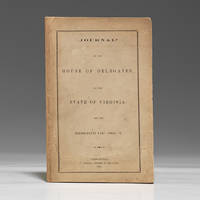
1865ref. 1260191865. First Edition. CONSTITUTION. Journal of the House of Delegates of the State of Virginia. for the Session of 1864Ñ5. Alexandria: D. Turner 1865. Octavo original front printed wrapper respined renewed rear wrapper original string stitching; pp. 1-3 4-83 1. Housed in a custom chemise and clamshell box. $4500.First edition one of 500 copies of the momentous Journal featuring its February 9 1865 entry on the Alexandria Virginia government's passage of the 13th Amendment mere days after the U.S. Congress the first of the four Unionist southern states to pass the Amendment also featuring the governor's Message noting: ""though we have in inherited from our fathers of the revolution the blessings of a great nation yet they also left to us an inheritance of African slavery which has proved a bitter dreg in our cup of freedom"" a vital record of forces for constitutional change near the end of the Civil War.Soon after the 1860 election amidst southern secession ""the great questions of union or disunion war or peace hung in the balance. Probably the crucial weight on the scale was VirginiaÉ as long as the federal government did not seek to coerce the states Virginia secessionists were unable to achieve a majority. When Lincoln responded with force to the attack on Fort Sumter however the vote in Virginia went in favor of secession."" Subsequently a Virginia convention ""met in Wheeling on May 13 1861É it elected as Governor Francis Pierpont a western Virginian and ardent Unionist and arranged for the creation of a legislature to replace the body sitting in RichmondÉ in July 1861 the new legislature met at the 'Restored Virginia' capital of Wheeling in a special session called by Pierpont."" Against its ""claim to represent a majority of Virginians"" a new state of West Virginia was created in 1863 and Pierpont's government moved to Alexandria to govern areas of Virginia under Union occupation Harrison Lawfulness of the Reconstruction Amendments 380-83.Scholars observe that the 13th Amendment its fellow amendments and Reconstruction as ""both a political process made possible by military successes and constitutional thought grew from wartime as well as post-Appomattox developments"" Hyman and Wiecek Equal Justice 247. This rare first edition of Journal of the House of Delegates substantiates that in documenting passage of the 13th Amendment by Pierpont's Virginia government mere days after the U.S. Congress passed the Amendment on January 31 1865. With that Virginia became the first of the four Unionist southern states that ratified the 13th Amendment. Of those Louisiana followed on February 17 with Arkansas and Tennessee that April. The 13th Amendment is the focus of the Journal's entry for February 9 1865 which states: ""Mr. Brownley called up Senate bill No. 12 entitled 'An Act to ratify the joint resolution of Congress passed January 31 1865 proposing an amendment to the Constitution of the United States.' The bill was read the first and second timeÉ and the rules were suspended and the bill read the third timeÉ and the bill passed."" Also notable herein is the complete printing of Governor Pierpont's opening Message where he notes: ""though we inherited from our fathers of the revolution the blessings of a great nation yet they also left to us an inheritance of African slavery which has proved a bitter dreg in our cup of freedom."" He speaks at length of the rights due people of color and the abolition of laws such as those that prohibit ""negro testimony"" or proscribe a ""different punishmentÉ for persons of African dissent"" from that of ""white persons.""""The legislature met for its second session on December 5 1864É The governor's message was a long and important document and indicated the changes of opinion that the war was bringing about. Pierpont gave his views upon the all-important negro question. He congratulated the constitutional convention which had met in the spring on the abolition of slavery in Virginia and advocated sweeping changes in the laws concerning negroes. The act prescribing different punishments for blacks should he said be altered in accordance with the amended constitution as well as the law for apprenticing them. The law prohibiting the education of negroes should be abolishedÉ His language was on the whole very moderate. He advised the legalizing of the marital relations of negroes and most important the establishment of public schoolsÉ Notwithstanding the governor's advice no acts of great importance passed the legislatureÉ On February 9 1865 the assembly ratified the 13th Amendment to the Constitution of the United States. It adjourned on March 7"" Eckenrode Political History of Virginia During the Reconstruction. Faint ""U.N.C. Duplicate"" stamp to front wrapper.Text fine; just a bit of faint soiling and a tide line to fragile front wrapper. An excellent copy of this elusive item. unknown
1834ref. 1215671834. First Edition. DORR Thomas Wilson. An Address to the People of Rhode-Island From the Convention Assembled at Providence on the 22nd Day of February and Again on the 12th Day of March 1834 to Promote the Establishment of a State Constitution. Providence: Cranston & Hammond 1834. Octavo period-style half diced calf gilt marbled boards pp. i-v 6-60. $2400.First edition of Dorr's foundational Address prompting his role as instigator and leader of the Dorr Rebellion placing him ""in the front rank of the political reformers of Jacksonian America.ÓBorn into privilege Rhode Island's Thomas Dorr became ""a political insurrectionaryÉ who hastened the demise of the royal charter of 1663 and the adoption of a written constitution"" Wiecek Peculiar Conservatism 242. Following the American Revolution by the 1820s Rhode Island remained the only state that clung to its colonial charter which ""restricted suffrage to white men who possessed real estate valued at a minimum of $134"" Chaput Proslavery and Antislavey Politics 662-63. It had ""evolved from the most to the least democratic state"" Lemons Rhode Island's Ten Turning Points 62. ""Dorr's political goalsÑ'free suffrage' with no discrimination against the foreign-born 'one-man one-vote' an independent judiciary a more powerful and dynamic executive the secret ballotÑthough not permanently achieved in Rhode Island during his lifetime placed him in the front rank of the political reformers of Jacksonian America"" ANB.In 1834 Dorr ""asked the General Assembly to call a convention to revise the state constitution in favor of taxpayer-militia suffrage and to adoptÉ 'equal representation'"" Wiecek 242. In this major Address delivered at that convention and ""composed primarily by Dorr"" Conley Democracy in Decline 255 he states: ""No form of a Constitution can be worth much ifÉ in this State the Legislative power isÉ in the hands of less than one third part of the qualified voters. A few political managersÉ rule the whole State as they please against the will of two thirds of the freeman and three fourths of the people"" emphasis in original."" To Dorr the state's ""strange adherence to the charter"" left Rhode Island with an ""inequality of representationÉ too unjust to be much longer tolerated."" In 1841 after Dorr was elected ""the People's governor"" under the state's ""People's Constitution"" he became the leader of the 1842 Dorr rebellion which historian Sean Wilentz calls ""'a striking and exceptional case in the history of American democratization before the Civil War' calling it no less than 'a deadly serious test of democracy's meaning and democracy's future.'"" The Dorr Rebellion increasingly viewed as the ""most significant political and constitutional event between the Age of Jackson and the election of LincolnÉDorr's constitutional understanding had roots not only in the Revolution and the post-Revolutionary era; it remained a vibrant part of American constitutionalism"" Chaput Rhode Island Question 55-56. Sabin 70537. American Imprints 26527. Text generally fresh with light scattered foxing. hardcover
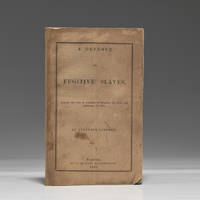
1850ref. 1229871850. First Edition. CONSTITUTION SPOONER Lysander. A Defence for Fugitive Slaves Against the Acts of Congress of February 12 1793 and September 18 1850. Boston: Bela Marsh 1850. Octavo original wrappers; pp. 1-2 3-4. i-iv 5 6-72. $3200.First edition of the rogue abolitionist's provocative call for ""vigorous"" public resistance to a pattern in the 1793 and 1850 Acts and court decisions such as Prigg v. Pennsylvania that demonstrated the government's refusal ""to champion liberty or justice"" especially elusive in original wrappers.The 1850 Fugitive Slave Act ""exposed the futility of antislavery constitutionalism grounded in a commitment to the 'proper rules of interpretation'"" Knowles Seeing the Light 544. It ""evinced a clear congressional policy favoring harsh and summary enforcement of the rendition policy over any solicitude for procedural or substantive rights of alleged fugitives"" Cover Justice Accused 121. Spooner crafted his answer to this in a ""devastating critique"" of both the 1793 and 1850 laws Smith Lysander Spooner. Defence one of his most elusive and provocative works offers ""significant evidence of the ways in which the passage of the 1850 Fugitive Slave Act shook his faith in the ability of the nation's courts to interpret the constitution in a manner consistent with the dictates of natural justice"" Knowles 546. Closely analyzing ""reasons why the 1793 and 1850 laws were unconstitutionalÉ he made it very clear why the passage of the 1850 law pushed him away from the 'quiet argument' of the courtroom to 'more vigorous'"" public action. In Defence while he continued to argue the importance of ""procedural objections to the lawsÉ Spooner spent far greater time 1 explaining why the courts would not actually strike down either of the laws and 2 outlining 'The Right of Resistance': ways in which 'The People' could respond to what he now recognized as the 'ugly reality' of proslavery constitutionalism."" He notably pointed to ""the 1842 decision in Prigg v. Pennsylvania in which the Supreme Court held that under the Constitution's Supremacy Clause the 1793 Fugitive Slave Act trumped Pennsylvania's personal liberty law which had made it far more difficultÉ for slaveholders to recover individuals they alleged were fugitive slavesÉ In the face of this judicial reality and to ensure the 'maintenance' of the Constitution Spooner encouraged popular resistance"" arguing the Second Amendment ""gave 'The People' an absolute and unqualified' Constitutional 'right' to do so."" By 1860 he would utterly lose ""faith in the ability or willingness of the government especially the courts to champion either liberty or justice"" Knowles 545 552. First edition: as issued with printing of 1793 Act of Congress and 1850 Fugitive Slave Act preceding title page; front and rear wrapper interior with publisher's advertisements. Sabin 89607. Work 335. Text very fresh a few minor stains to front wrapper expert repairs to wraps on the spine. Near-fine. paperback
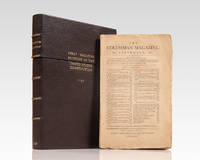
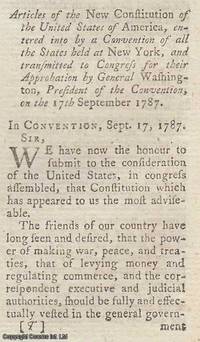
1787ref. 153385Philadelphia: Seddon Spotswood Cist and Trenchard 1787. Rare first periodical printing of the United States Constitution likely published within a week of its issuance as a broadside. Octavo disbound with a later string binding. The Constitution first appeared as a broadside followed quickly by its first newspaper appearance in The Pennsylvania Packet; later that same week it appeared in two magazines The Columbian Magazine and The American Museum and it remains unclear which of the two came first. The Columbian Magazine printed the Constitution in Philadelphia in 1787 on pages 659 to 665 under the title “The new plan for a Federal Government proposed by the Convention” together with the letter of George Washington transmitting the document from the Constitutional Convention to the Congress. In good condition with toning wear and chipping to the edges several leaves unopened including the Constitution leaves scattered soiling and foxing the meteorological table chipped at the left margin with some loss of text and the upper portion of the final leaf chipped away with loss not affecting the Constitution. Housed in a modern brown morocco pull-off case with chemise. Evans 20280. Mott A History of American Magazines I pp. 94-99. With the meteorological table and one of two plates lacking the View of the Natural Bridge in the State of Virginia. A rare and fragile survival of one of the earliest printings of the founding document of the United States. The Columbian Magazine published in Philadelphia from 1786 was among the earliest and most ambitious American monthly magazines mixing essays literature history and engraved plates. Its 1787 number carries one of the first printings of the United States Constitution which the Constitutional Convention had signed on September 17 of that year accompanied by George Washington’s letter transmitting the document from the Convention to the Congress. In the weeks after the signing the Constitution was rushed into print as a broadside in newspapers and in the new monthly magazines carrying the text to a public that would spend the following year debating and ratifying it and making these earliest appearances landmarks in the founding of the United States. Seddon, Spotswood, Cist, and Trenchard unknown
ref. 78868Very Good. Essays and addresses on constitution law and Pakistan legal system Publication unknown
2010ref. x-0230250343Palgrave Macmillan 2010. Hardcover. New. 330 pages. 8.75x5.75x1.00 inches. Palgrave Macmillan hardcover
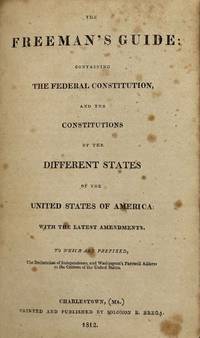
1812ref. 68721Charlestown Ms: Solomon B. Brega 1812. 18.5 cm. 294pp. Full leather rubbed gilt stamped leather spine label. Front joint cracked scattered foxing. Contains what is probably the earliest anthologized printing of the first Louisiana state constitution drafted in 1812. Very good. American Imprints 25460. Previous ownership signature of Moses Williams on front endpaper. Solomon B. Brega unknown
1809ref. 727231809. London: J. Blacklock and J. Luffman c.1809. London: J. Blacklock and J. Luffman c.1809. "Absolute Necessity of a Reform in Parliament" Great Britain. A True Friend to the Constitution And Nothing But the Constitution. Reform in Parliament. An Address to the People of England On the Absolute Necessity of a Reform in Parliament To Which are Annexed Complete Copies of the Magna Charta And the Bill of Rights with Explanatory Notes. London: Printed for J. Blacklock and J. Luffman c.1809. ii 64 pp. Octavo 8" x 4-3/4". Recent marbled boards printed paper spine label speckled edges endpapers renewed. Light toning to interior moderate soiling to title page a few creases to final leaf. $750. Only edition. After the Duke of York scandal in 1809 which involved the sale of military commissions through his mistress Mary Anne Clarke interest in Parliamentary reform surged. Our work draws particular attention to the constitutional aspects of the issue making frequent reference to particular contemporary scandals and their relationships to the appended Magna Carta and Bill of Rights. OCLC locates 8 copies 5 in North America Newberry Princeton Bowdoin Queens University McMaster. unknown
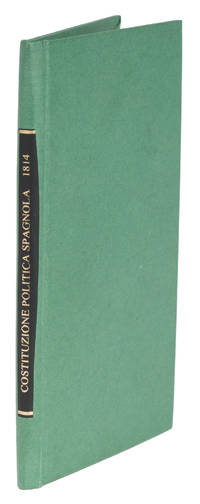
1814ref. 728671814. Piacenza: Dai Tipi d'Ignazio Orcesi 1814. Piacenza: Dai Tipi d'Ignazio Orcesi 1814. Rare Printing of the Short-Lived but Influential Constitution of 1812 Spain. Constitution. Costituzione Politica della Monarchia Spagnuola Promulgata in Cadice il 19 Marzo 1812. Piacenza: Dai Tipi d'Ignazio Orcesi 1814. 72 pp. Octavo 6" x 4". Stab-stitched pamphlet bound into recent paper-covered boards lettering piece to spine. Moderate toning negligible faint dampstaining to head of text block and upper outside corners in a few places. $650. Very rare Piacenza printing based on the translation that had appeared in Milan in the same year of the short-lived but influential Spanish constitution of 1812 one of the first attempts to construct a codified constitutional monarchy which applied not only to Spain but to the Spanish holdings in South America and the Philippines and gave Spanish citizenship to the natives of any territory that belonged to the Spanish monarchy but not necessarily those of African descent who could acquire citizenship through naturalization. This constitution was driven by the need to give legitimacy to the newly installed Joseph Bonaparte as king. Although it was repealed shortly after the restoration in 1814 of Ferdinand VII its influence was widespread. It was the model for the constitutions of Norway in 1814 and Mexico in 1824. A number of Italian printings appeared in several varying translations between 1812 and 1814. Our Piacenza printing is one of the rarest. OCLC locates 1 copy University of Turin Italy. unknown
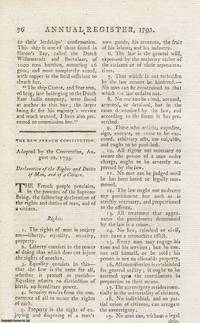
1787ref. 358416Annual Register London 1787. Softcover Booklet - Unbound Pages. Very Good Condition. 11 pages. An authentic standalone article extracted from a larger volume. Not a reprint or reproduction but an original work in its own right. Preserved in a modern card cover prepared for practicality - an unassuming but serviceable presentation that favours function over finery. Size: 13 x 20 cms. Category: Annual Register; Printed before 1800; This item may require more postage than the rates shown for delivery outside the UK. If extra postage is required we will contact you before processing your order and you will be given the details and option to decline the extra cost. Annual Register paperback
1795ref. 358514Annual Register London 1795. Softcover Booklet - Unbound Pages. Very Good Condition. 29 pages. An authentic standalone article extracted from a larger volume. Not a reprint or reproduction but an original work in its own right. Preserved in a modern card cover prepared for practicality - an unassuming but serviceable presentation that favours function over finery. Size: 13 x 20 cms. Category: Annual Register; Printed before 1800; This item may require more postage than the rates shown for delivery outside the UK. If extra postage is required we will contact you before processing your order and you will be given the details and option to decline the extra cost. Annual Register paperback