1,311 results
2006ref. 76533Washington DC: U. S. Government Printing Office 2006. Presumed First Edition First printing. Wraps. Good. Serial No. 109-79. Two volumes. Volume I v 1 1684 6 pages Volume II v 1 1685-3375 pages. During this hearing Representative John Lewis of Georgia stated "The Voting Rights Act helped expand our democracy and open up our democracy to elect hundreds of thousands and millions of our citizens who had been kept out let them in. The Voting Rights Act was needed then and it is needed now. The purpose of section 5 is very unique and very important. It prevents discriminatory plans from being enacted in the first place. It put the burden on the judiciary to show that the plan does not discriminate against minority voters. Congress Lewis continued "Prior to section 5 the burden was on the minority voters to challenge the voting practice; and every section was good at coming up with different procedures that had the same result discrimination. Anita Earls' testimony talks in some detail about the recent example how this is still happening. The difference is that we have section 5 to prevent these practices from harming minority voters. Many people like the court said that we have come a long ways; and again today I would say that we've come a distance. We've come a long way and that is true. We're not the same Nation that we were 40 years ago but it's clear today that we have not come far enough. Section 5 is still needed. Today section 5 prevents discrimination and redistricting and changes that move voting locations out of minority neighborhoods into less accessible areas. These are issues that are different from the fight to register to vote but they are no less fundamental." U. S. Government Printing Office paperback
2006ref. 76535Washington DC: U. S. Government Printing Office 2006. Presumed First Edition First printing. Wraps. Good. Serial No. 109-83. Part I ONLY. Volume I iv 1446 22 pages. This Committee will focus on section 203 the provision authorizing bilingual language assistance to American citizens who are members of covered language minority groups and who have limited English proficiency. Section 203 has not been revisited by Congress since 1992 and like the sections that we have discussed in previous hearings is set to expire in 2007 unless reauthorized. The Voting Rights Act was enacted in 1965 in response to a history of racial discrimination against some of our Nation's citizens. In 1975 Congress expanded the Voting Rights Act to include section 203 and its companion section 4f. Section 203 requires certain jurisdictions to provide bilingual election assistance-including notices instructions information and ballots-to citizens who are members of a designated language minority group and who have limited English proficiency. As cited in the 1975 House Report section 203 was added in response to ''an extensive evidentiary record demonstrating the prevalence of voting discrimination and high illiteracy rates among language minorities.'' This record revealed that similar discrimination patterns and practices that had been used to prevent African-Americans from voting were being administered against Asian-Americans American Indians Native Alaskans and citizens of Hispanic origin. These citizens are more than likely to live in environments in which the dominant language is other than English. Section 203 breaks down these barriers by providing citizens in a language minority group with the assistance necessary to participate in the political process. Section 203 has enabled an increased number of minority citizens to register and cast ballots as revealed in the last Census and latest election records. U. S. Government Printing Office paperback
2006ref. 76538Washington DC: U. S. Government Printing Office 2006. Presumed First Edition First printing. Wraps. Good. Serial No. 109-103. Volume IV ONLY. Volume IV v 1 4297-5711 3 pages. Footnotes. Illustrations. This volume contains the Appendix to Hearings: Table of Contents and Appendix Materials Continued from the National Commission on the Voting Rights Act. The Subcommittee will be holding its tenth hearing examining the Voting Rights Act of 1965 and the temporary provisions that are to expire. They're set to expire in 2007 unless we reauthorize by Congress which I think most of us anticipate will occur. The Subcommittee examined each of the expiring provisions in great detail. This afternoon we examine the evidence of continued discrimination against racial and language minority citizens since 1982 that have been compiled by a number of non-governmental organizations who will be testifying. I'd thank these organizations for completing these reports and in making sure that this Committee has before it a complete and accurate record of discrimination over the last 25 years. In continuing to reauthorize the temporary provisions Congress on four separate occasions examined the extent to which discrimination continued to exist by analyzing information such as enforcement statistics minority voter registration rates minority voter turnout and litigation pursued to protect minority voting rights. Federal agencies such as the United States Commission on Civil Rights were instrumental in investigating analyzing and reporting back to Congress on the state of minority voting during each consideration. Each time Congress concluded based upon the evidence presented that the exceptional conditions which existed in 1966 continued to exist in 1970 1975 1982 and in 1992 when it was last reauthorized. This afternoon the Committee continues to examine whether the exceptional conditions warranting the extension of the temporary provisions continue to exist in 2006. U. S. Government Printing Office paperback
2006ref. 76619Washington DC: U. S. Government Printing Office 2006. Presumed First Edition First printing. Wraps. Good. Serial No. 109-103. 3 of 4 volume set. Volume I v 1 1453 5 pages. Volume II v 1. 1455-2388 2. Volume III v 1 2389-4296. Volume IV NOT PRESENT. Footnotes. Illustrations. The Subcommittee will be holding its tenth hearing examining the Voting Rights Act of 1965 and the temporary provisions that are to expire. They're set to expire in 2007 unless we reauthorize by Congress which I think most of us anticipate will occur. The Subcommittee examined each of the expiring provisions in great detail. This afternoon we examine the evidence of continued discrimination against racial and language minority citizens since 1982 that have been compiled by a number of non-governmental organizations who will be testifying. I'd thank these organizations for the time and effort that they have put into completing these reports and in making sure that this Committee and Congress has before it a complete and accurate record of discrimination over the last 25 years. In continuing to reauthorize the temporary provisions Congress on four separate occasions examined the extent to which discrimination continued to exist by analyzing information such as enforcement statistics minority voter registration rates minority voter turnout and litigation pursued to protect minority voting rights. Federal agencies such as the United States Commission on Civil Rights were instrumental in investigating analyzing and reporting back to Congress on the state of minority voting during each consideration. Each time Congress concluded based upon the evidence presented that the exceptional conditions which existed in 1966 continued to exist in 1970 1975 1982 and in 1992 when it was last reauthorized. This afternoon the Committee continues to examine whether the exceptional conditions warranting the extension of the temporary provisions continue to exist in 2006. U. S. Government Printing Office paperback
2006ref. 76448Washington DC: U. S. Government Printing Office 2006. Presumed First Edition First printing. Wraps. Good. iii 1 302. 6 pages. Illustrations. Occasional footnotes. Some bottom corners curved at front and back. The chairman stated: Today we will examine the impact that Federal examiners and observers have had on increasing minority participation in the political process and the continued need for these provisions in the future. The Voting Rights Act of 1965 is a landmark piece of federal legislation in the United States that prohibits racial discrimination in voting.78 It was signed into law by President Lyndon B. Johnson during the height of the Civil Rights Movement on August 6 1965 and Congress later amended the Act five times to expand its protections.7 Designed to enforce the voting rights guaranteed by the Fourteenth and Fifteenth Amendments to the United States Constitution the Act secured the right to vote for racial minorities throughout the country especially in the South. According to the U.S. Department of Justice the Act is considered to be the most effective piece of federal civil rights legislation ever enacted in the country. U. S. Government Printing Office paperback
2006ref. 63994Washington DC: U.S. Government Printing Office 2006. Presumed first edition/first printing. Wraps. Good. No dust jacket as issued. Volume II ONLY. iii 1155-2307 p. Serial No. 109-84 Volume II. This volume includes affidavits from women who have had abortions inserted by Congressman Franks. These were compiled by The Justice Foundation. Also included is "Confession of an Ex-Abortionish by Dr. Bernard Nathanson; a statement by Nancy Keenan President of NARAL; and A statement submitted by Vicki Saporta of the National Abortion Federation. U.S. Government Printing Office paperback
2000ref. 62807Washington DC: U.S. Government Printing Office 2000. Presumed first edition/first printing. Wraps. Good. No dust jacket as issued. Cover has some wear and soiling. iv 90 p. Serial No. 120. H.R. 4292 was part of the late-term abortion debate. U.S. Government Printing Office paperback
ref. 14065Without date or place. Published in Blackwood's Magazine Edinburgh and London April 1826. 3pp. 8vo. Bifolium. Very good on lightly-aged paper. Unsigned but certainly in Croly's hand. The first page is headed: '- for tho' the Old Law was established in the promises of temporal prosperity yet the gospel is founded in temporal adversity'. The three extracts fiercely critical of the French emperor follow over a total of 61 lines with a few minor emendations. The differences from the published text are minor 'suitably and piously' for 'piously & suitably'; 'by even' for 'even by'The first extract of 24 lines present on p.456 in the published version begins: 'On the 24th. of October 1812 the French rear-guard left Moscow a day since piously & suitably commemorated by the Emperor's laying the first ston of a magnificent church dedicated to the "Redeemer'. The second extract of 23 lines preceding the first on p.456 of the published version begins: 'On the 14th. of September the advanced guard entered Moscow but Napoleon had scarcely reached the Kremlin when he saw the city in a blaze.' The last extract of 14 lines on pp.449-450 of the published version begins: 'In 1804 Napoleon was crowned Emperor of France. His first act was to dip his sceptre in blood.' Without date or place. [Published in Blackwood's Magazine (Edinburgh and London, April 1826).] unknown
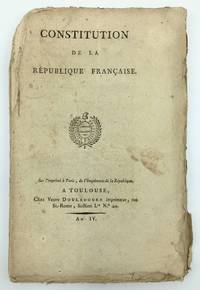
1795ref. 1507Toulouse: Douladoure. An. IV. 1795. Octavo. Stitched without wrappers likely as issued. Page edges untrimmed. Woodcut device emblematic of the French Republic to the title page. 62pp. A good copy with nibbling/loss to the top left-hand corner not affecting the text and a few minor marks to the title page and rear blank verso. The contents remain clean and in very good order. A scarce provincial printing of the Constitution of the Year III Constitution de l'an III the constitution of the French First Republic which established the Directory regime following the fall of Robespierre. Adopted by the convention on 5 Fructidor Year III 22nd August 1795 and approved by plebiscite on 6th September its preamble formed the Declaration of the Rights and Duties of Man and of the Citizen of 1789. Largely the work of political theorist Pierre Daunou it established a bicameral legislature made all taxpaying French males over 25 eligible to vote in primary elections enfranchising around one million more citizens than the 1791 Constitution and contained an explicit ban on slavery. It remained in effect until the coup of 18 Brumaire 9th November 1799 which effectively ended the Revolutionary period and began the rise to power of Napoleon Bonaparte. A pleasing unsophisticated copy remaining in the same form as it would have been when it reached the hands of ordinary Frenchmen in year that it was issued. Toulouse: Douladoure. unknown
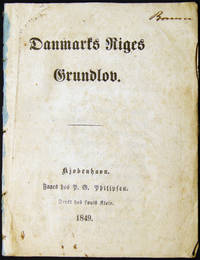
1849ref. 029756Kjøbenhavn Denmark: Faaes hos P.G. Philipsen Trykt Hos Louis Klein 1849. 31 pages; the 1849 Constitution text in Danish; previous owner name on title page top right. Approx. 3 1/2" x 4 3/4" size; sewn softcovers lacks outer wrappers. Some edge tips wear & age-soiling; in good condition. . Ephemera. Soft Cover. Good. Faaes hos P.G. Philipsen Trykt Hos Louis Klein paperback
ref. 0844405604.Gpaperback. Good. Access codes and supplements are not guaranteed with used items. May be an ex-library book. paperback
ref. 19807Temple London . 21 May 1867. 2pp. 12mo. With mourning border. In good condition lightly aged. When Twiss 'suggested the circumstance' Sir R. Palmer 'had some doubts about the United States Courts having limited the criminal consequences of violating neutrality to the cruise last word underlined'. There was also 'some doubt about the effect of a sale by a <> of a Prize Court to a third party. Twiss thinks 'it might be desirable to print & circulate the enclosed observations bearing upon those two points'. Temple [ London ]. 21 May 1867. unknown
ref. 1378073223.Gpaperback. Good. Access codes and supplements are not guaranteed with used items. May be an ex-library book. paperback
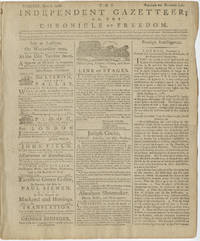
1788ref. 30007.003Philadelphia PA 1788. No binding. Fine. Independent Gazetteer; or The Chronicle of Freedom. Newspaper. Independent Gazetteer; or The Chronicle of Freedom Philadelphia Pa. May 6 1788. 4 pp. 9 1/2 x 11 1/2 in. The Maryland ratifying convention suggests some amendments along with their approval of the Constitution. ExcerptsFrom page 3:""From the MARYLAND GAZETTE or April 29 1788. The CONVENTION of this state on Saturday last determined to ratify the proposed plan of Federal Government. -YEAS 63 NAYS 11-And then appointed a committee of thirteen members to consider and report amendments to be recommended to the people. -The following amendments were proposed by a member and referred to the committee who are now sitting-And it is hoped that the great and essential rights of the people will be declared and secured.- PROPOSED AMENDMENTS.Wherefore whenever the ends of Government are perverted and public liberty manifestedly endangered and all other means of redress are ineffectual the people may and of right ought to object to reform the old or establish a new Government-that the doctrine of nonresistance against arbitrary power and oppression is absurd slavish and destructive of the good and happiness of mankind. All imposts and duties laid by Congress shall be placed to the credit of the state in which the same be collected. That there shall be no national religion established by law; but that all persons be equally entitled to protection in their religious liberty. That the Supreme Federal Courts shall not admit to fictions to extend its jurisdiction; nor shall citizens of the same state having controversies with each other be suffered to make collusive assignments of their rights to the citizens of another state for the purpose of defeating the jurisdiction of the State Courts; nor shall any matter or question already determined in the State Courts be revived or agitated in the Federal Courts. That Congress have no power to lay a Poll-Tax. That the people have a right to freedom of speech of writing and publishing their sentiments and therefore that the freedom of the PRESS ought not to be restrained and the printing presses ought to be free to examine the proceedings of Government and the conduct of its officers.""From page 2: Protesting the Slave Trade by Boycotting West Indian Produce""A CAUTION.WHEREAS in the year 1787 some vessels were fitted out at the port of Philadelphia for the iniquitous purpose of stealing the inhabitants of Africa from all the endearments of domestic life; one of which vessels has succeeded in obtaining a number of poor blacks and has taken the to a port in the West Indies where they are under the iron hand of oppression. From this shameful traffic this horrid source the proprietors of the vessel have purchased some West India produce which after landing at Wilmington they have brought up to this city and offered for sale. It is a grateful circumstance to the supporters of the common rights of mankind that the virtuous inhabitants of the city reprobate the horrid idea.-A correspondent hopes that the citizens will further testify their disapprobation of the practice by turning with indignation from the purchase of any property thus basely procured by men so lost to the common feelings of humanity; notwithstanding the patriotic convention at which Washington presided have declared that this abominable traffic shall be continued for TWENTY years by the people of America.From page 1:An advertisement with engraving for a ""Line of Stages"" between Philadelphia and New York started by four partners who split off from an established stage line and promising better service. From page 4:An advertisement for another different ""New Line of Stages."" And a report on the creation of a Philadelphia committee for the relief of the nearly 100 Americans captured by Algerian corsairs and Barbary pirates. unknown
1997ref. 2090202120410871Kenseikinenkan 1997. Soft Cover. Fine. Number of books: 1 Kenseikinenkan paperback
2004ref. 2090202118104831Iwanami Shoten Iwanami Shinsho 2004. Soft Cover. Fine. The book is in fine condition. Iwanami Shoten Iwanami Shinsho paperback
2003ref. 2090202118106027Iwanami Shoten Iwanami Shinsho 2003. Soft Cover. Fine. The book is in fine condition. Iwanami Shoten Iwanami Shinsho paperback
1960ref. 2090502113715215Not Available 1960. Soft Cover. Fine. The book is in fine condition. Not Available paperback
1990ref. 2090502113702484Not Available 1990. Soft Cover. Fine. The book is in fine condition. Not Available paperback
1996ref. 2090502113707457Not Available 1996. Soft Cover. Fine. The book is in fine condition. Not Available paperback
1967ref. 2090502113711536Not Available 1967. Soft Cover. Fine. The book is in fine condition. Not Available paperback
2006ref. 2090502113717137Not Available 2006. Soft Cover. Fine. The book is in fine condition. Not Available paperback
1979ref. 2090502113715385Not Available 1979. Soft Cover. Fine. The book is in fine condition. Not Available paperback
2006ref. 2090502113717135Not Available 2006. Soft Cover. Fine. The book is in fine condition. Not Available paperback
1962ref. 2083002116411747Yushindo 1962. Soft Cover. Fine. The book is in fine condition. Yushindo paperback