1,230 results
ref. 12036377-6USS Constitution Museum. Used - Good. Former library copy. Pages intact with minimal writing/highlighting. The binding may be loose and creased. Dust jackets/supplements are not included. Includes library markings. Stock photo provided. Product includes identifying sticker. Better World Books: Buy Books. Do Good. USS Constitution Museum unknown
ref. 78868Very Good. Essays and addresses on constitution law and Pakistan legal system Publication unknown
ref. 1-1432817035Thomson Gale 1861. Paperback. New. 158 pages. 8.00x5.25x0.39 inches. Thomson Gale paperback
1949ref. ZB1089960NY 1949-1951. 2 volumes 672 679 pp. each ex library in card covers; good. - If you are reading this this item is actually physically in our stock and ready for shipment once ordered. We are not bookjackers. Buyer is responsible for any additional duties taxes or fees required by recipient's country. Photos available upon request. NY unknown
1976ref. 11992Madrid: Aguilar Ed. 1976.- 374 p.: 28 ilus.; 16avo.; Plena Piel Ed.- Crisolín. 039. GUERRA DE LA INDEPENDENCIA-FERNANDO VII Libro en español Aguilar Ed. hardcover
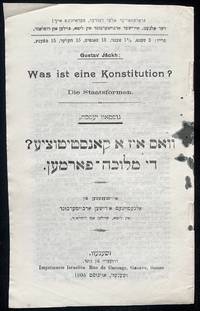
1905ref. 43542Zhenev Geneva: Imprimerie Israelite Rue de Carouge 1905. First Yiddish Edition. Original paper wrappers small 8vo 27 pages. In Yiddish. The title translates as "What is a Constitution Forms of Govenment." Printed on thin paper as was often used for Bundist publications from Geneva which were intended for legal and illegal distribution in Bundist strongholds across Europe and the Americas. Bundist pamphlet on constitutions by Gustav Jaeckh the well known historian and critical theorist who wrote one of the first historical chronicles of the First International. Published by the Bund in during the 1905 Russian Revolution during which it was a dominant revolutionary force and "the largest socialist group in the Russian Empire" Mendes Philip. The Rise and Fall of the Jewish Labor Bund jewishcurrents.org November 30 2013. OCLC: 122856344. OCLC locates only 3 copies worldwide HUC YIVO Institute for Social History only 2 in the US. Creasing/crinkling to thin paper a few stains no tears Very Good Condition thus. PSB-1-24-XX. Zhenev [Geneva]: Imprimerie Israelite Rue de Carouge unknown
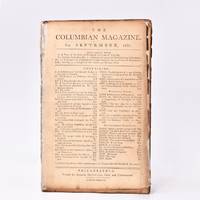
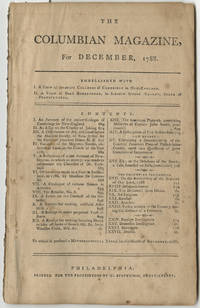
1787ref. 365066Philadelphia: Seddon Spotswood Cist and Trenchard 1787. 3 618-674. Without 2 plates. 8vo. Disbound fire damage at edges leaves detached. 3 618-674. Without 2 plates. 8vo. Along with a printing in the American Magazine among the earliest printings of the Constitution in a periodical. "One of the best of the eighteenth century magazines was the Columbian of Philadelphia. Considered from beginning to end the Columbian Magazine with its sequel the Universal Asylum affords an extremely valuable treasury of materials which reflect its own times and the war years immediately preceding. it was the handsomest American magazine of its century" Mott. Seddon, Spotswood, Cist and Trenchard unknown
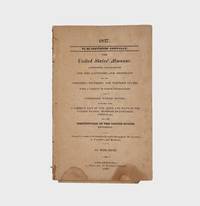
1827ref. 374087Philadelphia: R. Desilver 1827. Typeset frontispiece within typographic border approx. 15x18-1/2 inches detached from the accompanying almanac. 67 1pp. 8vo. Disbound. Old folds tear to gutter. Typeset frontispiece within typographic border approx. 15x18-1/2 inches detached from the accompanying almanac. 67 1pp. 8vo. Shaw & Shoemaker 27484; Drake 11567 R. Desilver unknown
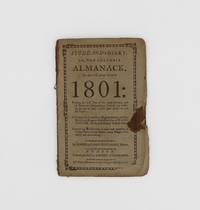
1800ref. 374113Hudson: Printed and sold by Ashbel Stoddard 1800. 36pp. Some interleaving with contemporary manuscript annotations recording weather deaths etc. 12mo. Stitched final leaf trimmed close with minor loss to final line on H2r staining and chipping at fore-edge other minor chips and tears. 36pp. Some interleaving with contemporary manuscript annotations recording weather deaths etc. 12mo. With a printing of the U.S. Constitution and the Bill of Rights on the final 12 pages. This almanac calculated by Beers Hutchins died in 1782. Evans 37670; ESTC W33544; Drake 6126 Printed and sold by Ashbel Stoddard unknown
1847ref. 1239761847. First Edition. CONSTITUTION PHILLIPS Wendell. Review of Lysander Spooner's Essay on the Unconstitutionality of Slavery. Reprinted from the ""Anti-Slavery Standard"" With Additions. Boston: Andrews & Prentiss 1847. Octavo modern half calf gilt marbled boards; pp. 1-3 4-95 1. $1600.First edition in book form of Phillips' bold and influential antebellum work on the U.S. Constitution and the question of slavery revised and ""with additions"" to its serialization in the Anti-Slavery Standard.Controversy over slavery ""was the most important single influence on American constitutional development before the Civil War"" Wiecek Sources 15. Leaders in that controversy were William Lloyd Garrison Wendell Phillips and Lysander Spooner. As an anti-constitutionalist Phillips deemed ""Prophet of Liberty Champion of the Slave"" made his ""first public pronouncement that the Constitution should be abandoned"" when in 1842 he asserted the ""'spirit of liberty' is 'chained down in the iron links of the United States Constitution'"" and subsequently argued the Constitution was a ""'compromise' between freedom and slavery"" Knowles Securing the 'Blessings'"" 41. Phillips' 1844 work Constitution: A Pro-Slavery Compact prompted Spooner to author Unconstitutionality of Slavery First Part: 1845 Second Part: 1847 arguing it was instead slavery that was unconstitutional not the founding document. Phillips quickly countered with this Review.""Phillips insisted the only path to justice 'is over the Constitution trampling it under foot'. and raised pertinent questions about the processes of constitutionalism. Must a just person reject an imperfect constitution or even one that sanctioned and protected an evil like slavery to work effectively for constitutional reform and to abolish injustice Or was it possible to regard the constitution as an imperfect but amendable instrument the only thing available in the here and now of a heterogeneous secular society that can serve as a means of changing a society's goals and structuring"" Wiecek 246. To Phillips Spooner's approach essentially ""leaves every one to do 'what is right in his own eyes.'"" Spooner and Phillips also disagreed on remedies to immoral laws. ""Spooner did not consider an immoral contract binding"" and argued for example that judges rely instead on natural law for their decisions. Phillips felt that in such circumstances a judge should resign. In this Review Phillips also offers ""a new area in which antislavery and anarchy"" could be connected when he describes Spooner's ""antislavery constitutionalism as 'the first step toward anarchy'"" Perry Radical Abolitionism 165-66. First edition first printing. Serialized earlier the same year in the Anti-Slavery Standard the official weekly newspaper of the American Anti-Slavery Society which was co-founded by William Lloyd Garrison and Arthur Tappen. Sabin 62524. Dumond 93. Not in Blockson. Text fresh and about-fine. hardcover
1682ref. 1206631682. CONSTITUTION SOMERS John. The Security of English-Mens Lives Or the Trust Power and Duty of the Grand Jurys of England. London: Printed for Benj. Alsop 1682. Small octavo 4 by 6-1/2 inches 18th-century brown morocco raised bands marbled endpapers all edges gilt; pp. 1-2 3-168. $3400.1682 edition of Somers' profoundly influential work on the power of the grand jury the second of only two 17th-century editions issued the year after the first""one of the fundamental foundations of the common law in the American colonies""prompting revolution with Somers' invoking the grand jury and its protection of secrecy as key in opposing ""corrupt Ministers of State"" and those who ""abuse or oppress the People in the form and course of Justice"" seminal in the creation of the Constitution's Fifth Amendment with Jefferson calling grand juries ""the true tribunal of the people.""British statesman Baron John Somers' most famous and influential work is Grand Jurys. ""Of the legal scholars writing about the grand jury in the late 17th century Somers is not only representative but eminent having been read in both England and the colonies"" Kadish Behind the Locked Door 5-10. Grand Jurys is considered a seminal influence on Locke and America's Founding Fathers and it is ""likely that Locke knew Somers by the early 1680s The opposition of absolute monarchy to the security provided by 'impartial law' was structurally central to Locke's Second Treatise 1689 which attacked the threat to life liberty and property posed by a loss of 'impartial justice' Locke's arguments are a logical extension of the arguments that juries provided the only security of life"" Marshall John Locke 52. To Somers similarly the grand jury offers ""security"" from the ""Ill Designs of corrupt Minsters of State"" and those who ""dare to abuse or oppress the People."" Somers' Grand Jurys is ""a classic statement of political freedom. He works his way through a number of themes that will be frequently repeated by others."" Chief among these is his argument that ""the independent grand jury is the linchpin of the entire criminal justice system. It brings offenders to justice and protects the innocent from false accusation guaranteeing the traditional rights of Englishmen particularly their political rights in relation to the Crown and joins Parliament as a counterweight to the arbitrary power of the monarch and his judges"" Shapiro Beyond Reasonable Doubt 67. With its origins found deep within English legal history the grand jury was ""eulogized by Coke and Blackstone and crossed the Atlantic as one of the fundamental foundations of the common law in the American colonies"" Roots If It's Not a Runaway. ""Indeed there is an important sense in which the jury issue united not only America's revolutionary period and Founding era but also the 'settlement' years immediately following 1789"" Stimson Juries and American Revolutionary Jurisprudence 34-5.As American ""opposition to the British became more overt grand juries became more sympathetic to the colonists the famous case of John Peter Zenger is a prime example as two separate N.Y. grand juries refused to indict him for criminal libel. Further in 1765 a Boston grand jury refused to find an indictment against the leaders of the Stamp Act Riots"" Paule Perversion of the Historic Function 304. ""Perhaps the best known case of grand jury independence involved the twice-unsuccessful efforts to indict former Vice President Aaron Burr for attempting to involve the U.S. in a war with Spain Burr was finally indicted when a grand jury was convened in Virginia the stronghold of Burr's enemy Thomas Jefferson. Despite Jefferson's best efforts Burr was acquitted at trial in part because the judge gave such a narrow jury instruction and made evidentiary rulings so favorable to the defense that conviction was nearly impossible. The trial judge was John Marshall one of Jefferson's rivals"" Leopold Why Grand Juries 286.""The framers of the Constitution perceived the function of the grand jury as so essential to liberty that they specifically provided for it"" in the Fifth Amendment Paule 305. ""With its Grand Jury Clause insuring that 'no person shall be held to answer for a capital or otherwise infamous crime unless on a presentment or indictment of a Grand Jury' the Clause protected the people against arbitrary and overzealous government by protecting 'against hasty malicious and oppressive prosecution.' Secrecy in grand jury proceedings played a role in that protection."" For Somers in particular the secrecy requirement was absolute. In Grand Jurys he describes ""how grand jurors were sworn not to disclose the subjects of the inquiry the witnesses or any of the evidence. In addition grand jurors were sworn not to reveal their own personal knowledge the knowledge of their fellow jurors their investigative plans or their deliberations according to Somers secrecy made possible the discovery of truth and protected individuals from malicious or hateful prosecution. In sum neither the king the general public nor the individual accused could benefit by making public the proceedings of a grand jury. The Grand Jury Clause of the Fifth Amendment made grand jury secrecy an implicit part of American criminal procedure"" Kadish 5-16. ""In a petition to the General Assembly of the Commonwealth of Virginia Jefferson once termed the Anglo-Saxon tradition of trial by grand and petit jury 'the true tribunal of the people'"" Shannon Grand Jury 141. Jefferson owned and held two other works by Somers in his library. Preceded only by the 1681 first edition. Anonymously issued with Wing identifying Somers as author. Precedes the 1773 American edition. Pages 156-167 containing Latin and English text printed on opposite pages; final text page with ""Finis."" ESTC R10363. Wing S4643. Sweet & Maxwell I:378 34. See Sowerby 2015 2712. Early owner signature above title page.Text very fresh expert restoration to handsome binding. A very good copy. hardcover
1865ref. 1260191865. First Edition. CONSTITUTION. Journal of the House of Delegates of the State of Virginia. for the Session of 18645. Alexandria: D. Turner 1865. Octavo original front printed wrapper respined renewed rear wrapper original string stitching; pp. 1-3 4-83 1. Housed in a custom chemise and clamshell box. $4500.First edition one of 500 copies of the momentous Journal featuring its February 9 1865 entry on the Alexandria Virginia government's passage of the 13th Amendment mere days after the U.S. Congress the first of the four Unionist southern states to pass the Amendment also featuring the governor's Message noting: ""though we have in inherited from our fathers of the revolution the blessings of a great nation yet they also left to us an inheritance of African slavery which has proved a bitter dreg in our cup of freedom"" a vital record of forces for constitutional change near the end of the Civil War.Soon after the 1860 election amidst southern secession ""the great questions of union or disunion war or peace hung in the balance. Probably the crucial weight on the scale was Virginia as long as the federal government did not seek to coerce the states Virginia secessionists were unable to achieve a majority. When Lincoln responded with force to the attack on Fort Sumter however the vote in Virginia went in favor of secession."" Subsequently a Virginia convention ""met in Wheeling on May 13 1861 it elected as Governor Francis Pierpont a western Virginian and ardent Unionist and arranged for the creation of a legislature to replace the body sitting in Richmond in July 1861 the new legislature met at the 'Restored Virginia' capital of Wheeling in a special session called by Pierpont."" Against its ""claim to represent a majority of Virginians"" a new state of West Virginia was created in 1863 and Pierpont's government moved to Alexandria to govern areas of Virginia under Union occupation Harrison Lawfulness of the Reconstruction Amendments 380-83.Scholars observe that the 13th Amendment its fellow amendments and Reconstruction as ""both a political process made possible by military successes and constitutional thought grew from wartime as well as post-Appomattox developments"" Hyman and Wiecek Equal Justice 247. This rare first edition of Journal of the House of Delegates substantiates that in documenting passage of the 13th Amendment by Pierpont's Virginia government mere days after the U.S. Congress passed the Amendment on January 31 1865. With that Virginia became the first of the four Unionist southern states that ratified the 13th Amendment. Of those Louisiana followed on February 17 with Arkansas and Tennessee that April. The 13th Amendment is the focus of the Journal's entry for February 9 1865 which states: ""Mr. Brownley called up Senate bill No. 12 entitled 'An Act to ratify the joint resolution of Congress passed January 31 1865 proposing an amendment to the Constitution of the United States.' The bill was read the first and second time and the rules were suspended and the bill read the third time and the bill passed."" Also notable herein is the complete printing of Governor Pierpont's opening Message where he notes: ""though we inherited from our fathers of the revolution the blessings of a great nation yet they also left to us an inheritance of African slavery which has proved a bitter dreg in our cup of freedom."" He speaks at length of the rights due people of color and the abolition of laws such as those that prohibit ""negro testimony"" or proscribe a ""different punishment for persons of African dissent"" from that of ""white persons.""""The legislature met for its second session on December 5 1864 The governor's message was a long and important document and indicated the changes of opinion that the war was bringing about. Pierpont gave his views upon the all-important negro question. He congratulated the constitutional convention which had met in the spring on the abolition of slavery in Virginia and advocated sweeping changes in the laws concerning negroes. The act prescribing different punishments for blacks should he said be altered in accordance with the amended constitution as well as the law for apprenticing them. The law prohibiting the education of negroes should be abolished His language was on the whole very moderate. He advised the legalizing of the marital relations of negroes and most important the establishment of public schools Notwithstanding the governor's advice no acts of great importance passed the legislature On February 9 1865 the assembly ratified the 13th Amendment to the Constitution of the United States. It adjourned on March 7"" Eckenrode Political History of Virginia During the Reconstruction. Faint ""U.N.C. Duplicate"" stamp to front wrapper.Text fine; just a bit of faint soiling and a tide line to fragile front wrapper. An excellent copy of this elusive item. unknown
1834ref. 1215671834. First Edition. DORR Thomas Wilson. An Address to the People of Rhode-Island From the Convention Assembled at Providence on the 22nd Day of February and Again on the 12th Day of March 1834 to Promote the Establishment of a State Constitution. Providence: Cranston & Hammond 1834. Octavo period-style half diced calf gilt marbled boards pp. i-v 6-60. $2400.First edition of Dorr's foundational Address prompting his role as instigator and leader of the Dorr Rebellion placing him ""in the front rank of the political reformers of Jacksonian America.Born into privilege Rhode Island's Thomas Dorr became ""a political insurrectionary who hastened the demise of the royal charter of 1663 and the adoption of a written constitution"" Wiecek Peculiar Conservatism 242. Following the American Revolution by the 1820s Rhode Island remained the only state that clung to its colonial charter which ""restricted suffrage to white men who possessed real estate valued at a minimum of $134"" Chaput Proslavery and Antislavey Politics 662-63. It had ""evolved from the most to the least democratic state"" Lemons Rhode Island's Ten Turning Points 62. ""Dorr's political goals'free suffrage' with no discrimination against the foreign-born 'one-man one-vote' an independent judiciary a more powerful and dynamic executive the secret ballotthough not permanently achieved in Rhode Island during his lifetime placed him in the front rank of the political reformers of Jacksonian America"" ANB.In 1834 Dorr ""asked the General Assembly to call a convention to revise the state constitution in favor of taxpayer-militia suffrage and to adopt 'equal representation'"" Wiecek 242. In this major Address delivered at that convention and ""composed primarily by Dorr"" Conley Democracy in Decline 255 he states: ""No form of a Constitution can be worth much if in this State the Legislative power is in the hands of less than one third part of the qualified voters. A few political managers rule the whole State as they please against the will of two thirds of the freeman and three fourths of the people"" emphasis in original."" To Dorr the state's ""strange adherence to the charter"" left Rhode Island with an ""inequality of representation too unjust to be much longer tolerated."" In 1841 after Dorr was elected ""the People's governor"" under the state's ""People's Constitution"" he became the leader of the 1842 Dorr rebellion which historian Sean Wilentz calls ""'a striking and exceptional case in the history of American democratization before the Civil War' calling it no less than 'a deadly serious test of democracy's meaning and democracy's future.'"" The Dorr Rebellion increasingly viewed as the ""most significant political and constitutional event between the Age of Jackson and the election of Lincoln Dorr's constitutional understanding had roots not only in the Revolution and the post-Revolutionary era; it remained a vibrant part of American constitutionalism"" Chaput Rhode Island Question 55-56. Sabin 70537. American Imprints 26527. Text generally fresh with light scattered foxing. hardcover
1850ref. 1229871850. First Edition. CONSTITUTION SPOONER Lysander. A Defence for Fugitive Slaves Against the Acts of Congress of February 12 1793 and September 18 1850. Boston: Bela Marsh 1850. Octavo original wrappers; pp. 1-2 3-4. i-iv 5 6-72. $3200.First edition of the rogue abolitionist's provocative call for ""vigorous"" public resistance to a pattern in the 1793 and 1850 Acts and court decisions such as Prigg v. Pennsylvania that demonstrated the government's refusal ""to champion liberty or justice"" especially elusive in original wrappers.The 1850 Fugitive Slave Act ""exposed the futility of antislavery constitutionalism grounded in a commitment to the 'proper rules of interpretation'"" Knowles Seeing the Light 544. It ""evinced a clear congressional policy favoring harsh and summary enforcement of the rendition policy over any solicitude for procedural or substantive rights of alleged fugitives"" Cover Justice Accused 121. Spooner crafted his answer to this in a ""devastating critique"" of both the 1793 and 1850 laws Smith Lysander Spooner. Defence one of his most elusive and provocative works offers ""significant evidence of the ways in which the passage of the 1850 Fugitive Slave Act shook his faith in the ability of the nation's courts to interpret the constitution in a manner consistent with the dictates of natural justice"" Knowles 546. Closely analyzing ""reasons why the 1793 and 1850 laws were unconstitutional he made it very clear why the passage of the 1850 law pushed him away from the 'quiet argument' of the courtroom to 'more vigorous'"" public action. In Defence while he continued to argue the importance of ""procedural objections to the laws Spooner spent far greater time 1 explaining why the courts would not actually strike down either of the laws and 2 outlining 'The Right of Resistance': ways in which 'The People' could respond to what he now recognized as the 'ugly reality' of proslavery constitutionalism."" He notably pointed to ""the 1842 decision in Prigg v. Pennsylvania in which the Supreme Court held that under the Constitution's Supremacy Clause the 1793 Fugitive Slave Act trumped Pennsylvania's personal liberty law which had made it far more difficult for slaveholders to recover individuals they alleged were fugitive slaves In the face of this judicial reality and to ensure the 'maintenance' of the Constitution Spooner encouraged popular resistance"" arguing the Second Amendment ""gave 'The People' an absolute and unqualified' Constitutional 'right' to do so."" By 1860 he would utterly lose ""faith in the ability or willingness of the government especially the courts to champion either liberty or justice"" Knowles 545 552. First edition: as issued with printing of 1793 Act of Congress and 1850 Fugitive Slave Act preceding title page; front and rear wrapper interior with publisher's advertisements. Sabin 89607. Work 335. Text very fresh a few minor stains to front wrapper expert repairs to wraps on the spine. Near-fine. paperback
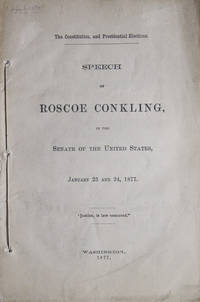
1877ref. 4062Washington 1877. 48 pp. 1 vols. 8vo. Original stitched wrappers. Minor soiling. Very Good. 48 pp. 1 vols. 8vo. Conkling was the senator from New York and in 1877 was the "favorite son" of New York for the Republican nomination in rivalry with James G. Blaine. As it turned out the nomination and the Presidency went to Rutherford B. Hayes. Conkling was bitterly opposed to Hayes and in this document questions the manner of vote counting by the House and Senate in regard to the election of the President. unknown
1926ref. 39748The S. J.Clarke Publishing Co. 1926. 1st Edition. Hardcover. Good ex-library set good except volume one has stiff clear plastic tape over the spine and a repaired frontispiece tear all have rear pastedown and/or end page pocket removal scrapes corner tips worn through the spine ends are worn edges worn in spots rubbing. A solid binding unmarked text. No dust jackets issued. Leather spines over green covers with gilt spine lettering marbled page edges. A very heavy oversize set additional postage may be required. ; Numerous plates.; 728 679 679 685 pages . The S. J.Clarke Publishing Co. hardcover
1788ref. 30007.048Philadelphia PA 1788. Softcover. Fine. The Columbian Magazine. Magazine. The Columbian Magazine Philadelphia Pa. December 1788. 52 pp. 5 x 8 in. Lacking plates. This title has the honor of being the first successful American magazine having begun in September 1786 and lasting until December 1792. Although many titles existed earlier none enjoyed the success of lasting beyond a few issues or a couple of years.Opens with five pages on ""An Account of the Ancient Colleges at Cambridge in New England."" that being Harvard University. pp. 669-673.A recipe for making artificial Asses milk p. 698.With ""The American Plutarch - Memoirs of Captain John Smith"" pp. 699-703 continued for a previous issue and concluded in the next.A section on ""American Intelligence"" pp. 715-718 with the latest news reports including an item from Edenton North Carolina:""a new convention be recommended for the purpose of reconsidering the new constitution held out by the federal convention as a government for the United States."" p. 716.With a ""List of Senators of the United States Already Chosen"" by state pp. 717-718.Also mention of the officers for the Masonic Lodge at Philadelphia p. 716. paperback
1881ref. 664891881. Concord NH 1881. Unrecorded. Concord NH 1881. Unrecorded. Are New Hampshire's U.S. Senators Serving Shorter Terms Than Their Fellow Senators Broadside. New Hampshire. U.S. Constitution. Opinion of the Supreme Court. To the Senate of New Hampshire Running Title. Concord NH June 10 1881. 18" x 9-1/2" broadside. Text in parallel columns. Light browning vertical and horizontal fold lines some with clean tears at edges. $350. This broadside records an opinion submitted to the U.S. Supreme Court. It states that New Hampshire's election schedule for state offices results in terms for New Hampshire's U.S. Senators that are three months shorter than those of other senators. It questions how to adjust the election cycle to guarantee 6-year terms to New Hampshire's senators which were then elected by the state senate. Signed in type by C. Doe Wm. L. Foster C.W. Stanley W.H.H. Allen Isaac W. Smith Leis W. Clark I.N. Blodgett. This appears to be an unrecorded broadside. OCLC locates 1 copy Library of Congress. unknown
ref. 45047841like new. unknown
ref. 45425509like new. unknown
1804ref. 42887London W. Bulmer and Co. 1804. 4to. No wrappers as extracted from "Philosophical Transactions" 1804 - Part II. Pp. 313-345. Clean and fine. First appearance of an importent paper in which Hatchett communicates his discovery that iron must be combined with a large portion of either carbon phosphorus or sulphur in order to acquire the property of receiving permanent magnetic virtue there being however a limit beyond which an excess of either of the above-named substances renders the compound wholly incapable of exhibiting the magnetic energy.Together with another paper by Patrick Russell: "Remarks on the voluntary Expansion of the Skin of the Neck in the Cobra de Capello or booded Snake of the East Indiea. With a Description of the Structure ofthe Parts which perform that Office. By Everard Home." Pp. 346-352 a. 2 large engraved plates showing the snake. unknown
1837ref. 42610London Richard and John E. Taylor 1837. 4to. No wrappers as extracted from "Philosophical Transactions" 1837 - Part II. Pp. 347-363. Clean and fine. First printing of Dalton's last paper submitted to the "Transactions". This paper one of his last deals with the constitution of the atmosphere just as his first love was meteorology."In an essay of mine on the constitution of the atmosphere which was printed in the Transactions for 1826 I signified my intention of following it with a sequel of experiments to ascertain if possible which of the two views therein developed was most counntenanced by facts. I now proceed to give an account of such investigations relating to this subject as havee engaged my attention during a long period of years."John Dalton. - Smith: John Dalton. A Bibliography. No. 78. unknown
1925ref. 48025Berlin Julius Springer 1925. Contemp. hcloth. Gilt lettering to spine. In: "Zeitschrift für Physik. Hrsg. von Karl Scheel" 32. Band. VI951 pp. textillustr. Entire volume offered. Heisenberg's paper: pp. 841-860. A small erased stamp on titlepage leaving two small holes no loss of text. Internally clean. First appearance of Heisenberg's importent paper on the complex spectra of many-electron atoms - the third paper Heisenberg submitted from Copenhagen on the Quantum Theory."The paper on multiplet structure and anomalous Zeeman effects. contained a complete discussion of the problem at that time. This paper had the blessing of Niels Bohr; also Pauli who wasin Copenhagen when the paper was completed agreed with its overall content. The central goal of the paper was to formulate what Bohr called 'the stress constraint which is not analogous to the action of external forces' and to derive quantitative conclusions from it." Mehra and rechenberg "The Historical development of Quantum Theory" vol. 2 p. 201.The volume contains another importent paper in the history of Quantum Physics: W. BOTHE und H. GEIGER "Über das Wesen des Comptoneffekts ein experimenteller Beitrag zur Theorie der Strahlung" pp. 639-663. hardcover
1925ref. 49362Berlin Julius Springer 1925. Contemp. hcloth. In: "Zeitschrift für Physik. Hrsg. von Karl Scheel" 32. Band. VI951 pp. textillustr. Entire volume offered. Heisenberg's paper: pp. 841-860. A stamp to title-page and front free endpaper. Interally clean. First printing of Heisenberg's importent paper on the complex spectra of many-electron atoms - the third paper Heisenberg submitted from Copenhagen on the Quantum Theory."The paper on multiplet structure and anomalous Zeeman effects. contained a complete discussion of the problem at that time. This paper had the blessing of Niels Bohr; also Pauli who was in Copenhagen when the paper was completed agreed with its overall content. The central goal of the paper was to formulate what Bohr called 'the stress constraint which is not analogous to the action of external forces' and to derive quantitative conclusions from it." Mehra and Rechenberg "The Historical development of Quantum Theory" vol. 2 p. 201.The volume contains another importent paper in the history of Quantum Physics: W. BOTHE und H. GEIGER "Über das Wesen des Comptoneffekts ein experimenteller Beitrag zur Theorie der Strahlung" pp. 639-663. hardcover
2005ref. G0160723795I3N00United States Government Printing Office 2005. Hardcover. Good. Disclaimer:A copy that has been read but remains in clean condition. All pages are intact and the cover is intact. The spine may show signs of wear. Pages can include limited notes and highlighting and the copy can include previous owner inscriptions. At ThriftBooks our motto is: Read More Spend Less.Dust jacket quality is not guaranteed. United States Government Printing Office hardcover