1311 risultati
rif. 201923Rouen, 1791 in-8, 44 pp., broché sous couverture d'attente. Légèrement défraîchie.
rif. 203308Paris, Chez Le Clerc, AN VII in-8, 30 pp., en feuilles, non coupé. Brochure légèrement défraîchie.
rif. 205024S.l.n.d. in-8, 47 pp., cousu.
rif. 12257, Kyoto, Doshisha Law association of Doshisha University s. dt., br., bon état, 9p.
rif. 12253, Tokyo, Ministère des Affaires étrangères du Japon 1956, in-8, br., bon état, 9p.
rif. 12258, Columbia, s. éd. 1958, br., bon état, 29p.
rif. 51830, Paris, Légation du Guatemala 1948, in-8, br., (couv légt fanée), int. frais, 66p.
rif. 51787, Buenos Aires, Sous-Secrétariat de l’Information - Présidence de la Nation 1949, in-8, fascicule agrafé, (papier jauni et fragile), 14p.
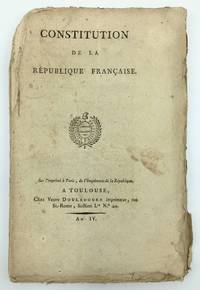
1795rif. 1507Toulouse: Douladoure. An. IV. 1795. Octavo. Stitched without wrappers likely as issued. Page edges untrimmed. Woodcut device emblematic of the French Republic to the title page. 62pp. A good copy with nibbling/loss to the top left-hand corner not affecting the text and a few minor marks to the title page and rear blank verso. The contents remain clean and in very good order. A scarce provincial printing of the Constitution of the Year III Constitution de l'an III the constitution of the French First Republic which established the Directory regime following the fall of Robespierre. Adopted by the convention on 5 Fructidor Year III 22nd August 1795 and approved by plebiscite on 6th September its preamble formed the Declaration of the Rights and Duties of Man and of the Citizen of 1789. Largely the work of political theorist Pierre Daunou it established a bicameral legislature made all taxpaying French males over 25 eligible to vote in primary elections enfranchising around one million more citizens than the 1791 Constitution and contained an explicit ban on slavery. It remained in effect until the coup of 18 Brumaire 9th November 1799 which effectively ended the Revolutionary period and began the rise to power of Napoleon Bonaparte. A pleasing unsophisticated copy remaining in the same form as it would have been when it reached the hands of ordinary Frenchmen in year that it was issued. Toulouse: Douladoure. unknown
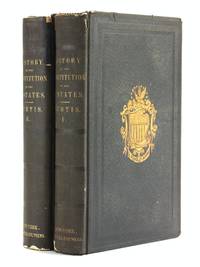
1858rif. 505860Harper and Brothers 1858. Hardcover. VERY GOOD. Vol. 1 1860 xxxvi 518; Vol. 2 1858 xvi 653 pp. 8vo original black cloth with gilt spine lettering and ornament to front covers a variation on the Great Seal of the United States. Tips show a bit of rubbing with some trivial loss typical light offsetting both volumes very clean and sharp internally with sound square bindings. From the personal library of lawyer F. K. Arnold with his Portland Oregon bookplate to FPEP and pencil signature d. 1876 to FFEP of volume 1. Harper and Brothers hardcover
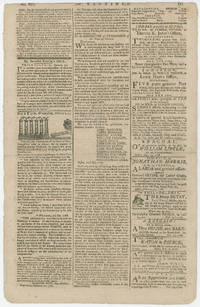
1788rif. 24836Boston MA 1788. No binding. Condition: Fine. Massachusetts Centinel illustrator. Newspaper. Massachusetts Centinel February 13 1788 Volume VIII pp. 171-174. Boston: Benjamin Russell. 4 pp. 9 5/8 x 14 7/8 in. This newspaper is replete with Constitution-related content including minutes from the debates of Massachusetts' State Ratifying Convention - everything from discourse on standing armies to Fisher Ames' hearkening back to 1775 with "WE MUST UNITE OR DIE"; a poem to Washington on his birthday; a fictional dialogue The Federal Anti-Federalist Returned to His Neighbours; a rare example of one of Benjamin Russell's famed 'Pillars' illustration series; and a great deal of reporting on the popular reception of the news of ratification expressed in particular by an enormous parade and surrounding celebrations. The Massachusetts Centinel employed the Federal Pillars political imagery to announce the ratification of the Constitution by successive states. In this issue the Centinel announces the pending ratification by New Hampshire. "This day the Convention of the State of New Hampshire meet at Exeter for the purpose of erecting another PILLAR to support the great Federal Superstructure; by ratifying the proposed Constitution." On February 6 1788 Massachusetts ratified the United States Constitution by a vote of 187 to 168 the sixth and largest state to do so. Two days later the people of Boston engaged in a grand procession led by the "Mechanicks" and Tradesmen of Boston "to express their approbation of the conduct of the Gentlemen who represented this town in the late Convention" p3/c2. A sampling of the groups of marchers most of whom carried implements and tools of their professions festooned for the occasion as detailed here p4c1-2: 73 Blacksmiths; 43 Shipwrights; 75 Rope-makers with part of a rope-walk on a sled and martial music; 30 Mast-makers; 36 Sail-makers; 34 Ship-joiners; 30 Block-makers pulley makers; 6 Mathematical Instrument Makers makers of navigation equipment etc.; 53 Coopers; 20 Boat-builders; 6 Pewterers; 40 Bakers 50 Shoe-makers; 56 Taylors; 26 Hatters; 20 Ship-builders; 136 Carpenters; 70 Masons; 30 Wheelwrights; 15 Printers; as well as a dozen other tradegroups such Bookbinders; Goldsmiths and Jewelers Saddlers Tobacconists Tanners Curriers Leather-dressers Cabinetmakers Carvers Painters Tinsmiths Coppersmiths and 250 of the "principal merchants in the town." Toward the middle of this assemblage thirteen horses pulled the ship "FEDERAL CONSTITUTION" manned by a crew of thirteen. A subtext of much of this was an emphasis on domestic manufactures as well as a celebration of Boston's power and potential in maritime trade.At this event "WE THE PEOPLE" of Boston "in GRAND PROCESSION MOVING" passed an ordinance to rename Long Lane as Federal Street in commemoration of the site where the convention had sat. The ordinance concluded "GIVEN under our auspices.the FIRST YEAR of OUR real political federal existence.GOD SPEED THE CONSTITUTION!" p1/c1. That night a long boat called "the Old Confederation" which had been exhibited during the parade was drawn to the Common and condemned "as unfit for any further service." The boat was immediately burned "in presence of an applauding concourse of citizens" p3/c2. On February 12 the twelve delegates who represented Boston in the ratifying convention including John Hancock and Samuel Adams responded to the procession in a letter to "the Committee of Tradesmen of the Town of Boston." Excerpt: "We endeavoured that our conduct in the late Convention should be governed by the magnitude of our subject:-And after the most mature deliberation we severally decided according to the best light of our understandings and the dictates of our consciences." "We are happy to find that our decisions have so fully corresponded with the sentiments and wishes of our constituents."
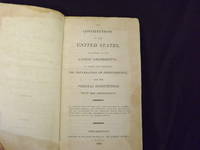
1802rif. 1063758vo period calf rebacked with leather 2 266 pp. Joints cracked rebacking crude some wear to covers paper slightly fragile front endpaper detached other front endpaper with piece missing ink name on front pastedown some darkening to contents; otherwise about very good. This is a rich volume of early American government. In addition to the United Sates Constitution and Declaration of Independence this volume also contains the constitutions of the original states and the ordinances for the government of the North West Territory. Printed under the title is the notation that "This edition contains the constitutions of Vermont Delaware Georgia and Kentucky with the regulations for the government of the territory north west of the river Ohio." This material was not in any other edition. William Duane,
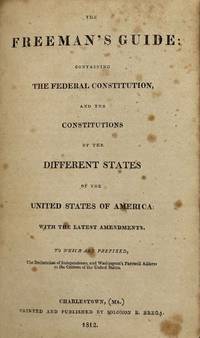
1812rif. 68721Charlestown Ms: Solomon B. Brega 1812. 18.5 cm. 294pp. Full leather rubbed gilt stamped leather spine label. Front joint cracked scattered foxing. Contains what is probably the earliest anthologized printing of the first Louisiana state constitution drafted in 1812. Very good. American Imprints 25460. Previous ownership signature of Moses Williams on front endpaper. Solomon B. Brega unknown
rif. 19152, Brasilia, Centro grafico do senado federal 1988, in-8, br., neuf, ENVOI, 292p.
1859rif. 24356O. O. u. J. (ungarn 1859). OBrosch. (stärker fleckig und bestoßen). 15 S. Gr.-8°. Großteil des Buchblocks lose. Mit Widmung an Georg Freiherr von Vincke auf dem Vorderdeckel.
rif. 8982Placard, 45 x 55 cm.
rif. 1332338054.Gpaperback. Good. Access codes and supplements are not guaranteed with used items. May be an ex-library book. paperback
rif. 2833Sans lieu ni date (1791). 4 pp. in 4° manuscrites au XVIIIème siècle.
rif. 2840P., Imprimerie Royale, 1791. 4 pp. in 4°.
1851rif. 371102Hannover, Rümpler, 1851. VIII, 229 S. Leinen d. Zeit mit Deckel- u. etwas Rückenvergoldung sowie Goldschnitt (Bezug des Vorderdeckels mit kleinen Schabstellen). [2 Warenabbildungen]
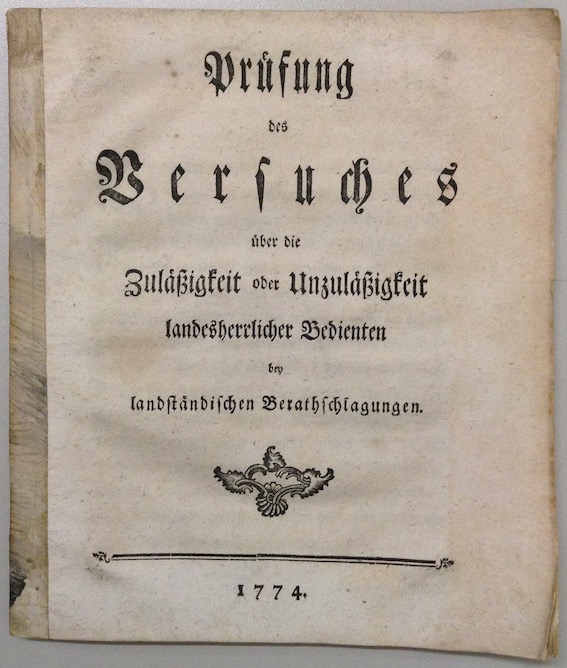
1774rif. 125857(Rostock), 1774. 4to. 68 S. Rückenfalz.
1754rif. 95953Paris, Herissant, 1754. 6 Bl., 721 S. Leder d. Zeit (berieben u. stärker bestoßen, Gelenke eingerissen). [2 Warenabbildungen]
1719In 12° (15,7x9,5 cm); (14), 354 (i.e. 344) pp. Bella legatura coeva in meza pelle con titolo su fascetta al dorso. Dorso a 4 nervi. Piatti foderati con bella carta spruzzata. Tagli rossi. Manca forse la prima carta (bianca?) posta alla sguardia. Prima edizione della "Premier Avertissement" (seguirono anche un secondo ed un terzo "avertissement") del celebre ecclesiastico e teologo francese Jean-Joseph Languet de Gergy e che fu anche vescovo dell'importante diocesi di Soissons. L'opera entra a fondo nelle polemiche che seguirono alla pubblicazione della bolla papale Unigenitus. La bolla papale era diretta contro l'opera del più famoso giansenista dell'epoca, Pasquier Quesnel. Nel novembre del 1711 il re Luigi XIV per sedare i contrasti fra i giansenisti (già dichiarati eretici) ed i fedeli alla dottrina di Roma, domandò al papa una nuova bolla (ma rispettosa delle libertà gallicane) che egli stesso si impegnava a far pubblicare. L'8 settembre 1713 usciva la bolla Unigenitus che condannava 101 proposizioni estratte dal libro di Quesnel. Ma in Francia le cose non andarono come il re desiderava. Il Noailles e altri 48 prelati si rifiutarono di accettare semplicemente ed immediatamente la bolla di Clemente XI, e nemmeno accettarono di partecipare ad un sinodo nazionale per confermare la bolla. Nel frattempo moriva Luigi XIV e il debole periodo di reggenza che ne seguì fu tutto a vantaggio degli oppositori. Quattro vescovi, il Noailles e la Sorbona si appellarono ben presto ad un concilio ecumenico contro la bolla. Ormai la Francia era divisa in due: gli appellanti e coloro che avevano accettato la bolla Unigenitus. Davanti alla possibilità di uno scisma, nel 1718 Clemente XI, con la bolla Pastoralis officii, scomunicava tutti gli appellanti e confermò tutti i documenti già promulgati contro il giansenismo. Con la morte nel 1719 del Quesnel e nel 1729 del Noailles, il giansenismo francese perdeva definitivamente vigore. Nel 1730 la bolla Unigenitus divenne legge di Stato. A parte la mancanza della carta di sguardia (probabilmente bianca) l'opera si presenta in buone condizioni di conservazione.
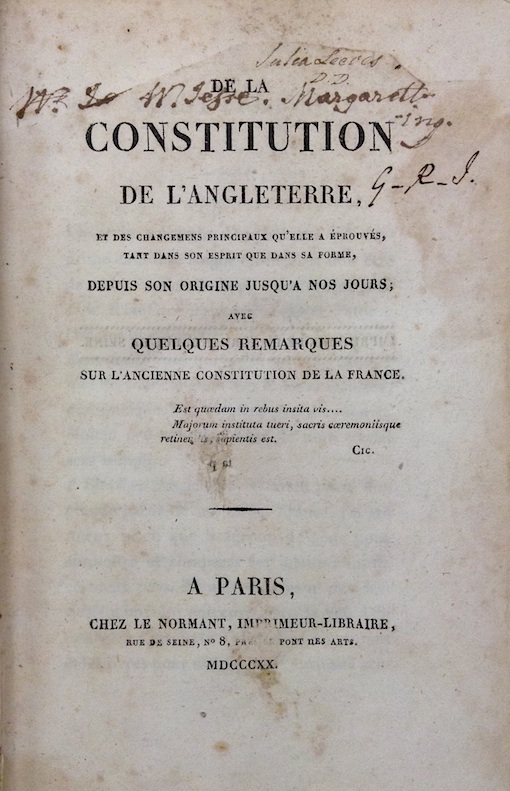
1820rif. 486374Paris, Le Normant, 1820. 100 S., 4 S. Verlagsanzeigen. - Angebunden: Charles COTTU. De l'administration de la justice criminelle en Angleterre et de l'esprit du gouvernement anglais. 2me édition, revue et corrigée. Paris, Gosselin 1822. XII, 312 S., 1 Bl. Leder d. Zeit (berieben, Rücken beschabt, Ecken etwas bestoßen). [2 Warenabbildungen]
1791rif. 1258Paris: de l'Imprimerie Nationale 1791. Book. 12mo 19th c. quarter morocco marbled boards raised bands gilt compartments. Pp. 2 iv 179 uncut. Lightly foxed near fine with the half-title. The official printing of France's first constitution and its famed preamble "Declaration de Droits de l'Homme et du Citoyen" and the only 18th century edition from the national press. The priority of the various editions of the constitution printed in 1791 seems not to have been yet sorted out but it would seem that the present one would reasonably bear a particular authority. A nice uncut copy with the half title. de l'Imprimerie Nationale, hardcover books