1 311 résultats
1923réf. 3131001München, 1923. 192 S. Interimskarton.
réf. c3817Sans lieu, ni nom, 1869 ; grand in-8°, demi-chagrin rouge de l'éditeur, dos à nerfs, filet pointillé doré sur les nerfs, fleurons et perits fers dorés, plat de toile chagrinée grenat ; 2ff.,LVIpp., 532pp.; rares piqûres, reliure légèrement frottée aux coiffes avec perte des ors aux 2 caissons inférieurs et petites décolorations à la toime des plats; discret ex-dono manuscrit au 1er feuillet de garde.
réf. 1391956982.Ghardcover. Good. Access codes and supplements are not guaranteed with used items. May be an ex-library book. hardcover
1865réf. 462580Duisburg, Falk und Volmer, 1865. 266 S., 1 Bl., 2 Bl. Anzeigen. Halbleder d. Zeit (berieben). [2 Warenabbildungen]
194628 pages. Features: Lovely full-page color ad for Rover fine cars inside front cover; Photo of King and Queen being greeted by Churchill and Mr. Attlee at the saluting-base; Two-page compilation of the "Heraldic" badges of British and Allied formations made famous in the late war; Many photos of famous war leaders and service chiefs celebrating victory; Aftermath of the War - Victory - Consequences and Disappointments - article by Cyril Falls; Nice full-page photo of the King and Queen in horse-drawn carriage amongst cheering crowds; Photos of Montgomery, Churchill, Lord Tedder, Sir Claude Auchinleck, Field Marshal Lord Alexander, Admiral Lord Louis Mountbatten, Marshal Lord Alanbrooke, Lord Portal, Marie-Pierre Loenig, Brig.-Gen. Hartt, Admiral Hewitt, and General McNarney in their parade vehicles; Wonderful photos of V-Day Marchers - the Royal Marines, Royal Navy and R.A.F.; Photos of Overseas Troops in Victory Parade - in the Mall and en route; Photos of overseas troops in Victory Parade - Canadians and Kiwis; Amazing centerfold photo of The King saluting Field Marshal Montgomery as his car passes the saluting station - also visible are Churchill, Mackenzie King, and many other notable personalities; More great photos of V-Day Marchers - Merchant Navy, Women's Forces and C.D. Services - of particular note is the full-page photo of the A.T.S. contingent in a "V" formation as the procession divides at the foot of Constitution Hill; Photos of Units of the Mechanised Column in the parade; Amazing full-page photo from the Admiralty Arch along the beflagged mall with the Indian contingent in the foreground and marching troops as far as you can see into the distance; Photos of troops from Greece, France, U.S.A., China, and Egypt in the parade; The History of Final Victory in Drawings by Bryan De Grineau - 15 images; Back cover photo ad for the New Lancaster 'Ten' car. Somewhat above-average wear. Chip from lower corner of front cover. Some peeling from front cover. A worthy reference copy. Book
1928réf. 1169081928 A Paris, G. Douin & Cie - Communications faites à la "Société d'Homoeothérapie de France" - 1928 - In-8, broché - 92 p. - Quelques reproductions photographiques in texte en N&B
1948336 p. 8vo. Original publisher's cloth binding. Original dust jacket, slightly chipped at extremities. Book of the month club edition. PA 8
1948336pp. , ports. 22 cm. Hardcover Very good condition
1878réf. 462429Leiden, 1878. 172 S. Hlwd der Zeit (Stempel auf Titel, Bibliotheks-Rückenschild).
réf. 18934(S. l., 1797.) broche,sans couvertures,16 p.dernier feuillet un peu derelie,complet,mention IVe edition
1981réf. 3360579Zürich, Schulthess, 1981. IX, 68 S. OKart.
réf. DG-34-0239949Very Good. unknown
1935réf. 34966Montevideo Imprenta Nacional 1935. Paperback. Good. lii 235p. wrps tall 4to wrps chipped; back wrps and errata leaves marginally chipped and detached. Includes provisional constitution. Montevideo, Imprenta Nacional paperback
1926réf. 184330Montevideo : Claudio Garcia 1926. 1st Edition in this form. Paperback. Very good paperback copy; edges slightly dust-dulled and nicked. Rounded corners. Remains particularly and surprisingly well-preserved overall; tight bright clean and especially sharp-cornered.; 8vo 8"" - 9"" tall; 91 pages; Description: 91p. 19cm. Subjects: Uruguay - Constitution - Constitutional law. Series: Coleccion de manuales de derecho y legislacion. ""La bolsa de los libros - Montevideo"" stamp to front cover and title. Language: Spanish. [Montevideo] : Claudio Garcia paperback
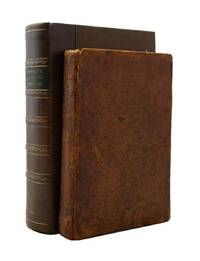
1788réf. 69689Boston: Adams and Nourse 1788. UNITED STATES CONSTITUTION. First edition of the proceedings leading to the Massachusetts Compromise being the ratification of the U.S. Constitution by the sixth of the needed nine States. Octavo in fours 7 1/8 x 4 1/2 inches; 180 x 115 mm. 219 1 blank pp. An early printing of the proposed Constitution appears on pages 3-19. Contemporary full speckled sheep. Boards scuffed and worn. Front outer hinge is cracked but holding firm. Without front free endpaper. Leaf U2 with one-inch closed tear no loss. Leaves are foxed and toned as usual for American paper of this time. Still overall a very good copy. Housed in a custom brown quarter calf clamshell. "Getting approval for the new Constitution was no small feat. Anti-federalists feared that the Constitution would over-centralize government and restrict individual liberties. They demanded changes and a Bill of Rights to guarantee personal freedoms. Federalists on the other hand argued that states should accept the proposed Constitution without further changes. When these opposing views clashed in Massachusetts an agreement- known as the Massachusetts Compromise- was brokered by two famous local statesmen John Hancock and Samuel Adams. Under it Massachusetts ratified the Constitution becoming the sixth U.S. state while also proposing future amendments including a Bill of Rights. The Massachusetts Compromise was used as a model by other states to reach similar agreements. Without it the U.S. Constitution may never have been ratified at all." from Bridgewater State University "Although the delegates to the Constitutional Convention in Philadelphia finished their work in September 1787 a ratification process of many months remained ahead before the Constitution could become the system of government for the new country. For this to happen at least 9 of the 13 states had to approve the document and Massachusetts was at the crux of that lineup. In January 1788 the Massachusetts convention met in the Old State House to address the matter; at that time Delaware Pennsylvania New Jersey Georgia and Connecticut had already ratified the Constitution. The remaining states watched the proceedings in Boston closely anticipating a close vote that could fall either way. Massachusetts had the largest convention of any state and a fundamental disagreement divided the 364 delegates: Federalists supported a strong central government and the Constitution as written; Anti-Federalists held that a centralized government would concentrate power in the hands of the elite and lead to the dissolution of the democratic ideals espoused during the Revolution. The turning point in the debate in Boston came when Gov. John Hancock proposed that Massachusetts recommend several amendments to the Constitution including a Bill of Rights. This proposal effectively gave voice to many of the Anti-Federalist concerns and after Revolutionary leader Samuel Adams spoke in favor of Hancock's "conciliatory proposition" a sufficient number of delegates shifted their positions to approve ratification. Massachusetts ratified the United States Constitution on February 6 1788 by a vote of 187 to 168. In June when New Hampshire came on board as the ninth state to ratify adoption of the Constitution was guaranteed. Its formal enactment on April 30 1789 coincided with George Washington's inauguration as the first president of the United States." Massachusetts Historical Society "In Massachusetts anti-federalist opposition to the Constitution was significant. In order to mollify their concerns convention delegate Theophilus Parsons added nine amendments which were presented by John Hancock. The Constitution was ratified by Massachusetts with the amendments added as a recommendation to "remove the fears and quiet the apprehensions of many of the good people of this Commonwealth and more effectually guard against an undue administration of the federal government." Three of these recommendations would become the Fifth Seventh and Tenth Amendments of the Constitution. The sixth state to ratify the Constitution Massachusetts was the first to suggest amendments which in turn led directly to the passage of the Bill of Rights." Freemans Evans 21242. Sabin 45702. HBS 69689. $5000. Adams and Nourse unknown books
1787réf. 67677London: Printed for D. Henry 1787. UNITED STATES CONSTITUTION; URBAN Sylvanus. One of The First Means by Which The British People Learned of The Enactment of The Constitution of The United States of America UNITED STATES CONSTITUTION subject. URBAN Sylvanus editor. The Gentleman's Magazine "New Constitution of the United States of America". Printed by John Nichols for D. Henry November December 1787. First edition of these November and December 1787 issues. Two small octavo volumes 8 1/2 x 5 1/8 inches; 215 x 130 mm. 941-1035 1; 1037-1131 1 pp. With woodcut text illustration on front wrapper of each volume. November issue with one fold-out plate and lacking plate I entitled "S.W. View of Aconbury Chapel 5 Miles from Here." The December issue with two plates plate II and Supp. but lacking plate I Illustrations of the Royal Charter School Near Dublin Clontarfe Castle Dublin and others. Text of American Constitution on pp. 1008-1011; 1110-1112. Self-wrappered. Newer stitching. Some very minor toning and light occasional spotting. Overall very good. This is the first English magazine printing of the U.S. Constitution. The November issue on pages 1008-1011 prints George Washington's Letter and the first Article. The December issue on pages 1110-1112 contains articles two through seven and the delegates names. "The following is the new Plan of the Constitution of the United States of America upon which the Convention of all the most distinguished men in the States have been deliberating for several months and by which if finally adopted the Constitution of the Union is totally changed." From the introduction Einaudi. Goldsmiths'. Howes. Howes. Kress. Streeter. Streeter. HBS 67677. $1500. Printed for D. Henry unknown books
1787réf. 69121London: Sold by T. Wilkie 1787. UNITED STATES CONSTITUTION. The London Chronicle "The New Plan for the Constitution of the United States of America". Vo. LXII. No. 4834-4835. From Saturday October 27 to Tuesday October 30 1787 and From Tuesday October 30 to Thursday November 1 1787. Pages 409-424. London: Sold by T. Wilkie 1787. Likely the first public printing of the United States Constitution in England. This newspaper printing precedes the know first edition pamphlet published by Debrett as well as the first magazine printing in "The Gentleman's Magazine." It is broadly stated that news of the United States Constitution hit England early in November however the dates of the Chronicle precede this by a few days. This copy also contains the preliminary cover letter from George Washington to the president of Congress which is usually included with early printings of the Constitution and which states Washington's strong support of ratification. "The Plan" is printed in its entirety without comment or explanation from the publisher. Together two issues no. 4834 and 4834. Each issue self bound along left margin. 11 3/8 x 8 5/8 inches; 288 x 222 mm. Number 4834 is four leaves pages 409-416 and number 4835 is four leaves pages 417-424. The first part of the Constitution is printed on pages 413-414 of the first part with the end stating "To be concluded in our next" and the second part is printed on pages 420-421. Both issues very good with just some slight toning. Page 421-422 trimmed close at top margin just touching header. A small red stamp on verso of first leaf of each issue along bottom margin. Overall about fine. We could find no other copies of this or any earlier British newspaper containing the US Constitution on Rare Book Hub. We could not locate any copies on OCLC or ESTC. Housed in a custom quarter red morocco clamshell. At the time of the Constitutional Convention John Adams was living in England as a diplomat. In a letter to John Adams from Elbridge Gerry dated September 20th 1787 just one day after the first newspapers in America printed the Constitution he states "The proceedings of the Convention being this day published I embrace the Oppertunity of transmitting them by a Vessel which is to sail this morning for London." According to the National Archives "Gerry enclosed a copy of the new U.S. Constitution. Gerry likely sent this letter to John Adams via the Prince George Capt. Strong which departed New York City in late September and arrived in London on 3 Nov. New York Independent Journal 1 Sept. 1787 2 Feb. 1788." This shows that it would have been impossible for news of the Constitution to arrive in England much before this date of November 3rd. Lengthy searches turn up no indication that any other British publication has a copy of the US Constitution before this London Chronicle printing. The National Archives go on to state "The U.S. Constitution was adopted on 17 Sept. 1787 and British newspapers first published the text in late autumn. The London Chronicle printed the preamble and the first article in its 27-30 Oct. issue and the remaining articles and signatures in its 30 Oct. - 1 Nov. issue. " The London Chronicle was a thrice weekly newspaper also known for being " one of the first to break the news that the United States had declared independence from the British Empire reporting on the event in its 13 August 1776 edition. It was also one of the first to publish the declaration in its entirety in the 15-17 August 1776 edition but containing no explanation or comment as to what it was" Wikipedia. This holds true for their publication of the Constitution as well. United States Constitution now the longest continuing charter of a national government in the world and "the product of a revolution in political thought at least as important and far-reaching as the winning of American independence from Great Britain and the culmination of the intellectual ferment and political experimentation in the new republic" Richard B. Bernstein Are We to Be a Nation. HBS 69121. $20000. Sold by T. Wilkie unknown books
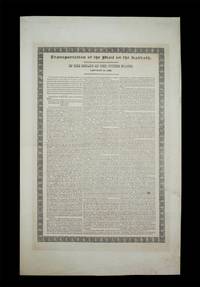
1829réf. 69246Kentucky 1829. UNITED STATES CONSTITUTION; BROADSIDE. BROADSIDE. Transportation of the Mail on the Sabbath. In the Senate of the United States. Kentucky: 1829. Full Description: UNITED STATES CONSTITUTION. BROADSIDE. Transportation of the Mail on the Sabbath. In the Senate of the United States. Kentucky: January 19 1829. An important and interesting broadside supporting the separate of church in state in so as it applies to the delivery of mail on Sunday the Sabbath. Broadside folio 16 3/4 x 10 1/2 inches; 428 x 266 mm. With a caption title printed above three columns separated by rules. All within a decorative woodcut border. Mounted at the top edge within a portfolio mat. Some minor toning and a few small spots of dampstaining. A One and one half-inch closed tear at right-hand margin just touching the border. Overall very good. This is a significant document in the history of the United States Constitution in relation to the concept of the separation of church and state. Christian leaders demanded that the Government institution of the Postal Office not work on Sunday as their God had deemed this the Sabbath. The following document discusses that while many Christians observe the Sabbath on Sunday others including their Jewish neighbors observe the Sabbath on Saturday. Demanding that the government institution not work on Sunday for religious reasons goes directly against the Constitution. The report states "With these different religious views the committee are of opinion that congress cannot interfere.-It is not the legitimate province of the legislature to determine what religion is true or what false. Our government is a civil and not a religious institution. Our constitution recognizes in every person the right to choose his own religion and to enjoy it freely without molestation. Whatever may be the religious sentiments of citizens and however variant they are alike entitled to protection from the government so long as they do not invade the rights of others." It goes on to powerfully state "Extensive religious combinations to effect a political object are in the opinion of the committee always dangerous. This first effort of the kind calls for the establishment of a principle which in the opinion of the committee would lay the foundation for dangerous innovations upon the spirit of the Constitution and upon the religious rights of the citizens. If admitted it may be justly apprehended that the future measures of government will be strongly marked if not eventually controlled by the same influence. All religious despotism commences by combination and influence; and when that influence begins to operate upon the political institutions of a country the civil power soon bends under it and the catastrophe of other nations furnishes an awful warning of the consequence." The five-person committee for this report consisted of Richard Johnson of Kentucky who later went on to serve as the country's 9th vice president under Martin Van Buren as well as future President John Tyler of Virgina Ellis of Mississippi Silsbee of Massachusetts and Johnson of Louisiana. "The opening of post offices on Sunday led to a national debate about the relationship of the federal government to the Sabbath day. The argument which raged from 1810 to 1830 involved whether the national government would exist as a secular commercial republic committed to a separation of church and state or as a Christian commonwealth. The U.S. postmaster general Gideon Granger responded by persuading Congress in 1810 to pass legislation to open all 2300 post offices seven days a week and transport mail every day. Congress immediately began to receive petitions from numerous religious denominations urging repeal of the law. Under strong public pressure House and Senate committees formed to study the postal law. While the chair of the House committee waffled on the subject the head of the Senate committee swayed Congress to keep the law. Gen. Richard M. Johnson of Kentucky a devout Baptist wrote in the committee's 1829 report that congressional action to stop Sunday mail would be unconstitutional. Johnson reminded Americans that they had religious freedom and that government had no right to coerce the religious homage of anyone. The invention of the telegraph in 1844 ultimately spelled the end of Sunday mail. It was now possible to get market information without the mail system. By the 1850s postmaster generals were eliminating the movement of most mail on Sunday." Free Speech Center Caryn E. Neumann. HBS 69246. $1750. Kentucky unknown books
2000réf. 62807Washington DC: U.S. Government Printing Office 2000. Presumed first edition/first printing. Wraps. Good. No dust jacket as issued. Cover has some wear and soiling. iv 90 p. Serial No. 120. H.R. 4292 was part of the late-term abortion debate. U.S. Government Printing Office paperback
réf. 0844405604.Gpaperback. Good. Access codes and supplements are not guaranteed with used items. May be an ex-library book. paperback
1788réf. 69689Boston: Adams and Nourse 1788. UNITED STATES CONSTITUTION. First edition of the proceedings leading to the Massachusetts Compromise being the ratification of the U.S. Constitution by the sixth of the needed nine States. Octavo in fours 7 1/8 x 4 1/2 inches; 180 x 115 mm. 219 1 blank pp. An early printing of the proposed Constitution appears on pages 3-19. Contemporary full speckled sheep. Boards scuffed and worn. Front outer hinge is cracked but holding firm. Without front free endpaper. Leaf U2 with one-inch closed tear no loss. Leaves are foxed and toned as usual for American paper of this time. Still overall a very good copy. Housed in a custom brown quarter calf clamshell. "Getting approval for the new Constitution was no small feat. Anti-federalists feared that the Constitution would over-centralize government and restrict individual liberties. They demanded changes and a Bill of Rights to guarantee personal freedoms. Federalists on the other hand argued that states should accept the proposed Constitution without further changes. When these opposing views clashed in Massachusetts an agreement- known as the Massachusetts Compromise- was brokered by two famous local statesmen John Hancock and Samuel Adams. Under it Massachusetts ratified the Constitution becoming the sixth U.S. state while also proposing future amendments including a Bill of Rights. The Massachusetts Compromise was used as a model by other states to reach similar agreements. Without it the U.S. Constitution may never have been ratified at all." from Bridgewater State University "Although the delegates to the Constitutional Convention in Philadelphia finished their work in September 1787 a ratification process of many months remained ahead before the Constitution could become the system of government for the new country. For this to happen at least 9 of the 13 states had to approve the document and Massachusetts was at the crux of that lineup. In January 1788 the Massachusetts convention met in the Old State House to address the matter; at that time Delaware Pennsylvania New Jersey Georgia and Connecticut had already ratified the Constitution. The remaining states watched the proceedings in Boston closely anticipating a close vote that could fall either way. Massachusetts had the largest convention of any state and a fundamental disagreement divided the 364 delegates: Federalists supported a strong central government and the Constitution as written; Anti-Federalists held that a centralized government would concentrate power in the hands of the elite and lead to the dissolution of the democratic ideals espoused during the Revolution. The turning point in the debate in Boston came when Gov. John Hancock proposed that Massachusetts recommend several amendments to the Constitution including a Bill of Rights. This proposal effectively gave voice to many of the Anti-Federalist concerns and after Revolutionary leader Samuel Adams spoke in favor of Hancock's "conciliatory proposition" a sufficient number of delegates shifted their positions to approve ratification. Massachusetts ratified the United States Constitution on February 6 1788 by a vote of 187 to 168. In June when New Hampshire came on board as the ninth state to ratify adoption of the Constitution was guaranteed. Its formal enactment on April 30 1789 coincided with George Washington's inauguration as the first president of the United States." Massachusetts Historical Society "In Massachusetts anti-federalist opposition to the Constitution was significant. In order to mollify their concerns convention delegate Theophilus Parsons added nine amendments which were presented by John Hancock. The Constitution was ratified by Massachusetts with the amendments added as a recommendation to "remove the fears and quiet the apprehensions of many of the good people of this Commonwealth and more effectually guard against an undue administration of the federal government." Three of these recommendations would become the Fifth Seventh and Tenth Amendments of the Constitution. The sixth state to ratify the Constitution Massachusetts was the first to suggest amendments which in turn led directly to the passage of the Bill of Rights." Freemans Evans 21242. Sabin 45702. HBS 69689. $5000. Adams and Nourse unknown
1787réf. 67677London: Printed for D. Henry 1787. UNITED STATES CONSTITUTION; URBAN Sylvanus. One of The First Means by Which The British People Learned of The Enactment of The Constitution of The United States of America UNITED STATES CONSTITUTION subject. URBAN Sylvanus editor. The Gentleman's Magazine "New Constitution of the United States of America". Printed by John Nichols for D. Henry November December 1787. First edition of these November and December 1787 issues. Two small octavo volumes 8 1/2 x 5 1/8 inches; 215 x 130 mm. 941-1035 1; 1037-1131 1 pp. With woodcut text illustration on front wrapper of each volume. November issue with one fold-out plate and lacking plate I entitled "S.W. View of Aconbury Chapel 5 Miles from Here." The December issue with two plates plate II and Supp. but lacking plate I Illustrations of the Royal Charter School Near Dublin Clontarfe Castle Dublin and others. Text of American Constitution on pp. 1008-1011; 1110-1112. Self-wrappered. Newer stitching. Some very minor toning and light occasional spotting. Overall very good. This is the first English magazine printing of the U.S. Constitution. The November issue on pages 1008-1011 prints George Washington's Letter and the first Article. The December issue on pages 1110-1112 contains articles two through seven and the delegates names. "The following is the new Plan of the Constitution of the United States of America upon which the Convention of all the most distinguished men in the States have been deliberating for several months and by which if finally adopted the Constitution of the Union is totally changed." From the introduction Einaudi. Goldsmiths'. Howes. Howes. Kress. Streeter. Streeter. HBS 67677. $1500. Printed for D. Henry unknown
1787réf. 69121London: Sold by T. Wilkie 1787. UNITED STATES CONSTITUTION. The London Chronicle "The New Plan for the Constitution of the United States of America". Vo. LXII. No. 4834-4835. From Saturday October 27 to Tuesday October 30 1787 and From Tuesday October 30 to Thursday November 1 1787. Pages 409-424. London: Sold by T. Wilkie 1787. Likely the first public printing of the United States Constitution in England. This newspaper printing precedes the know first edition pamphlet published by Debrett as well as the first magazine printing in "The Gentleman's Magazine." It is broadly stated that news of the United States Constitution hit England early in November however the dates of the Chronicle precede this by a few days. This copy also contains the preliminary cover letter from George Washington to the president of Congress which is usually included with early printings of the Constitution and which states Washington's strong support of ratification. "The Plan" is printed in its entirety without comment or explanation from the publisher. Together two issues no. 4834 and 4834. Each issue self bound along left margin. 11 3/8 x 8 5/8 inches; 288 x 222 mm. Number 4834 is four leaves pages 409-416 and number 4835 is four leaves pages 417-424. The first part of the Constitution is printed on pages 413-414 of the first part with the end stating "To be concluded in our next" and the second part is printed on pages 420-421. Both issues very good with just some slight toning. Page 421-422 trimmed close at top margin just touching header. A small red stamp on verso of first leaf of each issue along bottom margin. Overall about fine. We could find no other copies of this or any earlier British newspaper containing the US Constitution on Rare Book Hub. We could not locate any copies on OCLC or ESTC. Housed in a custom quarter red morocco clamshell. At the time of the Constitutional Convention John Adams was living in England as a diplomat. In a letter to John Adams from Elbridge Gerry dated September 20th 1787 just one day after the first newspapers in America printed the Constitution he states "The proceedings of the Convention being this day published I embrace the Oppertunity of transmitting them by a Vessel which is to sail this morning for London." According to the National Archives "Gerry enclosed a copy of the new U.S. Constitution. Gerry likely sent this letter to John Adams via the Prince George Capt. Strong which departed New York City in late September and arrived in London on 3 Nov. New York Independent Journal 1 Sept. 1787 2 Feb. 1788." This shows that it would have been impossible for news of the Constitution to arrive in England much before this date of November 3rd. Lengthy searches turn up no indication that any other British publication has a copy of the US Constitution before this London Chronicle printing. The National Archives go on to state "The U.S. Constitution was adopted on 17 Sept. 1787 and British newspapers first published the text in late autumn. The London Chronicle printed the preamble and the first article in its 27-30 Oct. issue and the remaining articles and signatures in its 30 Oct. - 1 Nov. issue. " The London Chronicle was a thrice weekly newspaper also known for being " one of the first to break the news that the United States had declared independence from the British Empire reporting on the event in its 13 August 1776 edition. It was also one of the first to publish the declaration in its entirety in the 15-17 August 1776 edition but containing no explanation or comment as to what it was" Wikipedia. This holds true for their publication of the Constitution as well. United States Constitution now the longest continuing charter of a national government in the world and "the product of a revolution in political thought at least as important and far-reaching as the winning of American independence from Great Britain and the culmination of the intellectual ferment and political experimentation in the new republic" Richard B. Bernstein Are We to Be a Nation. HBS 69121. $20000. Sold by T. Wilkie unknown
réf. B9781015419841Hardback. New. hardcover
réf. 45175834-nnew. unknown