41 résultats
1809réf. 727231809. London: J. Blacklock and J. Luffman c.1809. London: J. Blacklock and J. Luffman c.1809. "Absolute Necessity of a Reform in Parliament" Great Britain. A True Friend to the Constitution And Nothing But the Constitution. Reform in Parliament. An Address to the People of England On the Absolute Necessity of a Reform in Parliament To Which are Annexed Complete Copies of the Magna Charta And the Bill of Rights with Explanatory Notes. London: Printed for J. Blacklock and J. Luffman c.1809. ii 64 pp. Octavo 8" x 4-3/4". Recent marbled boards printed paper spine label speckled edges endpapers renewed. Light toning to interior moderate soiling to title page a few creases to final leaf. $750. Only edition. After the Duke of York scandal in 1809 which involved the sale of military commissions through his mistress Mary Anne Clarke interest in Parliamentary reform surged. Our work draws particular attention to the constitutional aspects of the issue making frequent reference to particular contemporary scandals and their relationships to the appended Magna Carta and Bill of Rights. OCLC locates 8 copies 5 in North America Newberry Princeton Bowdoin Queens University McMaster. unknown books
2000réf. 69677Gaborone: Govt. Printer 2000. Paperback. Very Good. color map iii 170p. Softcover in original wrapper. 30 cm. Pages 161-166 bound in upside down. Also included is an unbound paperclipped twenty-seven page photocopy of "Revised Draft Government White Paper No. ___ of 2002" which contains a less than enthusiastic Government response to this. Govt. Printer paperback books
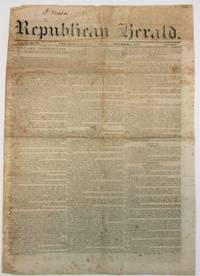
1841réf. 37252Providence 1841. Elephant folio sheet folded to 15-1/4" x 21-1/2." 4 pp. Old folds light foxing. Good. The "Proposed Constitution" adopted at "the Convention of the People" on 18 November 1841 is printed. It would grant the suffrage to "Every white male" adult. Articles favoring its adoption are printed along with Rhode Island's 1790 Declaration of Rights. Articles on national and local political affairs plus numerous advertisements are also printed. In 1843 Thomas Dorr was arrested at the offices of the Republican Herald for high treason. unknown books
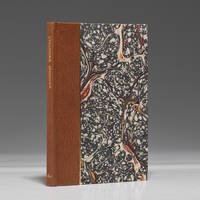
1847réf. 1239761847. First Edition. CONSTITUTION PHILLIPS Wendell. Review of Lysander Spooner's Essay on the Unconstitutionality of Slavery. Reprinted from the ""Anti-Slavery Standard"" With Additions. Boston: Andrews & Prentiss 1847. Octavo modern half calf gilt marbled boards; pp. 1-3 4-95 1. $1600.First edition in book form of Phillips' bold and influential antebellum work on the U.S. Constitution and the question of slavery revised and ""with additions"" to its serialization in the Anti-Slavery Standard.Controversy over slavery ""was the most important single influence on American constitutional development before the Civil War"" Wiecek Sources 15. Leaders in that controversy were William Lloyd Garrison Wendell Phillips and Lysander Spooner. As an anti-constitutionalist Phillips deemed ""Prophet of Liberty Champion of the Slave"" made his ""first public pronouncement that the Constitution should be abandoned"" when in 1842 he asserted the ""'spirit of liberty' is 'chained down in the iron links of the United States Constitution'"" and subsequently argued the Constitution was a ""'compromise'É between freedom and slavery"" Knowles Securing the 'Blessings'"" 41. Phillips' 1844 work Constitution: A Pro-Slavery Compact prompted Spooner to author Unconstitutionality of Slavery First Part: 1845 Second Part: 1847 arguing it was instead slavery that was unconstitutional not the founding document. Phillips quickly countered with this Review.""Phillips insisted the only path to justice 'is over the Constitution trampling it under foot'. and raised pertinent questions about the processes of constitutionalism. Must a just person reject an imperfect constitution or even one that sanctioned and protected an evil like slavery to work effectively for constitutional reform and to abolish injustice Or was it possible to regard the constitution as an imperfect but amendable instrumentÉ the only thing available in the here and now of a heterogeneous secular society that can serve as a means of changing a society's goals and structuring"" Wiecek 246. To Phillips Spooner's approach essentially ""leaves every one to do 'what is right in his own eyes.'"" Spooner and Phillips also disagreed on remedies to immoral laws. ""Spooner did not consider an immoral contract binding"" and argued for example that judges rely instead on natural law for their decisions. Phillips felt that in such circumstances a judge should resign. In this Review Phillips also offers ""a new area in which antislavery and anarchy"" could be connected when he describes Spooner's ""antislavery constitutionalismÉ as 'the first step toward anarchy'"" Perry Radical Abolitionism 165-66. First edition first printing. Serialized earlier the same year in the Anti-Slavery Standard the official weekly newspaper of the American Anti-Slavery Society which was co-founded by William Lloyd Garrison and Arthur Tappen. Sabin 62524. Dumond 93. Not in Blockson. Text fresh and about-fine. hardcover books
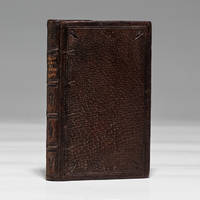
1682réf. 1206631682. CONSTITUTION SOMERS John. The Security of English-Mens Lives Or the Trust Power and Duty of the Grand Jurys of England. London: Printed for Benj. Alsop 1682. Small octavo 4 by 6-1/2 inches 18th-century brown morocco raised bands marbled endpapers all edges gilt; pp. 1-2 3-168. $3400.1682 edition of Somers' profoundly influential work on the power of the grand jury the second of only two 17th-century editions issued the year after the firstÑ""one of the fundamental foundations of the common law in the American colonies""Ñprompting revolution with Somers' invoking the grand jury and its protection of secrecy as key in opposing ""corrupt Ministers of State"" and those who ""abuse or oppress the PeopleÉ in the form and course of Justice"" seminal in the creation of the Constitution's Fifth Amendment with Jefferson calling grand juries ""the true tribunal of the people.""British statesman Baron John Somers' most famous and influential work is Grand Jurys. ""Of the legal scholars writing about the grand jury in the late 17th century Somers is not only representative but eminent having been read in both England and the colonies"" Kadish Behind the Locked Door 5-10. Grand Jurys is considered a seminal influence on Locke and America's Founding Fathers and it is ""likely that Locke knew Somers by the early 1680sÉ The opposition of absolute monarchy to the security provided by 'impartial law' was structurally central to Locke's Second Treatise 1689 which attacked the threat to life liberty and property posed by a loss of 'impartial justice'É Locke's arguments are a logical extension of the arguments that juries provided the only security of life"" Marshall John Locke 52. To Somers similarly the grand jury offers ""security"" from the ""Ill Designs of corrupt Minsters of State"" and those who ""dare to abuse or oppress the People."" Somers' Grand Jurys is ""a classic statement of political freedom. He works his way through a number of themes that will be frequently repeated by others."" Chief among these is his argument that ""the independent grand jury is the linchpin of the entire criminal justice system. It brings offenders to justice and protects the innocent from false accusation guaranteeing the traditional rights of Englishmen particularly their political rights in relation to the CrownÉ and joins Parliament as a counterweight to the arbitrary power of the monarch and his judges"" Shapiro Beyond Reasonable Doubt 67. With its origins found deep within English legal history the grand jury was ""eulogized by Coke and BlackstoneÉ and crossed the Atlantic as one of the fundamental foundations of the common law in the American colonies"" Roots If It's Not a Runaway. ""Indeed there is an important sense in which the jury issue united not only America's revolutionary period and Founding era but also the 'settlement' years immediately following 1789"" Stimson Juries and American Revolutionary Jurisprudence 34-5.As American ""opposition to the British became more overt grand juries became more sympathetic to the colonistsÉ the famous case of John Peter Zenger is a prime exampleÉ as two separate N.Y. grand juries refused to indict him for criminal libel. Further in 1765 a Boston grand jury refused to find an indictment against the leaders of the Stamp Act Riots"" Paule Perversion of the Historic Function 304. ""Perhaps the best known case of grand jury independence involved the twice-unsuccessful efforts to indict former Vice President Aaron Burr for attempting to involve the U.S. in a war with SpainÉ Burr was finally indicted when a grand jury was convened in Virginia the stronghold of Burr's enemy Thomas Jefferson. Despite Jefferson's best efforts Burr was acquitted at trial in part because the judge gave such a narrow jury instruction and made evidentiary rulings so favorable to the defense that conviction was nearly impossible. The trial judge was John Marshall one of Jefferson's rivals"" Leopold Why Grand Juries 286.""The framers of the Constitution perceived the function of the grand jury as so essential to liberty that they specifically provided for it"" in the Fifth Amendment Paule 305. ""With its Grand Jury Clause insuring that 'no person shall be held to answer for a capital or otherwise infamous crime unless on a presentment or indictment of a Grand Jury'É the Clause protected the people against arbitrary and overzealous government by protecting 'against hasty malicious and oppressive prosecution.' Secrecy in grand jury proceedings played a role in that protection."" For Somers in particular the secrecy requirement was absolute. In Grand Jurys he describes ""how grand jurors were sworn not to disclose the subjects of the inquiry the witnesses or any of the evidence. In addition grand jurors were sworn not to reveal their own personal knowledge the knowledge of their fellow jurors their investigative plans or their deliberationsÉ according to SomersÉ secrecy made possible the discovery of truth and protected individuals from malicious or hateful prosecution. In sum neither the king the general public nor the individual accused could benefit by making public the proceedings of a grand jury. The Grand Jury Clause of the Fifth Amendment made grand jury secrecy an implicit part of American criminal procedure"" Kadish 5-16. ""In a petition to the General Assembly of the Commonwealth of Virginia Jefferson once termed the Anglo-Saxon tradition of trial by grand and petit jury 'the true tribunal of the people'"" Shannon Grand Jury 141. Jefferson owned and held two other works by Somers in his library. Preceded only by the 1681 first edition. Anonymously issued with Wing identifying Somers as author. Precedes the 1773 American edition. Pages 156-167 containing Latin and English text printed on opposite pages; final text page with ""Finis."" ESTC R10363. Wing S4643. Sweet & Maxwell I:378 34. See Sowerby 2015 2712. Early owner signature above title page.Text very fresh expert restoration to handsome binding. A very good copy. hardcover books
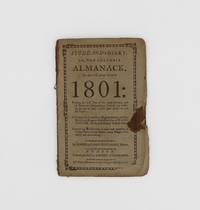
1800réf. 374113Hudson: Printed and sold by Ashbel Stoddard 1800. 36pp. Some interleaving with contemporary manuscript annotations recording weather deaths etc. 12mo. Stitched final leaf trimmed close with minor loss to final line on H2r staining and chipping at fore-edge other minor chips and tears. 36pp. Some interleaving with contemporary manuscript annotations recording weather deaths etc. 12mo. With a printing of the U.S. Constitution and the Bill of Rights on the final 12 pages. This almanac calculated by Beers Hutchins died in 1782. Evans 37670; ESTC W33544; Drake 6126 Printed and sold by Ashbel Stoddard unknown books
1874réf. 16168Atlanta 1874. Broadsheet 10" x 13" and printed in four columns. Light wear Very Good. The Report provides analyses "of most of the leading guanos and phosphates that are sold in this State." Included also are articlues by Mark W. Johnson of Atlanta on Cheap Corn Culture using the Thomas Patent Smoothing Harrow and Broadcast Reaper; and advice to every Georgia planter to "plant at least one to five acres of millet. unknown books
1789réf. 1001478vo later calf backed marbled boards 320 202 pp. Edges and covers rubbed occasional bit of foxing but overall very good. The most important feature of this collection is an early British printing of the United States Constitution p.289-300. Also contains a curious description of two Negro children with some unusual physical markings see p.53-55. Very interesting coverage of a few executions including a woman who was hanged for forgery is also provided. J. Dodsley hardcover books
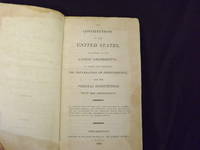
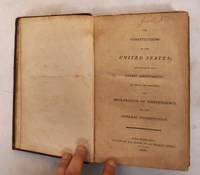
1802réf. 1063758vo period calf rebacked with leather 2 266 pp. Joints cracked rebacking crude some wear to covers paper slightly fragile front endpaper detached other front endpaper with piece missing ink name on front pastedown some darkening to contents; otherwise about very good. This is a rich volume of early American government. In addition to the United Sates Constitution and Declaration of Independence this volume also contains the constitutions of the original states and the ordinances for the government of the North West Territory. Printed under the title is the notation that "This edition contains the constitutions of Vermont Delaware Georgia and Kentucky with the regulations for the government of the territory north west of the river Ohio." This material was not in any other edition. William Duane, books
1806réf. 184040Philadelphia PA: Wm. Duane 1806. Hardcover. Good- front board nearly split yet firmly held; rattled. boards edge-worn & rubbed; moisture spotted. portion of spine top missing & chipped; tail rubbed torn at edge & flapped. pastedowns & endpapers tanned & foxed w/ pencil notations & names; front pastedown has paper remnants & dampstaining; back pastedown & endpaper has dampstaining to upper edges. pgs 264 to closing have tanned dampstaining to upper edge. leather boards w/ gilt ruled spine & maroon leather gilt printed title plate. 307 pgs. Narrow previous owner's name label to spine. Some instances of dampstaining to lower page edges. Page 166 has black ink spattering to lower text and page edge A few pages darkly tanned with higher concentrations of foxing. Instances of light to moderate foxing throughout; text dark. An uncommon 1806 edition. Wm. Duane hardcover books
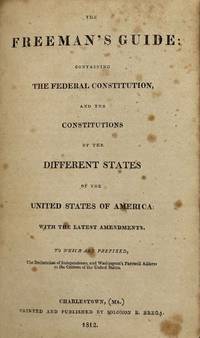
1812réf. 68721Charlestown Ms: Solomon B. Brega 1812. 18.5 cm. 294pp. Full leather rubbed gilt stamped leather spine label. Front joint cracked scattered foxing. Contains what is probably the earliest anthologized printing of the first Louisiana state constitution drafted in 1812. Very good. American Imprints 25460. Previous ownership signature of Moses Williams on front endpaper. Solomon B. Brega unknown books
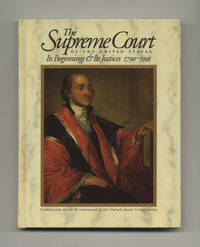
1992réf. 40426Washington D.C.: Supreme Court Historical Society. Fine. 1992. Hardcover. A lovely copy book appears to be a first edition; however bookplate on pastedown states that the book is "reprinted" in Fine condition without dust-jacket as issued; is the definitive history of the Supreme Court and its justices from the nation's founding through the present day.The Supreme Court of the United States: Its Beginnings & Its Justices 1790-1991 is the authoritative history of the nation's highest court and its justices from the nation's founding through the present day. The volume is the product of a commission appointed by the National Archives and Records Administration to commemorate the United States Constitution's 200th anniversary. The commission worked with a team of outstanding historians including Allan Nevins Stanley Kutler and Arthur Schlesinger Jr. to produce a highly readable and comprehensive account of the court and its justices. The book is organized into three parts each covering a different period of Supreme Court history. Part One covers the court's early years from its creation under the Articles of Confederation in 1787 to the appointment of John Marshall in 1801. Part Two covers the Marshall era from the first major decisions of the court under Marshall to; Color Photographs and Illustrations; 4to; 300 pages . Supreme Court Historical Society hardcover books
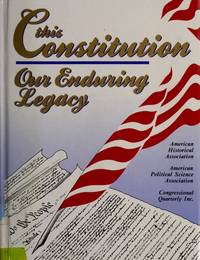
1986réf. 201643Washington: Congressional Quarterly 1986. hardcover. very good-. Illus. 8vo decorated boards back cover lightly soiled. Washington: Congressional Quarterly 1986. Collection of essays chosen from This Constitution magazine. Congressional Quarterly unknown books
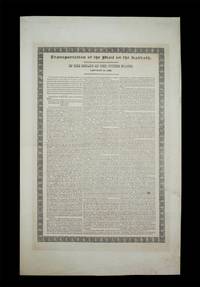
1829réf. 69246Kentucky 1829. UNITED STATES CONSTITUTION; BROADSIDE. BROADSIDE. Transportation of the Mail on the Sabbath. In the Senate of the United States. Kentucky: 1829. Full Description: UNITED STATES CONSTITUTION. BROADSIDE. Transportation of the Mail on the Sabbath. In the Senate of the United States. Kentucky: January 19 1829. An important and interesting broadside supporting the separate of church in state in so as it applies to the delivery of mail on Sunday the Sabbath. Broadside folio 16 3/4 x 10 1/2 inches; 428 x 266 mm. With a caption title printed above three columns separated by rules. All within a decorative woodcut border. Mounted at the top edge within a portfolio mat. Some minor toning and a few small spots of dampstaining. A One and one half-inch closed tear at right-hand margin just touching the border. Overall very good. This is a significant document in the history of the United States Constitution in relation to the concept of the separation of church and state. Christian leaders demanded that the Government institution of the Postal Office not work on Sunday as their God had deemed this the Sabbath. The following document discusses that while many Christians observe the Sabbath on Sunday others including their Jewish neighbors observe the Sabbath on Saturday. Demanding that the government institution not work on Sunday for religious reasons goes directly against the Constitution. The report states "With these different religious views the committee are of opinion that congress cannot interfere.-It is not the legitimate province of the legislature to determine what religion is true or what false. Our government is a civil and not a religious institution. Our constitution recognizes in every person the right to choose his own religion and to enjoy it freely without molestation. Whatever may be the religious sentiments of citizens and however variant they are alike entitled to protection from the government so long as they do not invade the rights of others." It goes on to powerfully state "Extensive religious combinations to effect a political object are in the opinion of the committee always dangerous. This first effort of the kind calls for the establishment of a principle which in the opinion of the committee would lay the foundation for dangerous innovations upon the spirit of the Constitution and upon the religious rights of the citizens. If admitted it may be justly apprehended that the future measures of government will be strongly marked if not eventually controlled by the same influence. All religious despotism commences by combination and influence; and when that influence begins to operate upon the political institutions of a country the civil power soon bends under it and the catastrophe of other nations furnishes an awful warning of the consequence." The five-person committee for this report consisted of Richard Johnson of Kentucky who later went on to serve as the country's 9th vice president under Martin Van Buren as well as future President John Tyler of Virgina Ellis of Mississippi Silsbee of Massachusetts and Johnson of Louisiana. "The opening of post offices on Sunday led to a national debate about the relationship of the federal government to the Sabbath day. The argument which raged from 1810 to 1830 involved whether the national government would exist as a secular commercial republic committed to a separation of church and state or as a Christian commonwealth. The U.S. postmaster general Gideon Granger responded by persuading Congress in 1810 to pass legislation to open all 2300 post offices seven days a week and transport mail every day. Congress immediately began to receive petitions from numerous religious denominations urging repeal of the law. Under strong public pressure House and Senate committees formed to study the postal law. While the chair of the House committee waffled on the subject the head of the Senate committee swayed Congress to keep the law. Gen. Richard M. Johnson of Kentucky a devout Baptist wrote in the committee's 1829 report that congressional action to stop Sunday mail would be unconstitutional. Johnson reminded Americans that they had religious freedom and that government had no right to coerce the religious homage of anyone. The invention of the telegraph in 1844 ultimately spelled the end of Sunday mail. It was now possible to get market information without the mail system. By the 1850s postmaster generals were eliminating the movement of most mail on Sunday." Free Speech Center Caryn E. Neumann. HBS 69246. $1750. Kentucky unknown books
1789réf. 2601011London: Annual Register 1789. early. hardcover. good. One of the earliest British printings of the US Constitution. Printed for J. Dodsley in Pall-Mall London 1789. Book good wear to covers gutters cracked front free end paper has two tears former owner's name stamp to 2nd front free end paper. Annual Register unknown books
1970réf. 65517Johannesburg: Black Sash 1970. Paperback. Very Good. 20p. Wrapper. 25cm. A few red ink underlinings & notes. James Michener's ownership stamp. Black Sash paperback books