818 résultats
réf. 1527762106.Gpaperback. Good. Access codes and supplements are not guaranteed with used items. May be an ex-library book. paperback
réf. DG-34-0239949Very Good. unknown
1962réf. 2083002116411747Yushindo 1962. Soft Cover. Fine. The book is in fine condition. Yushindo paperback
1789réf. 2601011London: Annual Register 1789. early. hardcover. good. One of the earliest British printings of the US Constitution. Printed for J. Dodsley in Pall-Mall London 1789. Book good wear to covers gutters cracked front free end paper has two tears former owner's name stamp to 2nd front free end paper. Annual Register unknown
réf. 1528331311.Gpaperback. Good. Access codes and supplements are not guaranteed with used items. May be an ex-library book. paperback
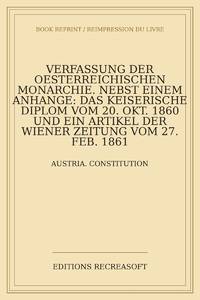
2026réf. LRB32008501Paris: Editions Recreasoft 2026 Sprache: Deutsch. Ca. 612 Seiten. Deutsch : Nachdruck auf Anfrage. Originalausgabe : 1861. Werk auf Deutsch. Diese Ausgabe enthält die Verfassung der Österreichischen Monarchie ergänzt durch ein Anhang mit dem kaiserlichen Diplom vom 20. Oktober 1860 und einem Artikel aus der Wiener Zeitung vom 27. Februar 1861. Das Werk bietet wertvolle Einblicke in die politische Struktur und rechtlichen Grundlagen des Habsburgerreichs im 19. Jahrhundert. Buchbilder sind unverbindlich English: Print-on-demand reprint. Original edition : 1861. Text in German. This edition features the Constitution of the Austrian Monarchy supplemented by an appendix containing the imperial diploma of October 20 1860 and an article from the Wiener Zeitung of February 27 1861. The work provides valuable insights into the political structure and legal foundations of the Habsburg Empire in the 19th century. Book images are non-contractual. Editions Recreasoft. Softcover. New. Editions Recreasoft paperback
réf. 0483556955.Ghardcover. Good. Access codes and supplements are not guaranteed with used items. May be an ex-library book. hardcover
2006réf. 76534Washington DC: U. S. Government Printing Office 2006. Presumed First Edition First printing. Wraps. Good. Serial No. 109-79. Volume I ONLY. Volume I v 1 1684 6 pages. During this hearing Representative John Lewis of Georgia stated "The Voting Rights Act helped expand our democracy and open up our democracy to elect hundreds of thousands and millions of our citizens who had been kept out let them in. The Voting Rights Act was needed then and it is needed now. The purpose of section 5 is very unique and very important. It prevents discriminatory plans from being enacted in the first place. It put the burden on the judiciary to show that the plan does not discriminate against minority voters. Congress Lewis continued "Prior to section 5 the burden was on the minority voters to challenge the voting practice; and every section was good at coming up with different procedures that had the same result discrimination. Anita Earls' testimony talks in some detail about the recent example how this is still happening. The difference is that we have section 5 to prevent these practices from harming minority voters. Many people like the court said that we have come a long ways; and again today I would say that we've come a distance. We've come a long way and that is true. We're not the same Nation that we were 40 years ago but it's clear today that we have not come far enough. Section 5 is still needed. Today section 5 prevents discrimination and redistricting and changes that move voting locations out of minority neighborhoods into less accessible areas. These are issues that are different from the fight to register to vote but they are no less fundamental." U. S. Government Printing Office paperback
2006réf. 76537Washington DC: U. S. Government Printing Office 2006. Presumed First Edition First printing. Wraps. Good. Serial No. 109-103. 4 volume set. Volume I v 1 1453 5 pages. Volume II v 1. 1455-2388 2. Volume III v 1 2389-4296. Volume IV v 1 4297-5711 3 pages. Footnotes. Illustrations. The Subcommittee will be holding its tenth hearing examining the Voting Rights Act of 1965 and the temporary provisions that are to expire. They're set to expire in 2007 unless we reauthorize by Congress which I think most of us anticipate will occur. The Subcommittee examined each of the expiring provisions in great detail. This afternoon we examine the evidence of continued discrimination against racial and language minority citizens since 1982 that have been compiled by a number of non-governmental organizations who will be testifying. I'd thank these organizations for the time and effort that they have put into completing these reports and in making sure that this Committee and Congress has before it a complete and accurate record of discrimination over the last 25 years. In continuing to reauthorize the temporary provisions Congress on four separate occasions examined the extent to which discrimination continued to exist by analyzing information such as enforcement statistics minority voter registration rates minority voter turnout and litigation pursued to protect minority voting rights. Federal agencies such as the United States Commission on Civil Rights were instrumental in investigating analyzing and reporting back to Congress on the state of minority voting during each consideration. Each time Congress concluded based upon the evidence presented that the exceptional conditions which existed in 1966 continued to exist in 1970 1975 1982 and in 1992 when it was last reauthorized. This afternoon the Committee continues to examine whether the exceptional conditions warranting the extension of the temporary provisions continue to exist in 2006. U. S. Government Printing Office paperback
2006réf. 76533Washington DC: U. S. Government Printing Office 2006. Presumed First Edition First printing. Wraps. Good. Serial No. 109-79. Two volumes. Volume I v 1 1684 6 pages Volume II v 1 1685-3375 pages. During this hearing Representative John Lewis of Georgia stated "The Voting Rights Act helped expand our democracy and open up our democracy to elect hundreds of thousands and millions of our citizens who had been kept out let them in. The Voting Rights Act was needed then and it is needed now. The purpose of section 5 is very unique and very important. It prevents discriminatory plans from being enacted in the first place. It put the burden on the judiciary to show that the plan does not discriminate against minority voters. Congress Lewis continued "Prior to section 5 the burden was on the minority voters to challenge the voting practice; and every section was good at coming up with different procedures that had the same result discrimination. Anita Earls' testimony talks in some detail about the recent example how this is still happening. The difference is that we have section 5 to prevent these practices from harming minority voters. Many people like the court said that we have come a long ways; and again today I would say that we've come a distance. We've come a long way and that is true. We're not the same Nation that we were 40 years ago but it's clear today that we have not come far enough. Section 5 is still needed. Today section 5 prevents discrimination and redistricting and changes that move voting locations out of minority neighborhoods into less accessible areas. These are issues that are different from the fight to register to vote but they are no less fundamental." U. S. Government Printing Office paperback
2006réf. 76535Washington DC: U. S. Government Printing Office 2006. Presumed First Edition First printing. Wraps. Good. Serial No. 109-83. Part I ONLY. Volume I iv 1446 22 pages. This Committee will focus on section 203 the provision authorizing bilingual language assistance to American citizens who are members of covered language minority groups and who have limited English proficiency. Section 203 has not been revisited by Congress since 1992 and like the sections that we have discussed in previous hearings is set to expire in 2007 unless reauthorized. The Voting Rights Act was enacted in 1965 in response to a history of racial discrimination against some of our Nation's citizens. In 1975 Congress expanded the Voting Rights Act to include section 203 and its companion section 4f. Section 203 requires certain jurisdictions to provide bilingual election assistance-including notices instructions information and ballots-to citizens who are members of a designated language minority group and who have limited English proficiency. As cited in the 1975 House Report section 203 was added in response to ''an extensive evidentiary record demonstrating the prevalence of voting discrimination and high illiteracy rates among language minorities.'' This record revealed that similar discrimination patterns and practices that had been used to prevent African-Americans from voting were being administered against Asian-Americans American Indians Native Alaskans and citizens of Hispanic origin. These citizens are more than likely to live in environments in which the dominant language is other than English. Section 203 breaks down these barriers by providing citizens in a language minority group with the assistance necessary to participate in the political process. Section 203 has enabled an increased number of minority citizens to register and cast ballots as revealed in the last Census and latest election records. U. S. Government Printing Office paperback
2006réf. 76538Washington DC: U. S. Government Printing Office 2006. Presumed First Edition First printing. Wraps. Good. Serial No. 109-103. Volume IV ONLY. Volume IV v 1 4297-5711 3 pages. Footnotes. Illustrations. This volume contains the Appendix to Hearings: Table of Contents and Appendix Materials Continued from the National Commission on the Voting Rights Act. The Subcommittee will be holding its tenth hearing examining the Voting Rights Act of 1965 and the temporary provisions that are to expire. They're set to expire in 2007 unless we reauthorize by Congress which I think most of us anticipate will occur. The Subcommittee examined each of the expiring provisions in great detail. This afternoon we examine the evidence of continued discrimination against racial and language minority citizens since 1982 that have been compiled by a number of non-governmental organizations who will be testifying. I'd thank these organizations for completing these reports and in making sure that this Committee has before it a complete and accurate record of discrimination over the last 25 years. In continuing to reauthorize the temporary provisions Congress on four separate occasions examined the extent to which discrimination continued to exist by analyzing information such as enforcement statistics minority voter registration rates minority voter turnout and litigation pursued to protect minority voting rights. Federal agencies such as the United States Commission on Civil Rights were instrumental in investigating analyzing and reporting back to Congress on the state of minority voting during each consideration. Each time Congress concluded based upon the evidence presented that the exceptional conditions which existed in 1966 continued to exist in 1970 1975 1982 and in 1992 when it was last reauthorized. This afternoon the Committee continues to examine whether the exceptional conditions warranting the extension of the temporary provisions continue to exist in 2006. U. S. Government Printing Office paperback
2006réf. 76619Washington DC: U. S. Government Printing Office 2006. Presumed First Edition First printing. Wraps. Good. Serial No. 109-103. 3 of 4 volume set. Volume I v 1 1453 5 pages. Volume II v 1. 1455-2388 2. Volume III v 1 2389-4296. Volume IV NOT PRESENT. Footnotes. Illustrations. The Subcommittee will be holding its tenth hearing examining the Voting Rights Act of 1965 and the temporary provisions that are to expire. They're set to expire in 2007 unless we reauthorize by Congress which I think most of us anticipate will occur. The Subcommittee examined each of the expiring provisions in great detail. This afternoon we examine the evidence of continued discrimination against racial and language minority citizens since 1982 that have been compiled by a number of non-governmental organizations who will be testifying. I'd thank these organizations for the time and effort that they have put into completing these reports and in making sure that this Committee and Congress has before it a complete and accurate record of discrimination over the last 25 years. In continuing to reauthorize the temporary provisions Congress on four separate occasions examined the extent to which discrimination continued to exist by analyzing information such as enforcement statistics minority voter registration rates minority voter turnout and litigation pursued to protect minority voting rights. Federal agencies such as the United States Commission on Civil Rights were instrumental in investigating analyzing and reporting back to Congress on the state of minority voting during each consideration. Each time Congress concluded based upon the evidence presented that the exceptional conditions which existed in 1966 continued to exist in 1970 1975 1982 and in 1992 when it was last reauthorized. This afternoon the Committee continues to examine whether the exceptional conditions warranting the extension of the temporary provisions continue to exist in 2006. U. S. Government Printing Office paperback
2006réf. 76448Washington DC: U. S. Government Printing Office 2006. Presumed First Edition First printing. Wraps. Good. iii 1 302. 6 pages. Illustrations. Occasional footnotes. Some bottom corners curved at front and back. The chairman stated: Today we will examine the impact that Federal examiners and observers have had on increasing minority participation in the political process and the continued need for these provisions in the future. The Voting Rights Act of 1965 is a landmark piece of federal legislation in the United States that prohibits racial discrimination in voting.78 It was signed into law by President Lyndon B. Johnson during the height of the Civil Rights Movement on August 6 1965 and Congress later amended the Act five times to expand its protections.7 Designed to enforce the voting rights guaranteed by the Fourteenth and Fifteenth Amendments to the United States Constitution the Act secured the right to vote for racial minorities throughout the country especially in the South. According to the U.S. Department of Justice the Act is considered to be the most effective piece of federal civil rights legislation ever enacted in the country. U. S. Government Printing Office paperback
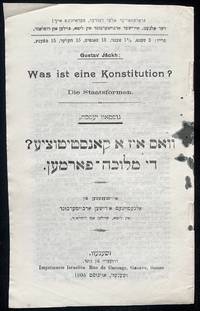
1905réf. 43542Zhenev Geneva: Imprimerie Israelite Rue de Carouge 1905. First Yiddish Edition. Original paper wrappers small 8vo 27 pages. In Yiddish. The title translates as "What is a Constitution Forms of Govenment." Printed on thin paper as was often used for Bundist publications from Geneva which were intended for legal and illegal distribution in Bundist strongholds across Europe and the Americas. Bundist pamphlet on constitutions by Gustav Jaeckh the well known historian and critical theorist who wrote one of the first historical chronicles of the First International. Published by the Bund in during the 1905 Russian Revolution during which it was a dominant revolutionary force and "the largest socialist group in the Russian Empire" Mendes Philip. The Rise and Fall of the Jewish Labor Bund jewishcurrents.org November 30 2013. OCLC: 122856344. OCLC locates only 3 copies worldwide HUC YIVO Institute for Social History only 2 in the US. Creasing/crinkling to thin paper a few stains no tears Very Good Condition thus. PSB-1-24-XX. Zhenev [Geneva]: Imprimerie Israelite Rue de Carouge unknown
1967réf. 2090502113711536Not Available 1967. Soft Cover. Fine. The book is in fine condition. Not Available paperback
1925réf. 48025Berlin Julius Springer 1925. Contemp. hcloth. Gilt lettering to spine. In: "Zeitschrift für Physik. Hrsg. von Karl Scheel" 32. Band. VI951 pp. textillustr. Entire volume offered. Heisenberg's paper: pp. 841-860. A small erased stamp on titlepage leaving two small holes no loss of text. Internally clean. First appearance of Heisenberg's importent paper on the complex spectra of many-electron atoms - the third paper Heisenberg submitted from Copenhagen on the Quantum Theory."The paper on multiplet structure and anomalous Zeeman effects. contained a complete discussion of the problem at that time. This paper had the blessing of Niels Bohr; also Pauli who wasin Copenhagen when the paper was completed agreed with its overall content. The central goal of the paper was to formulate what Bohr called 'the stress constraint which is not analogous to the action of external forces' and to derive quantitative conclusions from it." Mehra and rechenberg "The Historical development of Quantum Theory" vol. 2 p. 201.The volume contains another importent paper in the history of Quantum Physics: W. BOTHE und H. GEIGER "Über das Wesen des Comptoneffekts ein experimenteller Beitrag zur Theorie der Strahlung" pp. 639-663. hardcover
1925réf. 49362Berlin Julius Springer 1925. Contemp. hcloth. In: "Zeitschrift für Physik. Hrsg. von Karl Scheel" 32. Band. VI951 pp. textillustr. Entire volume offered. Heisenberg's paper: pp. 841-860. A stamp to title-page and front free endpaper. Interally clean. First printing of Heisenberg's importent paper on the complex spectra of many-electron atoms - the third paper Heisenberg submitted from Copenhagen on the Quantum Theory."The paper on multiplet structure and anomalous Zeeman effects. contained a complete discussion of the problem at that time. This paper had the blessing of Niels Bohr; also Pauli who was in Copenhagen when the paper was completed agreed with its overall content. The central goal of the paper was to formulate what Bohr called 'the stress constraint which is not analogous to the action of external forces' and to derive quantitative conclusions from it." Mehra and Rechenberg "The Historical development of Quantum Theory" vol. 2 p. 201.The volume contains another importent paper in the history of Quantum Physics: W. BOTHE und H. GEIGER "Über das Wesen des Comptoneffekts ein experimenteller Beitrag zur Theorie der Strahlung" pp. 639-663. hardcover