Constitution, IdahoBiblio.com
1308 risultati
rif. 1019648112.Ghardcover. Good. Access codes and supplements are not guaranteed with used items. May be an ex-library book. hardcover
rif. 1019477075.Ghardcover. Good. Access codes and supplements are not guaranteed with used items. May be an ex-library book. hardcover
rif. 133478177X.Gpaperback. Good. Access codes and supplements are not guaranteed with used items. May be an ex-library book. paperback
1825rif. 6784Paris: Dondey-Dupre Pere et Fils 1825. Hardcover Tapa dura. 133x80mm. 5¼x3¼". Paris Dondey-Dupre Pere et Fils 1825. En 12º 133 x 80mm. 110 pp. 1 h. Encuadernación de la época en piel. Primera edición francesa. La Constitución Federal de los Estados Unidos Mexicanos de 1824 entró en vigor el 4 de octubre de ese año después del Imperio Mexicano de Agustín de Iturbide. En la nueva Constitución la República tomaba el nombre de Estados Unidos Mexicanos y era definida como una República Federal Representativa. Esta traducción francesa es rara en comercio. Dondey-Dupre Pere et Fils hardcover
1990rif. 2090502113702484Not Available 1990. Soft Cover. Fine. The book is in fine condition. Not Available paperback
rif. 1168894476.Ghardcover. Good. Access codes and supplements are not guaranteed with used items. May be an ex-library book. hardcover
1795rif. NS0005Paris L'An 3 de la Republique Française une & indivisible. Hard Cover. 8vo; 56 pages a-c8 d4. Dated p. 56: 5 Fructidor l'an troisième i. e. 22 Aug. 1795. Signed p. 56 by Chenier président; Dersey Solignac Bernier Laurenceat Dentzel Quirot sécrétaires. The French Convention Nationale 1792-1795 had governed without a constitution. That of 1791 had been replaced by a more radical one of 1793 which was never activated. "The post-Robespierrist Convention continuing the reaction against popular revolutionism. elements of direct democracy that had characterized the earlier constitution were abandoned but the new one preserved the basic changes brought by the Revolution" see R.R. Palmer Age of Democratic Revolution 2: 214. This edition seems to be unrecorded. It is signed by the members of the committee that drafted it chaired by playwright Marie-Joseph Chenier 1764-1811. The edition seems to be an attempt to persuade people to accept its terms. This Constitution was rejected by even more reactionary elements and led to establishment of the Directorate in October 1795. Not in NUC; not in Martin & Walter cf. 4: 2: 4140. Very Good in contemporary boards leather spine. Stock#NS0005. L'An 3 de la République Française une & indivisible. hardcover
rif. 0666093644.Ghardcover. Good. Access codes and supplements are not guaranteed with used items. May be an ex-library book. hardcover
rif. 133139418X.Gpaperback. Good. Access codes and supplements are not guaranteed with used items. May be an ex-library book. paperback
1919rif. 438948London : People's Russian Information Bureau 1919. First Edition. Softcover. Very good paperback copy; edges somewhat dust-dulled and nicked. Remains quite well-preserved overall. Physical description; 17 pages ; 18 cm. Subjects; King David Collection. Constitutional law. Russia Federation Constitutional law. Russia Federation. Soviet Union. Soviet Union ; Constitution. Soviet Union Politics and government 1917-1936. London : People's Russian Information Bureau paperback
rif. 0844405604.Gpaperback. Good. Access codes and supplements are not guaranteed with used items. May be an ex-library book. paperback
1822rif. 12181Lisboa: Impresa Nacional 1822. Lisboa Imprensa Nacional 1822. En 8º mayor. 100 pp. Encuadernación en cartoné tejuelo de piel en el plano superior con letrería dorada. Primera edición de la primera Constitución Portuguesa votada en Cortes extraordinarias y constituyentes el 23 de Septiembre de 1822 y aceptada por el rey D. João VI en octubre del mismo año. Considerada como un triunfo de los liberales contenía 240 artículos en su mayoría inspirados cuando no directamente copiados de la constitución española de 1812: cesión de soberanía al pueblo e independencia de los poderes legislativo ejecutivo y judicial. Esta es la Constitución que los Andradas y otros diputados brasileños se negaron a firmar. Bien acogida en un principio por los brasileños supuso al final el detonante de la independencia de Brasil. Varios días antes de la publicación del "Suplemento" en Lisboa las Cortes declararon el gobierno brasileño subordinado a la constitución lo que fue rechazado por los representantes brasileños quienes comandados por Andradas declararon la independencia de Brasil en 1822. Inscripción en tinta en la portada ligeras manchas ocasionales papel ligeramente tostado. Impresa Nacional unknown
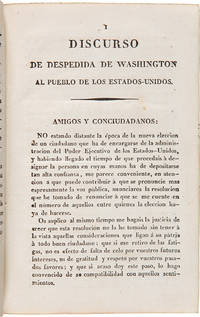
rif. 55421Mexico: Imprenta a cargo de Martin Rivera 1823. First Mexican Printing of the U.S. Constitution This is the first Mexican printing of the United States Constitution accompanied by two important addresses by George Washington. This work was produced in anticipation of Mexican independence from Spain and the U.S. Constitution in particular provided inspiration to the drafters of the constitution of newly-independent Mexico. Written in 1824 it was the first constitution of Mexico as a sovereign state and the constitution under which the colonization of Texas by Americans would take place. It is ample evidence of the transnational influence on the United States Constitution on emerging democracies in this case America's neighbor to the south. All seven articles of the United States Constitution are printed in full in Spanish in a section that is headed by a Federal garland ornament. The names of all the signers are given at the conclusion of the main text. This is followed by a section printing the first twelve amendments titled here as "Correcciones" an interesting interpretation of the role of constitutional amendments. The final page contains the text of an amendment passed by the House and Senate and signed in print by Senate President pro tem John Gaillard and House Speaker J.B. Varnum prohibiting any American citizen from accepting a title of nobility or honor from a foreign government under threat of losing one's American citizenship and holding any further elective office. This "Titles of Nobility" amendment was passed by Congress in 1810 and came close to ratification by two-thirds of the states in the 1810s but has to this day never been ratified. The inclusion of this amendment is an interesting commentary on the priorities and concerns of Mexican lawmakers. The U.S. Constitution is preceded by two chapters printing addresses by George Washington whose actions following the American Revolution and his two terms as President were influential well beyond the borders of the United States. The first chapter prints Washington's 1796 Farewell Address to the United States "Discurso de Despedida de Washington al Pueblo de los Estados-Unidos". Designed by Washington and his principal advisors in drafting it—James Madison and Alexander Hamilton—as both a valedictory and advice to succeeding generations the address served as a guidepost to Americans from the point of its publication. The Farewell Address would have been of particular interest to the Mexican Constitutional framers. The second section prints Washington's Address to the Continental Army in 1783 "Carta Circular del General Washington a los Gobernadores de los Estados fecha en el Cuartel General de Newburgh 18 de Junio de 1783". In this circular letter General Washington announces his intention to resign his command of the Continental Army and retire into private life. He also expounds in detail on the serious issues facing the nascent United States government. Both of Washington's addresses are printed fully in Spanish as is the Constitution. OCLC records just ten holding institutions over three records. This is the first copy that we can find in the market in over a century and the first copy we have handled of this first Mexican printing of the United States Constitution. Small octavo. Contemporary mottled Mexican sheep spine gilt. Minor edge wear light scuffing to boards short worm track on front board. Small ownership mark reading "JNB" branded on front and rear pastedowns ink ownership signature of "De Francisco Gonzalez de Cossio" on front flyleaf. Internally clean. Very good. OCLC 24072481 503926127 1097838706. SABIN 16060. PALAU 59641 374086. hardcover books
rif. 55421Mexico: Imprenta a cargo de Martin Rivera 1823. First Mexican Printing of the U.S. Constitution This is the first Mexican printing of the United States Constitution accompanied by two important addresses by George Washington. This work was produced in anticipation of Mexican independence from Spain and the U.S. Constitution in particular provided inspiration to the drafters of the constitution of newly-independent Mexico. Written in 1824 it was the first constitution of Mexico as a sovereign state and the constitution under which the colonization of Texas by Americans would take place. It is ample evidence of the transnational influence on the United States Constitution on emerging democracies in this case America's neighbor to the south. All seven articles of the United States Constitution are printed in full in Spanish in a section that is headed by a Federal garland ornament. The names of all the signers are given at the conclusion of the main text. This is followed by a section printing the first twelve amendments titled here as "Correcciones" an interesting interpretation of the role of constitutional amendments. The final page contains the text of an amendment passed by the House and Senate and signed in print by Senate President pro tem John Gaillard and House Speaker J.B. Varnum prohibiting any American citizen from accepting a title of nobility or honor from a foreign government under threat of losing one's American citizenship and holding any further elective office. This "Titles of Nobility" amendment was passed by Congress in 1810 and came close to ratification by two-thirds of the states in the 1810s but has to this day never been ratified. The inclusion of this amendment is an interesting commentary on the priorities and concerns of Mexican lawmakers. The U.S. Constitution is preceded by two chapters printing addresses by George Washington whose actions following the American Revolution and his two terms as President were influential well beyond the borders of the United States. The first chapter prints Washington's 1796 Farewell Address to the United States "Discurso de Despedida de Washington al Pueblo de los Estados-Unidos". Designed by Washington and his principal advisors in drafting it—James Madison and Alexander Hamilton—as both a valedictory and advice to succeeding generations the address served as a guidepost to Americans from the point of its publication. The Farewell Address would have been of particular interest to the Mexican Constitutional framers. The second section prints Washington's Address to the Continental Army in 1783 "Carta Circular del General Washington a los Gobernadores de los Estados fecha en el Cuartel General de Newburgh 18 de Junio de 1783". In this circular letter General Washington announces his intention to resign his command of the Continental Army and retire into private life. He also expounds in detail on the serious issues facing the nascent United States government. Both of Washington's addresses are printed fully in Spanish as is the Constitution. OCLC records just ten holding institutions over three records. This is the first copy that we can find in the market in over a century and the first copy we have handled of this first Mexican printing of the United States Constitution. Small octavo. Contemporary mottled Mexican sheep spine gilt. Minor edge wear light scuffing to boards short worm track on front board. Small ownership mark reading "JNB" branded on front and rear pastedowns ink ownership signature of "De Francisco Gonzalez de Cossio" on front flyleaf. Internally clean. Very good. OCLC 24072481 503926127 1097838706. SABIN 16060. PALAU 59641 374086. hardcover
rif. 028210285X.Gpaperback. Good. Access codes and supplements are not guaranteed with used items. May be an ex-library book. paperback
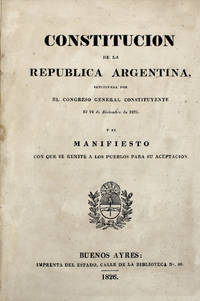
1826rif. 6783Buenos Aires: Imprenta del Estado 1826. First Edition Primera edición. Softcover Tapa blanda. 190x135mm. 7½x5¼". Buenos Aires Imprenta del Estado 24 de Diciembre de 1826. En 4º 190 x 135mm. 2 55 pp. Guardas de papel. Primera edición. Comienza con un Manifiesto del Congreso General Constituyente a los pueblos de la República Argentina. La Constitución de la República Argentina de 1826 estableció una forma de gobierno "representativa republicana consolidada en unidad de régimen adoptando oficialmente la religión Católica Apostólica Romana". Para la sanción de aquella constitución fueron consultadas las Provincias acerca de la forma de Estado: Salta y La Rioja se pronunciaron por el régimen unitario al igual que Tucumán pero curiosamente aclaró que quería conservar sus instituciones. Mendoza San Juan Santiago del Estero Tarija Entre Ríos Santa Fe y Córdoba se manifestaron por el sistema federal. San Luis Catamarca Corrientes y la Banda Oriental por lo que resolviese el Congreso en tanto que Buenos Aires y Misiones no opinaron. Primeras hojas ligeramente amarronadas. Imprenta del Estado paperback
1976rif. 11992Madrid: Aguilar Ed. 1976.- 374 p.: 28 ilus.; 16avo.; Plena Piel Ed.- Crisolín. 039. GUERRA DE LA INDEPENDENCIA-FERNANDO VII Libro en español Aguilar Ed. hardcover
rif. 1019516534.Ghardcover. Good. Access codes and supplements are not guaranteed with used items. May be an ex-library book. hardcover
rif. 46693428like new. unknown
1926rif. 184330Montevideo : Claudio Garcia 1926. 1st Edition in this form. Paperback. Very good paperback copy; edges slightly dust-dulled and nicked. Rounded corners. Remains particularly and surprisingly well-preserved overall; tight bright clean and especially sharp-cornered.; 8vo 8"" - 9"" tall; 91 pages; Description: 91p. 19cm. Subjects: Uruguay - Constitution - Constitutional law. Series: Coleccion de manuales de derecho y legislacion. ""La bolsa de los libros - Montevideo"" stamp to front cover and title. Language: Spanish. [Montevideo] : Claudio Garcia paperback
rif. 1391956982.Ghardcover. Good. Access codes and supplements are not guaranteed with used items. May be an ex-library book. hardcover
1875rif. 41190Puebla Imprenta del Hospicio 1875. Paperback. Good. 176p. wrps lacks wrps. Puebla, Imprenta del Hospicio paperback
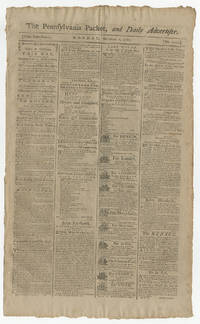
1787rif. 24135U.S. CONSTITUTION.Newspaper. The Pennsylvania Packet and Daily Advertiser. October 1 1787 No. 2700 Philadelphia: John Dunlap and David C. Claypoole including the September 28 resolution of the Confederation Congress to send to the states for ratification the recently completed U. S. Constitution. 4 pp. 12 x 18¾ in. "The United States in Congress Assembled. Friday September 28 1787. CONGRESS having received the Report of the CONVENTION lately assembled in Philadelphia Resolved unanimously THAT the said report with the resolutions and letter accompanying the same be transmitted to the several legislatures in order to be submitted to a convention of delegates chose in each state by the people thereof in conformity to the resolves of the convention made and provided in that case. CHARLES THOMSON Secretary." p2/c3 The convention called to revise the Articles of Confederation met in the Pennsylvania's State House in Philadelphia starting on May 25 1787. After many delegates agreed that the Articles could not be sufficiently improved they started to draft an entirely new structure. Maintaining their pledge of secrecy after months of private deliberations over trade defense taxation representation separation of powers the election of a president the slave trade international relations and many other issues the proposed United States Constitution was signed by thirty-nine of the fifty-five delegates on September 17. Two days later the Constitution was first published by the Pennsylvania Packetand four other Philadelphia newspapers. The cover letter sent by George Washington president of what came to be called the Constitutional Convention submitting the plan to Arthur St. Clair the President of the Congress of the Confederation in New York was also printed then. Congress received and read the proposed Constitution on September 20th. As a sampling of their deliberations William Grayson of Virginia thought it was too weak while Richard Henry Lee of Virginia and Nathan Dane of Massachusetts thought it was too strong. On September 27 Virginia's Richard Henry Lee proposed that the Constitution be sent to the executives of each of the states. A Delaware representative quickly added "in order to be by them submitted to conventions of delegates to be chosen agreeably to the said resolutions of the convention." Ten of the twelve states then represented in Congress voted in favor. Before Congress adjourned for the day the majority of Virginia's representatives and a minority of New York's representatives also indicated their support. On September 28 Federalists holding out for a unanimous vote found a way to compromise with anti-Federalists: Congress unanimously resolved to send the Constitution to the states but without any recommendation or approval. Arider from New York City arrived in Philadelphia with the resolution that same day. George Clymer presented his own resolution to the Pennsylvania Assembly noting that "the late Federal Convention has digested a plan of government for the United States and recommended that it should be referred to the consideration of State Conventions…" After a "very long and animated debate" Clymer's resolution passed by a vote of 43 to 19 and adjourned until 4:00 p.m. But only 44 members returned falling two shy of the necessary quorum. The Assembly's sergeant-at-arms was sent to show the resolution to absent members. Two who still refused to attend were seized by the public dragged through the streets and thrust into the assembly room. The involuntarily completed quorum voted that "it is the sense of great numbers of the grand people of this state already signified in petitions & declarations to this house that the earliest steps should be taken to assemble a convention within the state for the purpose of deliberating and determining on the said constitution." They called for the election of deputies who would assemble for that purpose "on the third Tuesday of November at the State-house in the city of Philadelphia…" p2/c3-4 Other articles of interest in this issue include news from Europe and a brief piece against Indians "from the western country who still continue their depredations on the whites…" p2/c3 The Pennsylvania Packet or the General Advertiser1771-1839 was founded by John Dunlap in late 1771 as a weekly newspaper in Philadelphia though it relocated to Lancaster during the British occupation of Philadelphia in 1777-1778. On May 30 1783 Benjamin Towne turned the Pennsylvania Evening Post into the first daily newspaper in the United States. However with Towne branded a traitor and forced to hawk his own papers on the street the newspaper collapsed the following year. John Dunlap and David Claypoole then made their Pennsylvania Packet the first successful daily on September 21 1784. It underwent numerous name changes in the 1790s until sold in 1800 and renamed Poulson's American Daily Advertiser. John Dunlap and David C. Claypoole books
1787rif. 24135U.S. CONSTITUTION.Newspaper. The Pennsylvania Packet and Daily Advertiser. October 1 1787 No. 2700 Philadelphia: John Dunlap and David C. Claypoole including the September 28 resolution of the Confederation Congress to send to the states for ratification the recently completed U. S. Constitution. 4 pp. 12 x 18¾ in. "The United States in Congress Assembled. Friday September 28 1787. CONGRESS having received the Report of the CONVENTION lately assembled in Philadelphia Resolved unanimously THAT the said report with the resolutions and letter accompanying the same be transmitted to the several legislatures in order to be submitted to a convention of delegates chose in each state by the people thereof in conformity to the resolves of the convention made and provided in that case. CHARLES THOMSON Secretary." p2/c3 The convention called to revise the Articles of Confederation met in the Pennsylvania's State House in Philadelphia starting on May 25 1787. After many delegates agreed that the Articles could not be sufficiently improved they started to draft an entirely new structure. Maintaining their pledge of secrecy after months of private deliberations over trade defense taxation representation separation of powers the election of a president the slave trade international relations and many other issues the proposed United States Constitution was signed by thirty-nine of the fifty-five delegates on September 17. Two days later the Constitution was first published by the Pennsylvania Packetand four other Philadelphia newspapers. The cover letter sent by George Washington president of what came to be called the Constitutional Convention submitting the plan to Arthur St. Clair the President of the Congress of the Confederation in New York was also printed then. Congress received and read the proposed Constitution on September 20th. As a sampling of their deliberations William Grayson of Virginia thought it was too weak while Richard Henry Lee of Virginia and Nathan Dane of Massachusetts thought it was too strong. On September 27 Virginia's Richard Henry Lee proposed that the Constitution be sent to the executives of each of the states. A Delaware representative quickly added "in order to be by them submitted to conventions of delegates to be chosen agreeably to the said resolutions of the convention." Ten of the twelve states then represented in Congress voted in favor. Before Congress adjourned for the day the majority of Virginia's representatives and a minority of New York's representatives also indicated their support. On September 28 Federalists holding out for a unanimous vote found a way to compromise with anti-Federalists: Congress unanimously resolved to send the Constitution to the states but without any recommendation or approval. Arider from New York City arrived in Philadelphia with the resolution that same day. George Clymer presented his own resolution to the Pennsylvania Assembly noting that "the late Federal Convention has digested a plan of government for the United States and recommended that it should be referred to the consideration of State Conventions…" After a "very long and animated debate" Clymer's resolution passed by a vote of 43 to 19 and adjourned until 4:00 p.m. But only 44 members returned falling two shy of the necessary quorum. The Assembly's sergeant-at-arms was sent to show the resolution to absent members. Two who still refused to attend were seized by the public dragged through the streets and thrust into the assembly room. The involuntarily completed quorum voted that "it is the sense of great numbers of the grand people of this state already signified in petitions & declarations to this house that the earliest steps should be taken to assemble a convention within the state for the purpose of deliberating and determining on the said constitution." They called for the election of deputies who would assemble for that purpose "on the third Tuesday of November at the State-house in the city of Philadelphia…" p2/c3-4 Other articles of interest in this issue include news from Europe and a brief piece against Indians "from the western country who still continue their depredations on the whites…" p2/c3 The Pennsylvania Packet or the General Advertiser1771-1839 was founded by John Dunlap in late 1771 as a weekly newspaper in Philadelphia though it relocated to Lancaster during the British occupation of Philadelphia in 1777-1778. On May 30 1783 Benjamin Towne turned the Pennsylvania Evening Post into the first daily newspaper in the United States. However with Towne branded a traitor and forced to hawk his own papers on the street the newspaper collapsed the following year. John Dunlap and David Claypoole then made their Pennsylvania Packet the first successful daily on September 21 1784. It underwent numerous name changes in the 1790s until sold in 1800 and renamed Poulson's American Daily Advertiser. John Dunlap and David C. Claypoole
rif. 19152, Brasilia, Centro grafico do senado federal 1988, in-8, br., neuf, ENVOI, 292p.