Uruguay - ConstitutionBiblio.com

1,374 results
1926ref. 184330Montevideo : Claudio Garcia 1926. 1st Edition in this form. Paperback. Very good paperback copy; edges slightly dust-dulled and nicked. Rounded corners. Remains particularly and surprisingly well-preserved overall; tight bright clean and especially sharp-cornered.; 8vo 8"" - 9"" tall; 91 pages; Description: 91p. 19cm. Subjects: Uruguay - Constitution - Constitutional law. Series: Coleccion de manuales de derecho y legislacion. ""La bolsa de los libros - Montevideo"" stamp to front cover and title. Language: Spanish. [Montevideo] : Claudio Garcia paperback
ref. 1391956982.Ghardcover. Good. Access codes and supplements are not guaranteed with used items. May be an ex-library book. hardcover
1875ref. 41190Puebla Imprenta del Hospicio 1875. Paperback. Good. 176p. wrps lacks wrps. Puebla, Imprenta del Hospicio paperback
ref. 4364In 8 demi-chagrin rouge à nerfs,titre doré,filets à froid. Faux-titre,titre,XXII ,218 pages,suivis de Essai sur le principe générateur des Constitutions politiques.Faux-titre,titre,XVI,91 pages.Lyon J.B Pelagaud & Cie 1846. Quelques rousseurs en marge supérieure aux dernières pages
ref. 010236Londres, Paris Barrois - Desenne 0 fort in-8 Reliure d'époque
ref. c4977Paris, Imprimerie de l' Assemblée Nationale, sans date (1963) ; livret in-12° broché, couverture gris pale imprimée en noir avec timbre-poste 0, 20+0, 10 F, oblitéré à la date du 20 décembre 1963; 34pp. ( dont les derniers feuillets roses.Livret fixant règlement et édité à l' occasion du Congrès du Parlement tenu à Versailles le décembre 1963, avec, oblitarétion philatélique " premier jour ".Très bon état.
1893ref. 60761893 Paris, Gauthier-Villars et fils, 1893. In-8, demi-chagrin lie de vin , dos lisse, orné de faux nerfs, titre auteur entre des filets dorés, ix, 379 p., diagrammes et illustrations in et hors texte. Première et unique traduction française de "Popular lectures and addresses" du célèbre physicien britannique, mieux connu en tant que Lord Kelvin
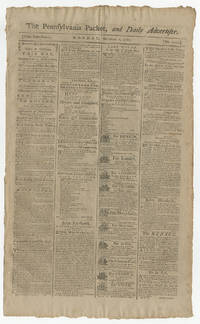
1787ref. 24135U.S. CONSTITUTION.Newspaper. The Pennsylvania Packet and Daily Advertiser. October 1 1787 No. 2700 Philadelphia: John Dunlap and David C. Claypoole including the September 28 resolution of the Confederation Congress to send to the states for ratification the recently completed U. S. Constitution. 4 pp. 12 x 18¾ in. "The United States in Congress Assembled. Friday September 28 1787. CONGRESS having received the Report of the CONVENTION lately assembled in Philadelphia Resolved unanimously THAT the said report with the resolutions and letter accompanying the same be transmitted to the several legislatures in order to be submitted to a convention of delegates chose in each state by the people thereof in conformity to the resolves of the convention made and provided in that case. CHARLES THOMSON Secretary." p2/c3 The convention called to revise the Articles of Confederation met in the Pennsylvania's State House in Philadelphia starting on May 25 1787. After many delegates agreed that the Articles could not be sufficiently improved they started to draft an entirely new structure. Maintaining their pledge of secrecy after months of private deliberations over trade defense taxation representation separation of powers the election of a president the slave trade international relations and many other issues the proposed United States Constitution was signed by thirty-nine of the fifty-five delegates on September 17. Two days later the Constitution was first published by the Pennsylvania Packetand four other Philadelphia newspapers. The cover letter sent by George Washington president of what came to be called the Constitutional Convention submitting the plan to Arthur St. Clair the President of the Congress of the Confederation in New York was also printed then. Congress received and read the proposed Constitution on September 20th. As a sampling of their deliberations William Grayson of Virginia thought it was too weak while Richard Henry Lee of Virginia and Nathan Dane of Massachusetts thought it was too strong. On September 27 Virginia's Richard Henry Lee proposed that the Constitution be sent to the executives of each of the states. A Delaware representative quickly added "in order to be by them submitted to conventions of delegates to be chosen agreeably to the said resolutions of the convention." Ten of the twelve states then represented in Congress voted in favor. Before Congress adjourned for the day the majority of Virginia's representatives and a minority of New York's representatives also indicated their support. On September 28 Federalists holding out for a unanimous vote found a way to compromise with anti-Federalists: Congress unanimously resolved to send the Constitution to the states but without any recommendation or approval. Arider from New York City arrived in Philadelphia with the resolution that same day. George Clymer presented his own resolution to the Pennsylvania Assembly noting that "the late Federal Convention has digested a plan of government for the United States and recommended that it should be referred to the consideration of State Conventions…" After a "very long and animated debate" Clymer's resolution passed by a vote of 43 to 19 and adjourned until 4:00 p.m. But only 44 members returned falling two shy of the necessary quorum. The Assembly's sergeant-at-arms was sent to show the resolution to absent members. Two who still refused to attend were seized by the public dragged through the streets and thrust into the assembly room. The involuntarily completed quorum voted that "it is the sense of great numbers of the grand people of this state already signified in petitions & declarations to this house that the earliest steps should be taken to assemble a convention within the state for the purpose of deliberating and determining on the said constitution." They called for the election of deputies who would assemble for that purpose "on the third Tuesday of November at the State-house in the city of Philadelphia…" p2/c3-4 Other articles of interest in this issue include news from Europe and a brief piece against Indians "from the western country who still continue their depredations on the whites…" p2/c3 The Pennsylvania Packet or the General Advertiser1771-1839 was founded by John Dunlap in late 1771 as a weekly newspaper in Philadelphia though it relocated to Lancaster during the British occupation of Philadelphia in 1777-1778. On May 30 1783 Benjamin Towne turned the Pennsylvania Evening Post into the first daily newspaper in the United States. However with Towne branded a traitor and forced to hawk his own papers on the street the newspaper collapsed the following year. John Dunlap and David Claypoole then made their Pennsylvania Packet the first successful daily on September 21 1784. It underwent numerous name changes in the 1790s until sold in 1800 and renamed Poulson's American Daily Advertiser. John Dunlap and David C. Claypoole books
1787ref. 24135U.S. CONSTITUTION.Newspaper. The Pennsylvania Packet and Daily Advertiser. October 1 1787 No. 2700 Philadelphia: John Dunlap and David C. Claypoole including the September 28 resolution of the Confederation Congress to send to the states for ratification the recently completed U. S. Constitution. 4 pp. 12 x 18¾ in. "The United States in Congress Assembled. Friday September 28 1787. CONGRESS having received the Report of the CONVENTION lately assembled in Philadelphia Resolved unanimously THAT the said report with the resolutions and letter accompanying the same be transmitted to the several legislatures in order to be submitted to a convention of delegates chose in each state by the people thereof in conformity to the resolves of the convention made and provided in that case. CHARLES THOMSON Secretary." p2/c3 The convention called to revise the Articles of Confederation met in the Pennsylvania's State House in Philadelphia starting on May 25 1787. After many delegates agreed that the Articles could not be sufficiently improved they started to draft an entirely new structure. Maintaining their pledge of secrecy after months of private deliberations over trade defense taxation representation separation of powers the election of a president the slave trade international relations and many other issues the proposed United States Constitution was signed by thirty-nine of the fifty-five delegates on September 17. Two days later the Constitution was first published by the Pennsylvania Packetand four other Philadelphia newspapers. The cover letter sent by George Washington president of what came to be called the Constitutional Convention submitting the plan to Arthur St. Clair the President of the Congress of the Confederation in New York was also printed then. Congress received and read the proposed Constitution on September 20th. As a sampling of their deliberations William Grayson of Virginia thought it was too weak while Richard Henry Lee of Virginia and Nathan Dane of Massachusetts thought it was too strong. On September 27 Virginia's Richard Henry Lee proposed that the Constitution be sent to the executives of each of the states. A Delaware representative quickly added "in order to be by them submitted to conventions of delegates to be chosen agreeably to the said resolutions of the convention." Ten of the twelve states then represented in Congress voted in favor. Before Congress adjourned for the day the majority of Virginia's representatives and a minority of New York's representatives also indicated their support. On September 28 Federalists holding out for a unanimous vote found a way to compromise with anti-Federalists: Congress unanimously resolved to send the Constitution to the states but without any recommendation or approval. Arider from New York City arrived in Philadelphia with the resolution that same day. George Clymer presented his own resolution to the Pennsylvania Assembly noting that "the late Federal Convention has digested a plan of government for the United States and recommended that it should be referred to the consideration of State Conventions…" After a "very long and animated debate" Clymer's resolution passed by a vote of 43 to 19 and adjourned until 4:00 p.m. But only 44 members returned falling two shy of the necessary quorum. The Assembly's sergeant-at-arms was sent to show the resolution to absent members. Two who still refused to attend were seized by the public dragged through the streets and thrust into the assembly room. The involuntarily completed quorum voted that "it is the sense of great numbers of the grand people of this state already signified in petitions & declarations to this house that the earliest steps should be taken to assemble a convention within the state for the purpose of deliberating and determining on the said constitution." They called for the election of deputies who would assemble for that purpose "on the third Tuesday of November at the State-house in the city of Philadelphia…" p2/c3-4 Other articles of interest in this issue include news from Europe and a brief piece against Indians "from the western country who still continue their depredations on the whites…" p2/c3 The Pennsylvania Packet or the General Advertiser1771-1839 was founded by John Dunlap in late 1771 as a weekly newspaper in Philadelphia though it relocated to Lancaster during the British occupation of Philadelphia in 1777-1778. On May 30 1783 Benjamin Towne turned the Pennsylvania Evening Post into the first daily newspaper in the United States. However with Towne branded a traitor and forced to hawk his own papers on the street the newspaper collapsed the following year. John Dunlap and David Claypoole then made their Pennsylvania Packet the first successful daily on September 21 1784. It underwent numerous name changes in the 1790s until sold in 1800 and renamed Poulson's American Daily Advertiser. John Dunlap and David C. Claypoole
ref. 0260646024.Ghardcover. Good. Access codes and supplements are not guaranteed with used items. May be an ex-library book. hardcover
ref. 0265013887.Gpaperback. Good. Access codes and supplements are not guaranteed with used items. May be an ex-library book. paperback
1791ref. 21491791 Tract de 1 p. in-8 (20,5 x 12 cm), slnd [Dijon, 1791].
ref. 1331006643.Gpaperback. Good. Access codes and supplements are not guaranteed with used items. May be an ex-library book. paperback
ref. 0656135484.Ghardcover. Good. Access codes and supplements are not guaranteed with used items. May be an ex-library book. hardcover
1782ref. 111429Göttingen, Vandenhoeck Witwe, 1782. 7 Bl., 370 S. Leder d. Zeit (beschabt u. bestoßen, Gelenke gebrochen). [2 Warenabbildungen]
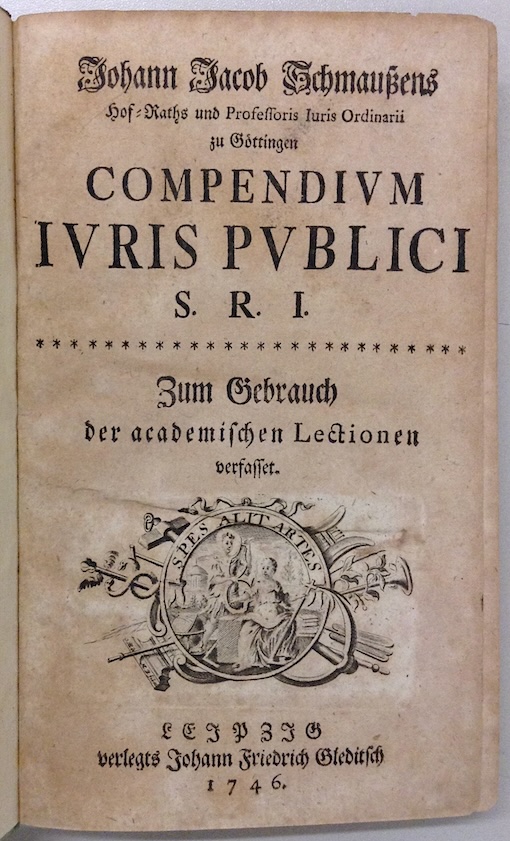
1746ref. 627967Leipzig, Gleditsch, 1746. 8 Bl., 256 S. Mit gestochener Titelvignette. Pappband d. Zeit (fleckig u. etwas bestoßen, Gelenke angebrochen). [2 Warenabbildungen]
1957160p. 8vo. Original full cloth binding, spine darkened. Original dust jacket, soiled. Hardbound. AMERICANA BOX 8
1949ref. ZB1089960NY 1949-1951. 2 volumes 672 679 pp. each ex library in card covers; good. - If you are reading this this item is actually physically in our stock and ready for shipment once ordered. We are not bookjackers. Buyer is responsible for any additional duties taxes or fees required by recipient's country. Photos available upon request. NY unknown
1783ref. 480681Turin, J. M. Briolus, 1783. 4to. 4 Bl., 378 S. Defekte Interimskartonage d. Zeit.
18298vo., First Edition; attractively bound in modern half calf, marbled sides, gilt back, uncut, laid endpapers, a bright, crisp, clean copy. An important and definitive history. SCARCE. Anderson p.190 (recording the third edition of 1869)
ref. 12258, Columbia, s. éd. 1958, br., bon état, 29p.
1997ref. 2090202120410871Kenseikinenkan 1997. Soft Cover. Fine. Number of books: 1 Kenseikinenkan paperback
ref. 0260794058.Gpaperback. Good. Access codes and supplements are not guaranteed with used items. May be an ex-library book. paperback
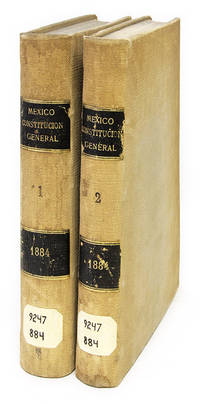
1884ref. 622541884. The Mexican Constitution in 1884 Mexico. Constitution. Coleccion que Comprende la Constitucion General de la Republica con sus Adiciones Reformas y Leyes Organicas Expedidas Hasta el 30 de Junio de 1884 y las Constituciones Especiales de Cada uno de los Estados de la Federacion. Mexico City: Imprenta del Gobierno en Palacio 1884. ii 451 2; ii 440 1 pp. Octavo 8-1/2" x 5-3/4". Later cloth red and black lettering pieces to spine endpapers renewed. Some soiling light fading to spine light wear to edges of lettering pieces. Moderate toning to text light foxing in a few places. Ex-library. Location label to spine stamps to title page annotations to verso. A solid copy of a scarce title. $450. Only edition. Mexico's 1857 constitution remained in force until 1917. It received numerous amendments and additions until its repeal which is why annotated editions from different periods are helpful. Coleccion also includes state constitutions. OCLC locates 7 copies in North American law libraries Columbia Harvard Library of Congress LA County St. Louis University University of Michigan University of Minnesota. See Clagett and Valderrama A Revised Guide to the Law & Legal Literature of Mexico 10. unknown books
1793ref. 167251793 A PARIS BARBOU, (1793.) .in 32mo.reliure pleine basane epoque,dos lisse titre,manque de cuir bas dos et charnieres,texte frais,pagination: 64+64+30 p.,tres rare- le 24 juin 1793, la Convention adopte et promulgue la Constitution de l’An I, la première Constitution républicaine et sociale française. Dans le préambule est énoncée la Déclaration des droits complétant celle du 26 août 1789. Assurément, la Constitution montagnarde de 1793 se singularise par l’élargissement des droits. En effet, aux simples droits formels individuels bourgeois proclamés en 1789, la Constitution de 1793 inclut les droits économiques et sociaux réels, tels que le droit au travail, le droit à la protection sociale, le droit à l’instruction.