41 résultats
1787réf. 67677London: Printed for D. Henry 1787. UNITED STATES CONSTITUTION; URBAN Sylvanus. One of The First Means by Which The British People Learned of The Enactment of The Constitution of The United States of America UNITED STATES CONSTITUTION subject. URBAN Sylvanus editor. The Gentleman's Magazine "New Constitution of the United States of America". Printed by John Nichols for D. Henry November December 1787. First edition of these November and December 1787 issues. Two small octavo volumes 8 1/2 x 5 1/8 inches; 215 x 130 mm. 941-1035 1; 1037-1131 1 pp. With woodcut text illustration on front wrapper of each volume. November issue with one fold-out plate and lacking plate I entitled "S.W. View of Aconbury Chapel 5 Miles from Here." The December issue with two plates plate II and Supp. but lacking plate I Illustrations of the Royal Charter School Near Dublin Clontarfe Castle Dublin and others. Text of American Constitution on pp. 1008-1011; 1110-1112. Self-wrappered. Newer stitching. Some very minor toning and light occasional spotting. Overall very good. This is the first English magazine printing of the U.S. Constitution. The November issue on pages 1008-1011 prints George Washington's Letter and the first Article. The December issue on pages 1110-1112 contains articles two through seven and the delegates names. "The following is the new Plan of the Constitution of the United States of America upon which the Convention of all the most distinguished men in the States have been deliberating for several months and by which if finally adopted the Constitution of the Union is totally changed." From the introduction Einaudi. Goldsmiths'. Howes. Howes. Kress. Streeter. Streeter. HBS 67677. $1500. Printed for D. Henry unknown books
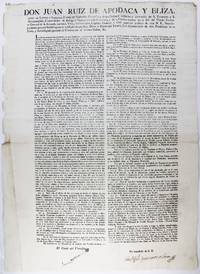
1820réf. 3330Mexico City: July 11 1820. About very good. Large double-sheet broadside approximately 23.5 x 17 inches. Two sheets joined at central horizontal fold. Five chips at left edge not affecting text and some additional minor edge wear; otherwise light toning and dust soiling. Two contemporary manuscript signatures at foot; contemporary duty stamps on blank verso. Fascinating and otherwise unrecorded broadside that dictates the organization and process for the 1820 election of Mexican deputies to the Spanish Cortes during the second and last period of constitutional monarchy in Mexico. Colonial Mexico first achieved some representation in the Spanish government under the liberal Constitution of 1812 which lasted for two years before being revoked by Ferdinand VII upon his return to power in 1814. The reinstatement of the liberal constitution and the Cortes of Cadiz in 1820 however was not enough to prevent Mexico from obtaining full independence one year later. This broadside promulgated in Mexico on July 11 1820 by the colonial Viceroy Juan Ruiz de Apodaca y Eliza announces the renewed representation via regional elections to select Provincial Deputies for the Cortes and contains eight articles delineating the process by which these elections are to be held. In brief these articles order representation be apportioned according to the population as approximated from the 1792 census; divides Mexico into provinces for the purposes of the election; and places parameters on representation for each province. In all a very interesting window onto the formation of the brief final period of Spanish colonial rule in Mexico. July 11 unknown books
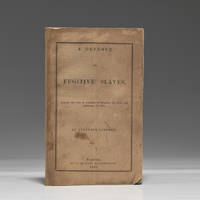
1850réf. 1229871850. First Edition. CONSTITUTION SPOONER Lysander. A Defence for Fugitive Slaves Against the Acts of Congress of February 12 1793 and September 18 1850. Boston: Bela Marsh 1850. Octavo original wrappers; pp. 1-2 3-4. i-iv 5 6-72. $3200.First edition of the rogue abolitionist's provocative call for ""vigorous"" public resistance to a pattern in the 1793 and 1850 Acts and court decisions such as Prigg v. Pennsylvania that demonstrated the government's refusal ""to champion liberty or justice"" especially elusive in original wrappers.The 1850 Fugitive Slave Act ""exposed the futility of antislavery constitutionalism grounded in a commitment to the 'proper rules of interpretation'"" Knowles Seeing the Light 544. It ""evinced a clear congressional policy favoring harsh and summary enforcement of the rendition policy over any solicitude for procedural or substantive rights of alleged fugitives"" Cover Justice Accused 121. Spooner crafted his answer to this in a ""devastating critique"" of both the 1793 and 1850 laws Smith Lysander Spooner. Defence one of his most elusive and provocative works offers ""significant evidence of the ways in which the passage of the 1850 Fugitive Slave Act shook his faith in the ability of the nation's courts to interpret the constitution in a manner consistent with the dictates of natural justice"" Knowles 546. Closely analyzing ""reasons why the 1793 and 1850 laws were unconstitutionalÉ he made it very clear why the passage of the 1850 law pushed him away from the 'quiet argument' of the courtroom to 'more vigorous'"" public action. In Defence while he continued to argue the importance of ""procedural objections to the lawsÉ Spooner spent far greater time 1 explaining why the courts would not actually strike down either of the laws and 2 outlining 'The Right of Resistance': ways in which 'The People' could respond to what he now recognized as the 'ugly reality' of proslavery constitutionalism."" He notably pointed to ""the 1842 decision in Prigg v. Pennsylvania in which the Supreme Court held that under the Constitution's Supremacy Clause the 1793 Fugitive Slave Act trumped Pennsylvania's personal liberty law which had made it far more difficultÉ for slaveholders to recover individuals they alleged were fugitive slavesÉ In the face of this judicial reality and to ensure the 'maintenance' of the Constitution Spooner encouraged popular resistance"" arguing the Second Amendment ""gave 'The People' an absolute and unqualified' Constitutional 'right' to do so."" By 1860 he would utterly lose ""faith in the ability or willingness of the government especially the courts to champion either liberty or justice"" Knowles 545 552. First edition: as issued with printing of 1793 Act of Congress and 1850 Fugitive Slave Act preceding title page; front and rear wrapper interior with publisher's advertisements. Sabin 89607. Work 335. Text very fresh a few minor stains to front wrapper expert repairs to wraps on the spine. Near-fine. paperback books
1788réf. 69689Boston: Adams and Nourse 1788. UNITED STATES CONSTITUTION. First edition of the proceedings leading to the Massachusetts Compromise being the ratification of the U.S. Constitution by the sixth of the needed nine States. Octavo in fours 7 1/8 x 4 1/2 inches; 180 x 115 mm. 219 1 blank pp. An early printing of the proposed Constitution appears on pages 3-19. Contemporary full speckled sheep. Boards scuffed and worn. Front outer hinge is cracked but holding firm. Without front free endpaper. Leaf U2 with one-inch closed tear no loss. Leaves are foxed and toned as usual for American paper of this time. Still overall a very good copy. Housed in a custom brown quarter calf clamshell. "Getting approval for the new Constitution was no small feat. Anti-federalists feared that the Constitution would over-centralize government and restrict individual liberties. They demanded changes and a Bill of Rights to guarantee personal freedoms. Federalists on the other hand argued that states should accept the proposed Constitution without further changes. When these opposing views clashed in Massachusetts an agreement- known as the Massachusetts Compromise- was brokered by two famous local statesmen John Hancock and Samuel Adams. Under it Massachusetts ratified the Constitution becoming the sixth U.S. state while also proposing future amendments including a Bill of Rights. The Massachusetts Compromise was used as a model by other states to reach similar agreements. Without it the U.S. Constitution may never have been ratified at all." from Bridgewater State University "Although the delegates to the Constitutional Convention in Philadelphia finished their work in September 1787 a ratification process of many months remained ahead before the Constitution could become the system of government for the new country. For this to happen at least 9 of the 13 states had to approve the document and Massachusetts was at the crux of that lineup. In January 1788 the Massachusetts convention met in the Old State House to address the matter; at that time Delaware Pennsylvania New Jersey Georgia and Connecticut had already ratified the Constitution. The remaining states watched the proceedings in Boston closely anticipating a close vote that could fall either way. Massachusetts had the largest convention of any state and a fundamental disagreement divided the 364 delegates: Federalists supported a strong central government and the Constitution as written; Anti-Federalists held that a centralized government would concentrate power in the hands of the elite and lead to the dissolution of the democratic ideals espoused during the Revolution. The turning point in the debate in Boston came when Gov. John Hancock proposed that Massachusetts recommend several amendments to the Constitution including a Bill of Rights. This proposal effectively gave voice to many of the Anti-Federalist concerns and after Revolutionary leader Samuel Adams spoke in favor of Hancock's "conciliatory proposition" a sufficient number of delegates shifted their positions to approve ratification. Massachusetts ratified the United States Constitution on February 6 1788 by a vote of 187 to 168. In June when New Hampshire came on board as the ninth state to ratify adoption of the Constitution was guaranteed. Its formal enactment on April 30 1789 coincided with George Washington's inauguration as the first president of the United States." Massachusetts Historical Society "In Massachusetts anti-federalist opposition to the Constitution was significant. In order to mollify their concerns convention delegate Theophilus Parsons added nine amendments which were presented by John Hancock. The Constitution was ratified by Massachusetts with the amendments added as a recommendation to "remove the fears and quiet the apprehensions of many of the good people of this Commonwealth and more effectually guard against an undue administration of the federal government." Three of these recommendations would become the Fifth Seventh and Tenth Amendments of the Constitution. The sixth state to ratify the Constitution Massachusetts was the first to suggest amendments which in turn led directly to the passage of the Bill of Rights." Freemans Evans 21242. Sabin 45702. HBS 69689. $5000. Adams and Nourse unknown books
1805réf. 57952Richmond. 1805. Second edition of the Virginia convention to ratify the federal constitution. An important document in the passing and implementation of the U.S. Constitution. Scarce. viii477pp. 20th-century tan buckram gilt leather labels. Institutional ink stamp and contemporary ink inscription on titlepage ink signature on first page of main text some toning and foxing. Good. SHAW & SHOEMAKER 9665 3 copies. hardcover books
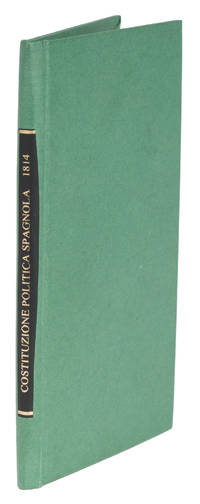
1814réf. 728671814. Piacenza: Dai Tipi d'Ignazio Orcesi 1814. Piacenza: Dai Tipi d'Ignazio Orcesi 1814. Rare Printing of the Short-Lived but Influential Constitution of 1812 Spain. Constitution. Costituzione Politica della Monarchia Spagnuola Promulgata in Cadice il 19 Marzo 1812. Piacenza: Dai Tipi d'Ignazio Orcesi 1814. 72 pp. Octavo 6" x 4". Stab-stitched pamphlet bound into recent paper-covered boards lettering piece to spine. Moderate toning negligible faint dampstaining to head of text block and upper outside corners in a few places. $650. Very rare Piacenza printing based on the translation that had appeared in Milan in the same year of the short-lived but influential Spanish constitution of 1812 one of the first attempts to construct a codified constitutional monarchy which applied not only to Spain but to the Spanish holdings in South America and the Philippines and gave Spanish citizenship to the natives of any territory that belonged to the Spanish monarchy but not necessarily those of African descent who could acquire citizenship through naturalization. This constitution was driven by the need to give legitimacy to the newly installed Joseph Bonaparte as king. Although it was repealed shortly after the restoration in 1814 of Ferdinand VII its influence was widespread. It was the model for the constitutions of Norway in 1814 and Mexico in 1824. A number of Italian printings appeared in several varying translations between 1812 and 1814. Our Piacenza printing is one of the rarest. OCLC locates 1 copy University of Turin Italy. unknown books
1820réf. SP561Gales and Seaton 1820. Second Edition. Hardcover. Good. Washington 1820. 12mo iv 409 pp. Contemporary paper covered boards. Expanded to include 23 states including Alabama and North Carolina. The first edition published a year earlier included just 21 states. A good copy with fraying and chipping to paper at spine foxing to contents and contemporary ownership marks to endpapers. Contents complete. Please contact us for additional pictures or information. Seven copies in OCLC. Cohen Bibliography of Early American Law 3014. Gales and Seaton hardcover books
1827réf. 374087Philadelphia: R. Desilver 1827. Typeset frontispiece within typographic border approx. 15x18-1/2 inches detached from the accompanying almanac. 67 1pp. 8vo. Disbound. Old folds tear to gutter. Typeset frontispiece within typographic border approx. 15x18-1/2 inches detached from the accompanying almanac. 67 1pp. 8vo. Shaw & Shoemaker 27484; Drake 11567 R. Desilver unknown books
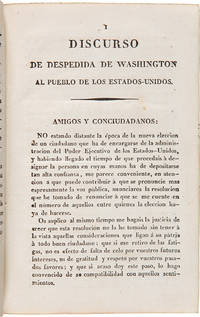
réf. 55421Mexico: Imprenta a cargo de Martin Rivera 1823. First Mexican Printing of the U.S. Constitution This is the first Mexican printing of the United States Constitution accompanied by two important addresses by George Washington. This work was produced in anticipation of Mexican independence from Spain and the U.S. Constitution in particular provided inspiration to the drafters of the constitution of newly-independent Mexico. Written in 1824 it was the first constitution of Mexico as a sovereign state and the constitution under which the colonization of Texas by Americans would take place. It is ample evidence of the transnational influence on the United States Constitution on emerging democracies in this case America's neighbor to the south. All seven articles of the United States Constitution are printed in full in Spanish in a section that is headed by a Federal garland ornament. The names of all the signers are given at the conclusion of the main text. This is followed by a section printing the first twelve amendments titled here as "Correcciones" an interesting interpretation of the role of constitutional amendments. The final page contains the text of an amendment passed by the House and Senate and signed in print by Senate President pro tem John Gaillard and House Speaker J.B. Varnum prohibiting any American citizen from accepting a title of nobility or honor from a foreign government under threat of losing one's American citizenship and holding any further elective office. This "Titles of Nobility" amendment was passed by Congress in 1810 and came close to ratification by two-thirds of the states in the 1810s but has to this day never been ratified. The inclusion of this amendment is an interesting commentary on the priorities and concerns of Mexican lawmakers. The U.S. Constitution is preceded by two chapters printing addresses by George Washington whose actions following the American Revolution and his two terms as President were influential well beyond the borders of the United States. The first chapter prints Washington's 1796 Farewell Address to the United States "Discurso de Despedida de Washington al Pueblo de los Estados-Unidos". Designed by Washington and his principal advisors in drafting it—James Madison and Alexander Hamilton—as both a valedictory and advice to succeeding generations the address served as a guidepost to Americans from the point of its publication. The Farewell Address would have been of particular interest to the Mexican Constitutional framers. The second section prints Washington's Address to the Continental Army in 1783 "Carta Circular del General Washington a los Gobernadores de los Estados fecha en el Cuartel General de Newburgh 18 de Junio de 1783". In this circular letter General Washington announces his intention to resign his command of the Continental Army and retire into private life. He also expounds in detail on the serious issues facing the nascent United States government. Both of Washington's addresses are printed fully in Spanish as is the Constitution. OCLC records just ten holding institutions over three records. This is the first copy that we can find in the market in over a century and the first copy we have handled of this first Mexican printing of the United States Constitution. Small octavo. Contemporary mottled Mexican sheep spine gilt. Minor edge wear light scuffing to boards short worm track on front board. Small ownership mark reading "JNB" branded on front and rear pastedowns ink ownership signature of "De Francisco Gonzalez de Cossio" on front flyleaf. Internally clean. Very good. OCLC 24072481 503926127 1097838706. SABIN 16060. PALAU 59641 374086. hardcover books
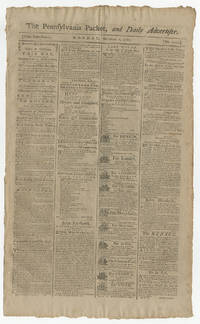
1787réf. 24135U.S. CONSTITUTION.Newspaper. The Pennsylvania Packet and Daily Advertiser. October 1 1787 No. 2700 Philadelphia: John Dunlap and David C. Claypoole including the September 28 resolution of the Confederation Congress to send to the states for ratification the recently completed U. S. Constitution. 4 pp. 12 x 18¾ in. "The United States in Congress Assembled. Friday September 28 1787. CONGRESS having received the Report of the CONVENTION lately assembled in Philadelphia Resolved unanimously THAT the said report with the resolutions and letter accompanying the same be transmitted to the several legislatures in order to be submitted to a convention of delegates chose in each state by the people thereof in conformity to the resolves of the convention made and provided in that case. CHARLES THOMSON Secretary." p2/c3 The convention called to revise the Articles of Confederation met in the Pennsylvania's State House in Philadelphia starting on May 25 1787. After many delegates agreed that the Articles could not be sufficiently improved they started to draft an entirely new structure. Maintaining their pledge of secrecy after months of private deliberations over trade defense taxation representation separation of powers the election of a president the slave trade international relations and many other issues the proposed United States Constitution was signed by thirty-nine of the fifty-five delegates on September 17. Two days later the Constitution was first published by the Pennsylvania Packetand four other Philadelphia newspapers. The cover letter sent by George Washington president of what came to be called the Constitutional Convention submitting the plan to Arthur St. Clair the President of the Congress of the Confederation in New York was also printed then. Congress received and read the proposed Constitution on September 20th. As a sampling of their deliberations William Grayson of Virginia thought it was too weak while Richard Henry Lee of Virginia and Nathan Dane of Massachusetts thought it was too strong. On September 27 Virginia's Richard Henry Lee proposed that the Constitution be sent to the executives of each of the states. A Delaware representative quickly added "in order to be by them submitted to conventions of delegates to be chosen agreeably to the said resolutions of the convention." Ten of the twelve states then represented in Congress voted in favor. Before Congress adjourned for the day the majority of Virginia's representatives and a minority of New York's representatives also indicated their support. On September 28 Federalists holding out for a unanimous vote found a way to compromise with anti-Federalists: Congress unanimously resolved to send the Constitution to the states but without any recommendation or approval. Arider from New York City arrived in Philadelphia with the resolution that same day. George Clymer presented his own resolution to the Pennsylvania Assembly noting that "the late Federal Convention has digested a plan of government for the United States and recommended that it should be referred to the consideration of State Conventions…" After a "very long and animated debate" Clymer's resolution passed by a vote of 43 to 19 and adjourned until 4:00 p.m. But only 44 members returned falling two shy of the necessary quorum. The Assembly's sergeant-at-arms was sent to show the resolution to absent members. Two who still refused to attend were seized by the public dragged through the streets and thrust into the assembly room. The involuntarily completed quorum voted that "it is the sense of great numbers of the grand people of this state already signified in petitions & declarations to this house that the earliest steps should be taken to assemble a convention within the state for the purpose of deliberating and determining on the said constitution." They called for the election of deputies who would assemble for that purpose "on the third Tuesday of November at the State-house in the city of Philadelphia…" p2/c3-4 Other articles of interest in this issue include news from Europe and a brief piece against Indians "from the western country who still continue their depredations on the whites…" p2/c3 The Pennsylvania Packet or the General Advertiser1771-1839 was founded by John Dunlap in late 1771 as a weekly newspaper in Philadelphia though it relocated to Lancaster during the British occupation of Philadelphia in 1777-1778. On May 30 1783 Benjamin Towne turned the Pennsylvania Evening Post into the first daily newspaper in the United States. However with Towne branded a traitor and forced to hawk his own papers on the street the newspaper collapsed the following year. John Dunlap and David Claypoole then made their Pennsylvania Packet the first successful daily on September 21 1784. It underwent numerous name changes in the 1790s until sold in 1800 and renamed Poulson's American Daily Advertiser. John Dunlap and David C. Claypoole books
1995réf. 74592Atlanta:: Longstreet Press. Near Fine in Near Fine dust jacket. 1995. Hardcover. 1563522349 . Color photographs throughout. First printing. Bumped along the top board edges else near fine in a near fine price clipped dust jacket. . Longstreet Press, hardcover books
1995réf. 17656Atlanta: Longstreet Press. Near Fine in Near Fine dust jacket. 1995. Hardcover. 1563522349 . Color photographs throughout. First printing. Lower corner of rear board is slightly bumped else fine in an about fine dust jacket. . Longstreet Press hardcover books
1995réf. 22498Atlanta: Longstreet Press. Near Fine in Near Fine dust jacket. 1995. Hardcover. 1563522349 . Color photographs throughout. First printing. Brief gift inscription on front free endpaper else fine in an about fine dust jacket. . Longstreet Press hardcover books
1791réf. 12452London: Printed for J. Debrett 1791. Two English editions of the French constitution of 1791 one in English translation described on the half title as being the third edition and the other in the original French both printed by J. Debrett of London here bound together in a single attractive volume in contemporary binding. The constitution of the French Republic horrified most Englishmen excepting Charles James Fox. Contemporary paper backed marbled boards printed paper spine label. Somewhat rubbed later endpapers. Very good untrimmed. ESTC T164253 T165382. hardcover books
1834réf. 1215671834. First Edition. DORR Thomas Wilson. An Address to the People of Rhode-Island From the Convention Assembled at Providence on the 22nd Day of February and Again on the 12th Day of March 1834 to Promote the Establishment of a State Constitution. Providence: Cranston & Hammond 1834. Octavo period-style half diced calf gilt marbled boards pp. i-v 6-60. $2400.First edition of Dorr's foundational Address prompting his role as instigator and leader of the Dorr Rebellion placing him ""in the front rank of the political reformers of Jacksonian America.ÓBorn into privilege Rhode Island's Thomas Dorr became ""a political insurrectionaryÉ who hastened the demise of the royal charter of 1663 and the adoption of a written constitution"" Wiecek Peculiar Conservatism 242. Following the American Revolution by the 1820s Rhode Island remained the only state that clung to its colonial charter which ""restricted suffrage to white men who possessed real estate valued at a minimum of $134"" Chaput Proslavery and Antislavey Politics 662-63. It had ""evolved from the most to the least democratic state"" Lemons Rhode Island's Ten Turning Points 62. ""Dorr's political goalsÑ'free suffrage' with no discrimination against the foreign-born 'one-man one-vote' an independent judiciary a more powerful and dynamic executive the secret ballotÑthough not permanently achieved in Rhode Island during his lifetime placed him in the front rank of the political reformers of Jacksonian America"" ANB.In 1834 Dorr ""asked the General Assembly to call a convention to revise the state constitution in favor of taxpayer-militia suffrage and to adoptÉ 'equal representation'"" Wiecek 242. In this major Address delivered at that convention and ""composed primarily by Dorr"" Conley Democracy in Decline 255 he states: ""No form of a Constitution can be worth much ifÉ in this State the Legislative power isÉ in the hands of less than one third part of the qualified voters. A few political managersÉ rule the whole State as they please against the will of two thirds of the freeman and three fourths of the people"" emphasis in original."" To Dorr the state's ""strange adherence to the charter"" left Rhode Island with an ""inequality of representationÉ too unjust to be much longer tolerated."" In 1841 after Dorr was elected ""the People's governor"" under the state's ""People's Constitution"" he became the leader of the 1842 Dorr rebellion which historian Sean Wilentz calls ""'a striking and exceptional case in the history of American democratization before the Civil War' calling it no less than 'a deadly serious test of democracy's meaning and democracy's future.'"" The Dorr Rebellion increasingly viewed as the ""most significant political and constitutional event between the Age of Jackson and the election of LincolnÉDorr's constitutional understanding had roots not only in the Revolution and the post-Revolutionary era; it remained a vibrant part of American constitutionalism"" Chaput Rhode Island Question 55-56. Sabin 70537. American Imprints 26527. Text generally fresh with light scattered foxing. hardcover books
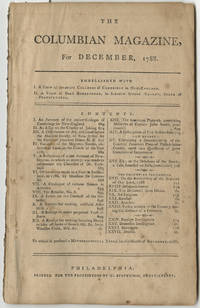
1788réf. 30007.048Philadelphia PA 1788. Softcover. Fine. The Columbian Magazine. Magazine. The Columbian Magazine Philadelphia Pa. December 1788. 52 pp. 5 x 8 in. Lacking plates. This title has the honor of being the first successful American magazine having begun in September 1786 and lasting until December 1792. Although many titles existed earlier none enjoyed the success of lasting beyond a few issues or a couple of years.Opens with five pages on ""An Account of the Ancient Colleges at Cambridge in New England."" that being Harvard University. pp. 669-673.A recipe for making artificial Asses milk p. 698.With ""The American Plutarch - Memoirs of Captain John Smith"" pp. 699-703 continued for a previous issue and concluded in the next.A section on ""American Intelligence"" pp. 715-718 with the latest news reports including an item from Edenton North Carolina:""a new convention be recommended for the purpose of reconsidering the new constitution held out by the federal convention as a government for the United States."" p. 716.With a ""List of Senators of the United States Already Chosen"" by state pp. 717-718.Also mention of the officers for the Masonic Lodge at Philadelphia p. 716. paperback books