Great Britain Parliament House of CommBiblio.com
ref. A9781343516915Hardback. New. hardcover
ref. 9108'3 Queen Sq 1st. June <year>. 12mo 2 pp. In bifolium. Good on lightly-aged paper. Difficult hand. He has not considered the question carefully but his impression is that 'the Monopoly of the printing of the Holy Scriptures in Scotland and Ireland might cease by the Kings Printers not only without injuring but with benefit to the public'. '3 Queen Sq | 1st. June <year?>. unknown
ref. 97316 March 1738; Paris. 12mo 5 pp. A substantial letter closely and neatly written. Very good on lightly-aged paper. A graceful and jaunty letter verging on the sycophantic. Begins 'I have as many pardons to ask of you for my long Silence as the Pope distributes in a year of Jubillee sic. In all Crimes a Confession of them is some Diminution of the Guilt'. 'All the French News I can tell you is that the Cardinal: Est un Homme Confisque . The Faubourg St Germain is vastly emptyd lately Lord Barrington Strange Mr Lewison and many more decamped last Week. Lord Berkeley is gone to Aubigny where he expected to meet Lord Bolingbroke .'.The connection between the two families came throught the first Earl of Denbigh who married Bridget Stanhope. 6 March 1738; Paris. unknown
ref. 105171 4 and 8 July 1901; all on letterheads of Broadwater Cross Tunbridge Wells. All three items good on lightly-aged paper. All bifoliums. Letter One 1 July 1901: 12mo 4 pp. 42 lines. He is pleased to have received Childers' life of his father published that year. 'I knew your Father well . I was in the House in the Parliaments of 68 & 80 when he had his most serious work'. Praises his 'amazing pluck in going out as he did to Australia Childers was first Vice-Chancellor of the University of Melbourne & in his conduct there in the early days & during the gold discoveries time the story of which in his letters is very curious'. He is interested to learn that he 'had Jewish blood in his veins'. He finds it 'evident that he was very doubtful as to Gladstone's wisdom on several points & in that I agree with him'. He believes that though 'most anxious to help Ireland' he was not 'really happy about Home Rule' wanting to 'separate the Imperial from the Local' which 'could not be done'. Ends: 'Where should we have been in 99 if we had given Ireland over to an Irish Parlmt in 93' Letter Two 4 July 1901: 12mo 4 pp. 33 lines. Having received Childers' reply he is pleased he wrote. Childers' 'Jewish blood' is 'very interesting to me'. Praises Disraeli's comments on the subject in his biography of Lord George Bentinck - 'a most interesting book & written by a most remarkable specimen of that famous nation'. Attacks Gladstone's handling of the Home Rule question. The recipient is 'right that Gladstone acted in a hurry . but he did more - He broke faith with his old friends to whom in Septr 1885 he sent a message utterly opposed to the plans which he developed even before the Election of that year. He was not straight & he had his reward. And he destroyed the Liberal party. - Where is it now' Letter Three 8 July 1901: 12mo 3 pp. 31 lines. He thanks him for 'the Copy of that very remarkable letter - It does the Father credit'. Until the recent case of 'Mr J. E. Backhouse of Darlington' he had 'never heard before of a boy being made a Baronet'. He does not 'altogether agree with your history as to 79-80 - I remember well saying after that terrible Afghan disaster at end of 79 that it would finish the Govmt - that & the Zulu war were too much for the Electors.' 1, 4 and 8 July 1901; all on letterheads of Broadwater Cross, Tunbridge Wells. unknown
ref. 1276614039.Gpaperback. Good. Access codes and supplements are not guaranteed with used items. May be an ex-library book. paperback
ref. 1276614853.Gpaperback. Good. Access codes and supplements are not guaranteed with used items. May be an ex-library book. paperback
ref. 6867London 1733. Sheets" ; 37 x 24 cm.Ten pages printed on a total of the six leaves of three folio bifoliums leaf dimensions roughly 40.5 x 25 cm. The first part apparently intended to fold around the others is unpaginated and printed on the recto of the first leaf and the verso of the last leaf of the bifolium. Each page consists of a list divided into three columns of small print giving details of the vote with the names of the members their constituencies and a key revealing biographical information e.g. 'Privy-Counsellors' sic and 'for and against Maintaining the Hessian Troops'. The first section is aged and with several closed tears and with some loss resulting in damage to three words. The second and third sections are in better condition though creased and on aged paper and stitched together and paginated 3-10. Pp.3-6 consist of the section entitled 'The Lords Protest' reporting a debate on the Bill in the House of Lords on 23 February 1732. Pp.7-10 carry the poem with pp.9-10 consisting of 'Britannia Excisa: Britain Excis'd. Part II. Tune of Packington's Pound.' At the head of p.7 is a sensational engraving 11.5 x 16.5 cm of a five-headed monster pulling a coach in which a figure Walpole sits complacently. The monster representing the bill flings goods this way and that with its mouths while two figures on foot run for cover. The first part of the poem begins 'Folks talk of Supplies To be rais'd by Excise Old Caleb is bloodily nettl'd;'. The first stanza of the second part reads 'Ye Knaves and ye Fools ye Maids Widows and Wives Come cast away Care and rejoice all your Lives; For since England was England I dare boldly say There ne'er was such Cause for a Thanksgiving Day; For if we're but wise And vote for the Excise Sir Blue-S--ing Walpole 'Sir Blue String' alluding to the ribbon of his Order of the Garter declares as you know he ne'er lies! He'll dismiss the whole Custom-House rascally Crew And fix in each Town an Excise-man or two.' Excessively scarce: the copies on COPAC consisting of electronic reproductions of the British Library copy. See Image of first folio page "An Exact List .". [London, 1733.] unknown
ref. 735728 August 1893; on parliamentary letterhead. 8vo: 1 p. 14 lines of text. On aged and spotted paper laid down on a piece of card and with the head of the letter not affecting the text but causing the loss of the top half of the letterhead worn away. Originally a 2-page 12mo bifolium but with the text from the second page laid down below the first. The subject of the letter appears to be the simmering controversy surrounding a 'Fracas' or 'Scene in the House' reported in The Times throughout August 1893 being an altercation involving the two Members of Parliament Logan and Hayes-Fisher both of whom claimed to be the injured party. Burns reproduces a letter which he says he is sending to the press 'in reply to one you send me but which I found subsequently you had published'. He refers to a statement 'attributed to me and referred to by you' which he says is 'due to a misapprehension of some chaffing remarks of mine in the Lobby of Friday last. I regret to say that I did not see you shaken like a dog and I am sorry to say that I did not witness the pulling of your ear'. 28 August 1893; on parliamentary letterhead. unknown
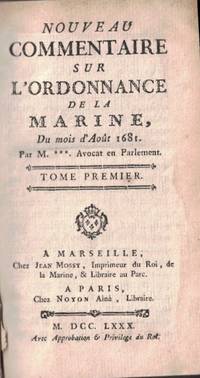
ref. 1090117Encuadernación de tapa dura. Aceptable. . Marseille / Paris. Chez Jean Mossy / Chez Noyon Ainé. 1780. 16x10 cm. LX 436 págs. plena piel falta en el plano anterior 2 tejuelos. Texto en francés. # literatura. Ordenanzas hardcover
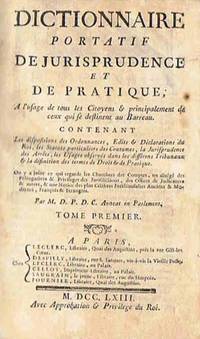
ref. 1064094Encuadernación de tapa dura. Aceptable. . Paris. Imp. Lib. Leclerc / Despilly / Cellot / Saugrain / Fournier. M. DCC. LXIII 1763 17x10 cm. T. I 559 págs. T. II 524 págs. T. III 570 págs. 1 h. approbation privilege du Rol. Texto a dos columnas. Plena piel época nervios 2 tejuelos por tomo guardas al agua y cortes pintados. Muy buen ejemplar limpio. Texto en francés. # diccionario hardcover
ref. 1006348Encuadernación de tapa dura. . Dijon. Francia. Chez Imp. Causse. 1765. 1ª edic. 17x10 cm. PortadaX2h.544 págs.2h. plena piel época nervios tejuelo lomo y cantos con hierros cinta de seda cortes pintados exlibris anterior propietario. hardcover
1739ref. 1364557Dublin: n.p. 1739 - 1749. First Editions. Hardcover. Octavos Twenty-Four Volumes; G-; Quarter-bound in leather and original light blue paper boards spines banded some with handwritten volume number notation; Boards show significant soiling and age-toning moderate plus wear/bumping to corners moderate cracking to leather along joints and moderate wear to spines; Textblock/spine of Vol. XXIII is split at p. 163 but all pages sound otherwise bindings sound; Textblocks show moderate age-toning and curling to untrimmed edges minor shelfwear to bottom edges light to moderate uneven age-toning to pages throughout interiorly and a 19th-century ink ownership inscription "Marcus Gage" appears on the titlepage of each volume. RWO-LC. Shelved in law annex. Oversized books. Additional postage necessary for expedited/international orders. Economy International shipping unavailable due to size/weight restrictions. For international/expedited customers please inquire for rates. Appears to be a set of true first editions as released in Dublin beginning in 1739. John Torbuck of London began releasing a reprint in 1741 but these volumes lack the publisher information on the titlepages consistent with that edition. This set appears to be complete in twenty-four volumes. 1364557. Special Collections. [n.p.] hardcover
ref. 1277315426.Gpaperback. Good. Access codes and supplements are not guaranteed with used items. May be an ex-library book. paperback
ref. elala6164London: 1804. The second Anglo-Maratha War 1803-05 saw the British gain significant territories and influence including regions around Delhi and in present-day Gujarat falling into direct Company rule. The two rulers who fought the EIC were Daulat Rao Sindhia 1779-1827 and Raghuji Bhonsle II d. 1816. General Gerard Lake and General Arthur Wellesley commanded the EIC army. Included here are the texts of government dispatches government correspondence with the secret committee of the EIC agents ministers and military officers commanding in the field and correspondence and proceedings with the Maratha Princes of States. The plates include two maps of India by A.Arrowsmith and six plans showing General Lake’s encampment at Secundra Aug. 26 1803 the battle of Assye Sept. 23 1803 the attack on Perron's Camp before Allyghur Aug. 29 1803 the entrance into the fort on Sept. 4 the Battle of Delhi Sept. 11 1803 and the Battle of Laswaree November 1 1803. “At the Battle of Assaye on 23 September 1803 General Sir Arthur Wellesley 1769-1852 the future Duke of Wellington masterminded victory for the EIC over the Maratha army of Daulat Rao Sindhia head of the Gwalior state. The cause was greatly helped by Wellesley first steadily building up supplies and then bribing British and Anglo-Indian mercenary officers in the Marathas' employ not to fight. When the Marathas heard of this subterfuge they promptly dismissed all their European officers believing them all of suspect loyalty. The unfortunate consequence for the Marathas was that their army now had no command structure and was routed but not before their artillery had caused tremendous damage to the British. The costs for the EIC victory in this bloody battle were high with around one-third of its army killed or wounded. 6000 Maratha soldiers were killed at Assaye. The experienced British officers were all in agreement that the Maratha artillery was as well organized and deadly as that of any European army they had ever faced. There was some consolation for the human losses in the capture of 98 Maratha cannons. Wellesley then won another battle at Argaum aka Argaon in November 1803 but at the end of his career and even after defeating Napoleon Bonaparte at Waterloo in June 1815 Wellesley declared that his greatest ever military challenge had been at Assaye. On 1 November 1803 the EIC won another decisive victory at the Battle of Laswari this time with a force of 10000 men under the able command of General Gerard Lake 1744-1808 a veteran of the American War of Independence. Again the costs of victory were high with around 838 EIC troops killed or wounded. The EIC then took over Delhi and its surrounding territory. There were a few minor Maratha successes such as the defence of Bhurtpore aka Bharatpur against multiple British attacks in early 1805 but with the large losses in central India to Wellesley and in northern India to Lake the Maratha Confederacy was now but a shadow of its former self. The Hindu princes were largely obliged to follow EIC policies and put up with a permanent resident backed by sepoys EIC Indian troops. However there would be one more conflict to come in a doomed effort to regain the Marathas' lost independence.” Mark Cartwright The World History Encyc. folio. pp. xix 1 587. 2 folding hand-coloured maps & 6 folding partly hand-coloured plans. modern half calf a few minor marks on spine. elala6164 [London]: 1804 unknown
1818ref. 24993London: John Baskett and others printers 1818. 12 works folio. 12 1/2 x 8 inches and smaller. Disbound or stitched A fascinating series spanning the whole of the period when whaling was carried out on a successful commercial basis in the waters off Greenland. After an abortive start by the South Sea Company between 1724 and 1732 the British whaling fleet operated off Greenland and the Davis Strait throughout the remainder of the 18th century with increasing success due to a large degree to the succession of bounties granted to ship owners by the British Government. The present selection of acts of parliament includes a number concerning the bounty: the first dated 16th January 1732 makes law "that a Bounty will be paid on the Return of every Ship of 200 tons and over imployed by His Majesty's Subjects in the Whale Fishery". For the bounty to be paid certain stringent criteria had to be met; these increased as the century progressed. By the time of the last Act in the present group March 1818 the Greenland whalers were reporting declining catches and were already beginning to turn their attention to other whaling grounds i.e. largely in the Pacific and Antarctic. This group offers and interesting series of snapshots of the industry during its most productive century. The acts comprise: 1. An Act for encouraging the Greenland Fishery. 1732. Stitched later wrappers. Exemption from duty extended for a nine year period. 2. An Act for the further Encouragment of the Whale Fishery carried on by His Majesty's British Subjects. 1733. Stitched later wrappers. The introduction of a bounty for ships over 200 tons. 3. An Act for continuing the several Laws therein mentioned . including granting a further Bounty for all Ships employed in the Whale Fishery during the present War; for exempting Harponers and others . from being impressed. No date but circa 1750. Spine reinforced. The bounty raised by a third other measures to help the trade. 4. An Act for granting a additional Bounty on Ships employed in the Greenland and Whale Fishery for a limited time. No adte but circa 1761. Disbound. The increased bounty confirmed for another five years. 5.An Act for further continuing several Acts . for the Encouragement of the Whale Fishery. 1768. Stitched. 6. An Act for the better Support and Establishment of the Greenland and Whale Fishery. 1771. Stitched. The rules about the amount of bounty to be paid has changed with additional laws concerning vessels of American origin exemption from duty extended to include the Gulf of St. Lawrence certain members of a whaler's crew to be exempt from being pressed into service in the Royal Navy etc. 7.An Act to explain and amend Two Acts made . with respect to the Limits of the Greenland Seas and Davis's Streights . and to enlarge the Time for the Return of the Vessels employed in the Whale Fisheries. 1780. Stitched. 8. An Act for granting an additional Bounty on Ships employed in the Greenland and Whale Fishery for a limited Time. 1782. Disbound. The bounty retained for a further five years. 9. An Act for allowing Vessels employed in the Greenland Whale Fishery to complete their full Number of Men at certain Ports for the Present Season. 1805. Spine strengthened. Whaling ships permitted to call in to ports in Scotland the Orkneys and the Shetland Islands to find men to complete their crews. 10. An Act for allowing until the Signature of Preliminary Articles of Peace Vessels . to complete their full Number of Men at certain ports. 1806. Spine strenghtened. An extension of the previous act. 11. An Act to revive and continue for five years several Laws. 1815. Strengthened spine. Several prvious acts re-confirmed. 12. An Act to amend an Act . so far as it relates to the Oaths thereby required. 1818. Unbound. Concerns the oaths required from owners/captains before the bounty due would be released to them. John Baskett [and others], printers unknown
ref. 38672London: Printed for Miles Mitchell junior 1661. First and only edition 12mo 4 68pp. first 3 leaves detached with chips to margins red morocco rubbed and worn spine defective. Provenance: Armorial bookplate of Lord Colchester Kidbrooke. London: Printed for Miles Mitchell junior, 1661 unknown
ref. 33106London: Printed for J. Almon 1759. First and only edition 32pp. with half-title disbound. London: Printed for J. Almon, 1759 unknown
ref. 244615 August 1818. Cowes Isle of Wight. See the entries in the Oxford DNB for his father Sir Francis Baring 1740-1810 and his son Thomas Baring 1799-1873. At the time of writing he was working with the merchant bankers Hope & Co. in Amsterdam but growing 'so disgusted with the drudgery of the counting house' that he wanted to abandon commerce for the law. 1p 4to. In good condition lightly aged with neat traces of windowpane mount adhering to the edges of the blank reverse. Folded for postage. Signed ‘Tho. Baring.’ Recipient not named. Reads: ‘Dear Sir / As I observe in the papers that the British is to be closed on ye. 8th. I shall be obliged to you to send to Mr. Gower and desire him to convey my pictures without loss of time the weather being favourable to Stratton - Have you had a good season and what have been your receipts’. In a postscript he acknowledges receipt of his letter. 5 August 1818. Cowes, Isle of Wight. unknown
ref. 243901 April 1815. Taunton Somerset. See his entry in the Oxford DNB. At the time of writing a year and a half before his death Horner was Member of Parliament for St. Mawes in Cornwall. 1p 4to. Eighteen lines neatly written. Addressed to ‘My dear Harrison’ and signed ‘Fra Horner.’ In good condition lightly aged with negligible remnants of windowpane mount adhering at edges of blank reverse. Folded for postage. He has received both of Harrison’s letters and is ‘particularly obliged’ to him for ‘sending the copy of Stephen’s communication. The omission is much to be expected to which the escape of the convicted slave-dealers is owing; but it is very important that we should be if possible by an official communication of the opinion of the Attorney General to state to the Subscribers the real grounds of the pardon granted against these men. When it is properly explained the matter throws new disgrace upon Thorpe.’ He has not seen the third edition of Thorpe’s book ‘nor the notice with which he has there honored me’ and he begins to feel ‘very anxious about the report to be made to the General Assembly’. He ends with details of his return to London. Note: He is referring presumably to the trials of the Slave Traders Samuel Samo Joseph Peters and William Tufft slave traders and "A letter to William Wilberforce Esq. M.P. vice president of the African Institution : containing remarks on the reports of the Sierra Leone Company and African Institution" pubd 1815Slave Trade 1 April 1815. Taunton [Somerset]. unknown
ref. 2492529 April no year. On embossed letterhead of 10 Bedford Square London. The address from which this letter is sent is said to have been 'the English home of Louis Kossuth and Garibaldi'. 1p 12mo. On aged paper and with strip of discoloration from glue along the inner edge the detaching of the item from its mount having caused a little wear to a couple of words of text. Reads: ‘Dear Sir / Northampton is the only Constituency I have represented in Parliament - I am not last word underlined the author of the work you allude to / Yours truly / C Gilpin’. A thin strip of paper is laid down at the head of the page with the printed one-line entry from an autograph catalogue three shillings for 'GILPIN Charles politician. a.l.s.'. 29 April [no year]. On embossed letterhead of 10 Bedford Square [London]. unknown
ref. 2483212 January 1716. His Majesty's Exchequer London. See his entries in the Oxford DNB and History of Parliament the former of which notes his ‘high reputation for courage’ and his presence ‘at Neerwinden and Landen in 1693 covering the retreat on 19 July and saving William III from capture by the enemy’. 1p 8vo. On aged and worn paper with chipping to edges and pitting along a horizontal central line but with both signatures clear and unblemished. The customary printed document completed in manuscript. Records in a secretarial hand the receipt of £25 by ‘Hen: Lumley Esqr. attor to the Rt. Honble Rd Lord Lumley Rd Hill & John Wiseman’. Signed towards bottom right ‘H Lumley’ and towards bottom left ‘Witness / John Letton’. See Image. 12 January 1716. [His Majesty's Exchequer, London.] unknown
ref. 2492215 March 1853; Leeds. An interesting letter linking two similar individuals like Baines Buckingham had also served as a Yorkshire Member of Parliament in his case for Sheffield as a radical between and 1835; and both men were newspaper proprietors. See the entries for Baines with those for Buckingham and his son in the Oxford DNB. 4pp 12mo. Bifolium. In good condition lightly aged and folded for postage. Addressed to ‘J. S. Buckingham Esq’ and signed ‘Edw Baines’. He begins by saying that he will try and promote Buckingham’s ‘son’s introduction to this part of the country as a Lecturer’. According to L. S. Buckingham’s ODNB entry his travels with his father had provided him with ‘experiences that he later put to good use when he was a lecturer’. A difficulty the son will face Baines feels ‘will be the name he bears for his father’s reputation is so high that it will not be easy to sustain the comparison’. Baines goes on to explains a change which has taken place from the former means of ‘negociating between Lecturers & their Institutes in our Yorkshire Union’ adding that if Buckingham will send him the subjects of his son’s lectures he will ‘recommend it to our Committee for their Mid-Summer list’. He also offers to lay newspaper testimonials ‘before the Committee of our Leeds Institute: but I believe they have made their arrangements for this season.’ He turns to ‘the Total Abstinence cause’ to which J. S. Buckingham has ‘rendered immense service’. Baines has recently published his own ‘Testimony’ ‘of which you may be pleased to see a copy’. He feels ‘a difficulty in advocating the Maine Liquor Law on the ground of its interference will personal liberty. But the American democrats are putting the wholesome chain upon themselves very fast.’ He ends by conveying his family’s regards to Buckingham’s. 15 March 1853; Leeds. unknown
ref. A9781344137423Hardback. New. hardcover
ref. A9781343630093Hardback. New. hardcover