7.200 resultados
ref. 13238Without date or place. 6pp. 4to numbered 4-9. Carbon copies on six leaves. In fair condition on aged and creased paper. The account does not appear to have been published and indeed could not have been published during wartime. It may be that it was written for an editor at the Daily Express but the extent of revision and emendation suggests that it was written with an eye to publication after the war. The first page numbered 4 begins after an eight-line deleted passage: 'Reynold's second-in-command is Major Mc.Cormack a whimsical helpful little Northern Irishman with strong Evangelical views. He & the four Chief Press Officers handled me amiably enough; none individually seems responsible for the rows & inconveniences which occur daily. Then there are the Conducting Officers - hearty convivial cavalrymen who wouldn't profess to know much about any periodical but the Field & Country Life. One of them said to me the other night "Hickey . . . . Oh yes I've read your stuff. You do cats in the Sunday Times don't you" Research established that he was referring to Nat Gubbins in the Sunday Express. Some of the reporters find this Bullingdon manner a little overwhelming; others say that they are useful on the job since they are on Christian-name terms with the OC of every unit visited.' At the foot of the first page he begins his description of how 'The King's visit brought the rows & inconveniences to a climax. To begin with elaborate arrangements had been made to keep all news of it secret till after he had returned to England. On the day the King sailed for France it was decided in London to release the news at once after all. But the first that PR in France knew of this decision was hours after the King's arrival when someone happened to be listening in & heard the news on the BBC.' Then the censorship fell into its most jittery mood. We were allowed to say that the news had been left secret till the King's arrival which was obvious. We were not allowed to say that the release came as a surprise to us in France: any hint that deprartmental co-ordination is not 100% perfect is regarded wrongly I think as dangerous. We were not allowed to quote even such amusing details as the pseudonyms by which for secrecy the King had been spoken of beforehand: even among ourselves we had to day "When Mr Harris arrives . . ."; some of the PR staff called him "Mr Big."' He addresses the reader: 'You have heard already of the curious fool arrangement by which glimpses of the King were rationed among the reporters.' He explains that the official description of the 'conference on the day the King lunched with Lebrun & Daladier' was 'not even accurate. There had been no exchange of toasts. There had been only one toast: the King as host had drunk the President of the Republic's health. The reporter put this in his story; found later to his fury that a censor had struck it out writing in instead the smug "Cordial toasts were exchanged".' He discusses the role of the censors. The last page numbered 9 concludes: 'Our reporters are annoyed by all this nonsense & tiresomeness; but its effect on the Americans is likely to be serious. . Red tape presented at least one glowingly pro-British news-agency story of the King's visit from appearing in 1500 newspapers mostly in America. The agency man was away that day. He asked another accredited war reporter to cover the story for him.' From the Driberg papers. See Image. Without date or place. unknown
ref. 14011First Letter: Edinburgh. 3 August 1814. Second Letter: Hope Park Edinburgh. 17 January 1815. Both letters 1p. 4to and both addressed with two postmarks on the reverse to 'John Jackson Esqr. M.P. New Broad Street London'. Both are docketted by Jackson. ONE: Headed by accounts of payments by Sir William Forbes and Messrs Robert Stein & Co totalling £4600 14s 3d against the shares of Lord Keith and 'Miss Mercer Elphinstone'. In the letter Mercer explains that Stein's share is for 'his Rent to Lord Keith'. He continues: 'I have about £200 in hand of Miss Mercer Elp<hins>tones part of which will be paid away here and there are Taxes to pay &c at Perth several tenants have not yet paid only part of Rent which when paid will be applied to pay what is due and what is over shall be remitted'. TWO: Referring to his 'letter from Meikelour and the Box with my Accots.' 'the Letter with the Lyoo Receipt' Peter Wighton James Dow and 'Mrs. McNeil'. Accompanying the two letters are two covers with franks of other letters from Mercer to Jackson 1814 and 1815 one is addressed to 'Sir John Jackson Bart M.P.' and both docketted by him. Note: Sir William Forbes was an eminent banker and philanthropist who drew compliment from Walter Scott in notes to "Marmion". First Letter: Edinburgh. 3 August 1814. Second Letter: Hope Park, Edinburgh. 17 January 1815. unknown
ref. 13140Santos São Paulo state Brazil. The first part to his mother dated 29 and 30 May 1860; the second part to his father dated 30 May 1860. 14pp. 12mo. The first 11pp. are addressed to his mother and signed and the last 3pp. to his father and not signed possibly indicating that a continuation is lacking. In fair condition on aged paper with the last leaf worn and creased. He explains his situation at the beginning of the letter: 'First of all you may see from my address above that I am in Santos & secondly from the more cleanly appearance of the letter that I am not in the woods. - Would that I were back again for ever since I have been here I have been ill . On the 11th. of May we finished our Picado or in other words we worked our way well down on to the flat - the next day we came to Santos & have been here with one or two days exception ever since'. He gives 'a short account' of when 'the first sod' was 'turned': 'The affair took place just behind the convent of San Antonio - which is sold for a terminus Station to the Company - it was a good large open place & in every way favourable for such an occasion. . According to the general custom of Brazilians the whole lot of them came an hour too soon & found every thing in a state of confusion - for we had run our time up too near. - You may fancy our horror when we still in our working clothes heard the national band coming & shortly after behld it marching with the guard into the grounds - attended by all the swells. Well there was nothing for it but to make them all wait & pay no attention to them till the time was up so on we worked & on they looked thoroughly disgusted at our cool reception of them - so much for the first mistake At twelve o'clock everything was all right however & the president of the Province a wretchedly small insignificant being agaisnt whom I have a small account for examining me so boringly to see if I bore any forged notes about me when I landed in Rio di Janeiro turned the sod - the Bishop of the diocese or whatever they call it here spat on it & blessed it & put holy water on it much to our disgust as we believe all three of these thing bosh especially the first & third - although according to the ideas of Brazilians the ceremony is not complete without each one - well after this a few of the gift-of-the-gab-in-their-own-opinion Brazilians jawed away for about 3/4 of an hour - the English taking it very quietly sitting down under the tent till they had finished . We all stuck ourselves near the ladies platform to see the far-famed Brazilian ladies - oh! horrors in horrors what a sight when they did come ! ! for one minute we all stood aghast & then as if by magic all disappeared in the crowd & noe talked more of the gentle sex that day'. He proceeds to discuss 'The "Tent affair"' with a small drawing of a tent. The weather worsens and a gust of wind sends 'all the ladies immediately under & in the middle of the tent - well it came stronger & stronger & blew & tore up sheet & holdfasts in the ground - unknown to all ladies we then had about forty men holding for their lives on tow or three other sails. At last came a sneezer - a heavy crack above - & with a shriek & a yell the whole of our beautiful femal garrison hooked it head over heels on hands & knees out of the place jumping forms chairs &c & under the ropes securing the sails'. The women are persuaded to return when there was a gust of wind 'such as I never felt . & away went 240 feet of Canvas'. The description continues in the same light tone 'Champagne & beer are rather apt to make one keep repeating to one's friends - Did you say I was drunk Sir 'cause if you did Sir let me tell you I'm not sir - it's you Sir it's you Sir who are drunk'. 'Everything has been steady work since.' He describes how that day he was 'thrown or rather tumbled off a horse'. On 30 May he describes to his mother how he has 'had a dispute just now' with 'Mrs Rankine the wife of one of our Engineers here' 'about the wife of Charles Matthews - she would have it that the present Mrs. C. M. was the former Mme. Vestris - of course I denied & she in her obstinacy would bet me a pair of gloves'. He concludes with the news that he is 'going to another ball'. To his father he writes in more businesslike terms giving a 'short account of my progress here' with financial details. He reports that 'Bolland with whom I am on the Sierra had spoken highly of me' and that 'Not one day passes on which I do not speak all the four languages & plenty of them too. French Germ. Portug & English. You see German after all turned out a most valuable addition.' He sends his best wishes and asks for family news. The letter concludes 'It is an awfully sickly country & one is liable to all sorts of fatal diseases any minute - People in England sitting quietly at their jolly fires in a comfortable parlour cannot understand what it is to have as much illness round you & to know that you are quite liable to it at any moment.' Santos [São Paulo state, Brazil]. The first part, to his mother, dated 29 and 30 May 1860; the second part, to his father, date hardcover
ref. 20505'Oxford & Cam Club' London . 16 July no year . 3pp 12mo. Bifolium with mourning border. In good condition lightly aged with reverse of second leaf laid down on leaf removed from album. Valentia's father had been like Neate a Member of Parliament for Oxford. The letter begins: 'Dear Lord Valentia. I am sorry it so happens that I was away and shall be till next Monday - when I return home <> to <> street for the next six Weeks'. He would have been 'very glad to meet even a Yankee at your <> - though I dont like those northerns especially those that stay in England just now.' If 'the Yankee' should be with Valentia or in the neighbourhood the following week he will be 'happy to show him Oxford'. 'Oxford & Cam Club' [ London ]. 16 July [ no year ]. unknown
ref. 19136Her Majesty's Receipt of Exchequer London. 10 July 1716. 1p. 8vo. On leaf removed from an Exchequer receipt book. On aged and worn paper. Laid out in the usual way with printed text completed in manuscript. Records payment of £15 to Haversham as 'Assee of ffrancis Carter'. Signed at foot by witness '<Richd Lissiman>'. [ Her Majesty's Receipt of Exchequer, London. ] 10 July 1716. unknown
ref. 2516915 February 1889. On letterhead of 2 North Great George’s Street Dublin. Dillon's entry in the Oxford DNB states that on 6 March 1889 he ‘sailed for Australia to solicit contributions; he also toured New Zealand and returned to Ireland via the United States in late April 1890. His mission raised about £33000’. 3pp 12mo. Bifolium. Addressed to ‘My dear Miss Meredith’ and signed ‘Yours very Sincerely / John Dillon’. In fair condition lightly aged with very light transfer of ink from another letter from blotting pad onto third leaf including signature. Folded for postage. In reply to a letter he states that he would ‘certainly go down’ to see her if he were ‘in London during the spring - but I hope to sail to Australia on the 1st March & expect to be away till the end of September’. He asks to be remembered to her father whose name Dillon saw ‘on the Protest Committee with very great pleasure’ and whom he hopes ‘is gaining strength’. He is glad they all ‘thought the photograph a good one’. From the Meredith album. From an album of letters received by the novelist George Meredith and his daughter Marie Eveleen Mariette; 1871-1933. 15 February [1889]. On letterhead of 2 North Great George’s Street, Dublin. unknown
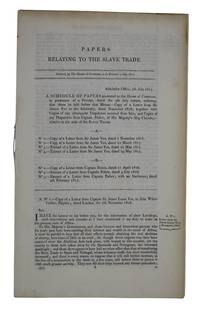
1817ref. AQ27624London: s.n. 1817. 10pp 2. Docket title to verso of terminal leaf. Sewn as issued. Three old horizontal folds. A clean and crisp copy. A selection of seven papers printed by order of the House of Commons regarding the Africa slave trade. The initial four letters contain reports of Royal Navy officer Sir James Lucas Yeo 1782- 1818 then commander-in-chief on the west coast of Africa with special responsibility for the anti-slavery patrol. He commences with the disheartening revelation that 'efforts toward obtaining the real abolition of slavery have been of little or no avail; for though fewer negroes may have been enslaved since the Abolition Acts took place with respect to this country yet the cruelty to those now taken away by Spaniards and Portuguese has increased quadruple; and those Acts appear to have had no other effect then that of transferring the Slave Trade to Spain and Portugal whose inhuman traffic has since wonderfully increased'. Yeo proceeds to provide accounts of numerous vessels recently seized both by himself and Captain Fisher who authors the final three letters reproduced here including the capture Portuguese brig San Antonio carrying 600 enslaved Africans and the American schooner Rosa sailing under Spanish colours trafficking 276. . Folio. [s.n.] unknown
ref. 3337160875.Gpaperback. Good. Access codes and supplements are not guaranteed with used items. May be an ex-library book. paperback
ref. 3337155154.Gpaperback. Good. Access codes and supplements are not guaranteed with used items. May be an ex-library book. paperback
ref. 1022355260.Gpaperback. Good. Access codes and supplements are not guaranteed with used items. May be an ex-library book. paperback
ref. 201922710X.Gpaperback. Good. Access codes and supplements are not guaranteed with used items. May be an ex-library book. paperback
ref. 2019227118.Gpaperback. Good. Access codes and supplements are not guaranteed with used items. May be an ex-library book. paperback
ref. 2329227213.Gpaperback. Good. Access codes and supplements are not guaranteed with used items. May be an ex-library book. paperback
ref. 2013683693.Gpaperback. Good. Access codes and supplements are not guaranteed with used items. May be an ex-library book. paperback
ref. 2329425139.Gpaperback. Good. Access codes and supplements are not guaranteed with used items. May be an ex-library book. paperback
ref. 2329425120.Gpaperback. Good. Access codes and supplements are not guaranteed with used items. May be an ex-library book. paperback
ref. 1432546252.Gpaperback. Good. Access codes and supplements are not guaranteed with used items. May be an ex-library book. paperback
ref. 1343969328.Ghardcover. Good. Access codes and supplements are not guaranteed with used items. May be an ex-library book. hardcover
ref. 1343511291.Ghardcover. Good. Access codes and supplements are not guaranteed with used items. May be an ex-library book. hardcover
ref. 1343668131.Ghardcover. Good. Access codes and supplements are not guaranteed with used items. May be an ex-library book. hardcover
ref. 1343624843.Ghardcover. Good. Access codes and supplements are not guaranteed with used items. May be an ex-library book. hardcover
ref. 1343923832.Ghardcover. Good. Access codes and supplements are not guaranteed with used items. May be an ex-library book. hardcover
ref. 1343705118.Ghardcover. Good. Access codes and supplements are not guaranteed with used items. May be an ex-library book. hardcover
ref. 1343575915.Ghardcover. Good. Access codes and supplements are not guaranteed with used items. May be an ex-library book. hardcover
ref. 1342465318.Ghardcover. Good. Access codes and supplements are not guaranteed with used items. May be an ex-library book. hardcover