[PARLIAMENT]Biblio.com
6.469 Ergebnisse
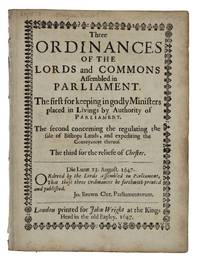
1647Best.-Nr. AQ20484London: Printed for John Wright 1647. 2 6pp. Disbound. Leaves toned scattered spotting. Three parliamentary pronouncements including edict for the raising of fund to support those impacted by the plague in Chester. . First edition. Quarto. Printed for John Wright unknown
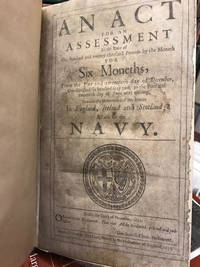
1652Best.-Nr. 58941London: Printed by John Field Printer to the Parliament of England 1652. Tall 8vo. 2 1829-1890 pp. Recent maroon cloth with gilt lettering to spine. New endpapers. Original wrapper bound in and repaired. Cloth clean. Internally clean. Black-letter text. Lacking final blank. ESTC : R209365 . Very Good. Cloth. 1652. Printed by John Field, Printer to the Parliament of England 1652 hardcover
1798Best.-Nr. 182503London: printed by George Eyre and Andrew Strahan 1798-99. First edition of this complete set of 114 statute laws. It opens with the act that granted Lord Nelson and his descendants a perpetual pension in reward for his victory at the Battle of the Nile. It also includes the Slave Trade Act 1799 notable for better regulating the conditions aboard slave ships sailing from Africa. Other laws of note include William Pitt's Income Tax Act; the Offences at Sea Act still in force today; and the Combination Act banning trade unions. Folio 294 x 183 mm pp. 887 36. Woodcut headpieces tables in text. Near-contemporary half calf flat spine gilt-lettered direct flat bands marbled boards. From the collection of Clive Richards although unmarked as such. Spine darkened and rubbed wormhole in fifth compartment corners worn front free endpaper stabilized pp. 321-33 with large loss at foot affecting text: a very good copy. hardcover
Best.-Nr. 13238Without date or place. 6pp. 4to numbered 4-9. Carbon copies on six leaves. In fair condition on aged and creased paper. The account does not appear to have been published and indeed could not have been published during wartime. It may be that it was written for an editor at the Daily Express but the extent of revision and emendation suggests that it was written with an eye to publication after the war. The first page numbered 4 begins after an eight-line deleted passage: 'Reynold's second-in-command is Major Mc.Cormack a whimsical helpful little Northern Irishman with strong Evangelical views. He & the four Chief Press Officers handled me amiably enough; none individually seems responsible for the rows & inconveniences which occur daily. Then there are the Conducting Officers - hearty convivial cavalrymen who wouldn't profess to know much about any periodical but the Field & Country Life. One of them said to me the other night "Hickey . . . . Oh yes I've read your stuff. You do cats in the Sunday Times don't you" Research established that he was referring to Nat Gubbins in the Sunday Express. Some of the reporters find this Bullingdon manner a little overwhelming; others say that they are useful on the job since they are on Christian-name terms with the OC of every unit visited.' At the foot of the first page he begins his description of how 'The King's visit brought the rows & inconveniences to a climax. To begin with elaborate arrangements had been made to keep all news of it secret till after he had returned to England. On the day the King sailed for France it was decided in London to release the news at once after all. But the first that PR in France knew of this decision was hours after the King's arrival when someone happened to be listening in & heard the news on the BBC.' Then the censorship fell into its most jittery mood. We were allowed to say that the news had been left secret till the King's arrival which was obvious. We were not allowed to say that the release came as a surprise to us in France: any hint that deprartmental co-ordination is not 100% perfect is regarded wrongly I think as dangerous. We were not allowed to quote even such amusing details as the pseudonyms by which for secrecy the King had been spoken of beforehand: even among ourselves we had to day "When Mr Harris arrives . . ."; some of the PR staff called him "Mr Big."' He addresses the reader: 'You have heard already of the curious fool arrangement by which glimpses of the King were rationed among the reporters.' He explains that the official description of the 'conference on the day the King lunched with Lebrun & Daladier' was 'not even accurate. There had been no exchange of toasts. There had been only one toast: the King as host had drunk the President of the Republic's health. The reporter put this in his story; found later to his fury that a censor had struck it out writing in instead the smug "Cordial toasts were exchanged".' He discusses the role of the censors. The last page numbered 9 concludes: 'Our reporters are annoyed by all this nonsense & tiresomeness; but its effect on the Americans is likely to be serious. . Red tape presented at least one glowingly pro-British news-agency story of the King's visit from appearing in 1500 newspapers mostly in America. The agency man was away that day. He asked another accredited war reporter to cover the story for him.' From the Driberg papers. See Image. Without date or place. unknown
1754Best.-Nr. R300109503CHEZ SAUGRAIN. 1753-1754. In-12. Relié plein cuir. Bon état, Couv. convenable, Dos à nerfs, Intérieur frais. 475 + 475 + 561 pages - contre plats jaspés - tranches rosées - petite annotation sur la page de titre - dos à 5 nerfs - caissons,titre et tomaison dorés sur le dos - 4 photos disponibles.. . . . Classification Dewey : 840.05-XVIII ème siècle
1876Contains Acts relating to: Assessment; Power of Attorney; Breeding Stock; Cattle Ranges; Choses in Action; Civil Causes; Foreign Companies; Voluntary Conveyances; Debentures; Debts and Choses in Action; Elections; Execution against Lands; Fences; Gold Mining; Jurors; Land; Licences; Loan; Methodist Church of Canada; Mining; Municipalities; Public Parks; Procedure; Qualification and Registration of Voters; Road Tolls; Roads; Public Schools; Supply; Taxes; Tolls; Trustees; Victoria and Esquimalt Railway (E&N); Voluntary Conveyances. Above-average wear. Usual library markings. Book
194076 pages. Features: Cover art of girl being thrown from saddle; Editorial entitled "If Germany Wins" in the wake of US Ambassador to Canada, James H.R. Cromwell being rebuked by his superiors for telling a Canadian audience that the future of world democracy depends upon victory over Germany; Nice full-page Fargo truck ad shows a Kraft cheese vehicle in service; The Passport (fiction); Your Mind and Your Car - safe driving is an attitude of mind; Political comments on the absence and return of U.S. Ambassador to Britain, Joseph Kennedy; Tux Luck (fiction); James H.R. Cromwell - U.S. Ambassador to Canada - photo and article; How many civic, home and health problems in Australia and New Zealand have been solved through direct land taxation; Red Drops Falling (fiction); Wonderful article and photos of Canada's Library of Parliament; Wakeville, Awake! (Part 3) (fiction); Full-page ad for the 1940 Dodge car; Canada's Fighting Forces - Part 8 - Coast Defense - article with photos; Gordon Dunstan's Thirteenth Quiz; Nice Chevrolet Truck ad; Full-page colour photo ad features the beautiful Dionne Quintuplets!; Colour full-page ad for the Ford V-8 engine; Photos of Miss Diana Blythe Barrymore in Woodbury soap ad; Nice 1940 DeSoto car ad; The Winnipeg Volunteer Signal Training School; College for Indian Youth at Ohsweken, Ontario; Half-page two-colour ad for Alka-Seltzer features photo of hockey game between the Maple Leafs and New York Rangers with Syl Apps and Gordie Drillon on the ice; Nice colour photo ad for the 1940 Studebaker Champion inside back cover. Somewhat above-average external wear. A nice vintage issue. Book
1759Best.-Nr. 23087Rouen R. Lallemant 1759 -in-4 plein-veau un fort volume, reliure plein veau (binding full calfskin) havane in-quarto (20,6 x 26,4 cm), RELIURE D'EPOQUE, dos à nerfs (spine with raised bands), décoré "or" et à froid (gilt and blind stamping decoration), titre frappé "or", pièce de titre sur fond marron clair avec double filets "or" en encadrement, roulette "or" en place des nerfs avec un filet à froid de part et d'autre des nerfs, entre-nerfs à fleuron "or" dans un encadrement de deux filets "or" avec fleurette (floweret), roulette et double filets "or" en tête et en pied, coiffe supérieure manquante avec 5 petits trous de vers en tête, mors du premier plat fendu sur 3 cm en tête et 5 cm en pied, mais la reliure est trés solide, plats frottés et légèrement épidermés, coins écornés (corners dog-eared), roulette "or" sur les coupes avec manque de dorure, toutes tranches lisses rouges (all edges red), marques de tampons "EX-LIBRIS" à l'encre brune d'un cabinet d'avocats de Granville sur la page de titre, ([XVI] + 732 + [85 p.de table]) pages avec Approbation & Privilège, 1759 Rouen : R. Lallemant Editeur,
Best.-Nr. 4200Petit in 4 plein cuir fauve à nerfs,reliure muette,titre,2 feuillets des titres contenus dans cette ordonnance,222 pages,41 pages de table des matières principales,3 pages de privilège du Roy 30 juin 1667.à Paris chez les associez choisis par ordre de sa Majesté pour l’impression de ses nouvelles ordonnances 1667,édition originale.Partie inférieure du deux plats et dos restaurés.Ex-libris manuscrit Première page de garde.Grande ordonnance unificatrice voulu par Colbert,portant sur la procédure civile;elle se fixe pour objectif d'uniformiser une procédure qui devra être observée dans tout le royaume, sans que l'on puisse y déroger d'une quelconque manière. Cela explique sans doute l'hostilité que va susciter auprès de divers parlements,surtout au Sud de la France,une ordonnance dont l'interprétation est réservée au roi.De l'observation des ordonnances des délais sur les assignations & ajournemens.Des congez & défauts en matière civile.Des délais & procédures es Cours de Parlement.Grand Conseil,& Cours des Aides en première instance;des Enquestes.Des reproches des Témoins.Des récusations des Juges
1581Best.-Nr. 26541Paris Chez Jacques Du Puys Libraire juré, à La Samaritaine 1581 Fort in Folio Folioté CCCCXXIIJJ, soit 1048 pp, il manque une partie du dos, le volume nécessite une restauration au dos et en coin. le corps d'ouvrage n'est pas dérelié , quelques mouillures claires à certains feuillets sans gravité (pleine basane du temps )
1752Best.-Nr. 22824Paris Denis Mouchet 1752 -in-4 plein-veau 2 parties reliées en 1 volume, reliure plein veau havane moucheté (binding full calfskin) in-quarto (19,8 x 25,8 cm), RELIURE D'EPOQUE, dos à nerfs (spine with raised bands) décoré or (gilt decoration) à filets "or", filets perlés "or" et roulettes "or"(gilt line and fillets) et filets à froid (blind-stamping line decoration), titre frappé "or", pièce de titre (label of title) sur fond bordeaux avec filet "or" et filet perlé "or" en encadrement, entre nerfs à fleuron "or" dans un encadrement avec filet "or" et filet perlé "or" avec rinceaux fleuron "or" aux angles, roulette "or" en place des nerfs avec un filet à froid de part et d'autre des nerfs, manque de cuir aux coiffes, mors fendu en bas à gauche du 1er plat sur 4cm, 1er plat décoré à froid d'un double filet à froid en encadrement, plats trés légèrement épidermés (lights scratches), roulette "or" sur les coupes (fillets on the cuts)avec léger manque de dorure (blurred gilding), toutes tranches lisses rouges (all red edges), sans illustration (no illustration) excepté une petite vignette représentant Thémis (la justice)gravée sur bois en noir + bandeaux front de chapitres + lettrines gravées sur bois en noir, (XXXVI + 888 + 15 p. de Tables) pages, 1752 Paris Denis Mouchet Editeur,
1809Best.-Nr. ZB585004London: 1809. narrow folio 6 125 appendix pp small pen note on title light extraction roughness at spine and now in self wrappers. - If you are reading this this item is actually physically in our stock and ready for shipment once ordered. We are not bookjackers. Buyer is responsible for any additional duties taxes or fees required by recipient's country. Photos available upon request. London: unknown
1782Best.-Nr. 00TP08Paris France 1782. On June 13th 1782 'Docteur rege de la Faculte de Medecine en L'Universite de Paris ancien Proffesseur de les Ecoles.' Etienne Pourfour-de-Petit first hired by the University in 1732 writes the Faculty beseeching that the Faculty honor and uphold his 1760 retirement 'edict'. Superbly interesting document that highlights the struggles of the revolutionary period and transition of power. The Professor obviously a monarchist and of the 'ancien regime' is faced with a new board made up of the rebels. Easily read is a certain disdain to the new Faculty members his deep respect for the Monarch but also an embracing of the new revolutionary ideas. Biographical Notes: SIR THOMAS PHILLIPPS 1792-1872. Born in 1792 Sir Thomas Phillipps from childhood was obsessed with the idea of obtaining virtually anything written or printed on paper including cartloads of documents from wastepaper merchants and the entire inventories of booksellers. "I wish to have one copy of every book in the world" he declared to a friend. He very nearly succeeded. His collection ultimately grew to more than 100000 books and at least 60000 manuscripts. As a result of his extravagant purchases Sir Thomas was permanently on the verge of bankruptcy and was constantly pursued by creditors. So many books arrived at his house that it was impossible to unpack his acquisitions much less keep pace with them. Visiting scholars driven to distraction would spend days hunting for an elusive text in the dusty heaps that filled every room. Because Sir Thomas has a morbid dread of fire most of his collection was housed in coffinlike boxes that could be carted away quickly. Visitors to Middle Hill were struck too by the presence of numerous logs a ploy he used to lure beetles away from his books. As Sir Thomas relentlessly pursued his passion the house itself began to crumble and its floors started to sag under the cast weight of hundreds of tons of paper. His neglect of Middle Hill was partly deliberate however. Sir Thomas's chief enemy in life James Halliwell had married his daughter against his wishes. It appears that Halliwell was in Sir Thomas' eyes the worst kind of criminal a book thief who had stolen valuable works from university libraries and even from his father-in-law. Having no sons Sir Thomas was unable to prevent Halliwell from inheriting his estate. To ensure that his detested heir would never receive anything of value Sir Thomas's solution was to allow Middle Hill to fall unto complete disrepair. He even went so far as to chop down and sell for lumber the centuries-old oak trees that lined the majestic mile-long drive to his home. In 1863 Sir Thomas decided to move - in order to accommodate his books. With the aid of 160 men 103 wagonloads of books and papers drawn by 230 horses the books were lumbered from Middle Hill top their new estate in nearby Cheltenham. It is said that for years afterwards the countryside was littered with the remains of carts that had collapsed under the sheer weight of the Phillipps collection. Sir Thomas continues to add to his library until his death in 1872. After Sir Thomas's death his immediate family had no room for his collection. So vast was the library that although individual items and large sections were sold privately or through numerous auction sales the Phillipps collection is still being sold more than a century after the death of its owner. In the course of its sales many treasures have come to light. As late as 1964 part of the long-lost and unique medieval manuscript of the Roman poet Ovid's Metamorphoses appeared and was subsequently reunited with its other half at Magdalen College Oxford. Once destined for destruction as worthless wastepaper this and many other priceless works were saved by the single-minded obsession of the greatest bibliomaniac of all time. Autograph. Manuscript. Very Fine. Folio - over 12" - 15" tall. Paperback
Best.-Nr. 6417In 12 plein cuir fauve raciné,pièce de titre cuir clair, roulette,fers,filets,palmette dorés.Titre,XXIV,444 pages, tranches rouges.A Neufchâtel et en Europe chez les libraires associés 1764.Une tache brune en long sur la page de titre,sinon bon exemplaire
Best.-Nr. elala3148London: Printed For John Stockdale 1786. First Edition. Including sections dealing with American and East Indian affairs. 2 Volumes. 8vo. pp. 1 p.l. v-xvi 307; viii 351 1. lacking half-title Uncut in original bds. rebacked in cloth rubbed small library stamps on front blank in Vol. II periodic staining in upper & lower margins London: Printed For John Stockdale, 1786 hardcover
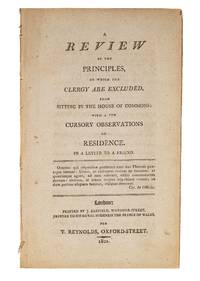
1801Best.-Nr. 845821801. A Rare Pamphlet Discussing an 1801 Act that Banned Ordained Church of England Ministers from Election to the House of Commons Great Britain. Parliament. A Review of the Principles on Which the Clergy are Excluded From Sitting in the House of Commons: With a Few Cursory Observations on Residence. In a Letter to a Friend. London: Printed by J. Barfield Printer to His Royal Highness the Prince of Wales for T. Reynolds 1801. 51 1 pp. Publisher advertisements to last page. Octavo 8-1/4" x 5"; 21 x 13 cm. Disbound stab-stitched pamphlet. Moderate toning negligible light soiling to exterior leaves just starting to separate at ends but secure. A good copy of a rare title. $350. Only edition. This pamphlet was written in response to the Clergy Disqualification Act of 1801 which formally banned ordained members of the Church of England from election to the House of Commons. The status of ministers in other denominations was left ambiguous as was the status of Anglican clergymen elected prior to the Act's passage. The work disagrees with proponents of the Act arguing that the election of clergy ties the clergy to the state and creates a shared sense of civic unity. Banning the election of clergy on the other hand creates a diminished and disaffected class of citizens and deprives constituents of the liberty to select from the widest possible array of candidates. The Act would not be overturned until 2001. This is a rare title. OCLC locates 2 copies Harvard University of Cambridge. No copies listed on Library Hub. unknown
Best.-Nr. elala5543London: Published For The Society By William Ball Aldine Chambers and Hatchard & Son 1838. Second Issue of this edition with title dated 1838. With sections on Newfoundland the Canadas British Guiana Australia Van Diemen's Land Islands in the Pacific New Zealand Society Islands Friendly Islands &c. and South Africa. Members of the Select Committee included Thomas Fowell Buxton William Gladstone Charles Lushington &c. Buxton was also the President of the Aborigines Protection Society. The Aborigines Protection Society founded in 1837 "campaigned to ensure the findings of the report were widely known and implemented in the policies of the day. What came to be known as the 'Aborigines report' documented wide spread frontier violence and had a major impact on the debates about how Aboriginal peoples were to be treated in British colonies. Its focus was on reducing frontier violence through the application of the rule of law and other approaches such as spreading Christianity and prosecuting renegade European whalers sailors and escaped convicts." Analysis and Policy Observatory website Ferguson 2217a. Goldsmiths' 29860. Rev. Mendelssohn II p. 423. Not in TPL. 8vo. pp. xi 1 140. 4pp. of ads tipped in at front. original printed wrs. wrs. soiled front. wr. detached spine perished. elala5543 London: Published For The Society, By William Ball, Aldine Chambers, and Hatchard & Son, 1838 unknown
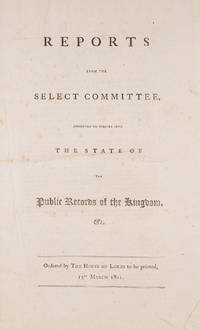
1801Best.-Nr. 847901801. London 1801. Folio 17" x 11". London 1801. Folio 17" x 11". The Beginning of Systematic State Records in the United Kingdom Great Britain. Parliament. Select Committee on the State of Public Records. Reports from the Select Committee Appointed to Inquire into the State of the Public Records of the Kingdom &c. London: Ordered by The House of Lords to be Printed 13th March 1801. 667 pp. Illustrations. Many engraved folding plates. Folio 17" x 11"; 43 x 26.5 cm. Contemporary quarter calf over marbled boards raised bands and lettering piece to spine. Moderate rubbing and wear to extremities. Light toning to interior occasional light foxing and faint offsetting from plates internally clean. A very good copy. $350. With the Second Report pagenated continal. The Select Committee on the State of Public Records was commissioned by the House of Commons in 1800 to assess the location condition and types of public records in the United Kingdom. Though public record keeping was an important tradition in Britain there had been no comprehensive parliamentary proceedings on the matter since the 1731 Cotton Library fire. Chaired by Charles Abbot a barrister politician and Fellow of the Royal Society and supported by a number of prominent clerks librarians and lawyers the committee began investigating in February and submitted its first report on July 4th 1800. A second report was issued soon after. The committee found that the kingdom's public records covered a significant period of time with some dating to the Domesday Book but that there were serious issues with storage indexing and cataloguing that made them difficult to access and often in danger of succumbing to fire or dampness. It recommended the creation and construction of specialized public record offices the standardization of record keeping and administrative practices and the compilation and printing of indexes and calendars to guide researchers. Both reports were republished at the request of the House of Lords in March 1801. The committee's work led to the establishment of the Record Commissions which would operate from 1800-1837 and produce a number of important publications. These in turn gave way to the Public Record Office now the National Archives of the UK. unknown
1801Best.-Nr. 845821801. A Rare Pamphlet Discussing an 1801 Act that Banned Ordained Church of England Ministers from Election to the House of Commons Great Britain. Parliament. A Review of the Principles on Which the Clergy are Excluded From Sitting in the House of Commons: With a Few Cursory Observations on Residence. In a Letter to a Friend. London: Printed by J. Barfield Printer to His Royal Highness the Prince of Wales for T. Reynolds 1801. 51 1 pp. Publisher advertisements to last page. Octavo 8-1/4" x 5"; 21 x 13 cm. Disbound stab-stitched pamphlet. Moderate toning negligible light soiling to exterior leaves just starting to separate at ends but secure. A good copy of a rare title. $350. Only edition. This pamphlet was written in response to the Clergy Disqualification Act of 1801 which formally banned ordained members of the Church of England from election to the House of Commons. The status of ministers in other denominations was left ambiguous as was the status of Anglican clergymen elected prior to the Act's passage. The work disagrees with proponents of the Act arguing that the election of clergy ties the clergy to the state and creates a shared sense of civic unity. Banning the election of clergy on the other hand creates a diminished and disaffected class of citizens and deprives constituents of the liberty to select from the widest possible array of candidates. The Act would not be overturned until 2001. This is a rare title. OCLC locates 2 copies Harvard University of Cambridge. No copies listed on Library Hub. unknown books
1801Best.-Nr. 847901801. London 1801. Folio 17" x 11". London 1801. Folio 17" x 11". The Beginning of Systematic State Records in the United Kingdom Great Britain. Parliament. Select Committee on the State of Public Records. Reports from the Select Committee Appointed to Inquire into the State of the Public Records of the Kingdom &c. London: Ordered by The House of Lords to be Printed 13th March 1801. 667 pp. Illustrations. Many engraved folding plates. Folio 17" x 11"; 43 x 26.5 cm. Contemporary quarter calf over marbled boards raised bands and lettering piece to spine. Moderate rubbing and wear to extremities. Light toning to interior occasional light foxing and faint offsetting from plates internally clean. A very good copy. $350. With the Second Report pagenated continal. The Select Committee on the State of Public Records was commissioned by the House of Commons in 1800 to assess the location condition and types of public records in the United Kingdom. Though public record keeping was an important tradition in Britain there had been no comprehensive parliamentary proceedings on the matter since the 1731 Cotton Library fire. Chaired by Charles Abbot a barrister politician and Fellow of the Royal Society and supported by a number of prominent clerks librarians and lawyers the committee began investigating in February and submitted its first report on July 4th 1800. A second report was issued soon after. The committee found that the kingdom's public records covered a significant period of time with some dating to the Domesday Book but that there were serious issues with storage indexing and cataloguing that made them difficult to access and often in danger of succumbing to fire or dampness. It recommended the creation and construction of specialized public record offices the standardization of record keeping and administrative practices and the compilation and printing of indexes and calendars to guide researchers. Both reports were republished at the request of the House of Lords in March 1801. The committee's work led to the establishment of the Record Commissions which would operate from 1800-1837 and produce a number of important publications. These in turn gave way to the Public Record Office now the National Archives of the UK. unknown books
1835Best.-Nr. ZB603403London: 1835. Parts 2 and 3 Session 19 February-10 September 1835 Volumes 24 and 25; Reports from Commissioners Volumes 4 and 5 only; narrow folio; Part II. South-Eastern and Southern Circuits. 6 683-1408 pp. pagination is continuous for the Appendix errata slip Part III. Northern and North-Midland Circuits. 6 1409-2080 pp. errata slip folding map; both ex library in later cloth general title of Part 2 has repairs but no loss Part 3 has a few preliminary leaves corner clipped with no loss light general age toning to interiors overall sound and good. - If you are reading this this item is actually physically in our stock and ready for shipment once ordered. We are not bookjackers. Buyer is responsible for any additional duties taxes or fees required by recipient's country. Photos available upon request. London: hardcover
1843Best.-Nr. 103363London 1843. Softcover. good to very good. 189pp. Folio original blue wrappers. Corners missing on top and bottom of spine and front cover. Front blank missing large chunk or top corner. good to very good TPL 7686. 1843 paperback
Best.-Nr. 426821866. folio. 32cm 17p. printed self wraps string tied docketed on the verso of the last page fine condition. cgc.bx. In the 1860's The Reciprocity Treaty of 1854 had become unpopular in the 1860's in the United States as reflected in the arguments put forward in this publication as was abrogated by the United States in 1866. Being a joint resolution of the United States Congress as approved by the President on the 18th of January 1865 notice was given to the British that the Reciprocity Treaty of 1854 would be terminated. The document reproduces seventeen letters and enclosures exchanged between the two countries during the twelve month period leading up to the expiration date of the treaty. 1866 unknown
Best.-Nr. 37216n.p. n.d. 1803. 1p. 4to. 26.5cm broadside. printed page is 21x 15cm caption-title uncut matted fine condition. cgc.bx Fleming 22. Lande S2254. This act amends 36 George 3. chapter 12 regarding the regulation of liquor licenses and introduces a fine of 20 pounds for violation of the laws and changes the procedure for applications for licenses from annually to quarterly. NOTE: On 19 March 1803 two hundred copies of each of six acts were ordered printed. Four have been located Fleming numbers 21 22 23 24 and can on the basis of physical evidence be matched to this documentation and recorded as 1803 imprints rather than 1794 1796 and 1797. n.p. n.d. [1803] unknown