7.164 Ergebnisse
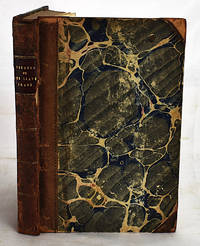
1808Best.-Nr. 2605200078W. Phillips and John Hatchard London 1808. First Edition. Hardcover. Good. An Extremely Rare Early Abolitionist Work : British Parliamentary debates on Slave Trade Abolition Bill of 1807 Bound in period marbled half calf. 12mo. 19.75 x 13.25 cm. iv 273 pp. Front joint cracked. Small chip off spine leather. Period manuscript note in shorthand on pages 66-67. A detailed account of the debates of the British Parliament on the abolition of the slave trade including full transcripts of speeches made by MPs. The speeches show the diversity of arguments opposing the slave trade. It includes rousing speeches against slavery on a religious and moral level; utilitarian speeches discussing the low profits of the slave trade and the ability of plantation owners to maintain the current slave population; testimonies on the complex social structure and craftsmanship of African societies and thus their humanity; and arguments that by abolishing slavery France will become Britain's "inferior in virtue". Includes numerous speeches by Lord Grenville the Prime Minister who shepherded the Slave Trade Abolition Bill through Parliament: "I know my Lords that on this subject strange notions of morality have been suggested as if what were just to one race of the species might be unjust to another. I know not my Lords on what principle of law divine or human such sentiments are founded. My Lords I have been always taught to consider justice to be one uniform consistent rule of conduct; to that it has been enough for me to listen to the proof that any particular acts are unjust with respect to certain individuals of classes of the species to convince me that the same acts must be unjust to all the rest of mankind." Grenville and other MPs advocate for a universal form of justice under the law that precludes the natural legal inequality of slavery. This book was printed by William Phillips the son of James Phillips a Quaker printer and abolitionist activist and founding member of the Society for Effecting the Abolition of the Slave Trade who published first hand accounts of the evils of the slave trade which were highly influential in the bills passage. Refs: Sabin 93370. A rare edition only one copy has appeared at public auction in the last 125 years. No other copies are available for sale. Cataloged by Anastasia Rittenhousesmith. W. Phillips and John Hatchard, London hardcover
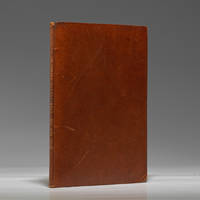
1562Best.-Nr. 1278941562. HENRY VIII PARLIAMENT. Acts. Anno XXXIIII et. V. Henrici VIII. London: T. Powell 1562. Slim folio 8 by 11-1/2 inches modern full brown morocco. $3800.Early edition of the Parliamentary Acts of 1542 featuring 25 acts featuring the important Act for the Advancement of True Religion and the first English act dealing with Bankruptcy finely printed in black-letter with lovely historiated woodcut initials.The first and most important act passed by the Parliament in 1542 banned the reading or owning of the Bible in EnglishÑat that point Tyndale's translationÑin England for most of the population. Exceptions were made for the clergy the gentry wealthy merchants and the wives of the gentry and nobility who were only allowed to read it in private effectively barring the Bible in English from the vast majority of the population. By the time of the act's passage Tyndale was already dead executed near Brussels in 1536 after being convicted of heresy for his promotion of theology influenced by Martin Luther. And Tyndale himself had never actually published a full Bible in English having only managed individual publications of the New Testament the Pentateuch and a few other books of the bible; the first full Bible in English was actually produced by Miles Coverdale in 1536 based heavily on Tyndale's earlier publications. The act also banned numerous other categories of books although it did provide exceptions for ""statutes and lawes of the realme cronicles Canturbury tales Chaucers bookes Gowers bookes and stories of menns lives."" The acts from this year are also notable for containing the Statute of Bankrupts the first codification of law for bankruptcy in England. First published in 1543 with several editions or issues following soon after; this is one of two editions published in 1562. Without the acts for Wales. STC 9409. Foxing to a few leaves mild dampstaining to inner margin of some early leaves but text readable and clear; handsomely bound. Rare. unknown
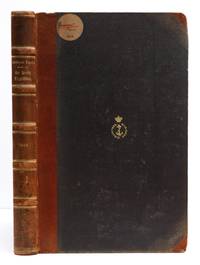
1852Best.-Nr. 144684London: George Edward Eyre and William Spottiswoode 1852. iii368 pp. Folio. Bound in 19th century diced calf and Victorian cloth. Spine ruled into 6 compartments. Paste paper endpapers. Gilt maritime library stamp on front board otherwise no other stamps. Binding a bit worn. With 28 maps mostly sledge tracks including 6 folding maps. Numerous illustrations mostly in the text. A very clean crisp copy internally. Arctic Bibliography 45228. Contains extensive and detailed reports by sledgers from Austin's and Penny's expeditions. Provenance is the Marinens Bibliothek The library of the Danish Navy. Very scarce and the second largest volume produced during the Franklin Search period. 1852 George Edward Eyre and William Spottiswoode hardcover
Best.-Nr. 027213London; 1803-1806: Np. Folio. These reports were issued between 1715 and 1801 and were not inserted into the Journals. The reason they are so important for research is that before 1801 very few House papers were printed. Those that were printed were simply included in the Journals. The public demand increased after the Act of Union with Ireland. Charles Abbot elected Speaker of the House in 1801 ordered the Clerk of the House to gather and list all the papers in his custody which became the Abbot Collection this set fills in many gaps for the student of 18th Century Egnland. It is now commonly known as the "First Series". All volumes are bound in half red lether over red cloth spines lettered in gilt with occaisonal leaves with either browning or scattred foxing. Vol. 1. Miscellaneous subjects 1715-1735 viii 707 pages 26 pages index. deals with the poor smuggling Tea tobacco pages 443-535 give details on the 1732 fire as Ashburnham House the Cottonian Library with a listing of the rare books or manuscripts that were totally lost damaged or partly damaged and still useful. v. 2. Miscellaneous subjects 1738-1765 viii 467 pages 19 pages index. Deals with army clothing Hudson's Bay North-West Passage; trade of Hudson Bay Company v. 3. Miscellaneous subjects 1771 to 1773; and East India 1772 & 1773 xix 564 pages 27 pages index. Double page plan for Gun Ship of War much on East India Company and trade pages 137-564 naval timber linen trade of Great Britain and Irelandv. 4. East Indies 1772 1773 xix 763 pages 12 pages index. v. 5. East Indies 1781 1782 -xii 1015 pages with index to volumes 4 and5 at the end. v. 6. East Indies 1783 xv 863 pages.7. East Indies Carnatic War &c. 1781 & 1782 1067 pages. v.8. East Indies Carnatic War &c. 1781 & 1782 xxiii 1105 pages v.9. Provisions poor 1774 to 1802 xi 735 pages index v. 10. Miscellaneous subjects 1785-1801 viii 804 pages 43 pages v. 11. Miscellaneous subjects 1782-1799 distilleries of Scotland with a few textual illustrations of still and 11 full page entravings of distillery apparatus large folding hand-colord map of Scotland v. 12. Finance reports I to XXII 1797-1798 503 pages v. 13. 1798. Finance reports XXIII-XXXVI 837 pages 13 pages with proceedings and measures of government thereon 1798-1803 and index to the whole 837 pages v. 14. Miscellaneous reports Port of London 1793-1802 with plates Dr. Jenner's petition regarding vaccine innoculations discover of nitrous fumigations 635 pages 29 pages bound without engravings. 15. Public records 1800 with plates 14 facsmile leaves between pages 64 and 65 from the Domesday Book 667 pages 23 pages index Bound without the plans. v. 16. General index 1715-1802. The approximately 12000 pages provide one of the deepest views of British politics as Parlaiment dealt with the shape of empire and the entire costs of its vast navy and the East India Company. Local pickup only. Np unknown books
Best.-Nr. 138486A Dijon, Ressayre, Causse, 1689-(1781) 17 vol. in-4, basane brune mouchetée, dos à nerfs (reliure de l'époque). Épidermures sur les plats. Accrocs sur certains dos. Pièces de titres parfois abîmées. Qqs rousseurs et mouillures. Il manque les pages de titre des tomes I et III. Petites galeries de vers sur quelques plats, au tome V, elles sont aussi dans l'ouvrage avec atteinte au texte. Au tome XII, l'année 1751 manquait, elle a été remplacée par une copie manuscrite.
Best.-Nr. elala6164London: 1804. The second Anglo-Maratha War 1803-05 saw the British gain significant territories and influence including regions around Delhi and in present-day Gujarat falling into direct Company rule. The two rulers who fought the EIC were Daulat Rao Sindhia 1779-1827 and Raghuji Bhonsle II d. 1816. General Gerard Lake and General Arthur Wellesley commanded the EIC army. Included here are the texts of government dispatches government correspondence with the secret committee of the EIC agents ministers and military officers commanding in the field and correspondence and proceedings with the Maratha Princes of States. The plates include two maps of India by A.Arrowsmith and six plans showing General Lake’s encampment at Secundra Aug. 26 1803 the battle of Assye Sept. 23 1803 the attack on Perron's Camp before Allyghur Aug. 29 1803 the entrance into the fort on Sept. 4 the Battle of Delhi Sept. 11 1803 and the Battle of Laswaree November 1 1803. “At the Battle of Assaye on 23 September 1803 General Sir Arthur Wellesley 1769-1852 the future Duke of Wellington masterminded victory for the EIC over the Maratha army of Daulat Rao Sindhia head of the Gwalior state. The cause was greatly helped by Wellesley first steadily building up supplies and then bribing British and Anglo-Indian mercenary officers in the Marathas' employ not to fight. When the Marathas heard of this subterfuge they promptly dismissed all their European officers believing them all of suspect loyalty. The unfortunate consequence for the Marathas was that their army now had no command structure and was routed but not before their artillery had caused tremendous damage to the British. The costs for the EIC victory in this bloody battle were high with around one-third of its army killed or wounded. 6000 Maratha soldiers were killed at Assaye. The experienced British officers were all in agreement that the Maratha artillery was as well organized and deadly as that of any European army they had ever faced. There was some consolation for the human losses in the capture of 98 Maratha cannons. Wellesley then won another battle at Argaum aka Argaon in November 1803 but at the end of his career and even after defeating Napoleon Bonaparte at Waterloo in June 1815 Wellesley declared that his greatest ever military challenge had been at Assaye. On 1 November 1803 the EIC won another decisive victory at the Battle of Laswari this time with a force of 10000 men under the able command of General Gerard Lake 1744-1808 a veteran of the American War of Independence. Again the costs of victory were high with around 838 EIC troops killed or wounded. The EIC then took over Delhi and its surrounding territory. There were a few minor Maratha successes such as the defence of Bhurtpore aka Bharatpur against multiple British attacks in early 1805 but with the large losses in central India to Wellesley and in northern India to Lake the Maratha Confederacy was now but a shadow of its former self. The Hindu princes were largely obliged to follow EIC policies and put up with a permanent resident backed by sepoys EIC Indian troops. However there would be one more conflict to come in a doomed effort to regain the Marathas' lost independence.” Mark Cartwright The World History Encyc. folio. pp. xix 1 587. 2 folding hand-coloured maps & 6 folding partly hand-coloured plans. modern half calf a few minor marks on spine. elala6164 [London]: 1804 unknown
1922Best.-Nr. 95292London: His Majesty's Stationary Office 1922. Rare original pamphlet establishing the Palestine Mandate. Octavo 12 pages. Scarce and desirable. A crucial document in Middle Eastern history. At the 1919 Paris Peace Conference despite huge pressure from France most of the 1916 Sykes-Picot Treaty relating to the post-war political solution of the Middle East was enforced. Emir Faisal bin Hussein bin Ali al-Hashemi 1885-1933 leader of the Arab Revolt was named as King of the Arab Kingdom of Syria but as he had relinquished coastal areas of Syria to the French he found himself undermined by Syrian extremists agitating for a Greater Syria. Wavering he caved in to their demands and rejected his previous accommodation with the French. Simultaneously Feisal's political grip of inland Syria started to wane and the Allies hurriedly reconvened this time at San Remo Italy in April 1920 and hammered out an allocation of Mandates. This change in policy supported by American enthusiasm for Mandates brought political stability to the region enforced by imperial ambition and repressive force killing off the Sykes-Picot Treaty which had at least in principle enshrined the idea of Arab self-determinism. The British under pressure from the Anglo-Indian government supported the French in order to secure Mesopotamia and were given the Mandate of Palestine. The present volume is the finalised version of the terms under which the British would govern the Mandate. There was provision for the settlement of Jews and the establishment of 'the Jewish national home' as per the Balfour Declaration of 1917. However there was considerable debate as to whether this should apply to the eastern area of the Mandate known as Trans-Jordan and the current work carries a note explicitly stating that these provisions are not be enacted in Trans-Jordan. In effect this limited the eastern boundary of any future Jewish state to the River Jordan Khalidi & Khadduri 1650. His Majesty's Stationary Office unknown books
1921Best.-Nr. 95293London: His Majesty's Stationary Office 1921. Rare collection of original documents relating to the Palestine Question 1917-1947. Octavos 3 volumes unbound. Scarce and desirable. With the failure of the Anglo-American Committee of Inquiry in 1946 the British government requested the General Assembly of the United Nations to form a special committee to investigate the Palestine problem. The United Nations Special Committee on Palestine UNSCOP arrived in Palestine on 15 June 1947. The Arab Higher Committee believed UNSCOP to be pro-Zionist and so boycotted proceedings although some members of the AHC did meet the committee in a private capacity. While UNSCOP was in Palestine the SS Exodus arrived in Haifa with Jewish Displaced Persons seeking to illegally immigrate to Palestine and some have stated that it was this that changed the UN's outlook to support the creation of the state of Israel. UNSCOP's final recommendations delivered on 3 September 1947 at Geneva supported the termination of the Mandate with a majority of committee members recommending the partition of Palestine into two separate states and a minority favouring a federal union with Jerusalem as its capital. Having originally boycotted UNSCOP the Arab Higher Committee must have realised that there would have been only a very small window of opportunity between the Geneva meeting and the General Assembly vote to present their case and so compiled the present lot. Published on 1 October 1947 it contains 46 different documents 'Including the texts of correspondence memoranda and notes submitted to British and international authorities by Palestinian Arab organisations between 1921 and 1947' Khalidi & Khadduri. One assumes it was distributed to members of the UN General Assembly prior to the vote on Partition; this occurred on 29 November 1947 with the General Assembly adopting Resolution 181 based on the UNSCOP majority plan with only slight modifications to the proposed recommendations. We can only trace 11 copies in institutions: 2 in the UK LSE and Oxford 8 in the US and one at the American University of Beirut Khalidi & Khadduri 780. His Majesty's Stationary Office unknown books
1921Best.-Nr. 95293London: His Majesty's Stationary Office 1921. Rare collection of original documents relating to the Palestine Question 1917-1947. Octavos 3 volumes unbound. Scarce and desirable. With the failure of the Anglo-American Committee of Inquiry in 1946 the British government requested the General Assembly of the United Nations to form a special committee to investigate the Palestine problem. The United Nations Special Committee on Palestine UNSCOP arrived in Palestine on 15 June 1947. The Arab Higher Committee believed UNSCOP to be pro-Zionist and so boycotted proceedings although some members of the AHC did meet the committee in a private capacity. While UNSCOP was in Palestine the SS Exodus arrived in Haifa with Jewish Displaced Persons seeking to illegally immigrate to Palestine and some have stated that it was this that changed the UN's outlook to support the creation of the state of Israel. UNSCOP's final recommendations delivered on 3 September 1947 at Geneva supported the termination of the Mandate with a majority of committee members recommending the partition of Palestine into two separate states and a minority favouring a federal union with Jerusalem as its capital. Having originally boycotted UNSCOP the Arab Higher Committee must have realised that there would have been only a very small window of opportunity between the Geneva meeting and the General Assembly vote to present their case and so compiled the present lot. Published on 1 October 1947 it contains 46 different documents 'Including the texts of correspondence memoranda and notes submitted to British and international authorities by Palestinian Arab organisations between 1921 and 1947' Khalidi & Khadduri. One assumes it was distributed to members of the UN General Assembly prior to the vote on Partition; this occurred on 29 November 1947 with the General Assembly adopting Resolution 181 based on the UNSCOP majority plan with only slight modifications to the proposed recommendations. We can only trace 11 copies in institutions: 2 in the UK LSE and Oxford 8 in the US and one at the American University of Beirut Khalidi & Khadduri 780. His Majesty's Stationary Office unknown
1713Best.-Nr. 1394685London: Printed by John Baskett 1713-1717. First Editions. Hardcover. Folio 61-174 2179-191 6 203-206 2 211-218 2 223-270 2 275-357 3 361-362 2 367-382 2 387-422 4. In Good minus condition. Bound in full contemporary calf with banded spine and tooling to boards. Boards show moderate wear to edges moderate plus wear and bumping to corners and several gouges to the front board. Cracking to leather along joint of front board. A clear lacquer appears to have been applied to the boards. Text block has light age toning to edges. Ex-Library institutional plate appears on front paste down. Ex libris of former owner appears on front pastedown. Several ink "doodles" in an 18th-century hand appear on the front paste down and front free end page. Square-inch tear to fore-edge of front free end page. Pages tightly trimmed by binder impacting some of the printed marginal annotations. BB Consignment. Shelved in Room A Oversized. Appears to contain two collections of public statutes passed in 1713 and 1714 but printed between 1713 and 1717 each with a closing contents page. The first collection contains Acts II - XVIII of 18 acts and the second contains Acts II - XXIII of 23 acts. The acts cover a range of topics including duties tariffs and taxes; the paying and management of military personnel and militias; and the management of churches. The most significant of the acts however is Act 15 of the second set of acts entitled "An Act for Providing a Publick Reward for such Person or Persons as shall Discover the Longitude at Sea". This formally established the Commissioners of the Longitude and the reward of £20000 for "the first Author or Authors Discoverer or Discoverers of any such method ." that to the satisfaction of the committee accurately determined a ship's longitude at sea accurate to within 20 geographical miles. This reward would not be claimed until 1765 when clockmaker John Harrison developed his "time-keeper" or marine chronometer. 1394685. Special Collections - Upstairs. Printed by John Baskett hardcover
1765Best.-Nr. 35551London: Mark Baskett 1765. Folio. 12 x 7 7/8 inches. 2 279-310pp. 5 George III cap. XII. Disbound. Housed in a blue full morocco box. Very rare first official printing of the Stamp Act: an exceptionally important document in American history. The passage of the Stamp Act was one of the signal events in the history of the United States. After its successful effort in the French and Indian War the British government was saddled with a massive debt. Added to this was the cost of administering its new lands in Canada and the necessity of protecting colonists on the American frontier from Indian attacks. In order to raise funds for border defenses the British Parliament decided to levy a tax directly on the colonists rather than relying on colonial legislatures to raise the funds themselves. Over the protests of colonial agents in London including Benjamin Franklin from Pennsylvania and Jared Ingersoll of Connecticut a tax was levied on all legal and commercial papers pamphlets newspapers almanacs cards and dice. Nine pages in the present act are taken up with descriptions of what type of printed materials would be subject to the tax. A Stamp Office was created in Britain and Stamp Inspectors were to be assigned to each colonial district. Colonists wishing to purchase or use any of the materials covered in the Act would be required to buy a stamp. The outrage in the colonies at this form of taxation was immediate and overwhelming and the Stamp Act was repealed in 1766. The bitterness engendered by the Act lingered on and coupled with subsequent British laws including the Intolerable Acts and the Townshend Acts became some of the many grievances enunciated in the Declaration of Independence. "This is the original folio edition of the famous or infamous Stamp Act by which the American colonies were taxed in and on their business papers" Church. "The importance of this act to our history needs no comment" Streeter. Sabin and Howes note an octavo edition of sixty-six pages also printed by Baskett in London in 1765. This momentous law was reprinted several times in the American colonies in 1765 in editions in Boston New York Philadelphia Annapolis New London and Woodbridge New Jersey. Sweet & Maxwell II:176; Church 1054; Stevens 6; Howes A285; Sabin 1606. Mark Baskett unknown books
RENNES, J. Plihon et L. Hervé / PARIS, A. Picard - 1896 - In-8 - 1/2 reliure - Dos à 5 nerfs avec titre doré - Plats et gardes marbrés - Couverture conservée - Eau-Forte de M. B. de La Pinelais - Bandeaux, lettrines, culs-de-lampe - XXIV & 340 pages - Très bel exemplaire
RENNES, J. Plihon et L. Hommay / PARIS, A. Picard - 1902 - In-8 - 1/2 reliure - Dos à 5 nerfs avec titre doré - Plats et gardes marbrés - Couverture conservée - Bandeaux, lettrines, culs-de-lampe - XXI & 468 pages - Très bel exemplaire
reliure plein veau époque. Dos à nerfs ornés de caissons, fleurons. Titre et tomaison gravés sur pièce de maroquin brique. Double filet sur les coupes. Tranches rouges. ([3-1 bl.-4]-XXXX-[40]-860 p. ; [3-1 bl.-64]-1009-[1 bl.] p. ; [3-1 bl.-58]-972 p. ; [3-1bl.-58]-1012 p.