3 330 résultats
1641réf. 707281641. London: Printed for William Cooke 1641. London: Printed for William Cooke 1641. The Long Parliament Establishes Fundamental English Liberties Great Britain. Parliament. Speeches and Passages of the Great and Happy Parliament From the Third of November 1640 To this Instant June 1641. Collected into One Volume And According to the Most Perfect Originalls Exactly Published. London: Printed for William Cooke 1641. 8 24 152 159-174 169-184 177-240 205-220 8 233-351 1 351-358 321-335 1 385-440 455-459 500-534 24 2 6 14; ii 46 pp. Pagination irregular text complete. Final two sections have their own dated title pages reading Mr. Speakers Speech With His Majesties Speech to Both Houses of Parliament At the Passage of the Bill for Tonnage and Poundage. and An Argument of Law Concerning the Bill of Attainder of High-Treason of Thomas Earle of Strafford. Quarto 7-1/4" x 5-3/4". Contemporary calf with later rebacking diced spine with raised bands lettering piece and gilt ornaments endpapers renewed hinges reinforced. Some rubbing and light gatoring to boards heavier rubbing to extremities with some wear to spine ends and corners hinges cracked front free endpaper and title page partially detached but secure. Moderate toning occasional faint dampspotting faint dampstaining to fore-edges of final 38 leaves chips to edges of a few leaves edgewear to endleaves small holes to leaf H2 pp. 53-54 due to paper flaw with minor loss to text legibility not affected light soiling and some edgewear and owner signature in tiny hand H.E. Cullen Jr. 1928 to title page. $500. Only edition. Opposed to King Charles I the Long Parliament sat from 1640 to 1660. Its duration lasted until the end Civil War and the close of the Interregnum. Speeches and Passages is a record of that Parliament's momentous first months. During that time it abolished the Star Chamber and High Commission and passed the Habeas Corpus and Triennial Acts which was intended to prevent kings from ruling without Parliament something Charles I did from 1629 and 1640. The final section An Argument of Law concerns a controversial decision. The Earl of Strafford was a leading supporter and advisor of King Charles I. Scapegoated by Parliament for his "treasonous" role in the Second Bishops' War one of the preliminary stages of the Civil War he was condemned to dea. unknown books
1788réf. 36279London: Printed and Sold by John Nichols. 1788. Folio. Pages 189-219 1 blank as issued. Disbound else Very Good. The recorded matters include protests from Scotland asserting that the Parliament of Scotland has overturned "the Ancient Constitutions of the Royal Boroughs of Scotland" by enacting "unjust and illiberal Systems" pertaining to the Suffrage pages 205-211. The Penns of Pennsylvania explain that in 1779 "during the unhappy Troubles which then prevailed in North America the aforementioned Proprietaries by an Act of Assembly passed in the Province of Pennsylvania were violently divested of all their said Charter Rights and of all their Estates in said Province." They seek redress Pages 214-215. Printed and Sold by John Nichols... unknown books
1766réf. 35634London: Mark Baskett 1766. Folio. 2 823-826pp. 6 George II cap. LI. Disbound Wiping the slate on the Stamp Act. An official British Act passed after the repeal of the Stamp Act in which those persons who had incurred penalties from non-compliance with the Stamp Act are cleared of charges against them. Because of the attacks on Stamp Act collectors many persons had been unable to obtain the official stamped paper for various legal transactions. The Stamp Act which caused such public outcry in the colonies was repealed the year after it was passed. This nullified any remaining Stamp Act issues. Only three copies in ESTC at the Lincoln's Inn Library the Newberry and the University of North Carolina. ESTC N56936. Mark Baskett unknown books
1765réf. 35551London: Mark Baskett 1765. Folio. 12 x 7 7/8 inches. 2 279-310pp. 5 George III cap. XII. Disbound. Housed in a blue full morocco box. Very rare first official printing of the Stamp Act: an exceptionally important document in American history. The passage of the Stamp Act was one of the signal events in the history of the United States. After its successful effort in the French and Indian War the British government was saddled with a massive debt. Added to this was the cost of administering its new lands in Canada and the necessity of protecting colonists on the American frontier from Indian attacks. In order to raise funds for border defenses the British Parliament decided to levy a tax directly on the colonists rather than relying on colonial legislatures to raise the funds themselves. Over the protests of colonial agents in London including Benjamin Franklin from Pennsylvania and Jared Ingersoll of Connecticut a tax was levied on all legal and commercial papers pamphlets newspapers almanacs cards and dice. Nine pages in the present act are taken up with descriptions of what type of printed materials would be subject to the tax. A Stamp Office was created in Britain and Stamp Inspectors were to be assigned to each colonial district. Colonists wishing to purchase or use any of the materials covered in the Act would be required to buy a stamp. The outrage in the colonies at this form of taxation was immediate and overwhelming and the Stamp Act was repealed in 1766. The bitterness engendered by the Act lingered on and coupled with subsequent British laws including the Intolerable Acts and the Townshend Acts became some of the many grievances enunciated in the Declaration of Independence. "This is the original folio edition of the famous or infamous Stamp Act by which the American colonies were taxed in and on their business papers" Church. "The importance of this act to our history needs no comment" Streeter. Sabin and Howes note an octavo edition of sixty-six pages also printed by Baskett in London in 1765. This momentous law was reprinted several times in the American colonies in 1765 in editions in Boston New York Philadelphia Annapolis New London and Woodbridge New Jersey. Sweet & Maxwell II:176; Church 1054; Stevens 6; Howes A285; Sabin 1606. Mark Baskett unknown books
1746réf. 35112London 1746. Folio printed in two columns per page. 2 150; 2 72; 2 195 1 blank pp. PLUS: large folding engraved illustrated plate 'The Situation of the English French and Spanish Fleets when They Began the Engagement in the Mediterranean on the Eleventh of Feby. 1743/4. Cape Sicie Bearing then N.N.E. & from the Center of the Fleet About ten Leagues.' Mild wear occasional light toning and mild foxing bound in modern institutional buckram with gilt-lettered spine title call numbers at base of spine. Title page with two rubberstamps. Very Good. These gentlemen were charged with permitting the combined French-Spanish fleet to escape after the British victory at Toulon during the War of Austrian Succession. It was feared that the fleets were heading for Gibraltar and a planned invasion of England. ESTC T114204. unknown books
1980réf. 675581980. 920 vols. of 967 lacking 47 vols. 154 linear feet. 920 vols. of 967 lacking 47 vols. 154 linear feet. Debates in the House of Commons 1909-1980 Great Britain. Parliament. Parliamentary Debates Official House of Commons. London: Printed for the Controller of H.M.S.O. 1909-1980. Vols. 1-362; 406-701; 704-898; 900-965; 967. Together 920 volumes. Lacking vols. 363-405 702 703 899 and 966. One hundred fifty-four 154 linear feet of shelf space. Contemporary cloth blind frames to boards blind fillets and gilt titles to spine a few volumes bound in similar-style later cloth. Light to moderate shelfwear some hinges craked or starting interiors clean. Ex-law school library. Location labels to spines stamps to edges bookplates and other markings to pastedowns and endleaves. $1995. New Series. Authorized by Parliament this series was the successor to Hansard's Parliamentary Debates which succeeded the series commenced by William Cobbett in 1804. unknown books
1891réf. 675561891. Debates in Parliament 1892-1908 Great Britain. Parliament. The Parliamentary Debates Fourth Series. London: Reuter's Telegram Co. and Others 1892-1908. 136 of 199 volumes lacking Volumes 16-77 1893-1899 and 100 1901. Contemporary cloth blind frames to boards gilt titles to spine. Several volumes bound in three-quarter calf over paper-covered boards some with cloth-reinforced spines a few bound in recent buckram. Moderate to heavy shelfwear with chipping to spine ends most hinges cracked several boards loose or detached interiors clean. Ex-law school library. Location labels to spines bookplates and other markings to pastedowns and endleaves. $1995. Fourth Series. Authorized by Parliament this series was the successor to Hansard's Parliamentary Debates which succeeded the series commenced by William Cobbett in 1804. unknown books
1980réf. 675571980. Debates in the House of Lords 1909-1980 Great Britain. Parliament. Parliamentary Debates Official House of Lords. London: Printed for the Controller of H.M.S.O. 1909-1980. 397 Vols. lacking vols. 129-133 and vol. 260. Forty-two 42 linear feet of shelf space. Contemporary cloth blind frames to boards gilt titles to spine. Volumes I bound in recent buckram. Moderate shelfwear interiors clean. Ex-law school library. Location labels to spines stamps to edges bookplates and other markings to pastedowns and endleaves. $1495. New Series. Authorized by Parliament this series was the successor to Hansard's Parliamentary Debates which succeeded the series commenced by William Cobbett in 1804. unknown books
1804réf. 675531804. The Earliest Accurate Reports of the Proceedings of Parliament": PMM Great Britain. Parliament. Cobbett William 1763-1835 Editor. Cobbett's Parliamentary Debates 1803-1819. London: Printed by Cox and Baylis and Others Primarily T.C. Hansard 1804-1820. 40 of 41 Volumes Lacking Volume 35. Octavo 9-1/4" x 5-3/4". Contemporary three-quarter calf over paper-covered boards gilt fillets and titles to spines spines of Volumes 10 27 and 30 rebacked with recent cloth. Moderate to heavy shelfwear with chipping to spines corners bumped and somewhat worn several joints and hinges cracked or starting a few boards loose. Light toning to texts somewhat heavier in places occasional light foxing. Ex-law school library. Location labels to spines bookplates card pockets and stamps to preliminaries and rear endleaves. $995. First Series first edition. Known as Hansard's Debates after the name of the publisher from 1812 onwards Cobbett's were the "earliest accurate reports of the proceedings in Parliament. They set a new standard for fidelity to the actual speeches. Like his predecessors Cobbett was forced to make a patchwork from speakers' notes and newspaper reports but despite his own prejudices he differed from them in his zeal to be accurate whereas fine writing or party advocacy had earlier been the rule.": Carter and Muir Printing and the Mind of Man Second Edition 268. unknown books
1798réf. 34069London: Printed by George Eyre and Andrew Strahan Printer's to the King's most Excellent Majesty 1798. Folio. Disbound pages 805-820 as issued. Very Good. This detailed law an important step in England's final abolition of the African slave trade regulates the maximum number of slaves that such ships may carry; requires the keeping of meticulous records the provision of written Declarations to Customs Officers mortality records; imposes bonds and penalties; requires surgeons' inspections; regulates living quarters for the slaves. ESTC N60199 2- Cornell Lincoln's Inn. OCLC 352927642 1- NYPL 64758335 2- Cornell Northwestern as of December 2018. Printed by George Eyre and Andrew Strahan, Printer's to the King's most Excellent Majesty unknown books
1734réf. 664601734. Scarce Collection of Statutes Concerning Election to the House of Commons Great Britain. Parliament. The Statutes At Large Concerning Elections Of Members To Serve In The House Of Commons; Containing a Compleat Collection of All the Acts of Parliament Now in Force Which Relate Thereto Continued to the End of the Last Session of Parliament 1734. London: Printed by John Baskett 1734. vi 73 64-109 17 10 pp. Complete. Text continuous despite pagination. Octavo 6-1/4" x 3-3/4". Recent period-style quarter calf over marbled boards gilt fillets and lettering piece to spine endpapers renewed. Light toning to text negligible foxing to a few leaves. Ex-library. Small inkstamps to title page and a few other leaves. A nice copy in a handsome binding. $250. Second edition enlarged 1 of 2 issues from 1734. Added here is an act pertaining to elections in the Scottish Parliament. The first edition was published in 1733. Separate editions for Scotland were published in 1744 and 1747. English Short-Title Catalogue T78250. unknown books
1867réf. 33475London 1867. Each document folio 8-1/2" x 13-1/2". Stitched except as noted; light wear each with inoffensive rubberstamping. Except as noted Very Good. A. CORRESPONDENCE WITH THE UNITED STATES' GOVERNMENT RESPECTING THE SUSPENSION OF THE FEDERAL CUSTOM-HOUSE AT THE PORT OF CHARLESTON. London: 1861. 2 4 1 blank 1 pp. B. EXTRACT OF A DESPATCH FROM LORD LYONS RESPECTING POLITICAL ARRESTS IN THE UNITED STATES. London: 1862. 4pp. C. NORTH AMERICA. NO. 7. PAPERS RELATING TO THE IMPRISONMENT OF MR. SHAVER AT FORT WARREN IN BOSTON HARBOR. London: 1862. 2 9. 1 pp. D. NORTH AMERICA. NO. 10. 1863. EXTRACT FROM A DESPATCH TO MR. STUART HER MAJESTY'S CHARGE D'AFFAIRES AT WASHINGTON RESPECTING THE SEIZURE OF MAIL-BAGS ON BOARD THE "ADELA." London: 1863. 4pp. E. DESPATCH RESPECTING THE CIVIL WAR IN NORTH AMERICA. London: 1863. 2 2 1 blank 1 pp. F. NORTH AMERICA. NO 6. 1863. CORRESPONDENCE WITH MR. ADAMS RESPECTING NEUTRAL RIGHTS AND DUTIES. London: 1863. 2 6 1 blank 1 pp. G. NORTH AMERICA. NO. 15. 1864. PAPERS RESPECTING THE ARREST AND IMPRISONMENT OF MR. JAMES MCHUGH IN THE UNITED STATES. London: 1864. 2 17 1 pp. Paper is brittle disbound Good only. H. NORTH AMERICA. NO. 18. 1864. FURTHER PAPERS RESPECTING THE ARREST AND IMPRISONMENT OF MR. JAMES MCHUGH IN THE UNITED STATES. London: 1864. 2 6 1 blank 1 pp. I. NORTH AMERICA. NO. 17. 1864. CORRESPONDENCE RESPECTING THE ENLISTMENT OF BRITISH SUBJECTS IN THE UNITED STATES ARMY. London: 1864. 2 59 1 pp. J. NORTH AMERICA. NO. 19. 1864. FURTHER CORRESPONDENCE RESPECTING THE ENLISTMENT OF BRITISH SUBJECTS IN THE UNITED STATES' ARMY. London: 1864. 2 4 2 pp. K. NORTH AMERICA. NO. 2. 1864. CORRESPONDENCE RESPECTING THE CAPTURE OF THE "SAXON" BY THE UNITED STATES' SHIP "VANDERBILT." London: 1864. 2 43 1 pp. L. NORTH AMERICA. NO. 11. 1864. RETURN OF CLAIMS OF BRITISH SUBJECTS AGAINST THE UNITED STATES' GOVERNMENT FROM THE COMMENCEMENT OF THE CIVIL WAR TO THE 31ST OF MARCH 1864. London: 1864. 2 18 pp. Pages brittle. Disbound Good only. M. NORTH AMERICA. NO. 19. 1864. FURTHER CORRESPONDENCE RESPECTING THE CESSATION OF CIVIL WAR IN NORTH AMERICA. London: 1865. 2 4 2 pp. N. NORTH AMERICA. NO. 2. 1865. FURTHER CORRESPONDENCE RESPECTING BRITISH AND AMERICAN CLAIMS ARISING OUT OF THE LATE CIVIL WAR. London: 1867. 2 3 1 pp. The Reports present an overview of British-American frictions during the Civil War with issues ranging from activities on the high seas drafting of alleged British nationals into the Union armed and naval forces arrests and other matters all handled with exquisite skill by Lord Russell Secretary of State Seward and others. unknown books
1864réf. 33165London: Printed by Harrison and Sons. 1864. 2 4 2 pp. Folio stitched. Docketed in print on last page. Light edge wear a couple of numerical accession stamps Very Good. The Correspondence concerns Thomas Tulley and six other Irish passengers of the steamer 'Nova Scotian'" who allegedly enlisted "improperly" into the 20th Maine Regiment at Portland. Lord Lyons claims "they were subjected to hardships and indignities of a most unwarrantable kind on their way from the army of the Potomac to Portland." For unspecified reasons they were taken under guard "well nigh starved as they had at one time to march three successive days without a mouthful of food and consequently were reduced to eating clover and green apples to support nature. They remonstrated with the authorities stating that they were not prisoners. but foreigners proceeding to Portland under British protection." Secretary of State Seward assures Lord Lyons that he is looking into the matter. Printed by Harrison and Sons. unknown books
1754réf. LV2072London:: Printed by Thomas Baskett Printer to the King’s most Excellent Majesty 1754. 1754. Folio. pp. 2 227-230. Self-wraps. Title-page: Anno Regni Georgeii II. Regis Magnae Britanniae Franciae & Hiberniae Vicesimo Septimo. At the Parliament begun and holden at Westminster the Tenth Day of November Anno Dom. 1747 . . . Defender of the Faith &c. Relating to Duty taxes applied to the importation of all wines vinegar cider beer as well as all brandy wines ‘strong waters’ and the like coming to London or any other "ports creeks or places" in the kingdom of England. Full title: "An Act to continue the Duties for Encouragement of the Coinage of Money; and for removing Doubts concerning the Continuance of the Duty of Twenty Shillings for every Ton of Brandy Wines and Strong Waters imported." Printed by Thomas Baskett, Printer to the King’s most Excellent Majesty, 1754. paperback books
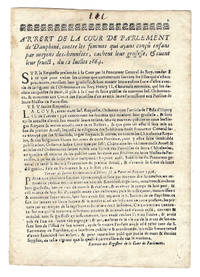
1757réf. 1623Paris: P.G. Simon 1757. First Edition. Unbound. Very good. 4to: 13 1 pp. final page blank. Original self-wrappers stitched some soiling. Top corner of the margins have a diagonal cut no loss of text perhaps to remove the "Arrest" from others that were fastened together otherwise the edges are untrimmed. ADDED: Arrest de la cour de Parlement contre la famille de Robert-Francois Damiens Extrait des registres du Parlement. Du 29 Mars 1757. 4to: 3 pp. THE INFAMOUS DAMIENS TRIAL CHANGED THE CRIMINAL PUNISHMENT PROCESS IN CIVILIZED NATIONS WORLDWIDE. ¶ First printing of all the gruesome details of the trial and death sentence by torture on Robert-Francois Damiens for feebly attempting to assassinate Louis XV. The sentence mandated execution by means of torture that was so cruel so ghastly so horrible and so sickening that it merited immediate and justifiable outrage on an international scale and even now continues to shock legal and sociological historians notably Michel Fouchault who described Damiens's torture and execution at length in his pioneering work on "Discipline and Punishment" 1979. Damiens' was the last sentence of its kind in France and the events prompted real changes in the punishment phase of the legal system in France and elsewhere. ¶ By the present Parliamentary decree the Royal Executioner aided by sixteen assistants was ordered first to torture Damiens with red-hot pincers; the hand with which Damiens had held the knife during the attempted assassination was to be burned with sulpher. Then molten wax molten lead and boiling oil were to be poured into the aforementioned wounds. He was then to be publicly drawn and quartered. ¶ All of this went according to plan except for the final punishment: Damiens' limbs did not separate even after several horrific hours during which time two of the four horses became so exhausted that they had to be replaced by two fresh horses. Damiens' endless shrieks were so incredibly disturbing that many people in the crowd -- including the Royal Executioner Nicolas-Charles-Gabriel Sanson -- were unable to watch and turned away. The officiants came to realize that the process simply was simply not working. As Sanson had abrubtly resigned from his post his son was ordered to partially cut Damiens' limbs with an ax in order to save the horses from further misery. When at last Damiens' limbs were pulled apart his reportedly still-living torso was burnt at the stake. ¶ Ours appear to be the only copies on the market. ¶ ADDED: The Edict which sentenced Damiens' family their only crime being that they were in some way related to him. The "Arrest de la cour de Parlement contre la famille de Robert-François Damiens Extrait des registres du Parlement" is the infamous 3-page pamphlet that was published on March 29 1757 i.e. on the day following Damiens' execution; it records the Parliamentary sentence of Damiens' family which mandated that: the house of Damiens' birth was to be razed; his wife daughter and father were to be banished from France and all other relatives were ordered to change their names with immediate effect. P.G. Simon unknown books
1695réf. 565London: Printed for J. Wickins; and to be sold by the Booksellers of London and Westminster 1695. FIRST EDITION. Hardcover. Very good. Octavo. COLLATION: A-B4 C-F8 G-Q4 COMPLETE. 2 19-176 pp. Attractive half calf antique marbled boards red morocco label gilt compartments gilt with small tools. ¶ FIRST EDITION of this important collection of Parliamentary debates providing original and valuable documentation of the constitutional crisis that ensued during the Glorious Revolution of 1688. James II of England a.k.a. James VII of Scotland while fleeing to France dropped the Great Seal of the Realm into the Thames. In Parliament the question was discussed whether he had forfeited the throne or had abdicated. The present volume offers detailed arguments for the both but ultimately the latter designation was agreed upon and in a full assembly of the Lords and Commons it was resolved in spite of James's protest "that King James II having endeavored to subvert the constitution of the kingdom by breaking the original contract between king and people and by the advice of Jesuits and other wicked persons having violated the fundamental laws and having withdrawn himself out of this kingdom has abdicated the government and that the throne is thereby vacant." The Scottish parliament pronounced a decree of forfeiture and deposition. ¶ In our copy the imprint reads "and to be sold" in another issue the imprint reads "and sold". ¶ References: Wing 2nd ed. E1288A. ESTC R14958. Provenance: the Sunderland copy sale of the Bibliotheca Sunderlandiana Puttick & Simpson 1882 Fourth Portion lot 9338 -- subsequently in the Theological Institute of Connecticut now known as the Hartford Seminary with blindstamps. NB: in 1976 a collection of more than 200000 books from the Hartford Seminary Library were sold to Emory University including this one --> deaccessioned from Pitts Theology Library. Printed for J. Wickins; and to be sold by the Booksellers of London and Westminster hardcover books
1734réf. 607741734. London: Printed by John Baskett 1734. 2nd Enl. ed. London: Printed by John Baskett 1734. 2nd Enl. ed. Scarce Collection of Statutes Concerning Election to the House of Commons Great Britain. Parliament. The Statutes At Large Concerning Elections Of Members To Serve In The House Of Commons; Containing a Compleat Collection of All the Acts of Parliament Now in Force Which Relate Thereto Continued to the End of the Last Session of Parliament 1734. London: Printed by John Baskett 1734. vi 58 49-109 11 6 10 pp. Complete. Text continuous despite pagination. Octavo 6-1/2" x 3-1/2". Recent period-style quarter morocco over marbled boards lettering piece and gilt-edges raised bands to spine endpapers renewed. Light toning to text faint dampstaining to upper corners of a few leaves internally clean. A handsome copy. $250. Second edition enlarged. Added here is an act pertaining to elections in the Scottish Parliament. The first edition was published in 1733. Separate editions for Scotland were published in 1744 and 1747. English Short-Title Catalogue T78250. unknown books
1784réf. 20795London: J. Debrett 1784. 37 1 advt pp. Disbound a couple of spots else Very Good. First and only edition. "Considers the question whether the system of a strong responsible parliamentary administration should be restored" NUC. In England ministers are "responsible to parliament for their conduct and looking up to parliament for support; and not as in despotic governments the mere instruments of the will of an arbitrary master." This is "the great palladium of the Constitution." The author attacks "Lord B." Bute and the King for subverting this system during the events leading to the American Revolution and giving the executive arm of government over to "men ever unfriendly to liberty." FIRST EDITION. J. Debrett unknown books
1856réf. 15713London: Harrison and Sons 1856. Folio original printed blue wrappers chipped along spine some wrapper edge wear old rubberstamp on front wrap. Stitched 267 clean pages. Very Good. offered with FURTHER PAPERS RELATIVE TO RECRUITING IN THE UNITED STATES. PRESENTED TO BOTH HOUSES OF PARLIAMENT BY COMMAND OF HER MAJESTY.1856. London: Harrison and Sons. 1856. Folio stitched. 57 1 pp. Very Good. The Papers reflect ongoing British efforts to recruit Americans for the British army in its war against Russia; and the conflict thus generated with the United States which protested that such attempts violated American neutrality and compromised American sovereignty. Documents concern diplomatic correspondence with the United States; and correspondence with Crampton England's point man for American recruitments. President Pierce's Attorney General Caleb Cushing "directed the prosecution of Crampton the British minister in Washington on the charge of recruiting soldiers within our borders for the British army during the Crimean War" DAB. This document also chronicles Parliament's reaction to that event. FIRST EDITION. Not in Sabin Marke Harv. Law Cat. Harrison and Sons unknown books
1664réf. 002881S.l. Grenoble : s. n. 1664. Very good. First edition thus OCLC lists one copy at Yale with the same title but different text and date - 1638; this edition not in OCLC; 8 3/4 x 6 1/4; single leaf removed text to recto only; illustrated with a woodcut border above the title; a small manuscript note to top margin; minor spotting to left margin; in very good condition. Reaffirming a royal edict first issued in 1556 the document dealt with prostitutes or women who had conceived in a dishonest way and concealed their pregnancy and after giving birth killed their infants and burried them or threw them away. The women were to be punished by death the manner of which was to be determined depending on the gruesomeness of the particular case. The paper contained an extract of the original 1556 edict as well which also required all unmarried women to officially declare their pregnancy and ordered the death penalty for any such mother whose infant died before receiving proper baptism regardless if an infanticide had actually occured. In early modern Europe pregnant unmarried women could face punishment for fornication and if they had a miscarriage or the newborn died they could be accused of infanticide but the courts rarely saw such cases as the magistrates were aware of the physicians' limitations in diagnosing and distinguishing a stillbirth a natural-cause death and a murder. It all chaged throughout most of Europe in the 16th century arguably beginning with the above-mentioned 1556 edict in France which was followed by similar ones in England and Germany in the 1600s and the early-1700s. s. n. unknown books
1818réf. 24993London: John Baskett and others printers 1818. 12 works folio. 12 1/2 x 8 inches and smaller. Disbound or stitched A fascinating series spanning the whole of the period when whaling was carried out on a successful commercial basis in the waters off Greenland. After an abortive start by the South Sea Company between 1724 and 1732 the British whaling fleet operated off Greenland and the Davis Strait throughout the remainder of the 18th century with increasing success due to a large degree to the succession of bounties granted to ship owners by the British Government. The present selection of acts of parliament includes a number concerning the bounty: the first dated 16th January 1732 makes law "that a Bounty will be paid on the Return of every Ship of 200 tons and over imployed by His Majesty's Subjects in the Whale Fishery". For the bounty to be paid certain stringent criteria had to be met; these increased as the century progressed. By the time of the last Act in the present group March 1818 the Greenland whalers were reporting declining catches and were already beginning to turn their attention to other whaling grounds i.e. largely in the Pacific and Antarctic. This group offers and interesting series of snapshots of the industry during its most productive century. The acts comprise: 1. An Act for encouraging the Greenland Fishery. 1732. Stitched later wrappers. Exemption from duty extended for a nine year period. 2. An Act for the further Encouragment of the Whale Fishery carried on by His Majesty's British Subjects. 1733. Stitched later wrappers. The introduction of a bounty for ships over 200 tons. 3. An Act for continuing the several Laws therein mentioned . including granting a further Bounty for all Ships employed in the Whale Fishery during the present War; for exempting Harponers and others . from being impressed. No date but circa 1750. Spine reinforced. The bounty raised by a third other measures to help the trade. 4. An Act for granting a additional Bounty on Ships employed in the Greenland and Whale Fishery for a limited time. No adte but circa 1761. Disbound. The increased bounty confirmed for another five years. 5.An Act for further continuing several Acts . for the Encouragement of the Whale Fishery. 1768. Stitched. 6. An Act for the better Support and Establishment of the Greenland and Whale Fishery. 1771. Stitched. The rules about the amount of bounty to be paid has changed with additional laws concerning vessels of American origin exemption from duty extended to include the Gulf of St. Lawrence certain members of a whaler's crew to be exempt from being pressed into service in the Royal Navy etc. 7.An Act to explain and amend Two Acts made . with respect to the Limits of the Greenland Seas and Davis's Streights . and to enlarge the Time for the Return of the Vessels employed in the Whale Fisheries. 1780. Stitched. 8. An Act for granting an additional Bounty on Ships employed in the Greenland and Whale Fishery for a limited Time. 1782. Disbound. The bounty retained for a further five years. 9. An Act for allowing Vessels employed in the Greenland Whale Fishery to complete their full Number of Men at certain Ports for the Present Season. 1805. Spine strengthened. Whaling ships permitted to call in to ports in Scotland the Orkneys and the Shetland Islands to find men to complete their crews. 10. An Act for allowing until the Signature of Preliminary Articles of Peace Vessels . to complete their full Number of Men at certain ports. 1806. Spine strenghtened. An extension of the previous act. 11. An Act to revive and continue for five years several Laws. 1815. Strengthened spine. Several prvious acts re-confirmed. 12. An Act to amend an Act . so far as it relates to the Oaths thereby required. 1818. Unbound. Concerns the oaths required from owners/captains before the bounty due would be released to them. John Baskett [and others], printers unknown books
1881réf. 45683Boston: Soule and Bugbee 1881. Reprinted from the Edition of 1630 or 1641. Hardcover. Very good/No jacket issued. Showing What Cases Properly Belong to the Cognizance of That Court. Boston: Soule and Bugbee 1881. Reprinted from the Edition of 1630 or 1641. 57 pp. Hardcover. 8vo. Professionally rebound in deep burgundy silk with leather label to spine. New endpapers; avery clean copy in a smart plain binding. Very good/No jacket issued. Insurance required to ship this item. Soule and Bugbee hardcover books
réf. 50373Two volumes iv 315 appendix of 2 174 pp.; and viii 427-524 4 395-728 2 pp. comprising three of the five reports issued in 1835 by the House of Lords to investigate the state of prisons in England and Wales with the goal of researching the prospect of instituting a system which separated prisoners and establishing uniformity of discipline and diet across the prison system to be supervised by a group of Inspectors with interviews conducted with a range of gentlemen including some prison workers as well as questions posed to prisoners at institutions including Wakefield the Millbank Penitentiary the House of Corrections at Lewes and Cold Bath Field Prison and instructions for how to deal with convicts in various situations. Each volume is illustrated with dozens of tables and three lithographic plates which include: "Ergometer - Tread Wheel - Labour. Lewes Prison"; "Tread Wheels at Petworth"; "Crank-House at Petworth"; and "Design for a Prison Chapel by Jas. Savage upon a plan propsed by the Rev. Whitworth Russell Chaplain to the General Penitentiary Millbank in which all the prisoners can see the Clergyman and be seen by him and yet not see or communicate with each other." 4to. Modern three-quarter leather with papered boards and gilt lettering to spine Norwich binder's label to rear pastedown of each volume. London House of Commons 1835. By 1835 the threat of "prisoner culture" whereby prisoners spent time with other prisoners sharing stories learning from each other and plotting was recognized by the State. A Select Committee in the House of Lords was tasked to research a system to separate the prisoners. Six resolutions were laid out in the introduction to the first report including a uniform system of discipline a group of Inspectors to be appointed to visit the prisons and report to the Secretary of State and a new rule that persons who have been acquitted or had their trials postponed should not be imprisoned. The resolutions also include the proposal for the new system of separation: "That entire Separation except during the Hours of Labour and of Religious Worship and Instruction is absolutely necessary for preventing Contamination and for securing a proper System of Prison Discipline. That Silence be enforced so as to prevent all Communication between Prisoners both before and after Trial." One of the witnesses in the first report was Lieutenant John Siblly Governor of the Brixton House of Corrections who had a plan for a "solitary confinement prison" with 284 cells. Another was John Mance Keeper of the House of Corrections at Petworth who is credited as the inventor of the ergometer a labor scale a device which could quantify how much labor could be doled out to various types of prisoners rated both on physical and mental qualifications. The ergometer was "made to show the superintending officer the quantum of labour to be executed hourly daily and weekly.and notifies the officer and prisoners by an alarm bell when the day's work is executed." The final report includes new evidence from Mance the tread wheels and crank-house that he supervised and regulated with his ergometer. Very scarce institutionally. hardcover books
1643réf. 37991London: Printed for Edw. Husbands 1643. 4to 19 cm 7.5". 63 pp. The Irish rebellion of 1641 is nicely explained on the Trinity College Dublin library website http://1641.tcd.ie/historical-rebellion.php. Thousands of English and Scottish settlers were dispossessed during the uprising; many of those who fled to Dublin for safety were interviewed by crown authorities and their depositions taken. This publication contains abstracts of some of those eyewitness testimonies as well as the House's reasoning on the cause of the rebellion and a short narrative of its early months the latter with considerable emphasis on naval operations. ESTC R4373; Wing rev. ed. E2557. Quarter red morocco with French-swirl marbled paper sides and gilt spine lettering; binding signed with small rubber-stamp on verso of front free endpaper by the Macdonald Company of New York. Leather of joints lightly rubbed in places. Very good condition. Printed for Edw. Husbands hardcover books
1642réf. 37985London: Printed for John Wright 1642. 4to 19 cm 7.5". 8 pp. First edition. This ordinance made provision for privateers to hinder aid reaching the Irish during the Rebellion of 1641 although the rebellion wasn't entirely quelled until Cromwell's New Model Army reconquered Ireland in 1653. The war was almost certainly the most destructive in Irish history and its abiding legacy was the wholesale transfer of land ownership and political power from the old Catholic elite to a Protestant one in part newly installed and in part pre-existing the war. The publisher of this wartime proclamation was an official printer for the Parliament of England and published several early newspapers and ballads. ESTC R19001; Wing rev. ed. E1765. Quarter red morocco with French-swirl marbled paper sides and gilt spine lettering; binding signed with small rubber-stamp on verso of front free endpaper by the Macdonald Company of New York. Leather of joints rubbed. Very good condition. Printed for John Wright hardcover books