Jacques-Louis David: Empire to Exile Philippe
réf. 01231015.exp2FNew. unknown

OrangeandBlueBooks · États-Unis225,00 $US≈ 201,40 €
1991réf. BN253453Kiel : Neuer Malik-Verl. 1991. 1991. Hitlerflüchtlinge im Norden : Asyl und politisches Exil 1933 - 1945. hrsg. v. Hans Uwe Petersen Gesellschaft für Politik und Bildung Schleswig-Holstein Beirat für Geschichte der Arbeiterbewegung und Demokratie in Schleswig-Holstein: Veröffentlichungen des Beirats für Geschichte der Arbeiterbewegung und Demokratie in Schleswig-Holstein ; Bd. 7 Hitlerflüchtlinge im Norden : Asyl und politisches Exil 1933 - 1945. hrsg. v. Hans Uwe Petersen Gesellschaft für Politik und Bildung Schleswig-Holstein Beirat für Geschichte der Arbeiterbewegung und Demokratie in Schleswig-Holstein: Veröffentlichungen des Beirats für Geschichte der Arbeiterbewegung und Demokratie in Schleswig-Holstein ; Bd. 7 Schleswig-Holstein Asyl 3. Reich Exil - Petersen Hans Uwe Hrsg. Kiel : Neuer Malik-Verl. unknown
réf. 01231015.exp2FNew. unknown
1917réf. 64488Melbourne: Critchley Parker 1917. 1st edition. Very Good. small octavo. chipped wrappers 141pp. Ôpublished in aid of the work of the Overseas Committee of the British Institute of Journalists in seeking help throughout the world for the exiled Journalists of Belgium their wives and children.Õ Some chipping to wrappers & toning to paper o/w a very good complete & tight copy of a very scarce item Critchley Parker unknown
réf. 24743‘18bre sic 1855’ Wimbledon London. An interesting letter indicating the networks of sympathisers who assisted those fleeing to England in the years following the revolutions of 1848. In the July 1895 edition of the Atlantic the subject of this letter the Christian Socialist J. M. Ludlow in reviewing Nadaud’s memoirs described him as ‘a friend of my own of many years’ standing’. The present item was written in the seventh of the eighteen years of Nadaud’s English exile part of which was spent as a teacher in Wimbledon under the name ‘Henri Geo. Nadaud’. The identity of the recipient is not known. 4pp 16mo. Bifolium on grey paper. Worn and with a small part of one corner torn away but in fair overall condition. Folded once for postage. Sixty-six lines of text addressed to ‘Cher Mons Delabussière’ and signed ‘Martin’. He begins by explaining why he has not been able to return in person the ‘numéro’ of a periodical that Delabussière has sent him and that he has read with great pleasure. He had previously made arrangements about altered worktimes with a colleague. He goes on to ask whether Delabussière would like to dine with him the following Wednesday and whether he would like him to invite ‘Boura’ and another man as well. He states that he does not recall talking to Boura on the subject of a letter ‘écrite par le monsieur ou je suis à celui que je venais de quitter. / Le fait de votre réussite parle assez haut en lui même pour que aucun on dit ne puisse atteindre votre amore propre. Si on n’avait pas eu confiance en vous je n’y pourais pas été appele’ He hopes that Delabussière's ‘association’ brings him money as friends are rare and a man is placed in the scales of wealth rather than of honour. He has distributed Delabussière's prospectuses along with his own calling card and bids him visit ‘un de mes bons amis Mr Ludlow avocat anglais 3 Old Square Lincom-inn sic’ and tell him that he is ‘le professeur de Mechanics institution’ and ‘il aura peut être un collège à vous offrir’. It will be worth his while ‘car ces messieurs font des sacrifices énormes pour l’education du peuple anglais’. He gives a few further instructions regarding how to approach Ludlow ending ‘Il sait toute mon affaire je ne lui cache rien!’ ‘18bre [sic] 1855’ [Wimbledon, London]. unknown
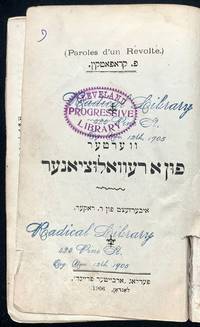
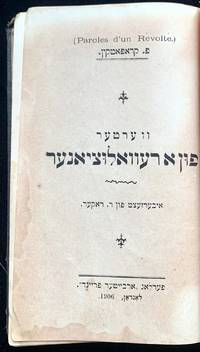
1906réf. 43217London: "Arbayter fraynd 1906. First Yiddish edition. Period boards 8vo xiii 426 pages 19 cm. In Yiddish. Title translates as “Words from a Revolutionary.” Translation of “Paroles d'un re´volte´.” Includes translation of the forewords by the author and Elise´e Reclus. Includes bibliographical references. “During his long exile Kropotkin wrote a series of influential works the most important being ‘Paroles d’un révolté’ 1885; “Words of a Rebel”.Kropotkin’s aim as he often remarked was to provide anarchism with a scientific basis. In Mutual Aid which is widely regarded as his masterpiece he argued that despite the Darwinian concept of the survival of the fittest cooperation rather than conflict is the chief factor in the evolution of species. Providing abundant examples he showed that sociability is a dominant feature at every level of the animal world. Among humans too he found that mutual aid has been the rule rather than the exception. He traced the evolution of voluntary cooperation from the primitive tribe peasant village and medieval commune to a variety of modern associations—trade unions learned societies the Red Cross—that have continued to practice mutual support despite the rise of the coercive bureaucratic state. The trend of modern history he believed was pointing back toward decentralized nonpolitical cooperative societies in which people could develop their creative faculties without interference from rulers clerics or soldiers.” SUBJECTS: Anarchism. OCLC: 19303211. Ex-library with early 19th Century left-wing library markings see photos. Good- Condition YID-48-41-LXCCGG-’e. London: "Arbayter fraynd unknown
1906réf. 43219London: "Arbayter fraynd 1906. First Yiddish edition. Period boards 8vo xiii 426 pages 19 cm. In Yiddish. Title translates as “Words from a Revolutionary.” Translation of “Paroles d'un re´volte´.” Includes translation of the forewords by the author and Elise´e Reclus. Includes bibliographical references. “During his long exile Kropotkin wrote a series of influential works the most important being ‘Paroles d’un révolté’ 1885; “Words of a Rebel”.Kropotkin’s aim as he often remarked was to provide anarchism with a scientific basis. In Mutual Aid which is widely regarded as his masterpiece he argued that despite the Darwinian concept of the survival of the fittest cooperation rather than conflict is the chief factor in the evolution of species. Providing abundant examples he showed that sociability is a dominant feature at every level of the animal world. Among humans too he found that mutual aid has been the rule rather than the exception. He traced the evolution of voluntary cooperation from the primitive tribe peasant village and medieval commune to a variety of modern associations—trade unions learned societies the Red Cross—that have continued to practice mutual support despite the rise of the coercive bureaucratic state. The trend of modern history he believed was pointing back toward decentralized nonpolitical cooperative societies in which people could develop their creative faculties without interference from rulers clerics or soldiers.” SUBJECTS: Anarchism. OCLC: 19303211. Spine is taped.Tight binding but text block is clean and intact. Good Condition YID-48-40-LXCCGG-’e. London: "Arbayter fraynd unknown
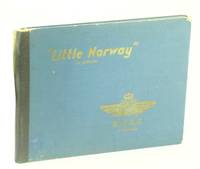
1943réf. 811h1965Toronto: S. J. Reginald Saunders Publishers. Poor. 1943. First Edition. Hardcover. The first 32 pages serve as an introduction to the Norway of today and yesterday accompanied by many black and white photos. The remaining 92 pages describe the history of "Little Norway" established in Canada around the Toronto Island Airport shortly after Germany occupied Norway in WWII. Profusely illustrated with black and white photos we see and read how Norwegian military forces were trained and lived in Canada. Includes names and photos of the Norwegian leaders of this project four photos of the Muskoka aerodrome opened by Crown Prince Olav on May 4th 1942 photos of V.I.P. visitors headshot photos of dozens of unidentified headquarters staff members and an aerial photo of "Little Norway" a completely modern military camp. Undated but appears to be circa 1943. Text in English. Very heavily worn with many military library markings and binding issues. Spine taped. Oblong 12" x 9.25". Not pretty but a worthy reference copy of this important facet of Norwegian and Canadian WWII history. Cooke 3rd Edn p.343. ; 8vo . S. J. Reginald Saunders Publishers hardcover
réf. DADAX1845533062New unknown
1983réf. 16656Munich: Edition Text Kritik 1983-2010. Together 28 octavo volumes. Original printed card wrappers. Condition uniformly fine - free of markings or significant wear. Texts entirely in German. A complete run through 2010 of this important annual publication devoted to German Exile Literature primarily of the Thirties and Forties. Each yearbook is an edited volume of essays on a particular theme as follows: 1- Stalin und die Intellektuellen :: 2- Erinnerungen ans Exil kritische Lektüre der Autobiographien nach 1933 :: 3- Gedanken an Deutschland im Exil :: 4- Das jüdische Exil :: 5- Fluchtpunkte des Exils :: 6- Vertreibung der Wissenschaften :: 7- Publizistik im Exil :: 8- Politische Aspekte des Exils :: 9- Exil und Remigration :: 10- Künste im Exil :: 11- Frauen und Exil. Zwischen Anpassung und Selbstbehauptung :: 12- Aspekte der künstlerischen inneren Emigration :: 13- Kulturtransfer im Exil :: 14- Rückblick und Perspektiven :: 15- Exil und Widerstand :: 16- Exil und Avantgarden :: 17- Sprache - Identität - Kultur :: 18- Exile im 20. Jahrhundert :: 19- Jüdische Emigration zwischen Assimilation und Verfolgung Akkulturation und jüdischer Identität :: 20- Metropolen des Exils :: 21- Film und Fotografie :: 22- Bucher Verlage Medien :: 23- Autobiografie und Wissenschaftliche Biografik :: 24- Kindheit und Jugend im Exil - Ein Generationenthema :: 25- Ubersetzung als transkultureller Prozess :: 26- Kulturelle Räume und asthetische Universalität :: 27- Exil Entwürzelung Hybridität :: 28- Gedachtnis des Exils Formen der Erinnerung. Edition Text + Kritik unknown
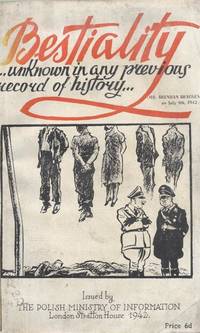
1942réf. 39727London: Stratton House 1942. with no dust jacket. First edition. Original illustrated wraps. 12mo. 56 pages. 19 cm. 'A Record of the German Barbarities in Poland in the First Six Months of 1942.' With two page map of concentration camps in Germany. Extremely detailed early report concerning Nazi atrocities executions concentration camps the extermination of the Lublin ghetto etc. Contents include: Introduction; Documents from Poland; General Sikorski's protest speech; Resolution of the Polish National Council; Press conference at the Ministry of Information; and Justice will be done: official statements and declarations. Included in in the "Documents from Poland" section is a piece on the "Destruction of the Jewish Population." "As early as 1940 the Government Delegate alerted London about the persecution of Jews in Poland. Thereupon the Polish government-in-exile sent a note on this subject to allied governments May 3 1941. Also in 1941 the Polish Ministry of Information in London published a booklet on the persecution of Jews in Poland entitled 'Bestiality Unknown in Any Previous Record of History' and based on information received from occupied Poland. In January 1942 the Ministry issued another publication 'The New German Order in Poland. ' Both publications created a stir throughout the allied world which after 1941 could no longer plead ignorance of the persecution of Jews in Poland. " "The Polish Underground State: A Guide to the Underground 1939-1945" Stefan Korbonski. The US Holocaust Museum keeps their copy in their Rare Book Room. Subjects: World War 1939-1945 - Poland. World War 1939-1945 - Atrocities. OCLC: 8022841. Staples show rust as generally found light rubbing to covers attractive and dramatic about Very Good Condition.B HOLO2-104-27C-MMACCBBE-I-'. London: Stratton House unknown
1960réf. 58268NP 1960. 9 x 7 1/8 inches. Black and white photograph a publicity still bears no attribution on the verso. Stravinsky is generally acknowledged as one of the most important and influential composers of the 20th century. Among his works are the ballets The Firebird 1910 and The Rite of Spring 1915 and the opera The Rake's Progress 1951 with libretto by W.H. Auden and Chester Kallman. Very good. #5145. unknown
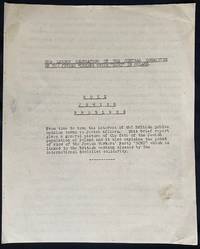
1945réf. 43528No Place London: No Publisher London Delegation of the Bund 1945. No Date 1945 1st Edition. Original Stapled Paper Wrappers Small 4to 17 pages. Mimeograph production. Early 1945 Bundist report aimed at the British public on the impact of six years of Nazi extermination policy on Polish Jewry. "From time to time the interest of the British public opinion turns to Jewish affairs. This brief report gives a general picture of the fate of the Jewish population of Poland and it also explains the point of view of the Jewish Workers' Party 'BUND' which is linked to the British working classes' by the international Socialist solidarity" From the front cover. This early 1945 report to the British public on the destruction of and resistance by Polish Jewry lays out the brutal numbers and facts of ghettoization and then extermination as well as a detailed history of Bund-led Jewish resistance to the Nazis and to deportations to the camps. The mimeograph production and many typographical errors lend a kind of open authenticity to the document that of exiled Jewish trade unionists addressing their British comrades in England. It begins: "The Jewish nation has borne tremendous sacrifices in this war. Several million Jews have been first tortured in a sic inhuman manner and then murdered - several millions that is many times more than the losses suffered by the much more numerous communities of the British Empire and the United States put together. Polish jews sic suffered the greatest losses. There were nearly three and half millions of them living in six hundred Polish cities and towns not counting villages. First they were deported by the Germans to the few ghettos established by them in Poland. Soon afterwards the ghettos were emptied in turn and their 'deported' population was murdered in extermination camps and death chambers." The publication lists the figures for "the ten biggest ghettos of Poland" noting that "In these towns alone the Germans murdered more than one million Jews. Incidentally in all of them with the exception of Cracow Lwow and Czestowchowa 'Bund' was the dominant Jewish party. Out of the nearly three and half millions of Polish Jews there is only a small fraction left today. A small number of survivors have been saved from death by the victorious advance of the Soviet Army. The remainder of the Jews who are still alive under the German Occupation are either in concentration and forced labour comps or in hiding among the Polish population with whom they are fighting in the ranks of the underground movement. Those survivors address to us constant appeals for help and rescue." The solution at this point in the war is that "We must - and our brothers in Poland demand it - we must put such fear into the Germans that they stop the murders of Jews and all the other people whom they still hold in their weakening clutches." The authors are careful at this point to be clear that they do not see Zionism and the immigration of surviving Jews to Palestine as the goal for survivors and post-War Jewish life. They demand immediate assistance and reparations for survivors the criminalization of all antisemitic activity which "should be considered as an attack against the fundamental principles of democracy" and the reconstruction of Jewish life under Socialism in the countries where Jewish refugees now find themselves or in their countries or origin. "Immigration should be free and should not be regulated according to the nationality or religion of the emigrant. Any attempts at presenting the emigration of Jews as a separate problem and considering it as a means of solving the Jewish question always lead to anti-Jewish discrimination." .PALESTINE. does not offer a solution of the Jewish question. Even if one takes into consideration that millions of Jews have been murdered the present Jewish population of Palestine comprises at the most 5% of the number of Jews all over the world. Palestine does not solve the question of anti-semitism either. The majority of Jews will remain dispersed in many countries and in those countries the Jewish question will have to be solved on the spot and anti-semitism extirpated. Palestine is a country of the Jews living there and of the non-Jews who are her inhabitants. We believe that in the same way as we wish to see it in other countries in Palestine also the Jewish minority should build its future on a collaboration with the non-Jewish majority having at the same time a guarantee of a full equality of rights and a complete freedom of its own national and cultural development. We are not a homeless people. The home of the Jews is in the countries in which they live and with which they are linked by many ties. In the same way as for British Jews Britain is their homeland to which they are attached and which they do not want to give up and for American Jews the U.S. A. and French Jews France so for Polish Jews their homeland is Poland. The attitude towards Jews in various countries should be based on the principle that a country is a common homeland for the whole of its population irrespective of origin and religion. The fate of the Jewish population is irrevocably linked to that of the countries it inhabits. It means for the Jews in every country the necessity of fighting for the country's freedom prosperity progress and development as these are a condition of the Jews' own freedom prosperity progress and development. For us as a Labour Party of the Jewish population of Poland it means a fight for the freedom and independence of our country that if sic is of Poland and the building of her future and at the same time the future of Polish Jews on democratic and Socialist principles." The authors then outline the long history of the Bund's underground resistance work against the Nazis" including much on the Warsaw Ghetto Uprising. "In its activities which started on the first day of the occupation the 'Bund' collaborated with the Polish Workers' Underground Movement in the same way as before the war it collaborated with the Polish Socialist Party" including work within the trade union movement and among Jewish youth including 'regularly publishing our clandestine papers eight of them appearing every month.' To achieve this aim fighting detachments of the party were being developed and the whole organisation which from the very first has been proclaiming the idea of an armed struggle against the occupier began to prepare to oppose the 'deportations' to the extermination camps by an armed action. In October 1942 began the last phase of these preparations. The 'Bund' underground movement and the so-called Jewish National Committee an organisation comprising various Zionist groups got together and while preserving their political differences established a Co-ordination Committee and the joint 'Jewish Armed Resistance Organisation' Z.O.B. From that time onwards the armed struggle of the Jewish population in Poland has been led by this resistance organisation. In January 1943 the streets of the Warsaw Ghetto were the scene of the first armed engagement which lasted for several days.Space does not allow us to tell the full story of this rising which in any case had better be written in Poland and not abroad. According to our latest reports from Poland those few remaining survivors of the rising in the Warsaw Ghetto have been writing the story of the events in which they have taken part. After this rising fürther acts of Jewish armed resistance were reported from Poland;" these further acts are then listed and include: "BIALYSTOK In this city the Jews who before the war had been strongly under the influence of the 'Bund' put up a fierce resistance when the Nazis began to liquidate the ghetto in mid- August 1943. The armed rising lasted a month and was conducted with remarkable heroism. TREMBLIN sic This death camp where the Nazis had murdered hundreds of thousands of Jews was completely destroyed at the beginning of August 1943 by the Jews who were there at the time. They attacked the German guards and killed the entire Nazi unit thirty men strong. They seized the ammunition set fire to all the camp buildings and damaged electric cables. Afterwards two hundred Jews escaped to the neighbouring forest. u>SOBIBOR Heroism characterising the Tremblinka revolt marked also the rebellion of Jews at another extermination camp at Sobibor. The Jews revolted there in October 1943 and a large number of them escaped from the camp. General strike in the Lódz ghetto. In February 1943 a general strike broke out in the Lodz ghetto because of German executions. The strike was successful and the executions ceased. MAY DAY 1944 The few survivors of the 500000 Jews of the Warsaw Ghetto who had found refuge among the Polish population the 'Aryan' quarters of Warsaw have not ceased the struggle. Members of the Jewish Workers Movement in Warsaw and in other parts of Poland have even succeeded in organising this year special May Day celebrations. In Warsaw alone five armed Jewish May Day meetings took place." Additional battles between the Jewish-Polish underground and Nazi forces are described as well as underground Jewish resistance newspapers-including one still publishing several thousand copies per issue "distributed in Warsaw and in the provinces" in early 1945. "According to other reports the Jewish survivors of Warsaw organised themselves in fighting detachments. One detachment was named 'Michal Klepfisz' after the hero of the 'Bund' one of the leaders of the rising in the Warsaw ghetto.This detachment distinguished itself particularly during the severe fighting with the Germans for the Old City quarter of Warsaw. General Bor the Commander of the Warsaw uprising gave the detachment special recognition and stated that it alone had killed three hundred Germans and captured a large amount of German arms and ammunition. The other Jewish detachment was fighting under the name of 'Berek Joselewicz' well known historical figure of the Kosciuszko insurrection in Poland in 1794. This detachment took part in the siege and occupation of the main Warsaw post office building. General Bor reported that this Jewish detachment captured more than hundred Germans. 'Even now' it would be difficult to find words which would testify better to the continuity of action and of the struggle waged by the Jewish Workers' Movement irrespective of circumstences sic. After three battles in Warsaw after the slaughter of millions of Jews and the loss of the most valued comrades this movement is still fulfilling its difficult task of fighting th oppression and bringing help to the victims of the Germans." The publication gives a brief introductory history of the Bund appropriate for a British reader which events from the recent past such as: 1936. 'Bund' organised a political strike to protest against anti-Jewish riots which took place in the little town of Przytyk. Hundreds of thousands joined the strike which was supported by many Polish Socialists and by workers organised in Polish Trade Unions. 1938-39. During the municipal elections the majority of the Jewish population in the big cities and in many towns of Poland voted for 'Bund'. In Warsaw out of twenty Jewish municipal councillors 17 belonged to the 'Bund' and only three represented other parties. Finally the authors offer other details about the Bund its strength its publications and its various cultural and political activities concluding with great impact with a description of the "well known Medem Sanatorium for children at Miedzesyn near Warsaw.The sanatorium remained open until 1942 when the Germans 'deported' all the children to extermination camps. The sanatorium's staff were allowed to choose between staying at their posts or accompanying the children. They all chose the latter and together with the children left by a death-train for the notorious Treblinka Camp." OCLC: 504396338. OCLC locates only 1 copy worldwide British Library none in North America or Israel. Light wear and toning very well preserved Very Good Condition. Rare and important. PBERL-1-12-XX. No Place [London]: No Publisher [London Delegation of the Bund] unknown
1995réf. BN496037De Gruyter Saur 1995. 1995. Gesellschaft für Exilforschung / Society for Exile Studies. Nachrichtenbrief / Newsletter: 1984 bis 1993 mit Gesamtregister Gesellschaft für Exilforschung / Society for Exile Studies. Nachrichtenbrief / Newsletter: 1984 bis 1993 mit Gesamtregister Loewy Ernst Studies Gesellschaft für Exilforschung / Society for Exile Barbara Seib u. a. De Gruyter Saur unknown
réf. 2081502111903345Chinese social sciences N.A. Soft Cover. Fine. The book is in fine condition. Chinese social sciences paperback
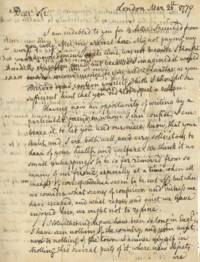
1779réf. List3711London 1779. Autograph letter signed Joseph Green to Boston merchant Samuel Eliot. Folded letter datelined "London Mar. 26th 1779" with "Rec'd 22nd Decr. 1779" docket on top flap. 7 x 9 ¼ inches 3pp. Some repairs with archival tape folded small tears at some folds. Excellent. A thoughtful Revolutionary-era letter written by Joseph Green the Boston clergyman poet satirist and wit whose verses made him one of the best-known literary figures in colonial New England. A graduate of Harvard College and member of Boston's mercantile elite Green maintained friendships with figures including Mather Byles and Benjamin Church. He is known for his satirical poetry and as a signer of the 1773 attestation supporting Phillis Wheatley's authorship of Poems on Various Subjects Religious and Moral. A Loyalist during the American Revolution and named in the 1778 Massachusetts Banishment Act Green departed Boston in 1775 and spent the remainder of his life in England. The present letter was written only a year before his death in London in 1780. Written during the period of British blockade and privateering that turned the Atlantic into a contested military space the letter survives as a rare example of communication successfully passing between a Loyalist exiled in London and a Boston merchant. Green repeatedly returns to the difficulty of maintaining contact noting that "all means of correspondence seem to be cut off" and explaining that he is able to write only because he has found "a particular friend in whom I can confide." The letter itself written in March and not received until December 1779 provides tangible evidence of the obstacles confronting transatlantic correspondence during the Revolution. Green writes: "Having now an opportunity of writing by a particular friend in whom I can confide I embrace it to let you and our niece know that your Aunt and I are both well and very solicitous to hear of your health and welfare. We think it no small unhappiness to be so far removed from so many of our friends especially at a time when all means of correspondence seem to be cut off; but when we consider what scenes of confusion and distress we have escaped and what repose and quiet we have enjoyed here we ought not to repine. "Notwithstanding we have been so long in Engl'd I have seen nothing of the country and your Aunt next to nothing of the town. I amuse myself in trolling thro' several parts of it where new objects are perpetually presenting themselves; and I am the fonder of this exercise as it contributes to health as well as amusement. "The climate here agrees well with my constitution. I enjoy better health than I did at home & my friends tell me I am younger. But I know better than to believe them in this because I think if I was to go about it I could prove I am near four years older than when I left Boston." Green's remarks describe the reality of transatlantic communication during the Revolutionary War when Loyalists abroad and their friends in America frequently depended upon trusted private carriers rather than regular postal channels. The letter's journey from London to Boston-requiring months to arrive and bearing Eliot's receipt docket of December 22 1779-illustrates precisely the obstacles Green describes. Green continues with observations on one of the great public controversies of wartime Britain the celebrated court martial of Admiral Augustus Keppel following his engagement with the French fleet off Brest. Green describes the intense public reaction and the partisan passions surrounding the affair: "We have had a forced and ostentatious display of joy on acct. of Admiral Keppel's acquittal. He has been try'd by a court martial on a charge brought against him by Admiral Palliser for misconduct in the engagement he had the last summer with the French fleet off Brest. This has been made a party affair and has been carry'd to a most extravagant height. The whole city has been illuminated three or four nights and there have been great rejoicings thro' the Kingdom. But the matter is now pretty well over and Palliser has ruin'd himself by it." Most affecting however is Green's reflection on the increasingly remote prospect of ever returning to Boston. He seems to realize that his exile may be permanent writing that "At the time I left Boston it was uncertain when I should return or whether I should return at all. But the improbability was not so great then as it is now. The door was then shut now it is bolted." Green's letter offers a moving account of Loyalist exile-separation from friends and family with hope for return fading. We find no other records of letters written by Green during this period in commerce or at auction.