334 résultats
1946réf. MMRM1658Varsovie:: American Joint Distribution Committee 1946. 1946. 8vo. 264 4 pp. 11 black and white photographic plates 50 tables charts index. Original printed wrappers; scotch tape along spine front and rear covers age-darkened first 3 pages including half title and last three blank end-papers are loose. Main body of work remains bound and in good condition. Loose pages have some slight area of extremities missing. Some fading and foxing to pages. Thus wrappers poor but text good to good plus. First edition. SEMINAL WORK IN MEDICAL CLINICAL RESEARCH & A CRITICAL ARTIFACT OF THE WARSAW GHETTO AND HOLOCAUST. Copies of the book are uncommon in part because of the fragile nature of the paper used to publish the report. In the immediate aftermath of World War II paper ink and binding facilities in Europe were scarce. The published report was done with economy in mind and with a rushed sense of needing to reveal to the world what happened. / Six articles report on the clinical research by 28 Jewish physicians and a student intern the 1946 book only records the names of 21 physicians and the student – subsequent research in the 1960s revealed the additional names who conducted the studies on adults and children at the two Jewish hospitals in the Ghetto. Abbreviated biographies of the physicians can be found in The Uses of Adversity: Studies of Starvation in the Warsaw Ghetto by Leonard Tushnet published in 1966. The physicians hoped to study these patients to somehow benefit humanity perhaps in the spirit of the Jewish concept of tikkun olam - to repair the world. The studies were conducted in secret since any scientific research in the Ghetto was prohibited by the Nazi overseers. It is also quite possible that many if not all the clinical physicians believed that granting children and others the status of being a patient would protect them by preventing their transport out of the ghetto to death camps. Theories also suggest that the physicians wanted to preserve a record of the atrocities being committed as well as advance medical research. The studies remain the most comprehensive research of the effects and progression of starvation in part because any contemporary studies would largely be blunted by existing ethical guidelines for informed consent and subject welfare. Contemporary debates about the ethical wisdom of conducting these studies remains contentious. / The Warsaw Ghetto occupied approximately 1.3 square miles 3.4km2 and its population was as much as 500000 men women and children. The Ghetto was a staging area for transporting Polish and Eastern European Jews to the death camps and a locale for starving to death Jews prior to transport. The average daily caloric intake of a resident of the Ghetto was 600 to 800 calories of low-protein food for adults. This amount was calculated by Adolf Eichmann to starve-to-death most of the residents in approximately nine months. The physicians performing the research were no exception to the plan. All were starving as they performed their studies. Equipment for clinical research was smuggled into the hospitals. / Each article in the book is devoted to specific results of these studies. Chapter V offers autopsy results on 710 patients; 492 died of starvation and 218 died of complications of secondary conditions. Chapter VI offers clinical observations of one-hundred adults who died from starvation. Chapter VII offers clinical observations of 40 children who died of starvation. Chapter VIII examines the effects of starvation on the cardiovascular system in adults and children. Chapter IX discusses changes in peripheral blood and bone marrow. Ophthalmic responses to starvation are discussed in Chapter X. Only one doctor engaged in the research Emil Apfelbaum survived the war. He arranged to have the studies smuggled out of the Ghetto to a Polish professor of medicine who released the reports after the liberation of Warsaw. After the war Apfelbaum edited the report for publication by the Joint Distribution Committee. He died a week before the book was published. / Research was performed at the two hospitals in the Ghetto from late February to July 22 1942. On July 22 the hospitals were closed and any patients unable to be transported were summarily executed regardless of age. The attending and clinical physicians were fully aware of the fate awaiting transported patients and in many instances they performed euthanasia on elderly and child patients who were scheduled for transport. Some of the physicians committed suicide rather than face transport. Other physicians accompanied their patients to the death camps providing whatever aid they could. / The studies were smuggled out of the ghetto in a manner befitting a Ken Follet thriller. A Jewish physician Henryk Fenigstein played a crucial role. "Before the war Henryk was a stamp collector. In fact he had one of the largest collections of Polish stamps in the country. One day two SS members arrived at the hospital and told Henryk to come with them to Gestapo headquarters. Of course he was terrified. Jews taken to Gestapo headquarters did not return. On arrival he was taken to the office of a senior officer who told him that he himself was an avid stamp collector. He took out a list and handed it to Henryk. He wondered if Henryk had these stamps and if not if he knew where to procure them. Henryk told him that he had many of the stamps including some of the very rare ones. He told him that he thought he could procure the rest. In order to do this he would need a pass to get out of the ghetto for a few hours each week. And of course the SS officer was welcome to those that he had. The officer agreed and even gave Henryk his phone number in case he needed any help. Thus Henryk Fenigstein a key member of the study team was able to leave the ghetto" 2005 lecture Myron Winick. During such an outing Fenigstein arranged for the smuggling of the reports. A pregnant woman reportedly was used to hide the documents and transport them out of the ghetto. / The supervising physician of the project Israel Milejkowski wrote in his Introduction to the studies that each author refused to allow the Nazis to destroy their work and that through the research and the publication of that research "Nous avons termine nos Recherches et nous les conserverons bien comme c'etait Ton desir. Les paroles immortelles que Tu a jetees "Non omnius Moriar" doivent etre en premier lieu appliquees a Toi! Gloire eternelle a Ta Memoire !" / The research as well as results from the Minnesota Semi-Starvation studies of 1944-1945 continues to benefit the millions of persons facing starvation each year. The participants in the Minnesota study lost an average of 25% of pre-test body weight and the final phase of the study included recovery techniques and methods. The Warsaw studies measured effects until death. This artifact of scientific integrity individual bravery and resistance to oppression is a rare opportunity to truly own a small piece of history illuminating the courage of physicians determined to use their craft to help the world and advance the memory of atrocities. American Joint Distribution Committee, 1946. unknown books
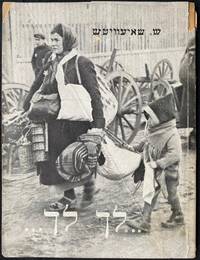
1946réf. 43433Lodzsh: Tsentraler Yidisher Historisher Komisye baym Tsentral-Komitet fun Poylishe Yidn 1946. 1st edition. Original dramatic photgraphic covers 8vo 70 1 page 1 leaf. Includes facsimiles. 21 cm. In Yiddish. Poems. "Oysgabes fun Der Tsentraler Yidisher Historisher Komisye baym Tsentral-Komitet fun Poylishe Yidn. Serye yidishe literatur 1." "Published by a commission The Central Jewish Historical Commission dedicated to recording the fate of Polish Jews published this book length poem by Simkhah Szajewics. Written in the Lodz Ghetto it appeared immediately after the war in 1946; Szajewicz perished in a concentration camp in 1944" from an exhibit at the National Yiddish Book Center which houses their copy in their Rare Book Collection. The book includes two long poems: "Lekh-lekha" and "Friling 702 " as well as letters and other related material. See David Roskies' interesting reflection on this work and it's stunning photographic cover at jtsa.edu/torah/go-forth-the-grammar-of-remembrance. For more about the author-poet see Chava rosenfarb's essay on Shayevitch in Tablet Magazine at tabletmag.com/sections/arts-letters/articles/the-last-poet-of-lodz. SUBJECTS: Jews -- Persecutions -- Poland -- Lódz. Holocaust Jewish 1939-1945 -- Poetry. Jews -- Correspondence. Crease and wear to wrapper and foot and crown of spine see photo better condition than usually found attractive. Good Condition. B HOLO2-110-36A-CCALX-'emm H-40-10. Lodzsh: Tsentraler Yidisher Historisher Komisye baym Tsentral-Komitet fun Poylishe Yidn unknown
2013réf. 2-8479787228Ediciones Díaz de Santos 2013. Paperback. New. 398 pages. Spanish language. 9.37x6.61x0.71 inches. Ediciones Díaz de Santos paperback
2011réf. DADAX1456794744AuthorHouse 2011-09-16. hardcover. New. 6.00x0.94x9.00. Buy with confidence. Excellent Customer Service & Return policy. AuthorHouse hardcover
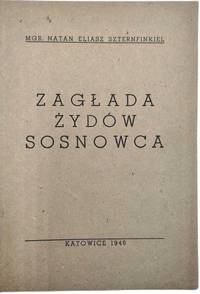
1946réf. 43546Katowice: Centralna Zydowska Komisja Historyczna 1946. 1st edition. Original printed paper wrappers 8vo 80 pages. Includes seven photos and fold out map of the Ghetto in Bedzin and Sosnowiec. In Polish. Title translates as "The Extermination of the Jews of Sosnowiec." From the series "Wydawnictwa Centralnej Zydowskiej Komisji Historycznej w Polsce" Nr. 25. Wiener Library I: 1352. Published under the Kolegium Redakcyjne with leadership from Filip Friedman & Jozef Wulf among others. "The Sosnowiec Ghetto German: Ghetto von Sosnowitz was a World War II ghetto set up by Nazi German authorities for Polish Jews in the Srodula district of Sosnowiec in the Province of Upper Silesia. During the Holocaust in occupied Poland most inmates estimated at over 35000 Jewish men women and children were deported to Auschwitz death camp aboard Holocaust trains following roundups lasting from June until August 1943. The ghetto was liquidated during an uprising a final act of defiance of its Underground Jewish Combat Organization ZOB made up of youth. Most of the Jewish fighters perished. Before the war there were about 30000 Jews in Sosnowiec making up about 20% of the town's population. Over the next two years the Germans resettled thousands of Jews from smaller towns to Sosnowiec temporarily increasing the size of the local Jewish community to 45000. By late 1942 Bedzin and nearby Sosnowiec which bordered Bedzin became the only two cities in the Zaglebie Dabrowskie region that were still inhabited by Jews. The city located on the pre-war Polish-German border was taken over by the Germans on the first day of the invasion of Poland. Arrests and beatings among more prominent Jews began the next morning. On 9 September 1939 the Great Synagogue in Sosnowiec was burned. Local Jews were being evicted from better homes and terrorized on the streets. Jewish businesses were plundered by individual soldiers and closed by the Nazis pending confiscation proceedings. Shootings and first mass executions followed soon afterwards. Forced relocations into crowded tenements slowly created a ghetto. Judenrat and the Jewish police were soon established on German orders; the head of the Sosnowiec Judenrat was Moshe Merin Mojzesz Merin in Polish. Food rationing was introduced. The Jews were prohibited from buying anything outside their own community. In the first months of 1940 the Zentrale der Jüdischen Ältestenräte in Oberschlesien Central Office of the Jewish Councils of Elders in Upper Silesia headed by Merin was created in Sosnowiec representing about 45 communities. For a time Merin became infamous as the dictator of the Jews of the Zaglebie region with the power of life and death over local Jews. A labour camp was established for the Jews deported to Sosnowiec from Czechoslovakia to work at the factory of the Shine brothers. Numerous forced labour facilities were established for the locals; making uniforms underwear corsets bags leather handbags and military boots. In 1940 some 2592 German war profiteers arrived in the city. By 1942 their number rose to 10749 settlers constituting 10% of the general population. Ever since the ghetto was established numerous deportation actions were organized by the Germans with the help of the Judenrat and Merin selecting healthy men for slave labor at the camps. Large transfers of Jews took part in May 1500 and June 1942 2000. Around October 1942 - January 1943 the ghetto was moved to the Srodula district. Srodula also bordered the site of the Bedzin Ghetto. At this point about 13000 Jews still lived in Sosnowiec. The creation of the Sosnowiec ghetto ended on 10 March 1943 when it was finally closed off from the outside world. Thousands of Jews were deported from Sosnowiec to Auschwitz in June 1943 during the major deportation action extending to nearby Bedzin. The ghetto was liquidated two months later in August whereas almost all remaining Jews were also deported to Auschwitz. A few hundred Jews remained in the Srodula ghetto which was liquidated in January 1944. Frumka Plotnicka age 29 led the uprising in the Bedzin Ghetto adjacent to SosnowiecThere had been considerable underground activity among the Jews in Sosnowiec and Bedzin Ghetto nearby organized by the youth organizations Ha-No'ar ha-Ziyyoni Gordonia and Ha-Shomer ha-Za'ir. During the final major deportation push in August 1943 the Jewish Combat Organization Polish: Zydowska Organizacja Bojowa ZOB in Bedzin and Sosnowiec staged an uprising against the Germans. The uprising which began on 3 August 1943 was led by Cwi Tzvi Brandes Frumka Plotnicka and the Kozuch brothers. It was the final act of defiance of the local population with no chance of success. Most of the young Jewish fighters perished 400 killed in action fighting the overwhelming German forces. The last Holocaust transport to Auschwitz-Birkenau with Jews forced to bury the dead left Sosnowiec on 15 January 1944. Resistance of the ghetto inhabitants is commemorated by one of the streets in Sosnowiec bearing the name "Street of the Ghetto Heroes" Ul. Bohaterów Getta. There is also Kozuch Brothers square Plac Braci Kozuchów with a ghetto memorial. The Catholic convent of Carmelite Nuns led by Mother Teresa Kierocinska aided the Jews in the ghetto and hiding. Kierocinska was awarded a medal of the Righteous 46 years after her death. She was declared 'heroic in virtue' by Pope Francis in 2013. The Carmelite Sisters run an orphanage at the monastery. They delivered free bread to Jews in hiding send food parcels to Auschwitz and rescued Jewish children by hiding them under false names among the Christian orphans. The convent was frequently inspected by the Gestapo on suspicion of illegal activities."Other local rescuers were later identified by surviving Jews and were named "Righteous Among the Nations." Wikipedia. SUBJECTS:World War 1939-1945 -- Poland -- Sosnowiec Wojewo´dztwo S´laskie Jews. Holocaust Jewish 1939-1945 -- Judenverfolgung Joden. OCLC: 769381.Toning as expected Very Good Condition much better than usually found. B HOLO2-63-36B-XLABCCE. Katowice: Centralna Zydowska Komisja Historyczna unknown
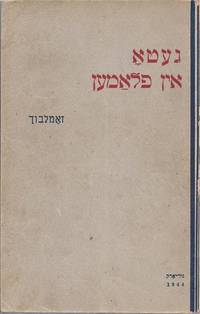
1944réf. 40092New York: Nyu-York: Amerikaner reprezentants fun "Bund" in Poyln 1944. Paperback. 1st edition. Original printed paper wrappers 8vo 206 pages. Includes illustrations & facsimiles. 21 cm. In Yiddish. Title translates as "Ghetto in Flames." Early report from the year following the Warsaw Ghetto Uprising published by one of the participating organizations the Jewish Bund. SUBJECTS: Jews -- Poland -- Warsaw. World War 1939-1945 -- Jews. Geographic: Poland -- History -- Occupation 1939-1945. Warsaw Poland -- History -- Warsaw Ghetto Uprising 1943. OCLC: 1227410408. Wear to corwn and foot of spine otherwise Very good Condition. Important. BER-1 HOLO2-98-26A-. Nyu-York: Amerikaner reprezentants fun "Bund" in Poyln paperback
réf. 54428175-nnew. unknown
réf. 54428175like new. unknown
1988réf. BN258021Frankfurt am Main : S. Fischer 1988. 1988. Hinaus aus dem Ghetto : Juden in Frankfurt am Main ; 1800 - 1950 ; Begleitbuch zur ständigen Ausstellung des Jüdischen Museums der Stadt Frankfurt am Main. Rachel Heuberger ; Helga Krohn Hinaus aus dem Ghetto : Juden in Frankfurt am Main ; 1800 - 1950 ; Begleitbuch zur ständigen Ausstellung des Jüdischen Museums der Stadt Frankfurt am Main. Rachel Heuberger ; Helga Krohn Ghetto FFM - Heuberger Rachel und Helga Krohn Frankfurt am Main : S. Fischer unknown
réf. ria9798184899671_inpPaperback. New. New Book; Fast Shipping from UK; Not signed; Not First Edition; Nel sistema sanitario moderno i flussi informativi rappresentano una componente essenziale per il governo dei processi clinici organizzativi e amministrativi. Dalla raccolta dei dati alla loro elaborazione dalla qualità dell'informaz paperback
réf. 8479787228.Gpaperback. Good. Access codes and supplements are not guaranteed with used items. May be an ex-library book. paperback
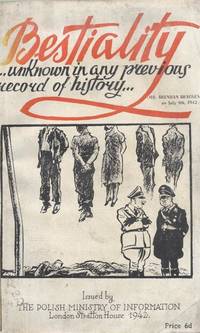
1942réf. 39727London: Stratton House 1942. with no dust jacket. First edition. Original illustrated wraps. 12mo. 56 pages. 19 cm. 'A Record of the German Barbarities in Poland in the First Six Months of 1942.' With two page map of concentration camps in Germany. Extremely detailed early report concerning Nazi atrocities executions concentration camps the extermination of the Lublin ghetto etc. Contents include: Introduction; Documents from Poland; General Sikorski's protest speech; Resolution of the Polish National Council; Press conference at the Ministry of Information; and Justice will be done: official statements and declarations. Included in in the "Documents from Poland" section is a piece on the "Destruction of the Jewish Population." "As early as 1940 the Government Delegate alerted London about the persecution of Jews in Poland. Thereupon the Polish government-in-exile sent a note on this subject to allied governments May 3 1941. Also in 1941 the Polish Ministry of Information in London published a booklet on the persecution of Jews in Poland entitled 'Bestiality Unknown in Any Previous Record of History' and based on information received from occupied Poland. In January 1942 the Ministry issued another publication 'The New German Order in Poland. ' Both publications created a stir throughout the allied world which after 1941 could no longer plead ignorance of the persecution of Jews in Poland. " "The Polish Underground State: A Guide to the Underground 1939-1945" Stefan Korbonski. The US Holocaust Museum keeps their copy in their Rare Book Room. Subjects: World War 1939-1945 - Poland. World War 1939-1945 - Atrocities. OCLC: 8022841. Staples show rust as generally found light rubbing to covers attractive and dramatic about Very Good Condition.B HOLO2-104-27C-MMACCBBE-I-'. London: Stratton House unknown
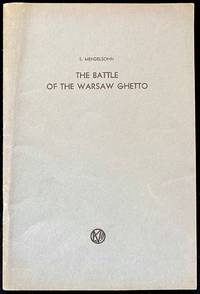
1944réf. 4620New York: Yiddish Scientific Institute 1944. Paperback. 1st separate edition. Original Paper Wrappers. 8vo. 28 pages. 23 cm. Wolff #I: 1441. Includes map in black red and white as the full-page center spread. Early report on the uprising: "It is as yet impossible to give a complete picture of the resistance in the Warsaw Ghetto.The material is as yet too scarce. " "This paper was read at the eighteenth annual conference of the Yiddish scientific institute on January 9 1944 .The paper was delivered in Yiddish and is published in the Yivo bleter Journal of the Yiddish scientific institute XXIII 1 January-February 1944." Very good condition. B HOLO2-65-17. Yiddish Scientific Institute paperback
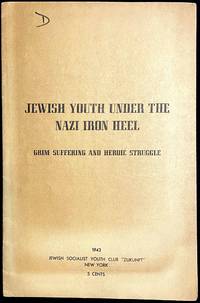
1942réf. 43351New York: Jewish Socialist Youth Club 1942. Paper Wrappers. Illustrated by 2 Facimilie Illustrations. 1st edition Original Paper Wrappers 8vo 16 pages another variant we have seen has 15 pages. From the year before the Warsaw Ghetto Uprising an early 1942 report by the American branch of the Bund on Jewish resistance by young people in Eastern Europe. "Hand in hand with the underground organizations of the General Jewish Labor Union and in contact with the organization of the Polish socialists the Youth Union 'Zukunfst' conducts an untiring and ramified activity which is preparing the ground for the open struggle of tomorrow against Hitlerism" p. 13. "Tsukunft or Cukunft or Zukunft Yiddish for future was the youth organization of the General Jewish Labor Union or Bund. It was founded in 1910 and in 1916 it was officially called Yugnt-Bund Tsukunft. Their newspaper was the Yugnt veker. In 1922 the organization changed its name to Yugnt-bund "Tsukunft" in poyln 'Youth Bund "Tsukunft" in Poland'.At the time of the sixth Tsukunft conference in 1936 the last before the outbreak of the Second World War the organization counted with 184 local groups. On the eve of the Second World War the organization had 15000 members. The Tsukunft took part in the Warsaw ghetto uprising as part of the Jewish Fighting Organization" Wikipedia. SUBJECTS: Jewish youth -- Poland. Holocaust Jewish 1939-1945 -- Jewish resistance. World War 1939-1945 -- Atrocities. OCLC: 6871875. Covers toning with pen notation to cover otherwise Very Good Condition B Holo2-139-22A-XAECC-'l. Jewish Socialist Youth Club unknown
réf. 8409841487.Gpaperback. Good. Access codes and supplements are not guaranteed with used items. May be an ex-library book. paperback
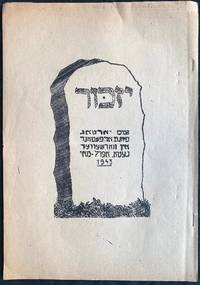
1944réf. 43395Shvayts Switzerland: Undzer Vort Poale Tziyon Left 1944. May 1944. 1st edition. Original stapled printed paper cover 4to 2 25 pages. In Yiddish. Title translates as "In Memoriam. On the Anniversary of the Uprising in the Warsaw Ghetto April-May 1943. First Anniversary of the Warsaw Ghetto uprising published in Europe during the Holocaust by Jewish "Poale Tziyon Left" members in Switzerland. The organization's name which means "Workers of Zion" is sometimes also romanized as "Poale Zion" or "Poaley Syjon." The imprint "Undzer Vort" "Our Word" was a Left Poale Tziyon publisher in Switzerland which also published a mimeograph newspaper titled "Undzer Vort" OCLC: 232675203 during this same period. A fully underground version of the paper was also published in Nazi-Occupied Belgium see below. Indeed Poale Tsiyon Left was an important part of Jewish resistance throughout Europe most notably during the Warsaw Ghetto Uprising which this publication commemorates. "The Holocaust-era Jewish resistance group ZOB was formed from a coalition including Hashomer Hatzair Dror Bnei Akiva the Jewish Bund various Jewish Communist groups and both factions of Poale Zion. Poale Zion was also active in the Anti-Fascist Bloc. Several notable Jewish resistance fighters during the Holocaust particularly those involved in the Warsaw Ghetto Uprising were members of Poale Zion. They include: Adolf Berman Warsaw ZOB fighter; Secretary of Zegota Poale Zion Left Hersz Berlinski member of Warsaw ZOB Command Poale Zion Left Yochanan Morgenstern member of Warsaw ZOB Command Poale Zion Right Emanuel Ringelblum member of Warsaw ZOB; chronicler of the Warsaw Ghetto Poale Zion Left" Wikipedia. The booklet opens with the moving story of the start of the uprising: "It has been a year since the glorious uprising of the Jews in the Warsaw ghetto. April 19 1943 - barely a few tens of thousands of Jews left in Warsaw after about half a million of their brothers and sisters were exterminated in the most gruesome way they rose up with organized resistance against the renewed attempts.that they too like the previous ones would be led out like sheep to the slaughter. Forty thousand Jews weapons in hand opposed an enemy tenfold a hundred hundred times outnumbered.Women men and children the high class and the humble. From the beginning they all knew without exception that they would be defeated that the outcome was not in doubt and that the enemy intended nothing but destruction for all of them. But no Nazi expected to fall on such a battlefield. And his was the biggest slap in the face which the proud Nazis.so hated when it was received from these these trampled down these unrefined these scorned these despised Jewish 'untermenchen'" Translated from the opening paragraphs on page 1. The publication later continues with a damnation of the "democracies" who did so little and a holding up of the comrades of Poale Tziyon who are doing so much fighting on all fronts: "The 'world democracies' didn't do anything.to save the Jewish victims and to stop the misery train they issued platonic statements about punishing the 'crimes' after the massacre. The warnings have so far helped little. The.Sacrifices keep growing.The world that is fighting 'for justice' and that is busy with courts after the massacre has not found any means to rescue the few escaped heroes in the ghetto for a whole year. This long eulogy is for dozens and hundreds of comrades who fell as loyal children of the nation and fighters for its working class on the fronts in the distant.north in the camps of France and Belgium. who went from one end of the world to the other - at their wounds and from hundreds of thousands of others - comrades of the Poale-Tziyon movement." page 24. Poale Zion.was a movement of Marxist-Zionist Jewish workers founded in various cities of Poland Europe and the Russian Empire at about the turn of the 20th century after the Bund rejected Zionism in 1901. Poale Zion was torn between left-wing and right-wing factions in 1919-1920; the organization formally split at the Poale Zion fifth world congress in Vienna in 1920 following a similar division that occurred in the Second International. The right wing was less Marxist and more nationalist and favoured a more moderate socialist program and supported the International Working Union of Socialist Parties to continue the work of the Second International essentially becoming a social democratic party. The left-wing faction did not consider the Second International radical enough and some accused its members of betraying Borochov's revolutionary principles although Borochov had begun to modify his ideology as early as 1914 and publicly identified as a social democrat the year before his death. Poale Zion Left which supported the Bolshevik revolution continued to be sympathetic to Marxism and Communism and attended the second and third congresses of the Communist International in a consultative capacity. They lobbied for membership but their attempts were unsuccessful as the internationalist communist movement under Lenin and Trotsky was opposed to Zionist nationalism. The Comintern advised individual members of Left Poale Zion to join their national Communist parties as individuals; at their 1922 Danzig conference these terms were rejected by the party. The Comintern declared it an enemy of the workers' movement. Poale Zion Left opposed the decision by Poale Zion to rejoin the World Zionist Organization viewing it as essentially bourgeois in character and viewed the Histadrut as reformist and non-socialist. Aside from differing attitudes towards Zionism and Stalinism the two wings of Poale Zion parted ways over Yiddish and Yiddish culture. The Left was more supportive of the latter similar to the members of the Jewish Bund while the Right bloc identified strongly with the emerging modern Hebrew movement in the early 20th century. In Poland for a brief period following World War I both factions of Poale Zion were reported as legal and functioning political parties. The Polish Left party was the largest Left Poale Zion party in the world. It worked closely with the Bund in developing Yiddish schools in Poland and supporting secular Yiddish culture although they had political differences e.g. the Bund was more supportive of the Polish Socialist Party than LPZ. As part of the large-scale ban on Jewish political parties in post-World War II Poland by the Communist leadership both Poale Zion groups were disbanded in February 1950" Wikipedia. Interestingly the image on the front cover this distinctive gravestone with "Yizkor" in a specific heavy font was a frequent image for memorials to the victims of pogroms as well as the Shoah in particular for memorials to the Warsaw Ghetto Uprising. A few examples include: • Hashin & Ben Gurion Yizkor tsum ondenken di gefalene vekhter un arbeiter in Erets Yisroel New York Poale Zion Palestine Committee 1917. Internal illustrated title page • Hurbn Proskurov New York: Proskurover Relief Organization 1924. See image on JHU's online Yizkor Book Exhibit at www.library.jhu.edu/news/2025/06/yizkor-books-traveling-homelands-and-portable-memorials And from another memorial to the first anniversary of the Warsaw Ghetto Uprising: • Tsum Yortog Funm Oyfshtand in Varshever Geto April-May 1943. Ramat Gan: Defus "liga" 1944. OCLC: 63647084. See Nr. 35 in our catalog 215 at danwymanbooks.cdn.bibliopolis.com/images/upload/catalog-215.pdf "Undzer Vort" also published similar underground Poale Tziyon Left newspapers and other materials in Nazi-occupied countries such as Belgium: "'Linke Poale Zion' Left-wing Workers of Zion was a Zionist-Socialist party in Belgium and one of the initiators of the Jewish Defense Committee of Belgium. This committee managed to save about 3000 children and several thousand Jewish adults from the clutches of the Nazis. With his party comrades Abusz Werber ensured the editing publication and distribution of 28 issues of a secret underground newspaper in Yiddish"Unzer Wort" Undzer Vort Our Word which appeared until the Liberation in September 1944 and even after" Werber The Word of Abusz Werber 2017. Note how the Yiddish documents on the cover of the book are similar to our Undzer Vort publication from Switzerland: https://m.media-/images/I/71sWHrhxgoL._SL1360_.jpg. SUBJECTS: Holocaust Jewish 1939-1945 -- Poland -- Warsaw -- Illustrations. OCLC: 233365664. OCLC locates only 1 copy worldwide NLI. Final leaf in facsimile. Paper toning as expected but strong. About Very Good Condition thus. Rare and important. B Holo2-163-28-XX. Shvayts [Switzerland]: Undzer Vort [Poale Tziyon Left] unknown
2017réf. 2-8868955156Edizioni Lswr 2017. Paperback. New. 554 pages. Italian language. 9.41x6.69x1.10 inches. Edizioni Lswr paperback
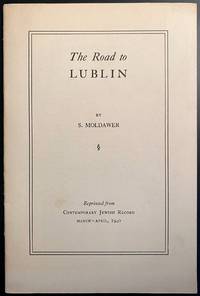
1940réf. 43325New York: American Jewish Committee 1940. 1st separate edition. Original paper wrappers. 8vo pages 119-133 14 pages total. “Reprinted from Contemporary Jewish Record March-April 1940.” Includes photo of “Armbands which Nazis are compelling the Jews to wear.” Moldawer’s story originally appeared in The Forward N.Y.C. Jan. 2-5 1940 in Yiddish. Moldawer a Polish Jew who had resided in Germany had been caught by the outbreak of the war in Hamburg on his way to the United States. Together with other Jews holding U.S. visas and steamship tickets on the Hamburg-America Line-which had suspended operations-he was deported to Lublin via Prague. Moldawer used his U.S. visa and left Poland in December 1939 and was able to issue this report which became important at the time for understanding what was happening to the Jews in Poland and is often cited in later analysis. “During the Holocaust 99% of the Jews from Lublin District in the General Governorate of German-occupied Poland were murdered along with thousands of Jews who had been deported to Lublin from elsewhere. There were three extermination camps in Lublin District Sobibor Belzec and Majdanek. The ghettoization of the Jews for the purpose of persecution terror and exploitation in the Nazi German controlled towns began immediately after the invasion of Poland….The number of major urban ghettos established in the General-Government in 1939–40 including those of Kraków and Warsaw reached one hundred before the end of the year. In the Lublin area the situation initially differed. Instead of their urban concentration some 10000 Polish Jews had been expelled from Lublin in early March 1940 to the rural towns where ghettos were not set up based solely on Globocnik's opposition to the Jewish people living near his staff headquarters. The remaining 40000 Jews of Lublin were forced into the Lublin Ghetto in May 1940” Wikipedia. SUBJECTS: Nazi concentration camps. World War 1939-1945 -- Jews. Concentration Camps Camps de concentration nazis. Guerre mondiale 1939-1945 -- Juifs. Majdanek Concentration camp. OCLC: 39753405. Touch of edgewear to rear wrapper Very Good Condition Overall. B HOLO2-162-15-AX-BB. New York: American Jewish Committee unknown
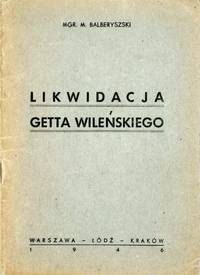
1946réf. 43329Warszawa; Lódz: Zaklady Graficzne WINW: Centralna Zydowska Komisja Historyczna 1946. 1st Edition. Original Paper Wrappers 8vo 40 pages. 21 cm. In Polish. Title translates as "The Liquidation of the Vilna Ghetto." Includes bibliographical references. Personal eyewitness account by Mendel Balberyszski 1894–1966 a prominent Vilna Jewish leader and later Holocaust survivor detailing life in the Vilna Ghetto and its destruction under German occupation. Balberyszski served on the Advisory Council of the “small ghetto” opposing Judenrat collaborationist policies. He survived both the liquidation of the ghetto and the Holocaust. Balberyszski a Lithuanian-Polish Jewish politician and journalist was prewar editor at Vilna’s Der Tog and active in the Folkspartei and later the Polish Democratic Party. After the war he emigrated to Melbourne where he became a leading communal figure. His memoir was later republished in English as Stronger than Iron: The Destruction of Vilna Jewry 1941–1945 2010. Pages 38-40 detail a list of 35 titles issued 1945–46 by the Historical Commission documenting early postwar Jewish testimony efforts. SUBJECTS : Holocaust Jewish 1939-1945 Lithuania Vilnius. Jewish ghettos Lithuania Vilnius. World War 19391945 Lithuania Vilnius Atrocities. Jews Lithuania Vilnius. OCLC: 13911170. Very Good Condition overall. B H2-3-5-VLGGAMPCCFE-XBB. Warszawa; Lódz: Zaklady Graficzne WINW: Centralna Zydowska Komisja Historyczna unknown
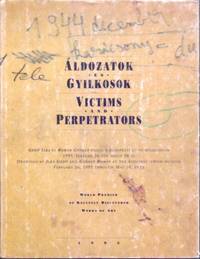
1995réf. 39266Budapest: Cultural Exchange Foundation 1995. Paperback. 1st edition. Original stiff paper wrappers with illustrated dust jacket 4to 122 pages. Includes llustrations and portraits ; 28 cm. Filled with drawings. Collection of 36 sketches drawn by Ilka Gedo in the Budapest Ghetto during Nazi occupation and sketches by Gyorgy Roman of defendants at war crimes trials held in Hungary after the war. OCLC: 34942605. Text is by several authors and is in English and Hungarian. Light edgewear and library marks to dust jacket otherwise Very Good condition with card pocket at rear no other markings. BK5 HOLO2-136-37--'e. [Budapest]: Cultural Exchange Foundation paperback
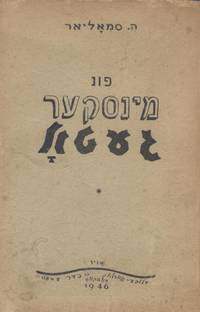
1946réf. 30905Moskve: Melukhe-farlag "Der Emes 1946. 1st edition. Original Printed Boards Small 8vo 167 pages. In Yiddish. Title translates as "From the Minsk Ghetto." Title also in Russian: Minskoe getto. In 1941 a group of Jews among them the Polish Jew Hersh Smolar; 1905–1993 the author organized a resistance movement in the ghetto in close connection with the Minsk Communist underground led by Isay Kazinets 1910–1942 and Masha Bruskina 1924–1941. Members of the resistance organized acts of sabotage and working together with the Judenrat led by Il’ia Mushkin diverted the production of the ghetto’s workshops and factories to the partisans. An underground printing press issued the leaflet Vestnik rodiny Homeland’s Messenger. The resistance enabled thousands of Jews to escape to the forests where they founded seven partisan brigades one of which in September 1943 organized the assassination of the governor-general of Belorussia Wilhelm Kube. Approximately 10000 Minsk Jews succeeded in escaping from the ghetto a proportion without parallel in Holocaust history. At liberation 13 Jews had survived the ghetto and about 5000 Jewish partisans and their families returned from the forests. In 1945 the first memorial to Jewish victims in Minsk—and the only one in the USSR with a Yiddish inscription explicitly mentioning the Jewishness of the victims—was erected” Bemporad YIVO Encyclopedia of Jews in Eastern Europe. SUBJECTS : Jews -- Persecutions -- Belarus -- Minsk. Holocaust Jewish 1939-1945 -- Belarus -- Minsk -- Personal narratives. World War 1939-1945 -- Jewish resistance -- Belarus -- Minsk. Named Person: Smolar Hersh 1905- Geographic: Minsk Belarus -- Ethnic relations. OCLC: 12284925. Small stain to title page Jewish institutional stamp on final page rear of title page and text block edges no other markings spine neatly rebacked new endpapers Good condition. B YID-17-15-ALBXGGCCOE. Moskve: Melukhe-farlag "Der Emes unknown
1946réf. 13981Lodzsh: Tsentraler Yidisher Historisher Komisye baym Tsentral-Komitet fun Poylishe Yidn 1946. 1st edition. Later cloth with original dramatic photgraphic cover mounted on front 8vo 70 1 pages 1 l. includes facsimiles. 21 cm. Poems. "Oysgabes fun Der Tsentraler Yidisher Historisher Komisye baym Tsentral-Komitet fun Poylishe Yidn. Serye yidishe literatur 1." A committee dedicated to recording the fate of Polish Jews published this book length poem by Simkhah Szajewics. Written in the Lodz Ghetto it appeared immediately after the war in 1946; Szajewicz perished in a concentration camp in 1944" from the permanent exhibit at the National Yiddish Book Center which houses their copy in their Rare Book Collection. The book actually includes two long poems: "Lekh-lekha" and "Friling 702 " as well as letters and other related material. See David Roskies interesting reflection on this work and it's stunning photographic cover at jtsa.edu/torah/go-forth-the-grammar-of-remembrance. For more about the author-poet see Chava rosenfarb's essay on Shayevitch in Tablet Magazine at tabletmag.com/sections/arts-letters/articles/the-last-poet-of-lodz. SUBJECTS: Jews -- Persecutions -- Poland -- Lódz. Holocaust Jewish 1939-1945 -- Poetry. Jews -- Correspondence. Expertly rebound in attractive black cloth with the original photographic front cover mounted on the front. Very Good Condition. B HOLO2-110-36-CCALX-'emm H-40-10. Lodzsh: Tsentraler Yidisher Historisher Komisye baym Tsentral-Komitet fun Poylishe Yidn unknown
réf. 1456794744.Ghardcover. Good. Access codes and supplements are not guaranteed with used items. May be an ex-library book. hardcover
1988réf. 13119Stock 1988 455 pages in8. 1988. Broché. 455 pages. L'ouvrage retrace l'histoire du ghetto de Venise de sa création en 1516 jusqu'aux déportations de 1943-1944 en passant par l'émancipation française de 1797. L'auteur Riccardo Calimani mêle érudition historique et portraits sensibles des habitants mettant en lumière la richesse culturelle et intellectuelle de cette communauté juive
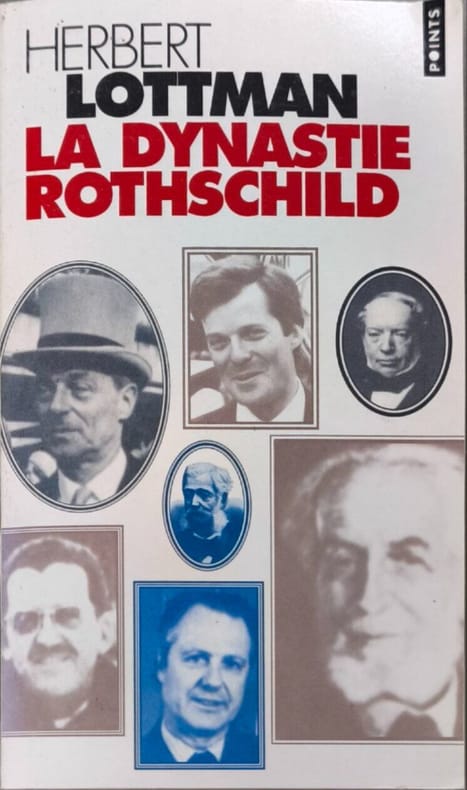
1996réf. 13245Seuil 1996 516 pages 10 8x2 4x17 2cm. 1996. broché. 516 pages. Ce livre retrace l'histoire de la famille Rothschild de ses débuts modestes dans le ghetto juif de Francfort au XIXe siècle à son ascension en tant que l'une des familles les plus influentes et riches d'Europe. Il raconte comment les descendants d'un juif du ghetto de Francfort sont devenus les Rothschild un nom synonyme de richesse et de puissance