4 259 résultats
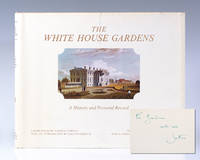
réf. 142435New York: Great American Editions 1973. First edition of the first book to trace the history of and fully illustrate the grounds of the White House gardens. Oblong quarto original cloth pictorial endpapers illustrated with color plates by Harold Sterner. Association copy inscribed by Jacqueline Kennedy on the half-title page "For Grandma with love Jackie." The recipient Rose Kennedy was the matriarch of the Kennedy family: the wife of Joseph P. Kennedy Sr. mother of John F. Kennedy and his eight siblings mother-in-law of Jacqueline Kennedy and grandmother of the children of John F. and Jacqueline Kennedy. She was a devout catholic and deeply embedded in the "lace curtain" Irish American community in Boston. After her son John was elected president in 1960 Rose "became a sort of quiet celebrity" and appeared on the International Best Dressed List. Most of her social activities consisted of involvement in charities and women's groups. Here Jackie refers to Rose and 'Grandma' as the book was given on her children's behalf to their grandmother. From the collection of Rose Kennedy. Near fine in a very good dust jacket. An exceptional association. The White House Gardens is the first book that traces both the history of the most famous gardens in the United States from the time of John Adams to the present and gives detailed illustrations on how they are planned and how they appear. Patricia Nixon states in the preface to the work: "This impressive volume is an artistic treasury . a comprehensive reference . a vital document. I invite you to experience the historic traditions which are so much a part of our national heritage." Great American Editions hardcover
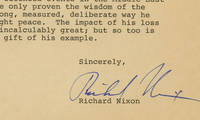
réf. 2145512/10/82. Nixon had himself played a key role in aiding the launch of the peace process mediating the Sinai I disengagement agreement between Egypt and Israel in 1974 Israel and Egypt with its Arab allies had been engaged in hostilities for three decades and this resulted in four wars in twenty four years. The hatreds in the region were fierce and the constant conflicts seemed interminable. The last of these the Yom Kippur War in October 1973 was launched by the Arabs as a surprise and they had initial successes before Israel emerged victorious. Egyptian President Anwar el-Sadat’s own brother was killed in that war. No one foresaw peace as a possibility. But President Sadat saw the wars as a disastrous drag on the Egyptian economy and knew that they stood as a barrier to its receiving aid from the United States and many NATO countries. They also tended to throw the Middle East into the arms of the Russians whom Sadat distrusted. Sadat had no intention of allowing Egypt to become a Soviet satellite. Despite friction with his Syrian allies Sadat signed the Sinai I 1974 and Sinai II 1975 disengagement agreements with Israel which stated that the conflicts between the countries ""shall not be resolved by military force but by peaceful means” and led to the partial withdrawal of Israeli forces in the Sinai the creation of a U.N. buffer zone in their place and the implementation of multiple U.S. stations in the Sinai. The also secured for Egypt large foreign assistance commitments. The first of these agreements were mediated by President Richard M. Nixon and U.S. Secretary of State Henry Kissinger and the second by President Gerald R. Ford and Kissinger who with thus played key roles in aiding the launch of the peace process. Jimmy Carter became President of the United States on January 20 1977. Israeli and Arab resistance was slowing Sadat’s hoped-for progress so on November 9 1977 Sadat made a stunning dramatic gesture one that left the world in shock: He would personally journey to Jerusalem to address the Israeli Knesset parliament to seek a permanent peace settlement between Israel and Egypt! The Israeli government led by Prime Minister Menachem Begin rose to the occasion and ignoring those who saw Sadat’s move as some kind of trick cordially invited him to address the Knesset in a message passed to Sadat via the US ambassador to Egypt. This was something of a surprise as Begin had a reputation as a hard-liner and some expected him to reject Sadat’s overture. On November 19 1977 Sadat arrived for the groundbreaking three-day visit which launched the first peace process between Israel and an Arab state. He met with Begin and spoke before Israel’s parliament as the world looked on in utter disbelief and glued to the television. The astonished approving reaction of ordinary Israelis and Egyptians who watched Sadat and Begin on live television was itself of importance. The sight of the two leaders facing each other in open honest debate changed attitudes at the street levels of both countries. Much of the change came from Sadat's choice of words. “The October War” he said “should be the last war.” The visit was however met with outrage in much of the Arab world. Despite this Sadat continued to pursue peace with Israel. However a reciprocal visit by Begin was unsuccessful and no progress was made toward peace. Then Rosalynn Carter the U.S. first lady suggested to her husband President Carter that he invite Sadat and Begin to Camp David where the relative privacy and seclusion might provide a setting for a breakthrough. Both Sadat and Begin trusted the United States to be an honest broker and the two leaders accepted Carter’s invitation. The summit began on September 5 1978 and lasted for 13 days. Carter preferred that the three men work together in private sessions in a small office at Aspen his cabin at Camp David. Carter compiled a document that encompassed a resolution of the major issues presented the proposals to each leader in separate meetings assessed their comments and redrafted the manuscript some two dozen times shuttling the manuscript back and forth for their review. The Camp David Accords signed on September 17 were the first peace agreement between the state of Israel and one of its Arab neighbors and laid the groundwork for diplomatic and commercial relations. In a ceremony at the White House on March 26 1979 Sadat and Begin signed the historic peace treaty; it was considered the diplomatic triumph of the the era. President Carter oversaw the signing and untold millions watched on television. The peace treaty formally ended the state of war that had existed between the two countries. Israel agreed to fully withdraw from Sinai and Egypt promised to establish normal diplomatic relations between the two countries and open the Suez Canal to Israeli ships which until then had been banned from the waterway. These provisions were duly carried out. Sadat was vilified for this in many Arab quarters and Egypt was expelled from the Arab League but Sadat was determined to end hostilities and move into a better future. He was well aware that his courage might well cost him his life as he received death threats and some predicted his assassination. For their achievement Sadat and Begin were jointly awarded the 1978 Nobel Prize for Peace. Then on October 6 1981 extremists assassinated Sadat in Cairo. He is widely recognized today as a martyr to peace and when we hear the phrase “blessed are the peacemakers” his image immediately springs to mind. Despite the tragedy the peace process continued without Sadat and in 1982 Egypt formally established diplomatic relations with Israel. This led to among many other benefits increased tourism in the region. Nixon who with Kissinger got this process going wrote this letter to Mrs. Sadat saying her husband is immortal. Typed letter signed on Nixon’s letterhead October 12 1982 with salutation in his hand to Sadat’s widow Jihan el-Sadat on the occasion of the honoring of President Sadat by the American Society of Travel Agents as Sadat’s efforts for peace did so much for tourism the region. He was to be awarded its 1st International Peace and Tourism Award. “I am honored to join in this tribute to Egypt’s great President and also to you his great First Lady. “Men are mortal but the spirit of a man of peace is immortal because it lives on in the millions he has inspired. President Sadat was such a man. In the year since his voice was silenced events in the Middle East have only proven the wisdom of the strong measured deliberate way he sought peace. The impact of his loss is incalculably great; but so too is the gift of his example.” Donald Reynolds was executive director of the American Tourism Society later the American Society of Travel Agents. Under his leadership ATSA facilitated travel to Russia and the newly independent republics of the USSR and later expanded its outreach to the Middle East. His efforts in Egypt brought him in contact with Mrs. Sadat and they became friends. She gave this letter to him and we obtained it from his heirs. It has never before been offered for sale. unknown
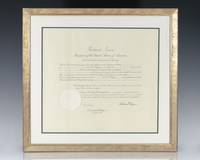
1969réf. 713822/01/1969. In February 1953 Henry Cabot Lodge was named U.S. Ambassador to the United Nations by President Eisenhower with his office elevated to Cabinet level rank. The position then was high profile and Lodge often engaged in debates with the UN representatives of the Soviet Union that were broadcast or covered on television. On the front lines in the Cold War in 1959 he escorted Soviet leader Nikita Khrushchev on a highly-publicized tour of the United States. Lodge left the ambassadorship during the election of 1960 to run for Vice President on the Republican ticket headed by Richard Nixon. Nixon selected Lodge because the latter had made a name for himself at the United Nations as a foreign-policy expert. President Kennedy appointed Lodge to the position of Ambassador to South Vietnam which showed the import U.S. policymakers were coming to place on that nation. Lodge held the post from 1963 to 1964 and again from 1965 to 1967. As ambassador there Lodge supported President Johnson's decision to escalate American involvement in the Vietnam War believing that a Communist takeover in the South would be disastrous for U.S. foreign policy goals. The original appointment of “Henry Cabot Lodge of Massachusetts”_as “Ambassador to head the United States Delegation at the Paris Meetings on Vietnam.” <!--break--> President Johnson and American military leaders had long insisted that the Vietnam War was going well and that they could see the light at the end of the tunnel. But in the aftermath of the Tet Offensive in February 1968 when the Communists were able to initiate coordinated attacks on all the regional capitals throughout Vietnam even in the American compound in Saigon itself Secretary of Defense Clark Clifford issued a report to the President in mid-March that the United States could not win the war. Johnson was stunned and he in turn stunned a nationwide audience on March 311968 announcing he would cease bombing north of the 20th parallel initiate peace talks to end the war and not seek renomination or reelection in 1968. The peace talks commenced in Paris on May 10 1968 with W. Averill Harriman leading the U.S. delegation. From the outset the talks were fraught with difficulties. The U.S. insisted on mutual withdrawal of American and North Vietnamese forces which would leave the Saigon government in control. The North Vietnamese refused to negotiate anything until all bombing of North Vietnam was halted. When the U.S. finally agreed to that condition the Johnson administration was unable to persuade cajole or coerce South Vietnam and its leader President Thieu to participate unless it was recognized as a legitimate party by its foes. It was alleged at the time that both candidates in the 1968 election were using the talks as a political football with Hubert Humphrey seeking to appeal to pro-peace voters by insisting that the South Vietnamese participate and more germanely with Nixon leading the South Vietnamese to understand that his administration would give them a better deal if they would continue to delay. Formal negotiations would not begin until January 18 1969 two days before Nixon took office. In the immediate aftermath of the 1968 election it seems that Lodge was Nixon’s foremost advisor on Vietnam. He urged Nixon to appoint a man of stature to negotiate in Paris and warned him away from a trip to Saigon for strategic reasons. Nixon adopted these suggestions. In fact on January 5 1969 fifteen days before his inauguration President-elect Nixon named Lodge himself to succeed Harriman as chief U.S. negotiator at the Paris talks. This signaled that Nixon was likely to take a hard line in the talks considering Lodge’s background as a proponent of American policy in Vietnam as promulgated by President Johnson and his chief military commander Gen. William Westmoreland. Document Signed as President Washington January 22 1969 just two days after his inauguration being the original appointment of “Henry Cabot Lodge of Massachusetts”_as “Ambassador to head the United States Delegation at the Paris Meetings on Vietnam.” The wording here is highly politically indicative showing that Nixon avoided using the terms “peace”_“talks” “negotiations” or “war.” These were simply “Meetings on Vietnam” nothing more to be implied. The document is countersigned by Secretary of State William P. Rogers. On January 25 the first fully attended meeting of the formal Paris peace talks was held. Ambassador Lodge urged an immediate restoration of a genuine Demilitarized Zone as the first ""practical move toward peace."" He also suggested a mutual withdrawal of ""external"" military forces and an early release of prisoners of war. Tran Buu Kiem and Xuan Thuy heads of the National Liberation Front and North Vietnamese delegations respectively refused Lodge's proposals and condemned American ""aggression."" Meanwhile Henry Kissinger Nixon’s National Security Advisor developed a two-track policy whereunder the Paris negotiators would discuss military matters while the real political decisions would be made privately out of the public eye by the leadership in Washington and Hanoi directly. This would avoid public pressure from all directions while also preventing the junior partners on either side South Vietnam and the National Liberation Front from exercising power to preclude a deal from happening. Nixon liked the idea and determined that political negotiations would emanate from the White House. So as Lodge continued treating with the North Vietnamese in Paris starting in early August Kissinger was secretly meeting with North Vietnam’s Le Duc Tho. As the summer turned to fall however Kissinger’s approaches to Hanoi failed to elicit an acceptable response and Nixon adopted a get tough policy to force an accommodation on his terms. In early October the President told Lodge to break off the talks by staging a walk-out at the October 23 plenary session. On the appointed day Lodge insisted that the talks be adjourned which they were immediately. Lodge himself had not favored this action and he suggested that the President use him as a personal intermediary to Hanoi’s leaders who were frequently in Paris. Nixon declined. The only official public negotiations to end the Vietnam War were over never to resume. Nixon went directly to Camp David to work on a foreign policy address to the nation which he delivered on November 3. Dubbed the Silent Majority speech in it he asked the American people to support his decision to continue the war until the North Vietnamese would accept “honorable” peace terms. On November 20 1969 seeing no role remaining for a peace negotiator Lodge resigned. The war did not end until January 23 1973 four years and one day after Nixon had appointed Lodge to help end the conflict. unknown
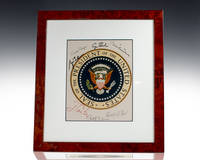
réf. 148492Rare photograph of the official seal of the president of the United States signed by seven American presidents. Color glossy photograph of the official seal of the president of the United States covering 40 consecutive years of presidential administrations. Boldly signed by Richard Nixon Gerald R. Ford Jimmy Carter Ronald Reagan George Bush Bill Clinton and George W. Bush. The Clinton and George W. Bush signatures were signed as president during their respective incumbencies. The signatures were all personally obtained by former California congressman James E. Rogan. A sheet to the frame backing lists the locations and dates of each signature: Richard Nixon New York September 15 1989 Gerald R. Ford Los Angeles April 12 1989 Jimmy Carter Plains Georgia July 9 1988 Ronald Reagan Beverly Hills May 28 1989 George Bush Sacramento October 15 1995 Bill Clinton The White House March 16 1997 and George W. Bush The White House March 30 2002. Matted and framed. In fine condition. The entire piece measures 15.25 inches by 17 inches. From the collection of California congressman James E. Rogan. The Seal of the President of the United States serves as a symbol of the executive authority and institutional continuity of the American presidency. Officially adopted in its current form by President Harry S. Truman in 1945 the seal features an American bald eagle clutching an olive branch and arrows signifying the nation's commitment to peace and readiness for defense. The eagle's head faces the olive branch reflecting a preference for diplomacy. Encircled by fifty stars representing the states the seal visually reinforces the president’s role as both a national leader and a representative of the federal union. While its design draws from the Great Seal of the United States the presidential seal has evolved in both form and function appearing on official documents lecterns and the presidential flag thereby reinforcing the ceremonial and symbolic stature of the office. unknown
1970réf. 95202Washington D.C 1970. Rare Richard Nixon Presidential Commission appointing Baseball Hall of Famer Joe DiMaggio as a "Member of the Conference on Physical Fitness and Sports." Dated September 25th 1970 the appointment is signed by President Richard Nixon and Secretary of State William Rogers with the Presidential seal. Double matted and framed. In fine condition. From the personal collection of Joe DiMaggio. Included is letter of provenance from DiMaggio's estate signed by his two granddaughters. An exceptional association linking two American icons. Double matted and framed. President Richard Nixon was an avid baseball fan he attended 11 games while serving in office and in 1985 he arbitrated the dispute between the Major League Baseball owners and umpires over expanded league playoff bonuses. Nixon made headlines when on June 22 1972 a reporter covering the upcoming national election asked the President to name his all-time favorite ballplayers. Nixon's long list of great players inspired the reporter to make a unique request: the first ever presidential All-Star team. With the assistance of his son-in-law David Eisenhower Nixon put together the team and it appeared in national newspapers on June 30 1972. American baseball legend Joe DiMaggio is widely considered one of the greatest baseball players of all time and is best known for his 56-game hitting streak May 15 - July 16 1941 a record that still stands. DiMaggio was one of the first sportsmen recognized in the Presidential Sports Award Program created by Richard Nixon in 1972. unknown books
réf. 95202Washington D.C 1970. Rare Richard Nixon Presidential Commission appointing Baseball Hall of Famer Joe DiMaggio as a "Member of the Conference on Physical Fitness and Sports." Dated September 25th 1970 the appointment is signed by President Richard Nixon and Secretary of State William Rogers with the Presidential seal. Double matted and framed. In fine condition. From the personal collection of Joe DiMaggio. Included is letter of provenance from DiMaggio's estate signed by his two granddaughters. An exceptional association linking two American icons. Double matted and framed. President Richard Nixon was an avid baseball fan he attended 11 games while serving in office and in 1985 he arbitrated the dispute between the Major League Baseball owners and umpires over expanded league playoff bonuses. Nixon made headlines when on June 22 1972 a reporter covering the upcoming national election asked the President to name his all-time favorite ballplayers. Nixon's long list of great players inspired the reporter to make a unique request: the first ever presidential All-Star team. With the assistance of his son-in-law David Eisenhower Nixon put together the team and it appeared in national newspapers on June 30 1972. American baseball legend Joe DiMaggio is widely considered one of the greatest baseball players of all time and is best known for his 56-game hitting streak May 15 – July 16 1941 a record that still stands. DiMaggio was one of the first sportsmen recognized in the Presidential Sports Award Program created by Richard Nixon in 1972. unknown
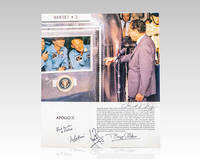
réf. 149952Rare Apollo XI quarantine image signed by President Richard Nixon and Apollo XI astronauts Neil Armstrong Buzz Aldrin and Michael Collins. The image shows Apollo XI crew members in quarantine being congratulated by President Nixon through a microphone. The oversized color photograph appears to be a blow-up of a contemporary magazine page complete with printed captions and is mounted on chipboard. Signed by Richard Nixon Neil Armstrong Buzz Aldrin and inscribed by Michael Collins "Best wishes to Felix - M Collins." The caption beneath the image reads: Once inside a special trailer where they began an eighteen-day period of quarantine to preclude contamination of the earth by potential moon germs the astronauts talked and joked by microphone with a jubilant President Nixon who was moved to acclaim their accomplishment as the greatest feat since the creation of the universe. Triple matted and framed. A very uncommon assemblage of signatures. Richard Nixon’s presidency became permanently entwined with Apollo 11 as the mission unfolded in July 1969 as both a scientific triumph and a powerful emblem of American leadership in the Cold War. Nixon followed the flight closely from the White House speaking repeatedly of the astronauts as representatives of the nation and after the lunar landing he placed a live telephone call to Neil Armstrong and Buzz Aldrin on the Moon—an unprecedented gesture he later described as the most historic phone call ever made. When Apollo 11 returned safely to Earth Nixon greeted Armstrong Aldrin and Michael Collins aboard the USS Hornet praising their achievement as a victory for “peaceful purposes” and for all mankind while also underscoring the technological and ideological stakes of the space race. He awarded the astronauts the Presidential Medal of Freedom and sent them on a global goodwill tour that functioned as cultural diplomacy projecting U.S. ingenuity and stability at a moment of domestic strain. In Nixon’s rhetoric and staging Apollo 11 was both a culmination of the Kennedy-era lunar goal and a visible affirmation of American prestige—an event he sought to frame as a unifying national milestone and a benchmark of what the country could accomplish. unknown
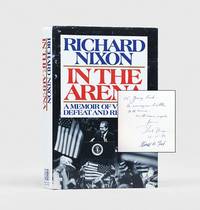
réf. 190684New York: Simon and Schuster 1990. Inscribed to the man he made President First edition an unequalled presentation copy inscribed by President Nixon to President Ford: "To Jerry Ford - a courageous battler in the arena - with warm regards from Dick Nixon 11-11-90" and signed by Ford underneath. It is no exaggeration to say that each was the most important man in the other's life - Nixon appointing Ford as Vice President resulted in Ford becoming President and Ford's pardoning of Nixon saved him from an ignominious trial and potential prison term. Their relationship was of profound consequence in American history. Nixon's choice of Vice President following Spiro Agnew's resignation in October 1973 needed confirmation by both Houses of Congress then controlled by Democrats. His need to choose a candidate who could attract bipartisan support resulted in Nixon appointing Ford a moderate Republican and House Minority Leader popular with both Houses and good friends with Nixon. Partly this choice can be attributed to the expectation that Ford would be quickly and decisively confirmed amid the escalating Watergate scandal as indeed happened. Nixon's resignation in August 1974 ensured Ford took the presidency - the only office holder to have not been elected to President or Vice President. It is generally accepted that Ford was unlikely to have otherwise ran for and won a popular presidential election. In the Arena is Nixon's account of his resignation pardon and the aftermath: "the most personal profound and revealing memoir ever written by a major political figure" jacket. Nixon recounts how after resigning the presidency he and his friends were being hounded that he was facing bankruptcy from legal fees if sent to trial and his reputation was trashed. Ford's pardon was his lifeline yet he knew it would hurt Ford politically. Consequently "Next to the resignation accepting the pardon was the most painful decision of my political career" p. 21. Ford's polling plummeted as a result of the pardon and his sacrifice may have cost him the 1976 presidential election. It is surely this to which Nixon refers when he inscribes to Ford as a "courageous battler in the arena". Octavo. Original blue quarter cloth spine lettered in gilt blue paper-covered sides red endpapers. With dust jacket. Housed in a blue quarter morocco box by the Chelsea Bindery. Unclipped jacket a little rubbed at extremities slight paperclip impression to front panel: a fine copy in near-fine jacket. hardcover
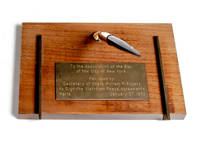
1973réf. 145329Paris January 27 1973. The original pen used by Secretary of State William P. Rogers to sign the Vietnam Peace Agreement ending the Vietnam War Paris 27 January 1973. Sheaffer fountain pen with 14 karat gold tip housed in an adjustable gold pen holder wooden base brass hardware including etched plaque. The plaque reads "To the Association of the Bar of the City of New York / Pen used by Secretary of State William P. Rogers to Sign the Viet-Nam Peace Agreements / Paris January 27 1973." During his tenure as Secretary of State under President Nixon William P. Rogers was involved in multiple matters of foreign policy including negotiations leading up to the signing of the Paris Peace Accords in 1973 after years of negotiations and secret talks. On 27 January 1973 representatives of the South Vietnamese communist forces North Vietnam South Vietnam and the United States gathered in Paris to sign the Paris Peace Accords and officially end the United States' involvement in the Vietnam War. The ceasefire took effect the next day on January 28 1973 and the last U.S. troops left Vietnam in March 1973. In very good condition. A unique piece of world history. In 1955 conflict between North and South Vietnam began. Fearing the spread of communism in Southeast Asia the United States entered the war in the early 1960s providing financial aid military advisors and eventually combat troops in support of South Vietnam. As the conflict escalated and anti-war sentiment grew talks about ending United States military intervention began in 1968 proceeding for years until an agreement in 1973. Fighting reignited almost immediately after US departure and continued for two more years before the Fall of Saigon and the end of the war. Eric Caren proprietor of the most significant private collection of historical documents in the United States notes that this item "represented the most tragic element of the 1960s inspiring the collective rebellion on university campuses and the combined rights for women and Blacks that led to the most positive changes in the most interesting decade. There is rare and there is unique this pen is obviously both." unknown