VOICI LES FAITSLivre Rare Book

1190 risultati
1955rif. 141053Couverture souple. Brochure. 20 pages. 13 x 21 cm.
1955rif. 141052Couverture souple. Brochure. 16 pages. 13 x 21 cm.
1954rif. 141050Couverture souple. Brochure. 16 pages. 13 x 21 cm.
1954rif. 141048Couverture souple. Brochure. 8 pages. 13 x 21 cm.
1954rif. 141047Couverture souple. Brochure. 16 pages. 13 x 21 cm.
1953rif. 141046Couverture souple. Brochure. 16 pages. 13 x 21 cm.
1953rif. 141045Couverture souple. Brochure. 16 pages. 13 x 21 cm.
1952rif. 141044Couverture souple. Brochure. 16 pages. 13 x 21 cm.
1952rif. 141043Couverture souple. Brochure. 16 pages. 13 x 21 cm.
1952rif. 141042Couverture souple. Brochure. 16 pages. 13 x 21 cm.
1998rif. 142716Couverture rigide. Reliure de l'éditeur 950 pages. Jaquette.
rif. 18142A Genève, 1777. (4), (2, Avis au Lecteur, blank), vii, (1, blank), 316, (4, errata) pp. 8vo. Contemporary marbled calf, spine richly gilt in compartments, label with gilt lettering, marbled edges. INED 2037 (later edition); not in Kress; not in Goldsmiths; not in Einaudi; not in Mattioli; Mornet, Les origines intellectuelles de la Révolution, pp. 217-8. Rare first edition of this work which is primarily a defence of monarchic government against the theories of Montesquieu and Mably, notable for a variety of observations on economic issues. Gin identifies the products of agriculture and manufacture as the basic forms of wealth, and condemns import on the grounds that they lead to a diminution in the population. 'Il y défend les lois fondamentales de la monarchie pure, réfute la théorie de la liberté politique ou de constitution de Montesquieu, celle de l'équilibre des pouvoirs et refuse de donner des limites à la puissance du monarque' (Mornet). 'Sociologie politique. De la monarchie, en général, et du gouvernement français en particulier. Plusieurs passages consacrés à des questions économiques. Réflexions sur les impôts et sur les richesses en général' (INED). - Some annotations concerning author and book on verso front free blank. A very nice copy with good margins, and an interesting copy: after the title-page there is a "Avis au Lecteur", reading: "Ce livre n'ayant pas ete imprime sous les yeux de l'Auteur, il s'y est glissé plusieurs fautes typographiques. On a corrigé les plus importantes dans l'Errata qui est à la fin de cet Ouvrage." Both this "avis" and the errata are almost always lacking in copies usually found, the errors in those copies not being corrected.
rif. 18497A Genève, et se trouve à Paris, Chez tous les Libraires qui vendent les Nouveautés, 1780. With engraved frontispiece. (4), xxiv, 427, (1) pp. 8vo. Contemporary marbled calf, spine richly gilt in compartments with red label and gilt lettering, a beautiful copy. INED 2037 (1782 edition); not in Kress; not in Goldsmiths; not in Einaudi; not in Mattioli; Mornet, Les origines intellectuelles de la Révolution, pp. 217-8. Rare second edition, as the first not to be found in any of the reference works. The present work, which is primarily a defence of monarchic government against the theories of Montesquieu and Mably, is notable for a variety of observations on economic issues. Gin identifies the products of agriculture and manufacture as the basic forms of wealth, and condemns import on the grounds that they lead to a diminution in the population. 'Sociologie politique. De la monarchie, en général, et du gouvernement français en particulier. Plusieurs passages consacrés à des questions économiques. Réflexions sur les impôts et sur les richesses en général' (INED). 'Il y défend les lois fondamentales de la monarchie pure, réfute la théorie de la liberté politique ou de constitution de Montesquieu, celle de l'équilibre des pouvoirs et refuse de donner des limites à la puissance du monarque' (Mornet).
rif. 24152Paris, Le Normant Fils, imprimeur du Roi, 1827. 16 pp. 8vo. Folded sheets, uncut. Larousse, Grand dictionnaire universel, vol. 11, p. 486. First edition. As a young liberal politician the author was noted for his publication concerning the freedom of the press, directed against Peyronnet; also this brochure raised much interest.Montalivet was peer of the Restoration, minister of the July monarchy and senator of the Third Republic. He inherited his father's title of count and his seat in the Peers when both his father and elder brother died in 1823. He advocated a constitutional course, opposed the Polignac ministry of 1829, and supported the 221 deputies who signed the address criticizing the king in March 1830.At head of title: 'Les amis de la liberté de la presse'.The Société des Amis de la Liberté de la Presse appeared briefly during the electoral campaign of 1827 when François-René Chateaubriand rallied Ultra and moderate royalists opposed to the Villèle government to protest censorship of the press and to elect deputies to the Chamber who would abolish censorship laws. Chateaubriand had become a dangerous opponent of the Villéle government in June 1824 when the celebrated writer had been unceremoniously dismissed from his post as minister of foreign affairs. The ordinances of 24 June 1827, which reimposed censorship on the periodical press, provided Chateaubriand with an opportunity for political revenge that he eagerly seized. Chateaubriand's society, probably never more than an informal grouping, formed early in June and included royalists, doctrinaires, and some members of the Center Left opposition that a common opposition, often personal, to the Villèle government, outrage at the reimposition of censorship, and admiration of Chateaubriand temporarily united in 1827. Meetings of the society brought together such figures as Prosper de Barante, the duc de Choiseul, the comte de Montalivet and the baron Hyde de Neuville, journalists like Alexis de Jussieu and Louis-François Bertin de Vaux and ambitious young intellectuals as de Salvandy and Villemain. Along with the more famous and influential society 'Aide-toi, le ciel t'aidera', the 'Amis' had an impact on the electoral campaign of 1827. Indirect testimony to the government's fear of the society's effectiveness lies in the policies adopted by the postal service. Because it could not be relied upon to deliver political pamphlets to provincial cities and towns, trusted friends of the society had to carry many works personally (See: Historical Dictionary of France from the 1815 Restoration to the Second Empire).
rif. 15197A Paris, De l'Imprimerie de Du Pont, député de Nemours à l'Assemblée Nationale constituante, hôtel de Bretonvilliers, Isle Saint-Louis, 1791. 56 pp. 8vo. Modern half morocco, marbled boards, gilt lettering to spine. Not in Martin & Walter; W. Walker Stephens,The life and writings of Turgot, pp. 18-19. Third edition, first published in 1754 with a second edition in 1788. The title is derived from a proposal made to effect the reconcilement of both Jesuits and Jansenists to the action of the State, by its sacrificing to them their common enemy, the Protestants. The attempt to deprive the small body of Protestants of the limited rights they enjoyed, and the unprincipled character of the policy suggested, raised Turgot's indignation. It is said that king read the work and was favourably impressed by it. At all events, the project of persecuting the Protestants was abandoned.In the preface, written by Dupont de Nemours, Dupont explains the reason for this reprint of this rare work: the National Assembly was about to discuss 'les moyens de faire cesser les maux que des querelles religieuses ont produits'. - Very rare.
1948rif. 047353Centre Social Des Jeunesses Libérales brochure Bruxelles 1948 39 pages en format 16 - 24 cm
1947rif. 047354Centre Social Des Jeunesses Libérales Broché Bruxelles 1947 102 pages en format 16 - 24 cm
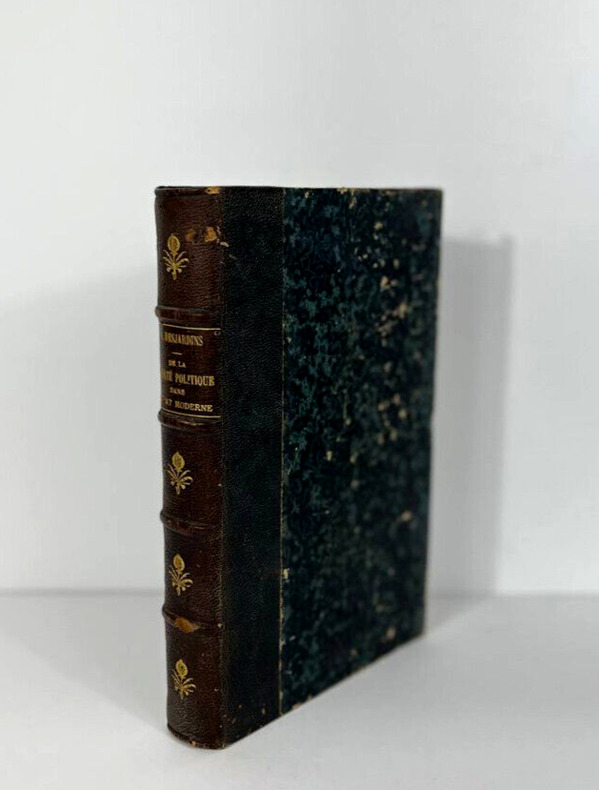
1894rif. 0348Paris, Plon, 1894. In-8 de 220 x 150 mm, 365 p. Relié demi-maroquin tabac à grains. Dos à nerfs, nom d'auteur et titre en doré, arbustes en fleurons dorés aux entre-nerfs, plats granités vert herbe et vert sombre, pages de garde marbrées vert émeraude et rouge. Magistrat, jurisconsulte, Arthur Desjardins (1835-1901) était un spécialiste reconnu du droit international, ce qui lui a valu d'être "sollicité en tant qu'arbitre par des États étrangers comme lors de l'affaire Ben Tillett entre la Grande-Bretagne et la Belgique (1898). Chrétien engagé, il a fait partie de la Société antiesclavagiste lancée par le cardinal Lavigerie et a présidé la Ligue nationale contre l'athéisme de 1893 à 1901. Membre de l'Académie de législation de Toulouse et de l'Académie d'Aix, auteur de plusieurs livres couronnés par l'Institut, Desjardins est élu membre de l'Académie des sciences morales et politiques le 4 février 1882, au siège laissant vacant par la mort de Gabriel Massé. Chevalier de la Légion d'honneur depuis 1873, il est promu officier de cet ordre en 1892 et candidat à l'Académie française en 1895." (Wikipédia) Livre peu courant avec sa reliure d'époque et des pages bien conservées.
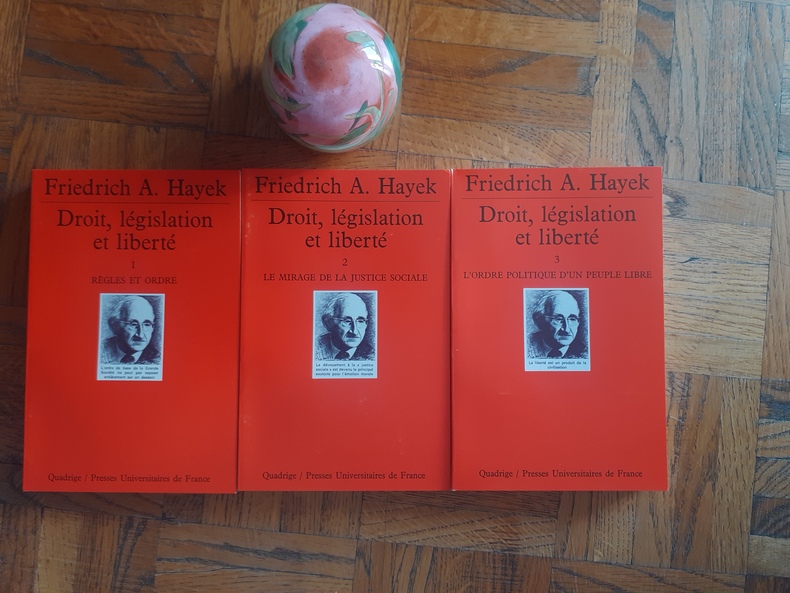
rif. QWA-19868Presses Universitaires de France, 1995, 3 vol. in-8 br. (13 x 19),IX-208 p. - XIII-221 p. - XII-253 p., coll. "Quadrige", traduit de l'anglais par Raoul Audouin, sous étui cartonné, très bon état.
1943rif. LFA-126746660Revue mensuelle : 44 pages, format 155 x 235 mm, brochée, Les Compagnons de France (Crépieux-la-Pape, dans l'Ain), bon état
1815rif. CSP-1751Chez Alexis Eymery, Paris, mai 1815. Édition originale. "Sans conteste le plus important des écrits politiques de Constant"(A. Roulin, p. 1593). "Les principes ramassent dans un développement unifié les principaux thèmes de réflexions de Constant sur les vrais principes de la liberté (…). Le premier classique de la pensée libérale dans son état proprement contemporain; celui créé par l'évènement fondateur de la modernité politique: la Révolution française" (M. Gauchet, Dictionnaire des oeuvres politiques)
1876rif. 179741876. Paris Librairie de Guillaumin et Cie 1876 3ème ed. - Relié demi-basane 12 cm x 18 cm LV+ 386 pages - Texte de Charles Coquelin introduction et notes de M. Courcelle-Seneuil notice biographique de M. G. de Molinari - Rousseurs sinon bon état
rif. ORD-18528Paris. Calmann-Lévy. 1897. In-12 (122 x 180 mm) dos chagrin vert viré au brun, plats mouchetés, 354 pages. Reliure un peu frottée, cachet de bibliothèque, menus défauts, assez bon exemplaire.
2004rif. LFA-126739075Un ouvrage de 620 pages, format 155 x 235 mm, broché, publié en 2004, Fayard, bon état
2017rif. LITTFRA659548540221Paris, Perrin / Genève, Fondation Martin Bodmer, 2017, 17 x 24, 208 pages sous reliure éditeur toilée et jaquette illustrée. iconographie noir & blanc et couleurs. Ouvrage publié à l'occasion de l'exposition présentée à la Fondation du 20 mai au 1er octobre 2003.