200 risultati
1911rif. 53367Leipzig, Johann Ambrosius Barth, 1911. Later full cloth. Stamps on title-page. In ""Annalen der Physik"", Vierte Folge, Band 36. - VIII,1088 pp. and 4 plates. (Entire volume offered). Ehrenfest's paper: pp. 91-118.
1911rif. 53367Leipzig Johann Ambrosius Barth 1911. Later full cloth. Stamps on title-page. In "Annalen der Physik" Vierte Folge Band 36. - VIII1088 pp. and 4 plates. Entire volume offered. Ehrenfest's paper: pp. 91-118. First edition of the paper in which the term "Ultraviolet Catastrophe" appeared for the first time. "Ehrenfest was one of the first to try to understand the significance of the strange new concept of energy quanta that Max Planck had introduced into physics in 1900 in his theory of blackbody radiation. In a series of papers culminating in his major study of 1911 the paper offered "Which Features of the Quantum Hypothesis Play an Essential Role in the Theory of Heat Radiation" Ehrenfest picked out the essentials of the early quantum theory and showed how they fit together. He proved rigorously that the energy of electromagnetic vibrations cannot take on all values - cannot vary continuously - if the total energy of the blackbody radiation in an enclosure is to be finite: Planck’s assumption that energy is a discrete variable was therefore logically necessary and not just sufficient. Ehrenfest also showed by an analysis of Wien’s displacement law that the ratio of energy to frequency was the only variable that could be quantized for a harmonic oscillator if one wanted to maintain the statistical interpretation of entropy."DSB. hardcover
rif. 125527aafSt. Gallen, Gedruckt bei Wegelin und Wartmann, 1831, in-8vo, Frontispiz, gef. Lithogr. + VIII + 296 ( v. 297 + 1 leer) + 6 lithogr. Tafeln, am Anfang fleckig, rez. Umschlag.
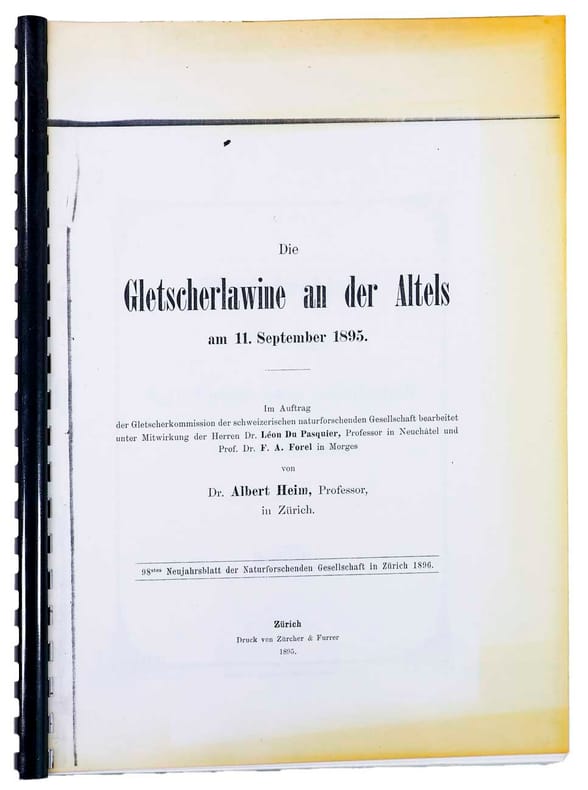
rif. 141036aafWien, Selbstverlag des Vereins, 1896, in-8vo, 30 S. + 5 Tafeln (davon 4 gefaltet) / Kopie: 63 S. + 3 Tafeln (2 Karten + 4 Abb. auf 1 Bl.), Original-Broschüre. Etwas eingerissen.
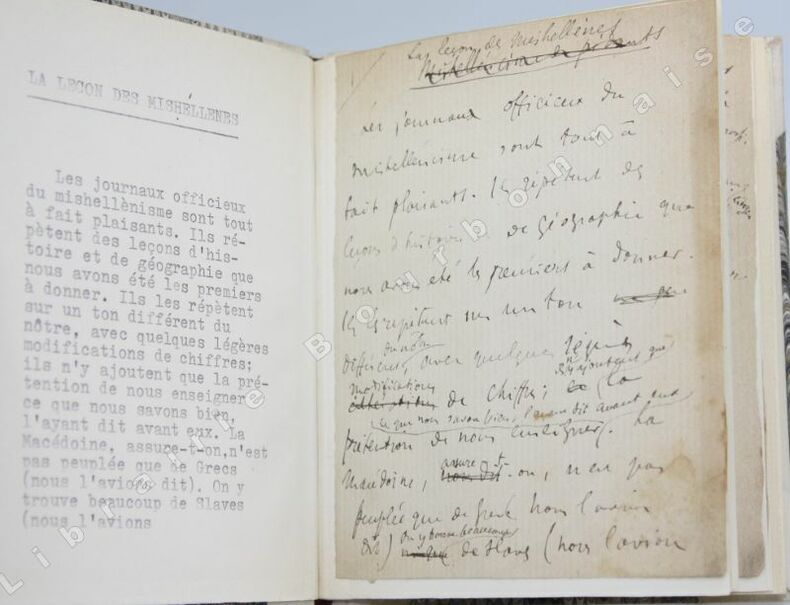
rif. 13714Manuscrit autographe de Maurras, in-12 (14,2 x 12 cm), s.l. - s.d. [vers 1920] ; 9 pages autographes à l'encre noire, signées, avec la transcription tapuscrite en regard. Demi-vélin ivoire à coins, pièce de titre en maroquin noir (rel. G. Gauché, Paris). Parfait état.
rif. 133321 page in-8 manuscrite et signée de la main de l'Intendant d'Auvergne ; à Clermont le 14 juillet 1733, adressée à M. Lafont (sans doute Lafont de Saint-Marts, qui fut longtemps subdélégué de la généralité de Riom à Issoire).
rif. 125228aafGenève, Editions du milieu du monde, 1944, in-8vo, 202 p. + 3 ff., exemplaire ‘SP’ (Service de Presse) de l’édition courante, (papier bien acide - bruni et cassant, petit déchirure en haut de la feuille de dédicace, envoi manuscr. ‘Au Bibliophile ami M. Alfred Comtesse ...de Jean Traven’ et (imprimée): ‘A mon ami Jean Traven’ puis manuscr.: ‘à qui je dois d’avoir écrit ce livre ce premier exemplaire lui revient de droit très affectueusement, Fr. Carco’, reliure en carton, dos avec pièce de titre sur cuir, brochure originale cons.
rif. 118970aafElberfeld, Schönian’sche Buchhandlung, (Schwelm, Gedruckt bey J. L. Schober), 1824, kl. in-8vo, Frontispiz-Kupfer + 2 Bl. (Titelbl. - Vorerinnerung) + 227 S. auf bläulichem Papier gedruckt, Seiten und mehrere Blattecken zerknittert (ohne Verlust), rez. Pappband, Lederrückenschildchen. Schönes Exemplar.
rif. 108775aafUttweil am Bodensee, C. Uhler o.J. (1860), in-8vo, VIII (Titelbl. - Vorwort) + 48 getönt. Holzst.-Tafeln, sehr sauberes Exemplar, gold- u. blindgepr. Lwd d. Zt, mit Deckeltitel, Buckblock aus d. Orig.-Einband gelöst, Rücken etwas verblasst, sonst tadellos.
rif. 123175aafMünchen, bey Johann Baptist Strobel, 1802, in-8vo, XX (inkl. Titelbl. mit gest. Vignette) + 299 S. (+ 1 weiss), Ex-Libris ‘SR Sammlung Schweiz. Rückversicherungs Gesellschaft’, Interimsbroschur.
rif. 124486aafZürich, bey Johann Kaspar Ziegler / Zürich, Ziegler /Zürich Rudolf Merister, 1763, gr. in-8vo, 4 Bl. (Inkl. Titelbl. mit gest. Ansicht eines Feuers durch ein Blitz im Turm) + Monatlichen Nachrichten einiger Merckwürdigkeiten in Zürich gesammlet und herausgegeben Augstmonat MDCCLXIII (1763) (S. 89) bis 100 + Heumonat MDCCLXIV (1764) (S. 77:) bis 92 + J. C. Ulrich, 26 S. + J. H. Meister: 20 S. Ex Libris ‘Schweiz. Rückversicherungs-Gesellschaft’ (SR Sammlung, aus ihrer Katastrophen Sammlung), rez. Halblederband. Schönes Exemplar.
1910rif. 20833Maurice (Ile), Minerva, 1910 ; in-8 (215 mm), broché, 12 pp., couverture jonquille imprimée.
rif. 124909aafLeipzig, in der Commerschen Buchhandlung, 1810, in-8vo, Titelblatt + 130 S. + gef. Kupfertafeln, Stempel auf Titelblatt ‘Bibliotheca Smecnensis’, schlichter O.-Pappband d. Zeit
rif. 126505aafBerlin, Gedruckt auf Kosten des Herausgebers, 1808, in-8vo, 3 Bl. + 122 S. + 12 S. Notenbeilagen (Musikschrift + Text), unbeschnitten u. nicht aufgeschnitten, Interimsumschlag d. Zeit.
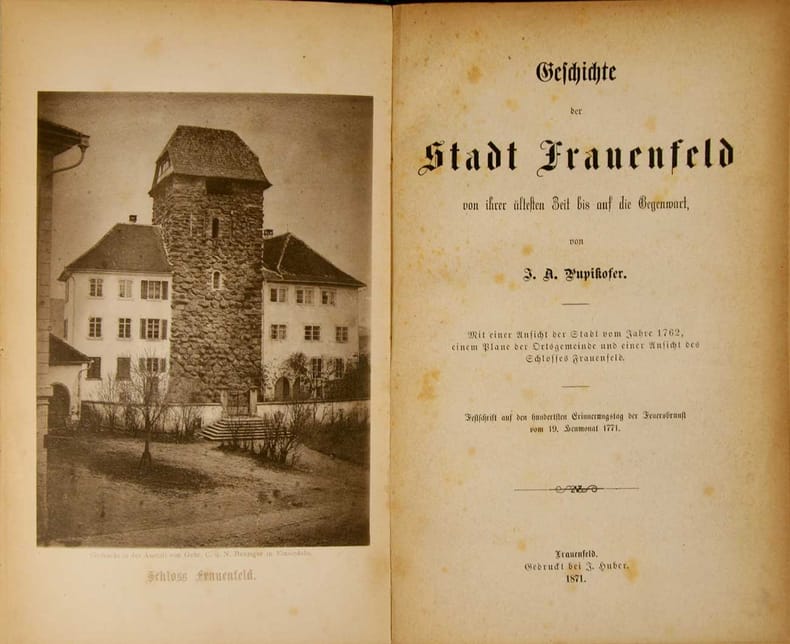
rif. 125333aafFrauenfeld, gedruckt bei J. Huber, 1871, in-8vo, Frontispiz-Ansicht des Schlosses Frauenfeld + XII + 469 S. (+ 1 leer) (Seiten gebräunt u. stockfleckig) + 1 mehrfach gefaltete Ansicht der Stadt Frauenfeld vom Jahre 1762 (nach einem Oelbild v. J. 1762) + 1 gef. lithogr. Plan von Freuenfeld, gez. v. U. Gentsch, (Top. Anst. Wurster u Randegger & Cie in Winterthur), (letztes Text-Blatt und Abbildungen am Ende lose). Originaler grüner Leinenband. Mit Goldsiegel im Zentrum ‘Sigillum in Frouwenfeld’. Gebrauchsspuren, komplett sehr selten.
1962rif. 013505Paris Galerie Raymond Cordier 1962 En feuilles
1924rif. 230704052051ybvkTokyo, Kaigyousha, Taisho 13-2-29 (February 29th, 1924). 2 titlepages in japanese Caligraphy, 1 manually-drawn (printed) map of the Kanto-region with numbers of victims in red, 2 foldout-plans of larger-Tokyo with marks in red (destroyed areas?), 5 partly folded plans and maps of the Area (Yokohama etc.); 2 plates with photographic portraits of the military staff, ca. 70 singleside printed plates with ca. 250 partly aerial photographs depicting the destructions of big earthquake at large and in detail as well as first reconstruction-starts (esp. bridge-building); each plate is covered with a loose half transparent page with captions for each photograph, all plates on stronger paper. - Publisher's gilt-titled cloth in traditional blockbook-binding, endpapers made of special silver-and-gold-spotted largepaper, all edges gilt; oblong-folio (ca. 27,5 x 37,5 x 2 cm; 2 kg.).
rif. 123167aafAmsterdam, G(errit) Warnars en P(etrus) den Hengst, MDCCLXXII ; MDCCLXXV, 1772 - 1775, in-4to, (23.3x18 cm), 4 leaves + 80 p. + 6 leaves (Raadt Aan hun...); 3 leaves +56 p. Illustrated with an engraved frontispiece, with a small engraved illustration by Noach van der Meer Junior (II) on both title-pages, 4 folding engraved plates of the old theatre; 5 folding engraved plates of the new theatre, all engraved by the publishers after designs by Van der Meer and 1 by Simon Fokke. Ex-Libris SR Sammlung ‘Schweiz. Rückversicherungs-Gesellschaft’, H-cloth with corners (19th c.).
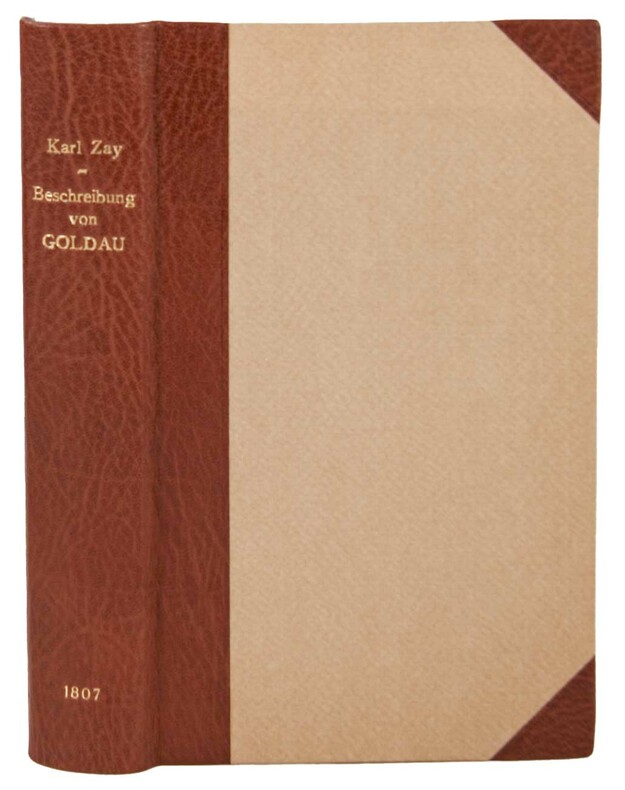
rif. 142181aafZürich, Orell, Füssli / 2) Verlag: Stuttgart, zu haben bei Dr. Marriott. 1807, in-8vo, Frontispiz (mit Abb.: das ehmalige Goldau) + 390 S. + 1 gefaltete (sehr detaillierte) kolorierte Karte, etwas stockfleckig / 2) 16 S., hs. auf Titelbl.: Christ-Focin,, leicht stockfleckig. Exlibris Dr. Phil. E. Bosshard / Exlibr. Peter E. Obergfell, Halb-Pergament d. Zeit mit Ecken.
rif. 125249aafVenezia, Tipografia Municipale di Gaetano Longo, M DCCCLXVIII, 1868, gr. in-8vo, 2 ff. + 116 p. + 1 f. ‘errata-corrige’ + 9 planches lithogr. avec 35 figures (Lit. Longo), reliure en d.-cuir recente. Dos orne or.
rif. 125235aafA Paris, chez. Magimel Libraire / Gailard, Garde-Magasin du Corps des Sapeurs-Pompiers. (Lottin de Saint-Germain, Imprimeur du Roi), 1816, in-4to, 2 ff. (titre et feuille de dédicace) + 128 p. + 5 planches gravées dont 2 dépliantes, non rogné, Cachet sur titre ‘Fideicommis Bodenstein’, reliure en d.-maroquin récent , titre or au dos (Stemmle Zürich).
rif. 125238aafLuzern, Gebr. Egli / Luzern, X. Merzer, o.J. (1828), 1820, Qu.-4° (26,5 x 36 cm). & 8°, (Schwegler:) 1 Textbl. + Mit Orig,-Umschl. mit 7 Titelvign. und 75 lithogr. Tafeln von Gebr. Eglin nach J. Schwegler. durchgehend stockfleckig im weissen Rändern / / Businger: Mit gest. Frontispiz von G. Engelmann (Aussicht der Kapell-Brücke in Luzern) + 2 gest. Titelbl. (mit ornamentalischer Federzeichnung am Rand) + 1 Bl. + 280 S.; XXXVII + 322 S., (stockfleckig), [1] Bl.; Tafeln. Halb-Leder d. Z. mit goldgepr. Rückenschild und eingebundenen Original-Broschuren. / Halb-Leder mit Ecken.
rif. 138882aafZürich, Orell, Füssli, 1807, in-8vo, kol. Frontispiz + 390 S. + 1 gefaltete kolorierte Karte, durchgehend stockfleckig, Exlibris Herm. Bossard / Peter E. Obergfell, Rez. Halbleder mit Ecken.
2016In March of 1921, journalist Kostas Faltaits arrived in Asia Minor (today’s Turkey) sent by newspaper Embros to cover Greece’s movements in the Greco-Turkish War. By the time he arrived in the region of Nicomedia (today’s Izmit) - a region inhabited by a large number of Greek, Armenian and Circassian communities - Kemalist forces had set fire to many of the villages, leaving behind a trail of death and destruction. Faltaits came face to face with the fleeing survivors of these massacres, and was able to collect these valuable and graphic eye-witness testimonies which were published in both Greek and French at the time. Translated for the very first time in English and with a prologue by Tessa Hofmann, this edition will shed some light into just one of the many chapters of the Greek Genocide, a genocide which claimed the life of approximately one million Greeks living in the former Ottoman Empire.The accounts by Greek survivors in The Genocide of the Greeks in Turkey, of massacres, torture, rape, theft, and the destruction of villages, and the brutalizers’ sheer pleasure in inflicting such suffering on fellow humans, attests to the depths to which humans are capable of descending. However, these accounts by survivors also attest to human courage and the sheer will to survive, even after enduring and witnessing such unspeakable depravity. That this kind of depravity has been repeated around the world since this blight occurred in Ottoman Turkey almost 100 years ago, reminds us how important it is to record these heinous crimes against humanity, demand acknowledgement from the responsible governments, and bring the perpetrators to justice. It also reminds us that powerful nations that stand by and witness these genocides without taking meaningful action to stop them should also be denounced as complicit in the genocides. Such was the case in ttoman Turkey when the Allies knew of the depravity taking place against the Ottoman Greeks and Armenians, but chose to silence relief workers and missionaries in order to ensure future trade with Mustapha Kemal’s emerging Nationalist government.....Countless other examples can be found since the Ottomans and Kemal destroyed the three and four millennia old Greek, Armenian, and Assyrian communities of Asia Minor between 1914 and 1923." Details Category: Asia Minor CatastropheCode: 10041ISBN: Binding: Paperback Pages: 156 Publication Date: 2016 Publisher: Published In: USA Translator: Ellene S. Phufas-Jousma, Aris Tsilfidis Language: English
2015Smyrna, one of the wealthiest cities and the most advanced civilizations in the Middle East (present-day Turkey) with a unique mixture of many nationalities-Greek, Armenian, Jewish, Turkish, European, and American-perished into ashes in September 1922. The Smyrniots became victims through the orders of Mustafa Ataturk, who was responsible for one of the largest purges of humanity known to man. This eradication led to the loss of 3.5 million Greek and Armenian Orthodox Christians who had occupied Asia Minor since the time of Alexander the Great. In September 1922, Ataturk led his troops into Smyrna (now Izmir), a predominantly Greek Christian City that was known as the City of Infidels to the Turks. The Turks then proceeded to indulge in an orgy of pillage, rape, and slaughter. This City of Infidels was cleansed and destroyed and with it the last hub of Christians in Turkey. The Whispering Voices of Smyrna is proof of the horrible atrocities the Turks, whether private citizens or government officials, committed by plundering, torturing, mutilating, burning alive, and massacring women, children, and aged people. The book details these brutal acts that were decided, planned, and directed by the Turkish central authorities and were aimed at cleansing lands under Turkish control of non-Muslim citizens. The Whispering Voices of Smyrna combines history and storytelling so that readers understand how the decision by government and military leaders of the victorious Allied powers affected the people of Smyrna. Through the eyes of the Samithakis family, one lives the cataclysmic events that determined the fate of Asia Minor following World War I. The Samithakis family lived a life of luxury among the different nationalities in Smyrna, until the Turks forced them to flee with other Greek, Armenian and European residents of Smyrna. In the course of their struggle to save themselves from the fire, the massacres, rapes, mutilations and plundering, they lost one another and became refugees, beggars and exiles. The reader also lives through the stages of destruction of a civilization centered on the once-thriving and beloved city of Smyrna. 350p.