1708 resultados
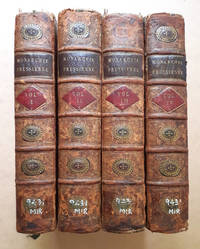
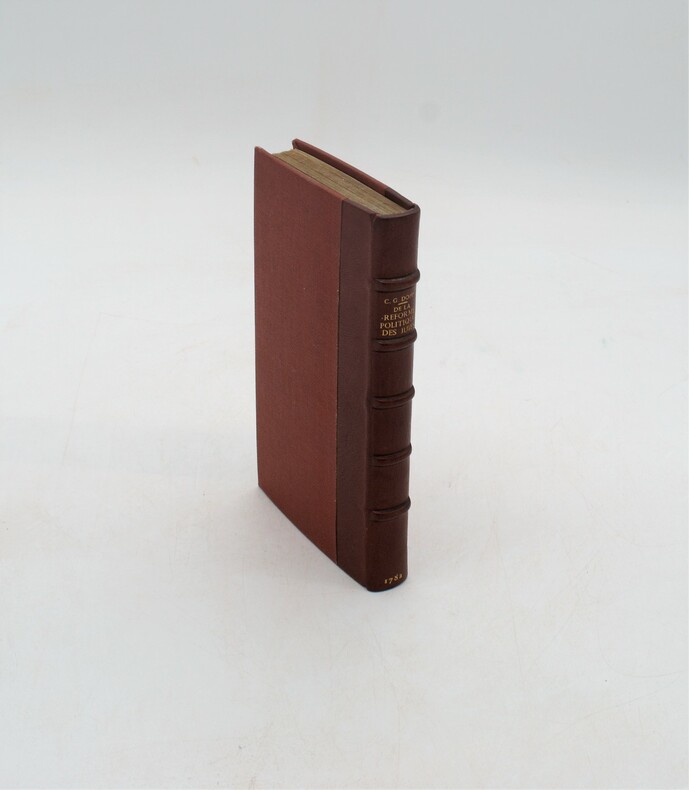
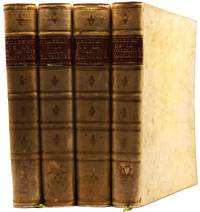
1788ref. 010138A Londres; et se trouve A Paris: Chez Le Jay & Maradan 1788. Book. Very Good Plus. Vellum. First Edition. 4to - over 9¾" - 12" tall. Four volumes bound in contemporary full vellum red morocco labels back with gilt lettering and devices marbled end papers. Provenance; with the bookplates of Francesco Rizzo Patarol 1749-1807 front paste downs of Vols. I III and IV whose noble family built the Rizzo Patarol palace in Venice which was at one time the seat of the Savoy embassy then the French embassy. A Very Good Plus set light soiling to vellum uniform browning. Vol. I: xliv 522 pp. 8 tables 7 of them fold-out. Vol. II: 2 566 4 pp. 34 tables 25 fold-out. Vol. III 710 pp. 2 fold-outs at p. 34 plus engraved Metropolis of Scotland Colledge fold-out plate tipped in at p. 449. Vol. IV: 4 560 1 pp. 14 fold-outs. An oversize and heavy set extra postage will be requested for priority mail or international orders. Chez Le Jay & Maradan Hardcover
1788ref. 010138A Londres; et se trouve A Paris: Chez Le Jay & Maradan 1788. Book. Very Good Plus. Vellum. First Edition. 4to - over 9¾" - 12" tall. Four volumes bound in contemporary full vellum red morocco labels back with gilt lettering and devices marbled end papers. Provenance; with the bookplates of Francesco Rizzo Patarol 1749-1807 front paste downs of Vols. I III and IV whose noble family built the Rizzo Patarol palace in Venice which was at one time the seat of the Savoy embassy then the French embassy. A Very Good Plus set light soiling to vellum uniform browning. Vol. I: xliv 522 pp. 8 tables 7 of them fold-out. Vol. II: 2 566 4 pp. 34 tables 25 fold-out. Vol. III 710 pp. 2 fold-outs at p. 34 plus engraved Metropolis of Scotland Colledge fold-out plate tipped in at p. 449. Vol. IV: 4 560 1 pp. 14 fold-outs. An oversize and heavy set extra postage will be requested for priority mail or international orders. Chez Le Jay & Maradan Hardcover books
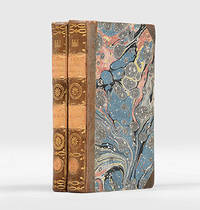
1769ref. 126597Amsterdam et se trouve à Paris: Lacombe 1769. Scarce complete thus attractively bound First duodecimo edition of Mirabeau's Les économiques also printed in a single quarto volume format the same year. A further volume was published in 1771 also in both quarto and 2-volume duodecimo formats. Complete sets are very scarce. Mirabeau who seems to have taken the title of this work from the Économiques of Xenophon here gives various methods of economic instruction for the various levels of society; he also suggests the method of approach in the instruction of heads of government. 2 vols duodecimo 162 x 95 mm. Engraved head- and tailpieces. Near-contemporary half calf twin morocco labels spine elaborately tooled in gilt red morocco onlay roundels with vol. numbers to foot of spine marbled paper boards. Ownership signature to title pages of both vols of one H. Wrangel possibly a descendant of the Swedish Governor General Hermann Wrangel 1584-1653 whose crest incorporates a turret as stamped at the head of each spine. Extremities lightly rubbed two neat paper repairs to title leaf of volume 1 else a very good set attractively bound. Einaudi 3943; Higgs 4568; INED 3196; Mattioli 2432 hardcover
1769ref. CLL-807Amsterdam, J. H. Schneider, 1769 In-12 de (3) ff., 186 pp., (2) ff., 256 pp., veau moucheté, double filet doré, roulette et filets à froid en encadrement sur les plats, dos à nerfs plats ornés de filets dorés, pièces de titre de maroquin rouge, roulette sur les coupes, tranches mouchetées rouges (reliure de l'époque).
1767ref. CLL-800La Haye, chez les Libraires associés, [Paris, Charles-Joseph Panckoucke], 1767 In-12 de (3) ff., CVI, 339, (2) pp., veau marbré, dos à nerfs orné de caissons de fleurons dorés, pièce de titre de maroquin rouge, tranches rouges (reliure de l'époque).
ref. #BIBLIO-1316De la Monarchie Prussienne sous Frédéric le Grand; avec un appendice contenant des recherches sur la situation actuelle des principales contrées De L'allemagne. Par le Comte de Mirabeau. Tome I-IV. On the Prussian Monarchy under Frederick the Great; with an appendix containing research on the current situation of the principal countries of Germany. By Honoré Gabriel Riqueti the Count of Mirabeau. Volume I-IV. Four-volume set. First edition. Quarto/4to. Each volume measures around 8" x 10 1/4" x 2" 203mm x 260mm x 50mm. Pagination: 4 xliv 522 2; 4 566 6; 4 710; 4 560 3 pp. Published in London 1788. Hardback full mottled calf. Raised bands. Gilt-tooled borders to boards gilt decoration to spines and gilt-blocked titles with brown title labels and red volume labels. All page edges gilt. Marbled endpapers. Frontispiece portrait of Frederick the Great to first volume engraved by H. Marais in 1788 after A. Graf and a plate of the "Metropolis of Scotland Colledge" opposite page 489 of the third volume. Contains numerous foldout tables. Notes of errata at rear. Green silk ribbon markers to volumes I II and IV lacking in volume III.Ex-library books containing typical markings including white library numbering to spines labels and cards to front pastedowns and endpapers and stamps to titles & final leaves. A little pencil writing to endpapers. Scuffing and marking to binding some tearing. Other signs of wear rubbing at edges and on hinges. Bumped and torn corners and some chipping and loss to heads and tails of spines. Some cracking to hinges but binding quite firm. Some scuffing and marking to page edges but gilt detail still vivid. A little tearing to the odd page. Some toning foxing soiling and staining to endpapers. A little grub here and there and minor toning to outer edges throughout but otherwise page surfaces generally quite clean with no underlining marginalia etc. A lovely set. See pictures for further information. About the author:Honoré Gabriel Riqueti Count of Mirabeau French: miÊabo; 9 March 1749 – 2 April 1791 was a French writer orator statesman and a prominent figure of the early stages of the French Revolution.A member of the nobility Mirabeau had been involved in numerous scandals that had left his reputation in ruins. Well-known for his oratory skills Mirabeau quickly rose to the top of the French political hierarchy following his election to the Estates-General in 1789 and was recognized as a leader of the newly organized National Assembly. Among the revolutionaries Mirabeau was an advocate of the moderate position of constitutional monarchy built on the model of Great Britain. He was also a leading member of the Jacobin Club.Mirabeau died of pericarditis in 1791 and was regarded as a national hero and a father of the Revolution. He received a grand burial and was the first to be interred at the Panthéon. During the 1792 Trial of Louis XVI the discovery that Mirabeau had secretly been in the pay of the king brought him into posthumous disgrace and two years later his remains were removed from the Panthéon. Historians are split on whether Mirabeau was a great leader who almost saved the nation from the Terror a venal demagogue lacking political or moral values or a traitor in the pay of the enemy. Source: Wiki hardcover
ref. LCS-17587Exemplaire d’une grande pureté, grand de marges car non rogné, conservé broché, tel que paru. S. l., 1789. 2 tomes en 2 volumes in-8 de : I/ xv pp., (1) p. bl., 168 pp.; II/ 207 pp. Conservé dans ses couvertures muettes d’attente, cote de bibliothèque sur le plat supérieur des volumes, non rognés. Brochure d’origine. 220 x 140 mm.
1788ref. AMO-24644 forts volumes in-4 (27 x 21,5 cm) de (10)-XLIV-522, (3)-566-(4), (3)-710-(6) et (3)-560-(1) pages. Portrait de Frédéric le Grand en frontispice du premier volume (gravé par H. Marais en 1788 d'après A. Graf). Exemplaire bien complet des 59 tableaux dépliants (ou non) qui se trouvent à leur place intercalés dans les volumes (les feuillets de placement des tableaux sont présents en tête de chaque volume). Le tome III contient un planche symbolique hors-texte gravée par Ransonnette "Grand Ordre de Monsieur" (p. 489). Cartonnage plein papier à la colle bleu à l'imitation des cartonnages de l'époque. Entièrement non rogné, cartonné sur brochure, pièces de titre imprimées sur papier (modernes), étuis cartonnés de papier à la colle (un fond d'étui fêlé, sans gravité). Ensemble en superbe état. Intérieurs généralement d'une très grande fraîcheur. Quelques cahiers légèrement teintés ou avec quelques rousseurs. Sans l'atlas in-folio vendu séparément et contenant 10 cartes sur double page, dressées par Mentelle et gravées par Pierre François Tardieu, 93 planches de tactique non signées. « Cette importante étude, fort bien documentée, sur la Prusse est le résultat d’une vaste enquête » ; « C’est une œuvre conçue par Mirabeau selon son plan, d’après sa conception de l’histoire économique et philosophique », il « fondait de grands espoirs sur cet ouvrage pour établir sa réputation d’écrivain et obtenir enfin un emploi digne de son talent, de son origine et de son ambition. » (H. Aureille, Bibliographie de Mirabeau.). On y trouve d'intéressantes informations sur l'organisation militaire de la Prusse, sa législation, son administration et son économie, ainsi qu'un certain nombre de considérations sur la population. Les données statistiques sur les habitants de la Prusse s'y trouvent en grand nombre. On y trouve également de l'économie-politique, les productions agricoles et les richesses naturelles, les manufactures, le commerce, la constitution civile et politique, les revenus et dépenses, le système militaire (tactique) et la religion. Le premier volume s'ouvre sur une délicate et reconnaissante épître "à mon père" (Mirabeau père). Mirabeau a été aidé pour cet ouvrage par Jakob Mauvillon (1743-1794), physiocrate allemand. On accusé Mirabeau de n'avoir rédigé que quelques passages et préambules de l'ouvrage, le gros du travail revenant à Mauvillon. La correspondance échangée entre Mirabeau et Mauvillon prouve le contraire. Mirabeau était non seulement à l'origine de cet important ouvrage mais encore le maître d'oeuvre et principal rédacteur (certaines études récentes présentent toutefois Mauvillon comme le nègre de Mirabeau pour cet ouvrage). Jean-Charles Laveaux (1747-1829), professeur de langue française à Bâle, puis professeur de littérature française à Stuttgart et à Berlin, à la demande de Frédéric le Grand, a participé à la documentation historique pour cette histoire de la monarchie prussienne. Provenance : Exemplaire offert par Mirabeau à Nicolas Frochot (1761-1828). Attesté par un petit billet autographe (non signé) par Nicolas Frochot et daté de Paris le 4 avril 1790 présent en tête du premier volume. Frochot y remercie M. le comte de Mirabeau de l'envoi qu'il lui a fait de son ouvrage sur la monarchie prussienne. "Comme il a été bien entendu entre nous que je ne lui vendais pas le petit Cicero de amicitiâ, et que d'ailleurs j'aurais dans ce cas un retour considérable à lui donner. J'accepte ce cadeau non comme un prix d'échange du petit traité de l'Amitié mais comme un don que je m'honorerai toujours de tenirde celle de l'auteur. (en haut du billet il est écrit de la main même de Frochot : Copie de mon billet de remerciement à M. le comte de Mirabeau). Très émouvant billet quand on sait que Nicolas Frochot s'est lié d'une réelle amitié avec Mirabeau qui fit de lui son exécuteur testamentaire. Élu député des États généraux le 25 mars 1789, il est chargé de rédiger les cahiers de doléances du tiers état de sa province, avant de siéger à la Constituante (il se lie à Mirabeau à ce moment là). Il est l'auteur du titre VII de la Constitution, publié sous le titre De la souveraineté nationale dont l'exercice n'est pas constamment délégué. D'abord administrateur de la Côte-d'Or, il est emprisonné sous la Terreur. Libéré à la suite de la chute de Robespierre, il occupe divers postes administratifs avant d'être élu député de la Côte-d'Or en décembre 1799. Quelques mois plus tard, le 22 mars 1800 (1er germinal an VIII), nommé préfet de la Seine par Bonaparte, il démissionne de son mandat de député. Il devient ainsi le premier Préfet de la Seine et de Paris (Étienne Mejan lui est adjoint comme secrétaire général de la préfecture). Il propose de nombreuses réformes à caractère social (prisons, hôpitaux, Mont-de-piété et service des enfants abandonnés), qu'il ne parvient toutefois pas à mettre totalement en application. Il réalise les premiers embellissements et aménagements de voirie décidés par Napoléon, dont la numérotation des immeubles. Il fait percer de nouvelles rues, voies, ponts et marchés. Il fait acheter des terrains, hors des limites du Paris de l'époque, qu'il fait transformer en 4 cimetières : cimetière du Père-Lachaise, cimetière de Montmartre, cimetière du Montparnasse et cimetière de Passy. Il est mis en retraite en 1812, à la suite de la Conspiration de Malet. Il est nommé comte d'Empire. Conseiller d'État honoraire sous la première Restauration, il se rallie à Napoléon qui le nomme préfet des Bouches-du-Rhône durant les Cent-Jours. Il est destitué lors de la deuxième Restauration pour être remplacé par le comte de Vaublanc. Il se retire alors définitivement de la vie publique. (source : wikipédia). Nous pensons que Nicolas Frochot a été gratifié de cette exemplaire sous forme brochée, tel que paru. Un cartonnage a sans doute été donné ensuite à cet ouvrage par Frochot. Le présent cartonnage est à l'imitation du premier. Mirabeau meurt tout juste un an après la rédaction de ce billet de remerciement (2 avril 1791). Bel exemplaire de cet important ouvrage, offert par Mirabeau à Nicolas Frochot, son ami et exécuteur testamentaire.
1791ref. 015877Paris: Lejay e poi Devaux 1791-92. .Precedée de tous les Discours et Ouvrages du meme Auteur prononcés ou publiés en Provence pendant le cours des élections. Par M. Etienne Méjan. - 5 volumi 125x21 cm in mezza pelle coeva dorso liscio ornato e dorato con tassello di titolo rosso fenditura alla cerniera del vol 1 e in coda la dizione Bibliothèque de Michel Chevalier. Ex libris di Chevalier anche all'interno di ognuno dei 5 volumi. Piatti con carta marmorizzata usure tagli gialli -Paginazioni: Vol 1: 4-396-IV pagine; ritratto di Mirabeau in antiporta. Una tavola ripiegata di tabelle fuori testo che si riferisce però al tomo 5. Vol 2: 4-514-IV pagine. Vol 3: 4-436-VII pagine. Vol 4: 4-362-II pagine. Vol 5: 538 pagine. Ricercata raccolta -sconosciuta allEinaudi e al Kress- degli interventi di Mirabeau allAssemblea Nazionale dal 1789 al 1791 pubblicata subito dopo la sua morte. Contiene numerosi pezzi di soggetto economico e finanziario per esempio: "Sur la proposition faite par M. Necker douvrir un emprunt de 30 millions"; "Sur le nouveau imprunt de 80 million proposé par M. Necker"; Discours sur la caisse descompte in polemica con Necker; Sur le papier monnoie; Motion pour létablissement dune caisse nationale; Discours sur le projet de banque nationale présenté par M. Necker; Discours sur le retour des Indes; numerosi interventi soprattutto nel IV vol. sulla emissione di assignats. Ma i discorsi potevano toccare naturalmente altri argomenti come "Sur les droits à donner aux Juifs et aux comediens" sic; "Discours sur le droit de paix et de guerre"; Eloge funebre de Franklin". Il 5° volume contiene per la prima volta in edizione completa uno dei più importanti lavori economici di M. le Observations préliminaires sur le premier rapport du comité des monnoies presentate il 12 dicembre 1790. Pp.11-224. Un errore del rilegatore ha spostato le pagg. 209-224 quaderno O dopo pag. 368. Inoltre la tabella fuori testo sui saggi delloro è stata per errore inserita allinizio del tomo 1. Proprio il saggio di Mirabeau venne poi ripreso e ripubblicato da Michel Chevalier nel suo "De la baisse probable de lor." Paris Capelle 1859 Einaudi 1050. Esemplare quindi di straordinaria provenienza. Mirabeau avait à cette date 41 ans. Il avait en finances des connaissances etendues mai sourtout dexcellents conseillers qui lui preparaient ses papiers. Ses idées en matière monétaire mériteraient une étude trés attentive: on sait che sa volumineuse Constitution monetarire a passé longtemps pour un classique de la littérature monetaire et Michel Chevalier la publiait encore en 1859: Guy Thuillier Les idées monetaires au debut de la Révolution: Mirabeau et la réforme monetaire de 1785 Roma Accademia dei Lincei 1979 pp.7. Lejay e poi Devaux unknown
ref. LCS-A61Edition originale de ce «virulent libelle cotre l’arbitraire de la justice de son temps» écrit par Mirabeau au donjon de Vincennes. Hambourg, 1782. 2 tomes en 1 volume in-8 de xiv pp., (1) f., 366, (2) pp., 237 pp., mouillure dans la marge sup. des pp. 1 à 17 de la seconde partie. Plein veau marbré, filet à froid autour des plats, dos lisse orné, tranches rouges. Reliure de l’époque, mors et coiffes frottées. 195 x 125 mm.
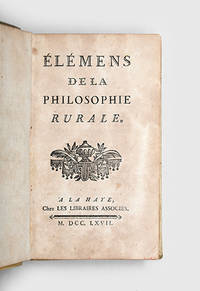
1767ref. 164209The Hague: chez les Libraires associés 1767. Handbook of Physiocracy including the Tableau économique First edition of Mirabeau's own abridgement of his and Quesnay's Philosophie rurale 1763 the first textbook of the physiocratic school. The Philosophie rurale presented "perhaps the most complete and magisterial account of the views of the Physiocratic school" Higgs p. 57. The Eléméns condenses the work into a more manageable textbook format aiming at a broader dissemination and understanding of the system. Importantly the Eléméns contains as a folding plate the Tableau économique first published in 1758 in a minute number of copies and reproduced in Mirabeau's L'Ami des hommes in 1760 and in the Philosophie rurale. The Tableau économique is cited as the earliest attempt to visualize a comprehensive model of the economic system illustrating the flow of goods and money and the interdependence of the agricultural manufacturing and commercial sectors. It is credited as "the most important and famous work of Physiocracy and has often been regarded as a summary of the entire corpus of Physiocratic economics" New Palgrave IV p. 23. Provenance: 19th-century bookplate of Isaac Iselin to the front pastedown; 20th-century note of authorship to front free endpaper; half-title with 20th-century library stamps of the Basel section of Schweiz Vereinigung für Sozialpolitik noted as bequeathed by the Austrian labour economist Stephan Bauer 1865-1934 and of the political science seminar of the University of Basel. Duodecimo 162 x 89 mm. Engraved folding Tableau économique at rear. Contemporary vellum spine lettered in gilt red sprinkled edges. Slight browning half-title loosening a little short closed tear to inner margin of table. A very good copy. Einaudi 3948; Goldsmiths' 10275; Higgs 3977; INED 3197; Kress 6477. Henry Higgs The Physiocrats 1963. hardcover
1782ref. PHO-1140Dessau, Librairie des auteurs et des artistes, 1782, XII-255pp.-2ff, relié demi basane postérieure, dos à nerfs avec auteur, titre et date en pied.
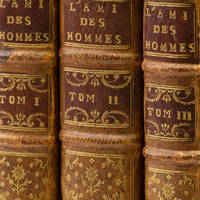
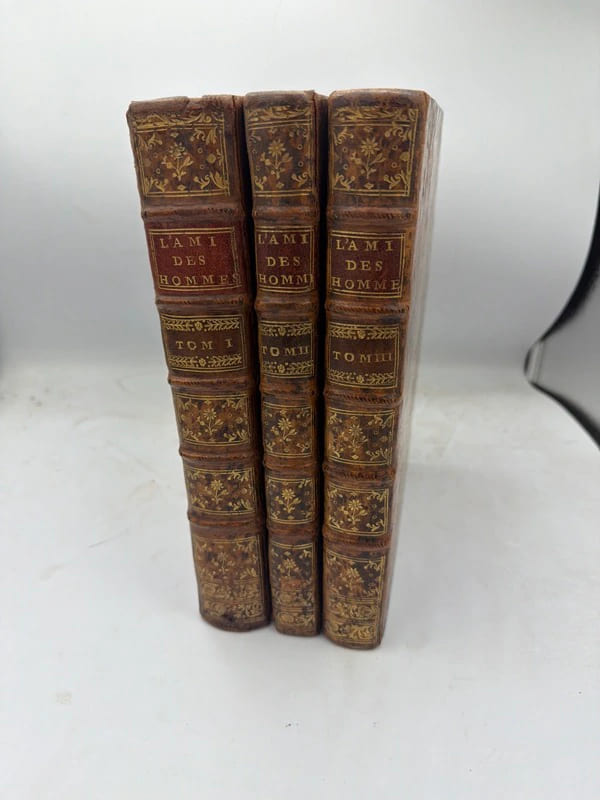
1760ref. 322182Paris 1760. First complete edition. Frontispiece. 192; 266 4; 6 263 1; 6 1-278; 80; viii 1-167 1; 279 5pp. Six parts in three volumes. 3 vols. 4to. Contemporary mottled french calf gilt spines red edges. Some wear at edges and joints. First complete edition. Frontispiece. 192; 266 4; 6 263 1; 6 1-278; 80; viii 1-167 1; 279 5pp. Six parts in three volumes. 3 vols. 4to. The first three parts constituting L'Ami des Hommes were first published by Mirabeau in 1756 before his meeting with Quesnay and his conversion to the physiocratic theses. In 1758 the work was reissued as a new edition with a fourth part added and in 1760 the fifth and sixth parts. Thus the present edition is the first complete one. Notably the final volume of the work includes Quesnay's Tableau Economique the first work attempting to describe the workings of the economy in an analytical way. Portions of Quesnay's work had been privately printed in a few copies only at the palace at Versailles in 1758 and 1759 but is here more widely and fully published. An important work on economic thought and political theory. Higgs 1628; Goldsmiths 9317; Kress 5735 unknown
1760ref. 322182Paris 1760. First complete edition. Frontispiece. 192; 266 4; 6 263 1; 6 1-278; 80; viii 1-167 1; 279 5pp. Six parts in three volumes. 3 vols. 4to. Contemporary mottled french calf gilt spines red edges. Some wear at edges and joints. First complete edition. Frontispiece. 192; 266 4; 6 263 1; 6 1-278; 80; viii 1-167 1; 279 5pp. Six parts in three volumes. 3 vols. 4to. The first three parts constituting L'Ami des Hommes were first published by Mirabeau in 1756 before his meeting with Quesnay and his conversion to the physiocratic theses. In 1758 the work was reissued as a new edition with a fourth part added and in 1760 the fifth and sixth parts. Thus the present edition is the first complete one. Notably the final volume of the work includes Quesnay's Tableau Economique the first work attempting to describe the workings of the economy in an analytical way. Portions of Quesnay's work had been privately printed in a few copies only at the palace at Versailles in 1758 and 1759 but is here more widely and fully published. An important work on economic thought and political theory. Higgs 1628; Goldsmiths 9317; Kress 5735 unknown books
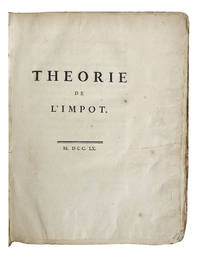
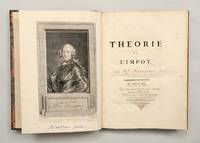
ref. 352620Théorie de l'impôt. 4to. VIII 336 pp. Publisher's original boards untrimmed. Covers somewhat foxed spine strenghtened in the time with vellum slightly worn corners worn some minor foxing few small stains in outer margins edges lightly dust-soiled. - Paris o. Dr. 1760. Very rare first edition in quarto of Mirabeau's chief work which led to the author's arrest at Vincennes. Assisted by François Quesnay Mirabeau's first book of his own after his conversion to Physiocracy offers an exposition of his economic ideas. On fiscal matters the Physiocrats famously pushed for their "single tax" l'impôt unique on landed property. The logic as laid out by Mirabeau seemed compelling. Any taxes levied throughout the economy will just passed from sector to sector until they fall upon the net product. As land is the only source of wealth then the burden of all taxes ultimately bears down on the landowner. So instead of levying a complicated collection of scattered taxes which are difficult to administer and can cause temporary distortions it is most efficient to just go to the root and tax land rents directly. This book was published the same year also in a duodecimo edition which is fare more current than the present quarto edition. - Untrimmed copy with wide margins Provenance: From the collection of Basel economics professor Edgar Salin 1892-1974 with his handwritten entry on the first flyleaf. References: Tchemerzine VIII 285; Barbier IV 702; Kress 5883; Humpert 13028; Higgs 2297; INED 3209; Goldsmith 9602. Paris 1760
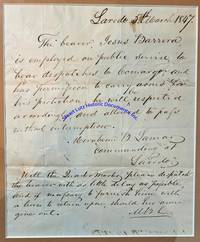
ref. 5857MIRABEAU LAMAR 1798-1859. Lamar served as the Second President of the Republic of Texas from 1838-1841. A protg of Sam Houston Lamar later served in the Texas Senate and as U.S. ambassadors to Costa Rica and Nicaragua under President James Buchanan. ALS.1 pg. 8 x 10. March 5 1847. Laredo Texas. An autograph letter signed Mirabeau B. Lamar Commanding at Laredo and initialed MBL. The letter grants the following: The bearer Jesus Barrera is employed on public serviceand has permission to carry arms for his protection; he will be respected accordingly and allowed to pass without interference Mirabeau B. Lamar Commanding at Laredo. The letter includes a postscript: Will the Quartermaster please dispatch the bearer with as little delay as possible and if necessary to furnish him with a horse to return upon should his own give out. Volume VI of the Lamar Papers within the Texas History Trust describe a Jesus Barrera who was captured in 1840 fighting on behalf of the Republic of the Rio Grande. This declared republic with several other northern Mexican states sought to break away from the centralized authoritarian Mexican government of General Santa Anna during the Texas Revolution to form a federal system modeled after the United States. Their revolution was brutally suppressed but received covert support from Lamar while he was President of Texas. Now almost a decade later Lamar was fighting for the United States Army at Laredo Texas and supported his one-time ally. His order to furnish a gun and horse during war-time to a Mexican citizen is very striking for how it complicates portrayals of loyalty during the Mexican-American War. This letter within its historical context is an excellent example of the ideological divisions that plagued Mexico around the time of Texas independence and the war with America. The letter is in fine condition with a few folds that do not hinder understanding. The letter is framed in brown wood and matted in tan with a hand-colored portrait of Lamar. unknown
ref. 5857MIRABEAU LAMAR 1798-1859. Lamar served as the Second President of the Republic of Texas from 1838-1841. A protg of Sam Houston Lamar later served in the Texas Senate and as U.S. ambassadors to Costa Rica and Nicaragua under President James Buchanan. ALS.1 pg. 8 x 10. March 5 1847. Laredo Texas. An autograph letter signed Mirabeau B. Lamar Commanding at Laredo and initialed MBL. The letter grants the following: The bearer Jesus Barrera is employed on public serviceand has permission to carry arms for his protection; he will be respected accordingly and allowed to pass without interference Mirabeau B. Lamar Commanding at Laredo. The letter includes a postscript: Will the Quartermaster please dispatch the bearer with as little delay as possible and if necessary to furnish him with a horse to return upon should his own give out. Volume VI of the Lamar Papers within the Texas History Trust describe a Jesus Barrera who was captured in 1840 fighting on behalf of the Republic of the Rio Grande. This declared republic with several other northern Mexican states sought to break away from the centralized authoritarian Mexican government of General Santa Anna during the Texas Revolution to form a federal system modeled after the United States. Their revolution was brutally suppressed but received covert support from Lamar while he was President of Texas. Now almost a decade later Lamar was fighting for the United States Army at Laredo Texas and supported his one-time ally. His order to furnish a gun and horse during war-time to a Mexican citizen is very striking for how it complicates portrayals of loyalty during the Mexican-American War. This letter within its historical context is an excellent example of the ideological divisions that plagued Mexico around the time of Texas independence and the war with America. The letter is in fine condition with a few folds that do not hinder understanding. The letter is framed in brown wood and matted in tan with a hand-colored portrait of Lamar. unknown books
ref. 246516S.l., 1758-1760 6 parties en 3 vol. in-4, première partie : V-(3)-192 pp. ; deuxième partie : (2)-266-(4) pp. ; troisième partie : (6)-263 pp. ; quatrième partie : (10)-278 pp. et 80 pp. ; cinquième partie : VIII-167 pp. ; sixième partie : (2)-279-(4) pp., planche gravée en frontispice par Fessard d'après Blakey, veau fauve, dos lisse orné, tranches rouges (reliure de l'époque). Début de fente à certains mors. Mouillure sur le frontispice du tome 1.
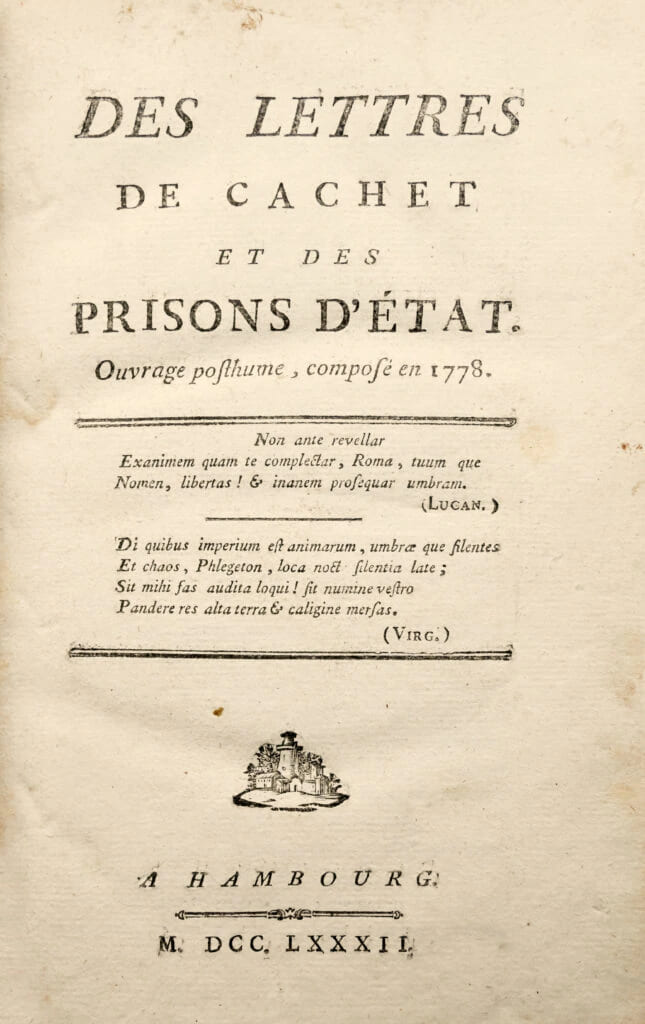
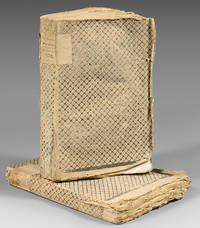
ref. ABAA25-33Hambourg n.n. 1782. 2 parts in 2 volumes 8vo of : I/ xiv pp. 1 l. 366 pp. 1 l. of errata; II/ 237 pp. ll. of the first quire interchanged wet stamp of a religious library repeated on the title p. 121 and on the last page of each volume. Preserved untrimmed in its "dominoté paper" wrappers title labels on spines plexiglas box. Original wrappers. 217 x 142 mm. First edition of Mirabeau's Virulent work written during his detention in the Dungeon of Vincennes and speaking out against despotism. Graesse IV 535; Einaudi 3932; Cioranescu 45191; Conlon 82; Bûcher 573. Mirabeau 1749-1791 was the son of the economist Victor Riquetti de Mirabeau. A French politician he was one of the most prominent figures of the Revolution and the most brilliant speaker of the Constituent Assembly. He had a very difficult relationship with his father and led a life of debauchery where he accumulated many debts. To get out of these debts he was locked up in prison by letters of seal at the request of his father on several occasions. Mirabeau wrote the Lettres de cachet in the dungeon of Vincennes where he remained locked up for three and a half years at the same time as the Marquis de Sade. An eloquent work in which he vigorously denounced the abuses of arbitrary power Les Lettres de cachet is a veritable indictment beginning with a history of French criminal law; Mirabeau goes on to denounce violently the organization of the prison administration at the end of the Old Régime. "Des Lettres de cachet' is not only an eloquent protest against despotism a warm advocacy in favor of individual freedom but also a real work of scholarship filled with historical examples and which implies immense reading". Barbier. "It is by history and by reason that Mirabeau fights against arbitrary detentions" P. Negrin. "Des Lettres de cachet deserves great praise. The principles of natural law the basis of all society and all civilization are exposed and developed with as much force as clarity. Mirabeau already shows himself to be a great publicist and the writer gives a foretaste of the orator". A. de Montor. "This work new denunciation of the arbitrary power plea in favor of the individual freedom defense of justice and humanity against despotism had such a repercussion at the time that Vergennes asked Prussia to stop the publication of this licentious writing to seize it and to destroy the manuscript." H. Aureole Bibliographie sur Mirabeau. A superb copy preserved as issued untimmed in its original wrappers in "dominote paper". One of the largest copies known height: 217 mm. The second volume is considered as rare because it was destroyed by the Prussian authorities at the request of the French government. Provenance: the copy comes from the library of Mr. Bidault Gentleman of the Count of Artois future Charles X. FR Hambourg s.n. 1782. 2 tomes en 2 volumes in-8 de : I/ xiv pp. 1 f. 366 pp. 1 f. d'errata ; II/ 237 pp. ff. du premier cahier intervertis cachet humide d'une bibliothèque religieuse répété sur le titre la p. 121 et en dernière page de chaque volume. Conservé non rogné dans ses brochures d'attente de papier dominoté étiquettes avec titre aux dos boite de plexiglass. Brochures de l'époque. 217 x 142 mm. Edition originale du virulent ouvrage de Mirabeau écrit pendant sa détention au donjon de Vincennes et s'élevant contre le despotisme. Graesse IV 535 ; Einaudi 3932 ; Cioranescu 45191 ; Conlon 82 ; Bûcher 573. Mirabeau 1749-1791 est le fils de l'économiste Victor Riquetti de Mirabeau. Homme politique français il est l'un des personnages les plus marquants de la Révolution et l'orateur de plus brillant de l'assemblée constituante. Il a des relations très difficiles avec son père et mène une vie de débauche où il accumule de nombreuses dettes. Pour le soustraire à ces dernières il sera enfermé par lettres de cachet en prison sur demande de son père à plusieurs reprises. Mirabeau rédigea les Lettres de cachet dans le donjon de Vincennes où il resta enfermé pendant 3 ans et demi au même moment que le Marquis de Sade. Œuvre éloquente où il flétrit énergiquement les abus du pouvoir arbitraire Les Lettres de cachet sont un véritable réquisitoire débutant par une histoire du droit pénal français ; Mirabeau poursuit par l'organisation de l'administration pénitentiaire à la fin de l'Ancien Régime qu'il dénonce violemment. " 'Des Lettres de cachet' n'est pas seulement une éloquente protestation contre le despotisme un plaidoyer chaleureux en faveur de la liberté individuelle mais encore un véritable travail d'érudition rempli d'exemples historiques et qui suppose d'immenses lectures ". Barbier. " C'est par l'histoire et par la raison que Mirabeau combat les détentions arbitraires " P. Negrin. " Des Lettres de cachet mérite de grands éloges. Les principes du droit naturel base de toute société et de toute civilisation y sont exposés et développés avec autant de force que de netteté. Mirabeau s'y montre déjà grand publiciste et l'écrivain y fait pressentir l'orateur ". A. de Montor. " Cet ouvrage nouvelle dénonciation du pouvoir arbitraire plaidoyer en faveur de la liberté individuelle défense de la justice et de l'humanité contre le despotisme eut un tel retentissement à l'époque que Vergennes demanda à la Prusse d'arrêter la publication de cet écrit licencieux de le saisir et de détruire le manuscrit… " H. Aureole Bibliographie sur Mirabeau. Superbe exemplaire conservé tel que paru à toutes marges car non rogné dans ses brochures d'attente de papier dominoté. L'un des plus grands exemplaires connus hauteur : 217 mm. Le second volume est considéré comme rare car il aurait été détruit par les autorités prussiennes à la requête du gouvernement français. Provenance : l'exemplaire provient de la bibliothèque de Mr. Bidault Gentilhomme du Comte d'Artois futur Charles X. hardcover
1763ref. LCPCECO-0008(La rarissime édition originale du monument de l'école physiocrate. Un superbe exemplaire, à très grandes marges, conservé dans sa reliure en veau strictement de l'époque) MIRABEAU Victor (Marquis DE) (1715-1789) - QUESNAY François (1694-1774). "PHILOSOPHIE RURALE OU ECONOMIE GENERALE ET POLITIQUE DE L'AGRICULTURE, REDUITE A L'ORDRE IMMUABLE DES LOIX PHISIQUES & MORALES, QUI ASSURENT LA PROSPERITE DES EMPIRES". 1763, Amsterdam, Libraires Associés. 1 volume in-4° (262x204 mm) (dimensions pages 257x192 mm) (2) ff. (faux-titre et titre), XXV, (1) pp. (préface, avertissement et table des chapitres), 412 pp. ; manquent les 3 tableaux h.t., oubliés par le relieur. ((2) ff., a-c4, d1, A-Z4, Aa-Zz4, Aaa-Eee4, Fff2) Reliure de l'époque en veau écaillé.Dos à cinq nerfs avec fleurons et décorations dorés et pièce de titre en maroquin vieux rouge. Double filet doré sur les coupes. Tranches rouges. Gardes de papier décoré et de papier blanc. Edition Originale, très rare. Quelques petits frottements à la reliure et deux petits chocs aux coins supérieurs. Quelques rares pages légèrement brunies, sinon intérieur très frais et propre. Superbe exemplaire à très grandes marges (quelques fois non rognées), peut-être un des plus grands passés sur le marché dans les derniers vingt ans. Très rare exemplaire conservé dans sa reliure strictement de l'époque, mais sans les 3 tableaux h.t., oubliés par le relieur. Cet ouvrage nait de la collaboration entre Mirabeau et Quesnay, ce dernier, médecin de Mme de Pompadour, rencontré à Versailles en juillet 1757. C'est le monument de la physiocratie et des théories sur le "Gouvernement par la Nature" ("The first of the four text-books of physiocrat orthodoxy" (Schumpeter, p. 225)). La doctrine de l'école physiocratique "est un mélange de libéralisme économique et de déspotisme éclairé". Ses principaux thèmes sont "la nature, la liberté, la terre et le déspotisme légal". Toute la richesse vient de la terre et seule la classe des agriculteurs est la vraie classe productive. Les lois de la proprieté privée et de la pleine liberté ("Laissez faire, laissez passer") doivent être réspectées, parce qu'elles sont les seules qui permettent d'atteindre la prosperité et de mantenir un ordre parfait. Provenance : Ex libris armorié du XIX siècle F.A. Garnier. (Tchémerzine, IV, 286 ; Quérard, VI, 154 ; Kress, 6120 ; INED, 3204 ; Conlon, 63:1131) (LCPCECO-0008)
ref. LCS-18316Séduisant exemplaire conservé tel que paru à toutes marges dans ses brochures d’attente, l’un des plus grands connus. Hambourg, s.n., 1782. 2 tomes en 2 volumes in-8 de : I/ xiv pp., (1) f., 366 pp., (1) f. d’errata ; II/ 237 pp., ff. du premier cahier intervertis, cachet humide d’une bibliothèque religieuse répété sur le titre, la p. 121 et en dernière page de chaque volume. Conservé non rogné dans ses brochures d’attente de papier dominoté, étiquettes avec titre aux dos, boite de plexiglass. Brochures de l’époque. 217 x 142 mm.
ref. LCS-18354La publication de l’Ami des hommes en 1756 valut à Mirabeau un véritable triomphe. S.l., 1759-1760. Sept parties en 7 volumes in-12 de: I/ 1 front. x pp., (3) ff. de table. 391 pp.; II/ (6) ff. et 534 pp.; III/ (6) ff. et 526 pp., déch. au coin inf. de la p. 225 sans atteinte au texte; IV/ xj-267 pp.; V/ (1) f. et 376 pp. ; VI/ xii, 298 pp. et (2) ff. table; VII/ (2) ff., 228 pp. et (1) f. de table plus 6 tableaux repliés. Les deux dernières parties sont datées de 1760. A partir de la quatrième partie, le texte se trouve ici en édition originale. Plein veau brun marbré, dos à nerfs ornés, coupes décorées, tranches rouges. Reliure de l’époque. 165 x 91 mm.
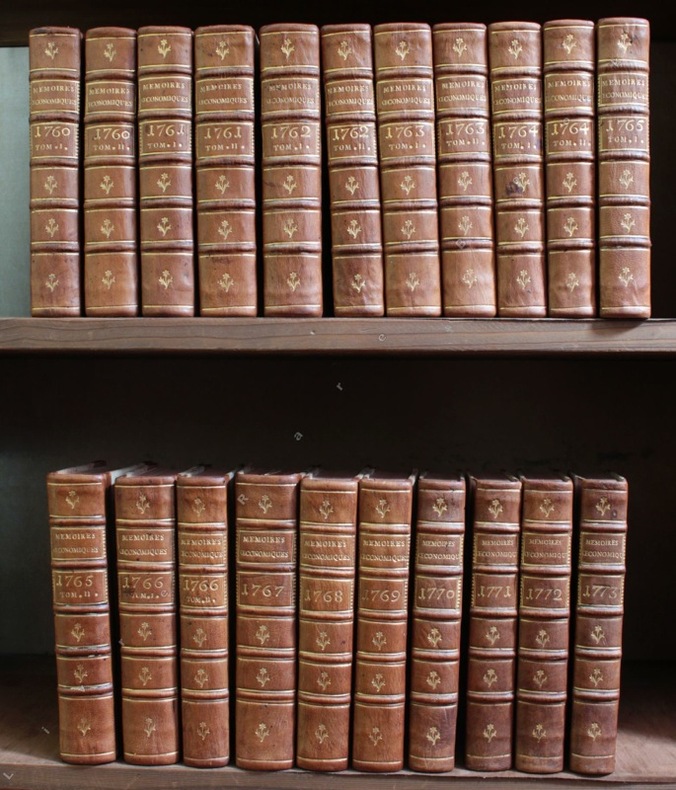
ref. 8335Zuric [puis] Berne, Heidegguer [puis] chez la Société typographique aux dépens de la Société Oeconomique, 1760 - 1773. 21 volumes in-8, demi veau fauve à coins, dos à nerfs ornés de filets et fleurons dorés, tranches teintées en rouge. Quelques rousseurs, parfois plus marquées en p. de titre, mouillure pour l'année 1771. Bel ensemble en reliure uniforme, chaque volume portant la signature de H. L. Roux en page de titre.
1760ref. 83935No place: no printer 1760. First edition of a spirited and able attack upon the financial administration of France and especially upon the "fermiers généraux" whom Mirabeau regarded as parasites preying upon the vitals of the nation. The work highlights the problems and injustices of the French system of taxation and added fuel to the fire of the coming revolution. The king disapproved of the work; Mirabeau was imprisoned on 16 December 1760 but through the efforts of Madame de Pompadour and others was released on Christmas Eve under orders to leave Paris for his estate at Bignon. The work proposes a reorganization of financial administrative machinery the abolition of the "Fermes" a reduction in the taxation upon salt with the object of increasing the total yield and a special tax upon tobacco farms. The domaine the post and the mint were to be further sources of revenue. The author ranks as one of the earliest important writers on taxation. Higgs notes that the book is "of real importance in the history of financial theory" The Physiocrats p. 57. Quarto 257 x 192 mm. Additional engraved frontispiece portrait of the author. Contemporary sprinkled calf spine ruled and decorated gilt in compartments red morocco label sprinkled edges. Spine ends and corners skilfully repaired. Manuscript note to title-page "par Mr Mirabeau père" with a short verse "helas dans le Siècle ou nous sommes / pour avoir dit la vérité / Mirabeau cet ami des hommes vient de perdre la liberté" in a neat calligraphic hand. Occasional light foxing. A very good copy. Goldsmiths' 9836; Higgs 2881; INED 3204; Kress 6120. unknown
ref. 6142Six parts bound in two vols. Large 4to cont. polished mottled calf spines nicely gilt. Avignon 1756-1758-1760. First edition of all six parts and a fine copy of one of the great classics of political economy. This work marks the birth of the physiocratic school and contains the first appearance on a large scale of the “Tableau Economique” of Quesnay portions of Quesnay’s work had been privately printed in a few copies only at the palace at Versailles in 1758 and 1759. In this work Mirabeau made the ideas of Cantillon known and the book had a very great influence in the years before the Revolution. Fine set. unknown