MIRABEAU, Honoré Gabriel Riquetti, comteLivre Rare Book
1 724 résultats
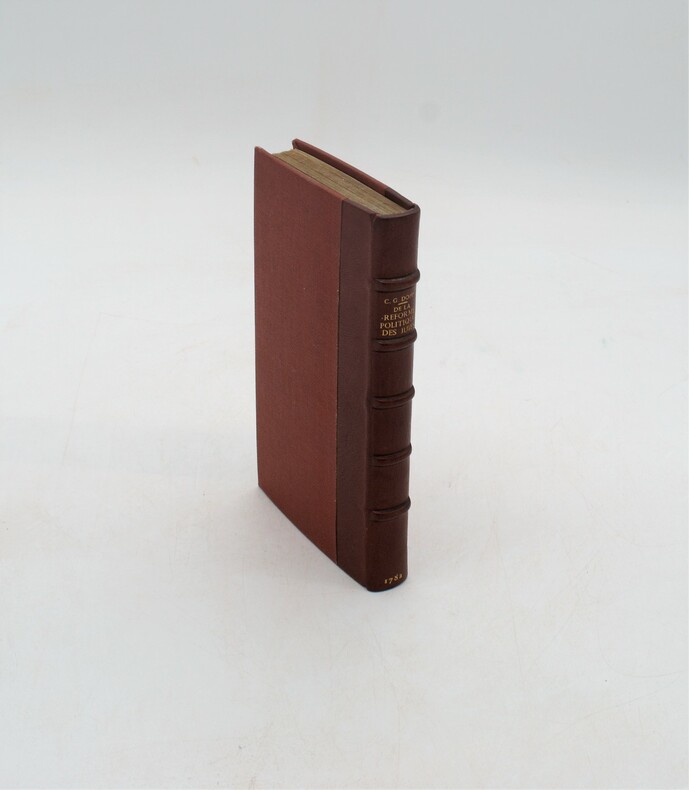
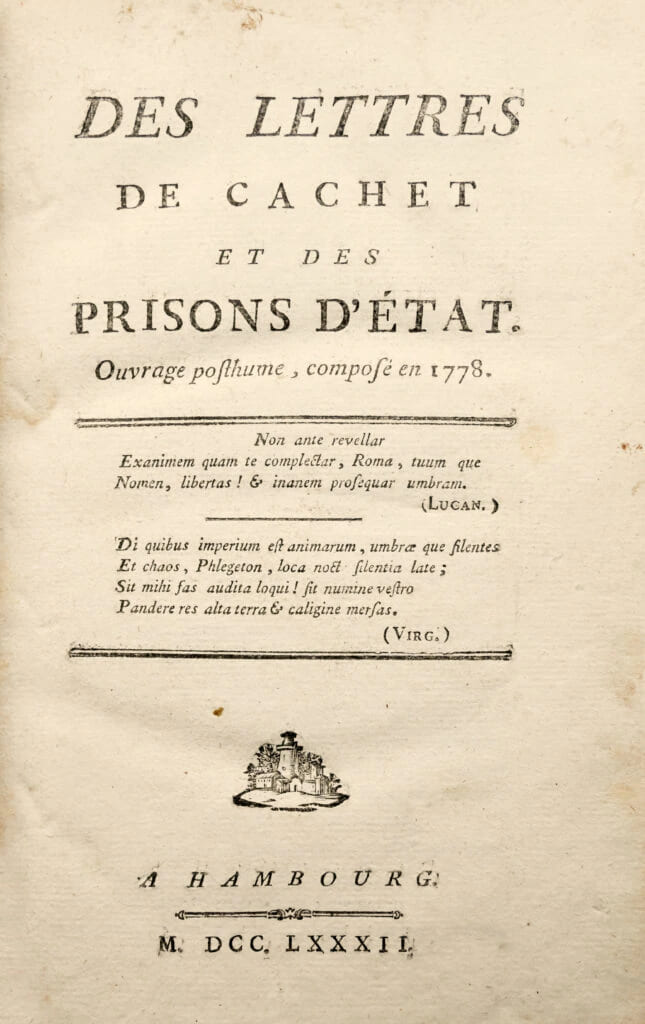
réf. LCS-A61Edition originale de ce «virulent libelle cotre l’arbitraire de la justice de son temps» écrit par Mirabeau au donjon de Vincennes. Hambourg, 1782. 2 tomes en 1 volume in-8 de xiv pp., (1) f., 366, (2) pp., 237 pp., mouillure dans la marge sup. des pp. 1 à 17 de la seconde partie. Plein veau marbré, filet à froid autour des plats, dos lisse orné, tranches rouges. Reliure de l’époque, mors et coiffes frottées. 195 x 125 mm.
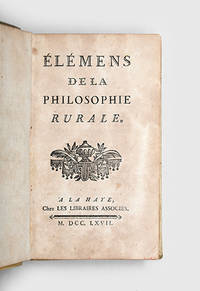
1767réf. 164209The Hague: chez les Libraires associés 1767. Handbook of Physiocracy including the Tableau économique First edition of Mirabeau's own abridgement of his and Quesnay's Philosophie rurale 1763 the first textbook of the physiocratic school. The Philosophie rurale presented "perhaps the most complete and magisterial account of the views of the Physiocratic school" Higgs p. 57. The Eléméns condenses the work into a more manageable textbook format aiming at a broader dissemination and understanding of the system. Importantly the Eléméns contains as a folding plate the Tableau économique first published in 1758 in a minute number of copies and reproduced in Mirabeau's L'Ami des hommes in 1760 and in the Philosophie rurale. The Tableau économique is cited as the earliest attempt to visualize a comprehensive model of the economic system illustrating the flow of goods and money and the interdependence of the agricultural manufacturing and commercial sectors. It is credited as "the most important and famous work of Physiocracy and has often been regarded as a summary of the entire corpus of Physiocratic economics" New Palgrave IV p. 23. Provenance: 19th-century bookplate of Isaac Iselin to the front pastedown; 20th-century note of authorship to front free endpaper; half-title with 20th-century library stamps of the Basel section of Schweiz Vereinigung für Sozialpolitik noted as bequeathed by the Austrian labour economist Stephan Bauer 1865-1934 and of the political science seminar of the University of Basel. Duodecimo 162 x 89 mm. Engraved folding Tableau économique at rear. Contemporary vellum spine lettered in gilt red sprinkled edges. Slight browning half-title loosening a little short closed tear to inner margin of table. A very good copy. Einaudi 3948; Goldsmiths' 10275; Higgs 3977; INED 3197; Kress 6477. Henry Higgs The Physiocrats 1963. hardcover
1782réf. PHO-1140Dessau, Librairie des auteurs et des artistes, 1782, XII-255pp.-2ff, relié demi basane postérieure, dos à nerfs avec auteur, titre et date en pied.
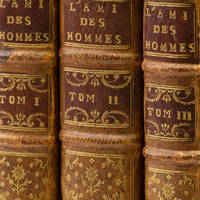
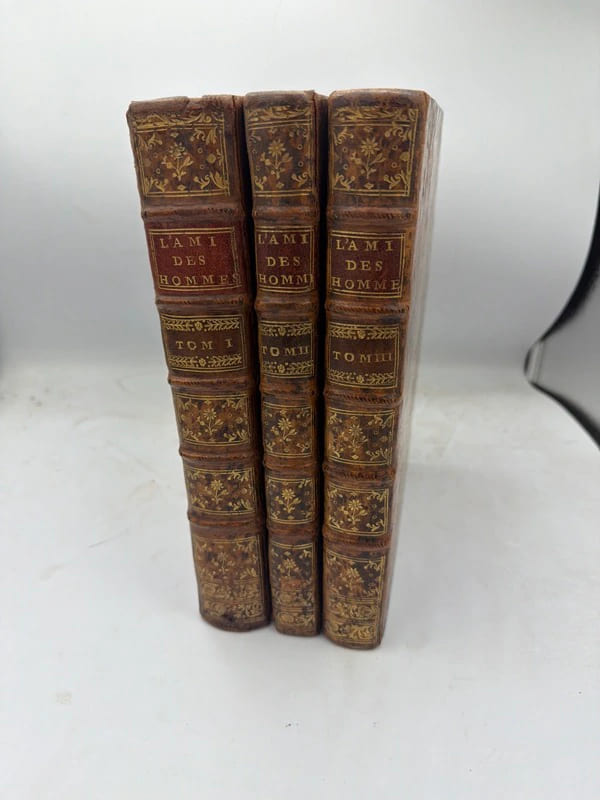
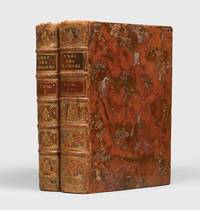
1760réf. 322182Paris 1760. First complete edition. Frontispiece. 192; 266 4; 6 263 1; 6 1-278; 80; viii 1-167 1; 279 5pp. Six parts in three volumes. 3 vols. 4to. Contemporary mottled french calf gilt spines red edges. Some wear at edges and joints. First complete edition. Frontispiece. 192; 266 4; 6 263 1; 6 1-278; 80; viii 1-167 1; 279 5pp. Six parts in three volumes. 3 vols. 4to. The first three parts constituting L'Ami des Hommes were first published by Mirabeau in 1756 before his meeting with Quesnay and his conversion to the physiocratic theses. In 1758 the work was reissued as a new edition with a fourth part added and in 1760 the fifth and sixth parts. Thus the present edition is the first complete one. Notably the final volume of the work includes Quesnay's Tableau Economique the first work attempting to describe the workings of the economy in an analytical way. Portions of Quesnay's work had been privately printed in a few copies only at the palace at Versailles in 1758 and 1759 but is here more widely and fully published. An important work on economic thought and political theory. Higgs 1628; Goldsmiths 9317; Kress 5735 unknown
1760réf. 322182Paris 1760. First complete edition. Frontispiece. 192; 266 4; 6 263 1; 6 1-278; 80; viii 1-167 1; 279 5pp. Six parts in three volumes. 3 vols. 4to. Contemporary mottled french calf gilt spines red edges. Some wear at edges and joints. First complete edition. Frontispiece. 192; 266 4; 6 263 1; 6 1-278; 80; viii 1-167 1; 279 5pp. Six parts in three volumes. 3 vols. 4to. The first three parts constituting L'Ami des Hommes were first published by Mirabeau in 1756 before his meeting with Quesnay and his conversion to the physiocratic theses. In 1758 the work was reissued as a new edition with a fourth part added and in 1760 the fifth and sixth parts. Thus the present edition is the first complete one. Notably the final volume of the work includes Quesnay's Tableau Economique the first work attempting to describe the workings of the economy in an analytical way. Portions of Quesnay's work had been privately printed in a few copies only at the palace at Versailles in 1758 and 1759 but is here more widely and fully published. An important work on economic thought and political theory. Higgs 1628; Goldsmiths 9317; Kress 5735 unknown books
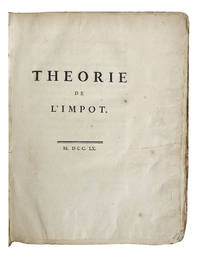
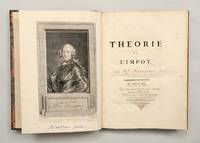
réf. 352620Théorie de l'impôt. 4to. VIII 336 pp. Publisher's original boards untrimmed. Covers somewhat foxed spine strenghtened in the time with vellum slightly worn corners worn some minor foxing few small stains in outer margins edges lightly dust-soiled. - Paris o. Dr. 1760. Very rare first edition in quarto of Mirabeau's chief work which led to the author's arrest at Vincennes. Assisted by François Quesnay Mirabeau's first book of his own after his conversion to Physiocracy offers an exposition of his economic ideas. On fiscal matters the Physiocrats famously pushed for their "single tax" l'impôt unique on landed property. The logic as laid out by Mirabeau seemed compelling. Any taxes levied throughout the economy will just passed from sector to sector until they fall upon the net product. As land is the only source of wealth then the burden of all taxes ultimately bears down on the landowner. So instead of levying a complicated collection of scattered taxes which are difficult to administer and can cause temporary distortions it is most efficient to just go to the root and tax land rents directly. This book was published the same year also in a duodecimo edition which is fare more current than the present quarto edition. - Untrimmed copy with wide margins Provenance: From the collection of Basel economics professor Edgar Salin 1892-1974 with his handwritten entry on the first flyleaf. References: Tchemerzine VIII 285; Barbier IV 702; Kress 5883; Humpert 13028; Higgs 2297; INED 3209; Goldsmith 9602. Paris 1760
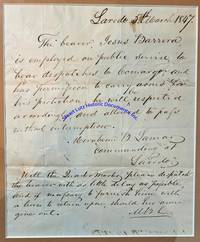
réf. 5857MIRABEAU LAMAR 1798-1859. Lamar served as the Second President of the Republic of Texas from 1838-1841. A protg of Sam Houston Lamar later served in the Texas Senate and as U.S. ambassadors to Costa Rica and Nicaragua under President James Buchanan. ALS.1 pg. 8 x 10. March 5 1847. Laredo Texas. An autograph letter signed Mirabeau B. Lamar Commanding at Laredo and initialed MBL. The letter grants the following: The bearer Jesus Barrera is employed on public serviceand has permission to carry arms for his protection; he will be respected accordingly and allowed to pass without interference Mirabeau B. Lamar Commanding at Laredo. The letter includes a postscript: Will the Quartermaster please dispatch the bearer with as little delay as possible and if necessary to furnish him with a horse to return upon should his own give out. Volume VI of the Lamar Papers within the Texas History Trust describe a Jesus Barrera who was captured in 1840 fighting on behalf of the Republic of the Rio Grande. This declared republic with several other northern Mexican states sought to break away from the centralized authoritarian Mexican government of General Santa Anna during the Texas Revolution to form a federal system modeled after the United States. Their revolution was brutally suppressed but received covert support from Lamar while he was President of Texas. Now almost a decade later Lamar was fighting for the United States Army at Laredo Texas and supported his one-time ally. His order to furnish a gun and horse during war-time to a Mexican citizen is very striking for how it complicates portrayals of loyalty during the Mexican-American War. This letter within its historical context is an excellent example of the ideological divisions that plagued Mexico around the time of Texas independence and the war with America. The letter is in fine condition with a few folds that do not hinder understanding. The letter is framed in brown wood and matted in tan with a hand-colored portrait of Lamar. unknown
réf. 5857MIRABEAU LAMAR 1798-1859. Lamar served as the Second President of the Republic of Texas from 1838-1841. A protg of Sam Houston Lamar later served in the Texas Senate and as U.S. ambassadors to Costa Rica and Nicaragua under President James Buchanan. ALS.1 pg. 8 x 10. March 5 1847. Laredo Texas. An autograph letter signed Mirabeau B. Lamar Commanding at Laredo and initialed MBL. The letter grants the following: The bearer Jesus Barrera is employed on public serviceand has permission to carry arms for his protection; he will be respected accordingly and allowed to pass without interference Mirabeau B. Lamar Commanding at Laredo. The letter includes a postscript: Will the Quartermaster please dispatch the bearer with as little delay as possible and if necessary to furnish him with a horse to return upon should his own give out. Volume VI of the Lamar Papers within the Texas History Trust describe a Jesus Barrera who was captured in 1840 fighting on behalf of the Republic of the Rio Grande. This declared republic with several other northern Mexican states sought to break away from the centralized authoritarian Mexican government of General Santa Anna during the Texas Revolution to form a federal system modeled after the United States. Their revolution was brutally suppressed but received covert support from Lamar while he was President of Texas. Now almost a decade later Lamar was fighting for the United States Army at Laredo Texas and supported his one-time ally. His order to furnish a gun and horse during war-time to a Mexican citizen is very striking for how it complicates portrayals of loyalty during the Mexican-American War. This letter within its historical context is an excellent example of the ideological divisions that plagued Mexico around the time of Texas independence and the war with America. The letter is in fine condition with a few folds that do not hinder understanding. The letter is framed in brown wood and matted in tan with a hand-colored portrait of Lamar. unknown books
réf. 246516S.l., 1758-1760 6 parties en 3 vol. in-4, première partie : V-(3)-192 pp. ; deuxième partie : (2)-266-(4) pp. ; troisième partie : (6)-263 pp. ; quatrième partie : (10)-278 pp. et 80 pp. ; cinquième partie : VIII-167 pp. ; sixième partie : (2)-279-(4) pp., planche gravée en frontispice par Fessard d'après Blakey, veau fauve, dos lisse orné, tranches rouges (reliure de l'époque). Début de fente à certains mors. Mouillure sur le frontispice du tome 1.
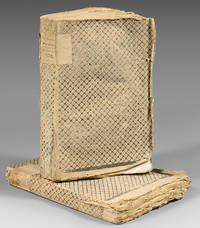
réf. ABAA25-33Hambourg n.n. 1782. 2 parts in 2 volumes 8vo of : I/ xiv pp. 1 l. 366 pp. 1 l. of errata; II/ 237 pp. ll. of the first quire interchanged wet stamp of a religious library repeated on the title p. 121 and on the last page of each volume. Preserved untrimmed in its "dominoté paper" wrappers title labels on spines plexiglas box. Original wrappers. 217 x 142 mm. First edition of Mirabeau's Virulent work written during his detention in the Dungeon of Vincennes and speaking out against despotism. Graesse IV 535; Einaudi 3932; Cioranescu 45191; Conlon 82; Bûcher 573. Mirabeau 1749-1791 was the son of the economist Victor Riquetti de Mirabeau. A French politician he was one of the most prominent figures of the Revolution and the most brilliant speaker of the Constituent Assembly. He had a very difficult relationship with his father and led a life of debauchery where he accumulated many debts. To get out of these debts he was locked up in prison by letters of seal at the request of his father on several occasions. Mirabeau wrote the Lettres de cachet in the dungeon of Vincennes where he remained locked up for three and a half years at the same time as the Marquis de Sade. An eloquent work in which he vigorously denounced the abuses of arbitrary power Les Lettres de cachet is a veritable indictment beginning with a history of French criminal law; Mirabeau goes on to denounce violently the organization of the prison administration at the end of the Old Régime. "Des Lettres de cachet' is not only an eloquent protest against despotism a warm advocacy in favor of individual freedom but also a real work of scholarship filled with historical examples and which implies immense reading". Barbier. "It is by history and by reason that Mirabeau fights against arbitrary detentions" P. Negrin. "Des Lettres de cachet deserves great praise. The principles of natural law the basis of all society and all civilization are exposed and developed with as much force as clarity. Mirabeau already shows himself to be a great publicist and the writer gives a foretaste of the orator". A. de Montor. "This work new denunciation of the arbitrary power plea in favor of the individual freedom defense of justice and humanity against despotism had such a repercussion at the time that Vergennes asked Prussia to stop the publication of this licentious writing to seize it and to destroy the manuscript." H. Aureole Bibliographie sur Mirabeau. A superb copy preserved as issued untimmed in its original wrappers in "dominote paper". One of the largest copies known height: 217 mm. The second volume is considered as rare because it was destroyed by the Prussian authorities at the request of the French government. Provenance: the copy comes from the library of Mr. Bidault Gentleman of the Count of Artois future Charles X. FR Hambourg s.n. 1782. 2 tomes en 2 volumes in-8 de : I/ xiv pp. 1 f. 366 pp. 1 f. d'errata ; II/ 237 pp. ff. du premier cahier intervertis cachet humide d'une bibliothèque religieuse répété sur le titre la p. 121 et en dernière page de chaque volume. Conservé non rogné dans ses brochures d'attente de papier dominoté étiquettes avec titre aux dos boite de plexiglass. Brochures de l'époque. 217 x 142 mm. Edition originale du virulent ouvrage de Mirabeau écrit pendant sa détention au donjon de Vincennes et s'élevant contre le despotisme. Graesse IV 535 ; Einaudi 3932 ; Cioranescu 45191 ; Conlon 82 ; Bûcher 573. Mirabeau 1749-1791 est le fils de l'économiste Victor Riquetti de Mirabeau. Homme politique français il est l'un des personnages les plus marquants de la Révolution et l'orateur de plus brillant de l'assemblée constituante. Il a des relations très difficiles avec son père et mène une vie de débauche où il accumule de nombreuses dettes. Pour le soustraire à ces dernières il sera enfermé par lettres de cachet en prison sur demande de son père à plusieurs reprises. Mirabeau rédigea les Lettres de cachet dans le donjon de Vincennes où il resta enfermé pendant 3 ans et demi au même moment que le Marquis de Sade. Œuvre éloquente où il flétrit énergiquement les abus du pouvoir arbitraire Les Lettres de cachet sont un véritable réquisitoire débutant par une histoire du droit pénal français ; Mirabeau poursuit par l'organisation de l'administration pénitentiaire à la fin de l'Ancien Régime qu'il dénonce violemment. " 'Des Lettres de cachet' n'est pas seulement une éloquente protestation contre le despotisme un plaidoyer chaleureux en faveur de la liberté individuelle mais encore un véritable travail d'érudition rempli d'exemples historiques et qui suppose d'immenses lectures ". Barbier. " C'est par l'histoire et par la raison que Mirabeau combat les détentions arbitraires " P. Negrin. " Des Lettres de cachet mérite de grands éloges. Les principes du droit naturel base de toute société et de toute civilisation y sont exposés et développés avec autant de force que de netteté. Mirabeau s'y montre déjà grand publiciste et l'écrivain y fait pressentir l'orateur ". A. de Montor. " Cet ouvrage nouvelle dénonciation du pouvoir arbitraire plaidoyer en faveur de la liberté individuelle défense de la justice et de l'humanité contre le despotisme eut un tel retentissement à l'époque que Vergennes demanda à la Prusse d'arrêter la publication de cet écrit licencieux de le saisir et de détruire le manuscrit… " H. Aureole Bibliographie sur Mirabeau. Superbe exemplaire conservé tel que paru à toutes marges car non rogné dans ses brochures d'attente de papier dominoté. L'un des plus grands exemplaires connus hauteur : 217 mm. Le second volume est considéré comme rare car il aurait été détruit par les autorités prussiennes à la requête du gouvernement français. Provenance : l'exemplaire provient de la bibliothèque de Mr. Bidault Gentilhomme du Comte d'Artois futur Charles X. hardcover
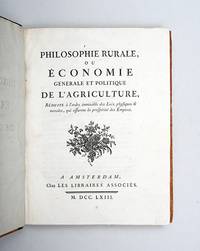
1763réf. LCPCECO-0008(La rarissime édition originale du monument de l'école physiocrate. Un superbe exemplaire, à très grandes marges, conservé dans sa reliure en veau strictement de l'époque) MIRABEAU Victor (Marquis DE) (1715-1789) - QUESNAY François (1694-1774). "PHILOSOPHIE RURALE OU ECONOMIE GENERALE ET POLITIQUE DE L'AGRICULTURE, REDUITE A L'ORDRE IMMUABLE DES LOIX PHISIQUES & MORALES, QUI ASSURENT LA PROSPERITE DES EMPIRES". 1763, Amsterdam, Libraires Associés. 1 volume in-4° (262x204 mm) (dimensions pages 257x192 mm) (2) ff. (faux-titre et titre), XXV, (1) pp. (préface, avertissement et table des chapitres), 412 pp. ; manquent les 3 tableaux h.t., oubliés par le relieur. ((2) ff., a-c4, d1, A-Z4, Aa-Zz4, Aaa-Eee4, Fff2) Reliure de l'époque en veau écaillé.Dos à cinq nerfs avec fleurons et décorations dorés et pièce de titre en maroquin vieux rouge. Double filet doré sur les coupes. Tranches rouges. Gardes de papier décoré et de papier blanc. Edition Originale, très rare. Quelques petits frottements à la reliure et deux petits chocs aux coins supérieurs. Quelques rares pages légèrement brunies, sinon intérieur très frais et propre. Superbe exemplaire à très grandes marges (quelques fois non rognées), peut-être un des plus grands passés sur le marché dans les derniers vingt ans. Très rare exemplaire conservé dans sa reliure strictement de l'époque, mais sans les 3 tableaux h.t., oubliés par le relieur. Cet ouvrage nait de la collaboration entre Mirabeau et Quesnay, ce dernier, médecin de Mme de Pompadour, rencontré à Versailles en juillet 1757. C'est le monument de la physiocratie et des théories sur le "Gouvernement par la Nature" ("The first of the four text-books of physiocrat orthodoxy" (Schumpeter, p. 225)). La doctrine de l'école physiocratique "est un mélange de libéralisme économique et de déspotisme éclairé". Ses principaux thèmes sont "la nature, la liberté, la terre et le déspotisme légal". Toute la richesse vient de la terre et seule la classe des agriculteurs est la vraie classe productive. Les lois de la proprieté privée et de la pleine liberté ("Laissez faire, laissez passer") doivent être réspectées, parce qu'elles sont les seules qui permettent d'atteindre la prosperité et de mantenir un ordre parfait. Provenance : Ex libris armorié du XIX siècle F.A. Garnier. (Tchémerzine, IV, 286 ; Quérard, VI, 154 ; Kress, 6120 ; INED, 3204 ; Conlon, 63:1131) (LCPCECO-0008)
réf. LCS-18316Séduisant exemplaire conservé tel que paru à toutes marges dans ses brochures d’attente, l’un des plus grands connus. Hambourg, s.n., 1782. 2 tomes en 2 volumes in-8 de : I/ xiv pp., (1) f., 366 pp., (1) f. d’errata ; II/ 237 pp., ff. du premier cahier intervertis, cachet humide d’une bibliothèque religieuse répété sur le titre, la p. 121 et en dernière page de chaque volume. Conservé non rogné dans ses brochures d’attente de papier dominoté, étiquettes avec titre aux dos, boite de plexiglass. Brochures de l’époque. 217 x 142 mm.
réf. LCS-18354La publication de l’Ami des hommes en 1756 valut à Mirabeau un véritable triomphe. S.l., 1759-1760. Sept parties en 7 volumes in-12 de: I/ 1 front. x pp., (3) ff. de table. 391 pp.; II/ (6) ff. et 534 pp.; III/ (6) ff. et 526 pp., déch. au coin inf. de la p. 225 sans atteinte au texte; IV/ xj-267 pp.; V/ (1) f. et 376 pp. ; VI/ xii, 298 pp. et (2) ff. table; VII/ (2) ff., 228 pp. et (1) f. de table plus 6 tableaux repliés. Les deux dernières parties sont datées de 1760. A partir de la quatrième partie, le texte se trouve ici en édition originale. Plein veau brun marbré, dos à nerfs ornés, coupes décorées, tranches rouges. Reliure de l’époque. 165 x 91 mm.
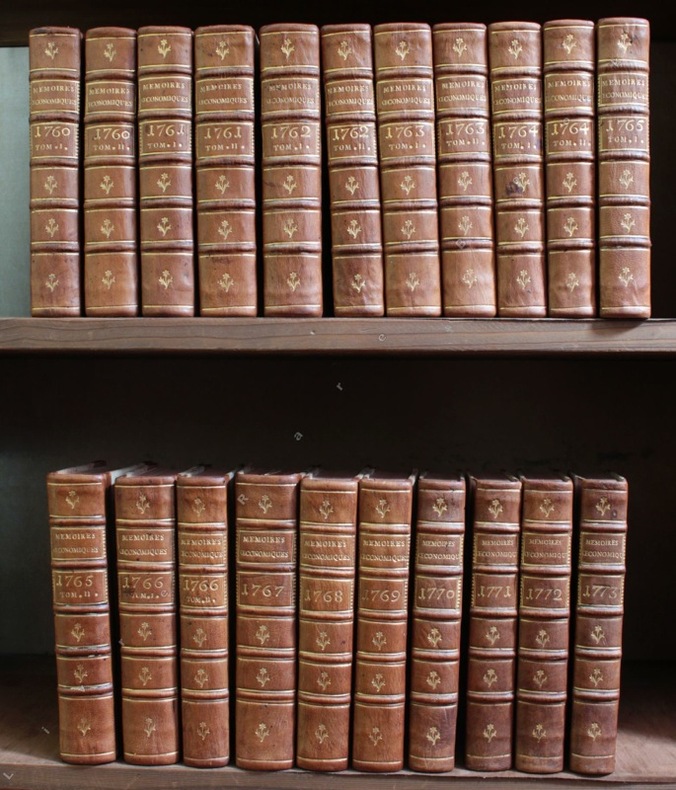
réf. 8335Zuric [puis] Berne, Heidegguer [puis] chez la Société typographique aux dépens de la Société Oeconomique, 1760 - 1773. 21 volumes in-8, demi veau fauve à coins, dos à nerfs ornés de filets et fleurons dorés, tranches teintées en rouge. Quelques rousseurs, parfois plus marquées en p. de titre, mouillure pour l'année 1771. Bel ensemble en reliure uniforme, chaque volume portant la signature de H. L. Roux en page de titre.
1760réf. 83935No place: no printer 1760. First edition of a spirited and able attack upon the financial administration of France and especially upon the "fermiers généraux" whom Mirabeau regarded as parasites preying upon the vitals of the nation. The work highlights the problems and injustices of the French system of taxation and added fuel to the fire of the coming revolution. The king disapproved of the work; Mirabeau was imprisoned on 16 December 1760 but through the efforts of Madame de Pompadour and others was released on Christmas Eve under orders to leave Paris for his estate at Bignon. The work proposes a reorganization of financial administrative machinery the abolition of the "Fermes" a reduction in the taxation upon salt with the object of increasing the total yield and a special tax upon tobacco farms. The domaine the post and the mint were to be further sources of revenue. The author ranks as one of the earliest important writers on taxation. Higgs notes that the book is "of real importance in the history of financial theory" The Physiocrats p. 57. Quarto 257 x 192 mm. Additional engraved frontispiece portrait of the author. Contemporary sprinkled calf spine ruled and decorated gilt in compartments red morocco label sprinkled edges. Spine ends and corners skilfully repaired. Manuscript note to title-page "par Mr Mirabeau père" with a short verse "helas dans le Siècle ou nous sommes / pour avoir dit la vérité / Mirabeau cet ami des hommes vient de perdre la liberté" in a neat calligraphic hand. Occasional light foxing. A very good copy. Goldsmiths' 9836; Higgs 2881; INED 3204; Kress 6120. unknown
réf. 6142Six parts bound in two vols. Large 4to cont. polished mottled calf spines nicely gilt. Avignon 1756-1758-1760. First edition of all six parts and a fine copy of one of the great classics of political economy. This work marks the birth of the physiocratic school and contains the first appearance on a large scale of the “Tableau Economique” of Quesnay portions of Quesnay’s work had been privately printed in a few copies only at the palace at Versailles in 1758 and 1759. In this work Mirabeau made the ideas of Cantillon known and the book had a very great influence in the years before the Revolution. Fine set. unknown
réf. 6142Six parts bound in two vols. Large 4to cont. polished mottled calf spines nicely gilt. Avignon 1756-1758-1760. First edition of all six parts and a fine copy of one of the great classics of political economy. This work marks the birth of the physiocratic school and contains the first appearance on a large scale of the “Tableau Economique” of Quesnay portions of Quesnay’s work had been privately printed in a few copies only at the palace at Versailles in 1758 and 1759. In this work Mirabeau made the ideas of Cantillon known and the book had a very great influence in the years before the Revolution. Fine set. unknown books
1756réf. 131625Avignon: n.p. 1756-60. The first public appearance of Quesnay's Tableau économique First edition of all six parts containing the first public appearance of Quesnay's Tableau économique. The first to follow Quesnay in the foundation of the Physiocratic circle Mirabeau was familiar with and influenced by Cantillon's theories. As well as fully articulating the principles that were to mark the school of physiocrats and expounding their implications regarding population agriculture and commerce the Ami des Hommes contained a reproduction of Quesnay's Tableau économique vol. VI previously published separately in very small numbers in 1758 and 1759. Mirabeau's reproduction made the essay obtainable thus bringing the founding document of the school of physiocrats to the attention of a wide public. "This remarkable treatise created the greatest sensation throughout the whole of Europe. It is said to have gone through forty editions and was translated into several languages. Its anonymous author soon discovered became the idol of the day and was generally referred to by the soubriquet which he had chosen for the title of his book" Palgrave II p. 775. Following the publication of the first three parts Mirabeau made the acquaintance of Quesnay who had been greatly impressed by his book. "Mirabeau now became the fervent admirer of Quesnay and between them they founded the school of the Physiocrats" ibid. In 1758 a fourth part was published in which Quesnay's influence is clearly visible. The remaining two parts were published in 1760. The final part is of particular importance as it contains the first obtainable appearance of Quesnay's Tableau économique which was previously published separately in tiny numbers in 1758 and 1759. An English translation was first published in 1766. 6 parts in 2 vols quarto 246 x 188 mm. Contemporary French mottled calf spines ruled and decorated gilt in compartments all edges red. Joints and extremities expertly restored scattered foxing to contents; a handsome copy. Einaudi 3941; Goldsmiths' 9092; Higgs 1143 1631 & 2160; INED 3194; Kress 5543 & 5736; Mattioli 2426 2428 & 2429. unknown
1760réf. 84111No place: no printer 1760 & 1761. OF REAL IMPORTANCE IN THE HISTORY OF FINANCIAL THEORY" - a BEAUTIFUL COPY First edition of both works pairing Mirabeau's Théorie de l'Impôt his spirited and able attack upon the financial administration of France especially the "fermiers généraux" whom Mirabeau regarded as parasites preying upon the vitals of the nation with Pesselier's counterattack notable for its terse affirmation of the characteristically Physiocratic doctrine that agriculture holds a privileged place in the economic system. Mirabeau's work highlights the problems and injustices of the French system of taxation and added fuel to the coming fire of the revolution. The king disapproved of the work; Mirabeau was imprisoned on 16 December 1760 but was released on Christmas Eve through the efforts of Madame de Pompadour and others under orders to leave Paris for his estate at Bignon. The work proposes a reorganization of financial administrative machinery the abolition of the "fermes" a reduction in the taxation upon salt with the object of increasing the total yield and a special tax upon tobacco farms. The domaine the post and the mint were to be further sources of revenue. Mirabeau ranks as one of the earliest important writers on taxation. Higgs notes that the book is "of real importance in the history of financial theory" The Physiocrats p. 57. Pesselier was one of the most forceful critics of the physiocrats. Of the products of the soil Pesselier here writes "Elles procurent un profit net et durable puisqu'elles sont à l'abri de l'imitation" "They provide a net and lasting profit since they are safe from imitation". Two works bound in a single vol. quarto 255 x 193 mm. Contemporary French mottled calf spine decorated gilt in compartments red morocco label marbled endpapers. Housed in a brown morocco-backed book-form case. Engraved armorial bookplate to front pastedown. Lower edge a little rubbed with corners worn very occasional spotting; very good copies. Mirabeau: Einaudi 3946; Goldsmiths' 9602; Higgs 2297; INED 3209; Kress 5883. Pesselier: Brunet I 1118; Einaudi 4409; Goldsmiths' 9695; Higgs 2534; INED 3524; Kress 5964. unknown
1763réf. 153616Amsterdam: Chez les Libraires Associés 1763. The new science of economics Rare first edition presenting "perhaps the most complete and magisterial account of the views of the Physiocratic school" Higgs. "Quesnay collaborated very substantially in preparing this last major work contributing the final chapter with further explanations and manipulations of his Tableau Économique analysis" The New Palgrave. Schumpeter calls the work "the first of the four textbooks of physiocrat orthodoxy" p. 225. It contains for the first time Quesnay's masterful explanation of his Tableau Économique "one of those works in the history of economics which have often been regarded as an anticipation of modern theories" Schumpeter p. 242. Originally printed as a pamphlet of 16 pages in 1758 in a minute number of copies Quesnay's Tableau Économique was first revealed to the public as the final part of Mirabeau's L'Ami des Hommes in 1760. In the Philosophie rurale Quesnay for the first time gives a full explanation of his system. The Tableau économique is credited as the "first precise formulation" of interdependent systems in economics and the origin of the theory of the multiplier in economics. An analogous table is used in the theory of money creation under fractional-reserve banking by relending of deposits leading to the money multiplier. In a letter to Mirabeau written late in 1758 Quesnay remarks "J'ai taché de faire un tableau fondamental de l'ordre économique pour y représenter les dépenses et les produits sous un aspect facile à saisir et pour juger clairment des arrangemens et des dérangemens que le gouvernement peut y causer" translated: "I have tried to make a fundamental table of the economic order in order to represent the expenses and the products in an aspect easy to grasp and to judge clearly of the arrangements and disturbances that the government can cause there". "A most remarkable analysis of the economic condition of his country" Palgrave the Tableau économique "is the most important and famous work of Physiocracy and has often been regarded as a summary of the entire corpus of Physiocratic economics. The Tableau has also been regarded as the analytical synthesis of the logical structure of Quesnay's economics or at least as its most relevant aspect. The Tableau économique is one of those works in the history of economics which have often been regarded as an anticipation of modern theories. The Tableau has been considered a first rough presentation of Keynes's multiplier and as a sort of general equilibrium system of a Walrasian type. For others the Tableau is an input-output table. Because of the Tableau Quesnay has been regarded as an early econometrician. The Tableau has also been interpreted as the first classical system of price determination thus anticipating Marx's reproduction schemes and Sraffa's price system" Giovanni Vaggi in The New Palgrave. Quarto 260 x 192 mm. With 3 engraved plates including the Tableau économique. Contemporary quarter marbled sheep orange paste paper sides light blue endpapers. Housed in a black cloth flat-back box by the Chelsea Bindery. Neatly restored at extremities insect abrasion to spine slight cockling to paste paper sides contents clean and fresh. A very good copy. Goldsmiths' 9836; Higgs 2881; INED 3204; Kress 6120; Mattioli 2435. hardcover
1763réf. 85559A Amsterdam: chez les Libraires Associés 1763. Cm. 26 pp. xxv 1 412. Con una testata in xilografia e tre tavole f.t. tableaux èconomiques. Solida ed elegante legatura coeva in piena pelle dorso a nervi con titoli in oro e ricchi fregi ai comparti. Tagli rossi e sguardie marmorizzate. Qualche brunitura marginale alle prime ed ultime carte ma complessivamente bell'esemplare genuino e marginoso in ottimo stato di conservazione. Edizione originale di grande rarità ed importanza che illustra per la prima volta in modo esauriente il pensiero della scuola fisiocratica. Opera celebrata dalle principali bibliografie. chez les Libraires Associés unknown
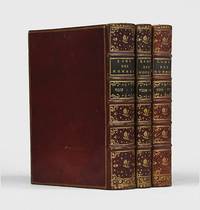
1758réf. 153197Avignon: no publisher 1758-60. The first public appearance of Quesnay's Tableau Économique First complete edition of all six parts containing the first public appearance of Quesnay's Tableau Économique; a superb copy in contemporary French red morocco very uncommon thus. The first to follow Quesnay in the foundation of the Physiocratic circle Mirabeau was familiar with and influenced by Cantillon's theories. As well as fully articulating the principles that were to mark the school of physiocrats and expounding their implications regarding population agriculture and commerce the Ami de l'Homme contained a reproduction of Quesnay's Tableau Économique vol. 6 previously published separately in very small numbers in 1758 and 1759. Mirabeau's reproduction made the essay obtainable thus bringing the founding document of the school of physiocrats to the attention of a wide public. "This remarkable treatise created the greatest sensation throughout the whole of Europe. It is said to have gone through forty editions and was translated into several languages. Its anonymous author soon discovered became the idol of the day and was generally referred to by the soubriquet which he had chosen for the title of his book" Palgrave II p. 775. Following the publication of the first three parts Mirabeau made the acquaintance of Quesnay who had been greatly impressed by his book. "Mirabeau now became the fervent admirer of Quesnay and between them they founded the school of the Physiocrats" ibid. With this new edition of the first three parts a fourth part was published in 1758 in which Quesnay's influence is clearly visible. The remaining two parts were published in 1760. The final part is of particular importance as it contains the first obtainable appearance of Quesnay's Tableau Économique which was previously published separately in tiny numbers in 1758 and 1759. An English translation was first published in 1766. 6 parts in 3 vols quarto 252 x 195 mm. Engraved frontispiece in part I engraved head- and tailpieces initials. Contemporary French red morocco spines elaborately decorated gilt in compartments twin green morocco labels raised bands triple gilt rule border to sides gilt inner dentelles marbled endpapers gilt edges green silk ribbon bookmarkers. Authorship attribution to first title in ink in an early hand. Bar a few trivial marks to sides the binding in beautiful condition corners a touch rubbed; vast majority of contents bright crisp and clean with very occasional spotting third volume with some light browning and foxing; loss to lower corners of leaves vol. 1 Hh2 and vol. 3 Aa3 not affecting text; patch of dampstain to last two leaves and final blank of vol. 2. A near-fine set. Einaudi 3941; Goldsmiths' 9317; Higgs 1628 1631; INED 3194; Kress 5735 & 5736; Mattioli 2427 2428 2429 & 2430. hardcover
1789réf. 57115Paris, Chez Baudouin, Imprimeur de l'Assamblée Nationale, 1789. 8vo. Bound in an exquisite later red half morocco with gilt spine. Top edge gilt. (1) f. (title-page), 8 pp. (""Déclaration des droits de l'Homme en société""), 6 pp. (""Articles de Constitution""), (1) f. (""Réponse du Roi""), (1) f. (blank). Woodcut head-pieces. Title-page slightly bowned, otherwise in excellent condition. A truly excellent copy.
1789réf. 57115Paris Chez Baudouin Imprimeur de l'Assamblée Nationale 1789. 8vo. Bound in an exquisite later red half morocco with gilt spine. Top edge gilt. 1 f. title-page 8 pp. "Déclaration des droits de l'Homme en société" 6 pp. "Articles de Constitution" 1 f. "Réponse du Roi" 1 f. blank. Woodcut head-pieces. Title-page slightly bowned otherwise in excellent condition. A truly excellent copy. The exceedingly scarce true first printing in an incredibly rare form of off-print/separate printing of one of the most important and influential documents in the history of mankind namely the French Human Rights Declaration containing also the articles for the first French Constitution. This groundbreaking publication constitutes a monumental change in the structure of the human world providing all citizens with individual rights that we now take for granted. This monument of humanist thought appeared in the "Procès verbal de l'Assemblée Nationale" copies of which are also very difficult to obtain. There however the two parts appeared without a title-page and without the final blank which together constitute a form of wrappers for this off-print/separate printing of which only five or six other copies are known and which is present in merely one or two libraries world-wide. As far as we now only one other copy has been on the private market and that did not have the blank back wrapper. This exceedingly rare separate printing of the Human Rights Declaration with the Constitution was intended for the inner circle of those participating in its creation and was limited to a very restricted number of copies - all of which will have been owned by the creators of the Declaration. This epochal document is just as important today as it was when it was formulated during the French Revolution in 1789 and since 2003 the Declaration has been listed in the UNESCO Memory of World Register - "This fundamental legacy of the French Revolution formed the basis of the United Nations Declaration of 1948 and is of universal value". Few other documents in the history of mankind has done as much to determine the way we live and think the way Western societies are structured and governed and few other documents have had such a direct impact upon our constitutional rights and the way we view ourselves and others in society. It is here that we find the formulation of liberty and equality upon which so much of Western political and moral thought is based - that all "men are born and remain free and equal in rights" Article 1 which were specified as the rights of liberty private property the inviolability of the person and resistance to oppression Article 2; that all citizens were equal before the law and were to have the right to participate in legislation directly or indirectly Article 6; no one was to be arrested without a judicial order Article 7; Freedom of religion Article 10 and freedom of speech Article 11 were safeguarded within the bounds of public "order" and "law" etc. etc.The content of the document that were to change the Western world for good emerged largely from the ideals of the Enlightenment. "The sources of the Declaration included the major thinkers of the French Enlightenment such as Montesquieu who had urged the separation of powers and Jean-Jacques Rousseau who wrote of general will-the concept that the state represents the general will of the citizens. The idea that the individual must be safeguarded against arbitrary police or judicial action was anticipated by the 18th-century parlements as well as by writers such as Voltaire. French jurists and economists such as the physiocrats had insisted on the inviolability of private property." Encycl. Britt.The key drafts were prepared by Lafayette working at times with Thomas Jefferson. In August 1789 Honoré Mirabeau played a central role in conceptualizing and drafting the Declaration. On August 26 1789 in the midst of The French Revolution the last article of the Declaration was adopted by the National Constituent Assembly as the first step towards a constitution for France. "In 1789 the people of France brought about the abolishment of the absolute monarchy and set the stage for the establishment of the first French Republic. Just six weeks after the storming of the Bastille and barely three weeks after the abolition of feudalism the Declaration of the Rights of Man and of the Citizen French: La Déclaration des Droits de l'Homme et du Citoyen was adopted by the National Constituent Assembly as the first step toward writing a constitution for the Republic of France.The Declaration proclaims that all citizens are to be guaranteed the rights of "liberty property security and resistance to oppression." It argues that the need for law derives from the fact that ".the exercise of the natural rights of each man has only those borders which assure other members of the society the enjoyment of these same rights." Thus the Declaration sees law as an "expression of the general will" intended to promote this equality of rights and to forbid "only actions harmful to the society." www.humanrights.com. This sensational document became the crowning achievement of the French Revolution; it came to accelerate the overthrow of the "Ancien Régime" and sowed the seed of an extremely radical re-ordering of society. The Declaration interchanged the pre-revolutionary division of society -in the clergy the aristocracy and the common people- with a general equality - "All the citizens being equal in the eyes of the law are equally admissible to all public dignities places and employments according to their capacity and without distinction other than that of their virtues and of their talents" From Article VI upon which today's society is still based. It is hard to imagine a work that is more important to the foundation of the society that we live in today. unknown